LISBON SURROUNDINGS PROPERTY GUIDES
The best of both worlds – a calm lifestyle with easy city access
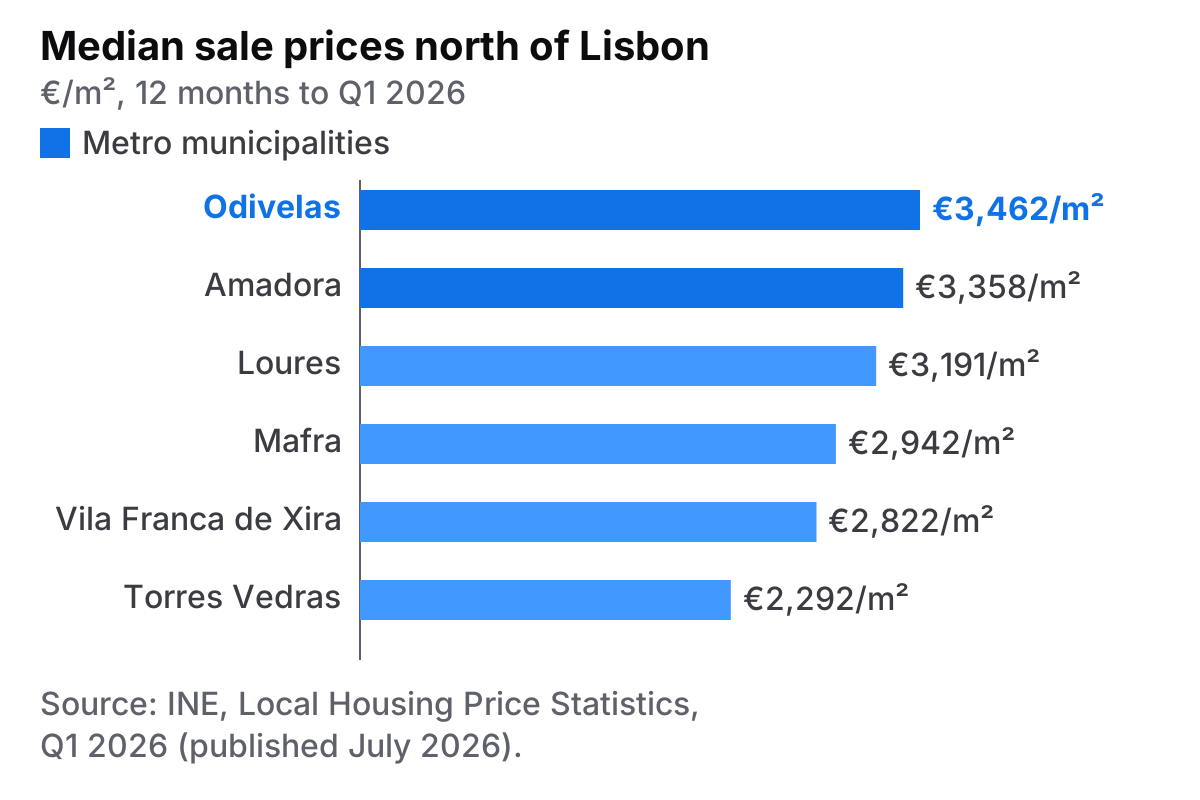
North of the Tagus, the 12 surrounding municipalities of the Lisbon District—Alenquer, Amadora, Arruda dos Vinhos, Azambuja, Cadaval, Loures, Lourinhã, Mafra, Odivelas, Sobral de Monte Agraço, Torres Vedras and Vila Franca de Xira—offer diverse property opportunities. According to the Instituto Nacional de Estatística (INE), transacted median housing prices for the 12 months to Q1 2026 ranged from €2,292 per square metre in Torres Vedras to €3,462 per square metre in Odivelas, presenting a cost-effective alternative to central Lisbon.
Why look at property in the Lisbon surroundings?
As defined by the Portal Autárquico - Direção-Geral das Autarquias Locais (DGAL), the Lisbon District comprises 16 municipalities. While Lisbon city, Cascais, Oeiras and Sintra frequently draw headline attention, the 12 northern municipalities establish three distinct property corridors that suit different investment strategies and lifestyles.
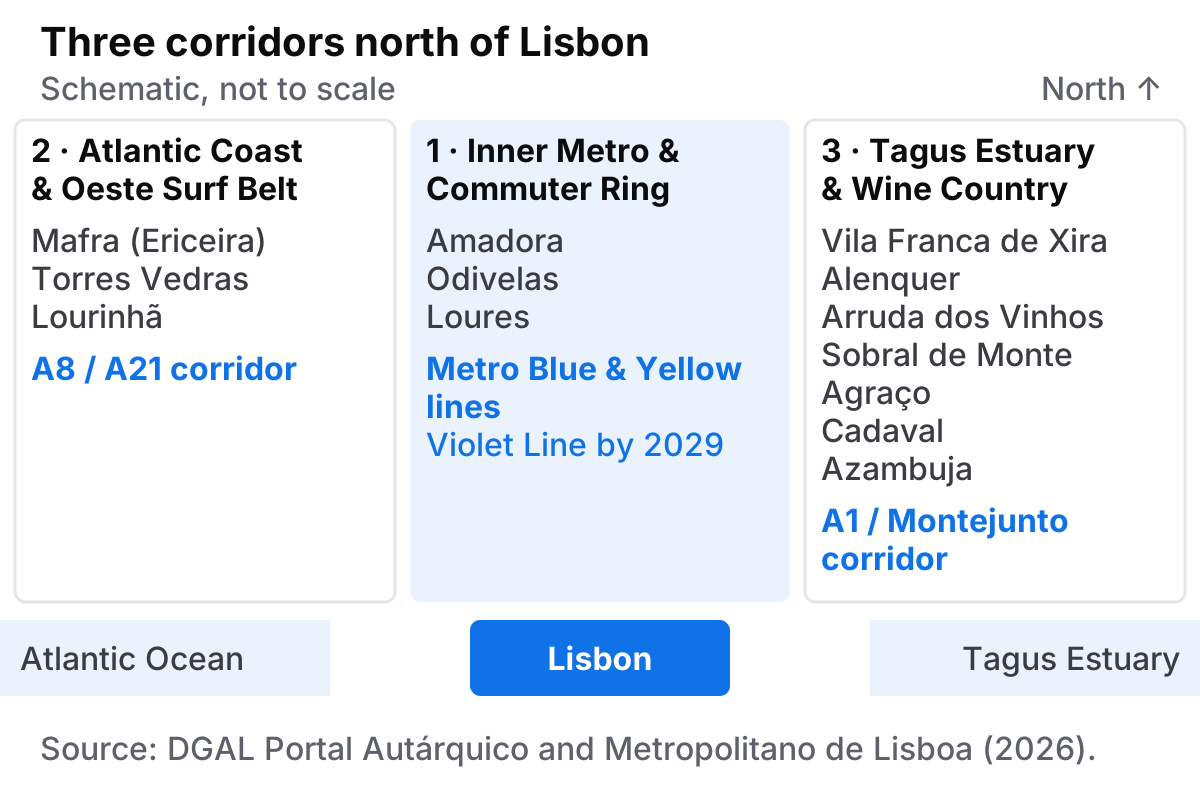
These three corridors serve distinct buyer profiles:
- The Inner Commuter Ring (Amadora, Odivelas, Loures): Dense, metro-connected suburban markets experiencing significant residential demand. Population estimates from INE for 2025 highlight substantial urban hubs, including Loures with an estimated 236,988 residents, Amadora with 205,517, and Odivelas with 185,736.
- The Atlantic Coast and Oeste Belt (Mafra, Torres Vedras, Lourinhã): Coastal and lifestyle markets combining ocean views, world-class surfing in Ericeira, and family-friendly suburban layouts.
- The Tagus and Wine Country Interior (Vila Franca de Xira, Alenquer, Arruda dos Vinhos, Sobral de Monte Agraço, Cadaval, Azambuja): Rural and riverside towns defined by vineyards and historic quintas. These municipalities range from industrial and logistics hubs like Vila Franca de Xira (137,529 residents in the 2021 Census) to picturesque countryside parishes such as Cadaval (13,372 residents) and Sobral de Monte Agraço (10,540 residents).
For investors and relocating families reviewing our guide to buying property in Portugal, these northern municipalities offer lower entry prices per square metre without compromising access to the capital. Real estate professionals can analyze localized pricing trends across all 12 municipalities using CASAFARI Area Insights.
How do transport links and the Lisbon Metro connect the northern municipalities?
Commuting infrastructure plays a central role in driving capital growth and rental demand across the northern municipalities. Underground connections provided by Metropolitano de Lisboa currently serve two surrounding municipalities:
- Amadora: Connected via three Blue Line stations (Alfornelos, Amadora Este, and Reboleira, which integrates with the CP Sintra railway line).
- Odivelas: Connected via two Yellow Line stations (Senhor Roubado and Odivelas).
A major mobility catalyst for the northern suburban ring is the Violet Line (Linha Violeta) light-rail project. Representing a €677.5 million investment, this 11.5 km surface light-rail network will add 17 stations—9 in Loures and 8 in Odivelas—with completion scheduled for 2029. This infrastructure enhancement is set to improve transit times between key hospital, commercial, and residential nodes.
For drivers, motorway networks offer rapid connections. The A8 and A21 motorways connect Ericeira and Mafra to Humberto Delgado Airport in 35 to 45 minutes (covering 35 to 50 km). Meanwhile, the A1 motorway links the eastern Tagus corridor, including Vila Franca de Xira and Azambuja, directly into Lisbon’s main northern arterial routes.
What do the Atlantic coast, nature reserves and retail hubs offer residents?
Beyond urban transport, the northern corridor combines coastal lifestyle, natural landscape protection, and retail amenities.
Along the coast, Mafra hosts Ericeira, designated Europe’s only World Surf Reserve by Save the Waves Coalition since 2011, according to Visit Lisboa. This coast attracts remote workers, international surfers, and lifestyle investors seeking primary or secondary residences.
Inland natural features provide protected outdoor spaces:
- Tagus Estuary Natural Reserve (Reserva Natural do Estuário do Tejo): Spanning 14,416.21 hectares across Vila Franca de Xira, Alcochete, and Benavente, this reserve, monitored by the Instituto da Conservação da Natureza e das Florestas (ICNF), forms Portugal’s largest wetland and hosts autumn flamingo migrations.
- Serra de Montejunto: Rising to 666 metres above sea level across Cadaval and Alenquer, this ridge serves as the highest point in the Oeste region. Encompassing nearly 4,880 hectares, it was designated a Special Area of Conservation in March 2026.
Commercial infrastructure across the inner ring supports everyday conveniences. Amadora hosts UBBO shopping resort (formerly Dolce Vita Tejo), featuring 127,344 m² of Gross Leasable Area and around 280 retail units, alongside an adjacent 12,000 m² Leroy Merlin store, as documented by the Associação Portuguesa de Centros Comerciais (APCC). Amadora’s IKEA store is located separately in the nearby Alfragide retail complex.
What should buyers and investors know about taxes and short-let rules in 2026?
Purchasing property in the northern municipalities offers distinct advantages under Portugal’s 2026 tax framework. As outlined on gov.pt, the IMT Jovem tax exemption allows eligible buyers aged 35 or under purchasing a first primary residence to benefit from:
- Full Exemption: 0% Property Transfer Tax (IMT) and 0% Stamp Duty (Imposto de Selo) on purchase prices up to €330,539.
- Reduced Marginal Rate: An 8% rate applied only to the portion between €330,539 and €660,982.
Because median transacted housing prices across municipalities like Loures (€3,191/m²), Mafra (€2,942/m²), Vila Franca de Xira (€2,822/m²), and Torres Vedras (€2,292/m²) remain below capital averages, standard family apartments frequently fall within the full IMT Jovem tax exemption threshold.
For general primary home purchases outside the youth exemption, the 2026 IMT schedule provides a full tax-free threshold up to €106,346, with progressive marginal rates between 2% and 8% up to €660,982. Annual municipal council tax (IMI) for urban properties across these municipalities ranges from 0.3% to 0.45% of the property’s tax registration value (VPT).
Investors examining short-term rental (Alojamento Local - AL) operational frameworks should note the legal updates in Decree-Law 76/2024. The legislation repealed nationwide bans on new AL licences, abolished the CEAL extraordinary tax, restored licence transferability, and set property limits at 9 bedrooms and 27 guests. Local containment decisions now sit directly with individual municipal councils. For instance, Mafra enforces containment rules in busy coastal areas like Ericeira, whereas Lourinhã permits standard prior registration in the national RNAL registry without municipal suspension.
Whether you are evaluating residential yields as part of investing in Portuguese property or looking for property listings, real estate professionals rely on precise market intelligence. You can evaluate street-level comparables with the property valuation and market study tool or query inventory across all 12 municipalities using CASAFARI Property Sourcing. Developers integrating valuation or analytics can review the Area Insights API documentation in English. To explore real-time property metrics across Greater Lisbon, sign in to CASAFARI.
Frequently asked questions
Which municipalities make up the Lisbon surroundings north of the Tagus?
According to the Direção-Geral das Autarquias Locais (DGAL, 2026), the Lisbon District comprises 16 municipalities in total. Excluding the city of Lisbon and the western coastal corridor of Cascais, Oeiras and Sintra, the 12 surrounding municipalities north of the Tagus are Alenquer, Amadora, Arruda dos Vinhos, Azambuja, Cadaval, Loures, Lourinhã, Mafra, Odivelas, Sobral de Monte Agraço, Torres Vedras and Vila Franca de Xira.
Which towns outside Lisbon are connected to the Metro network?
As of September 2026, two surrounding municipalities have direct underground stations on the Metropolitano de Lisboa network: Amadora, served by Alfornelos, Amadora Este and Reboleira on the Blue Line, and Odivelas, served by Senhor Roubado and Odivelas on the Yellow Line. Additionally, the €677.5 million Violet Line (Linha Violeta) light-rail expansion scheduled for 2029 will add 17 stations across Loures (9 stations) and Odivelas (8 stations).
What are the short-term rental (Alojamento Local) rules in Mafra, Ericeira and Lourinhã?
Under Decree-Law 76/2024, in force in 2026, Portugal repealed the national freeze on new Alojamento Local licences, abolished the CEAL extraordinary tax and restored licence transferability, while granting municipal autonomy over local containment zones. In practice, Mafra maintains municipal containment restrictions in the coastal surf town of Ericeira, whereas Lourinhã permits free prior registration in the national RNAL registry without municipal suspension.
How does property transfer tax (IMT) work when buying a home in the Lisbon district in 2026?
In 2026, general IMT for a primary residence exempts purchases up to €106,346, applying progressive rates up to 8% above that threshold. Under the IMT Jovem regime, first-time buyers aged 35 or under purchasing a primary home are fully exempt from IMT and 0.8% Stamp Duty on properties up to €330,539, paying an 8% rate only on the portion between €330,539 and €660,982.