
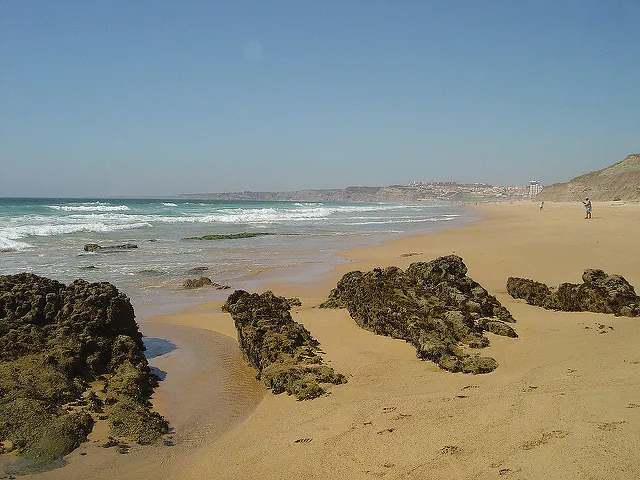
LOURINHÃ PROPERTY GUIDES
Scenic beaches and a fascinating history
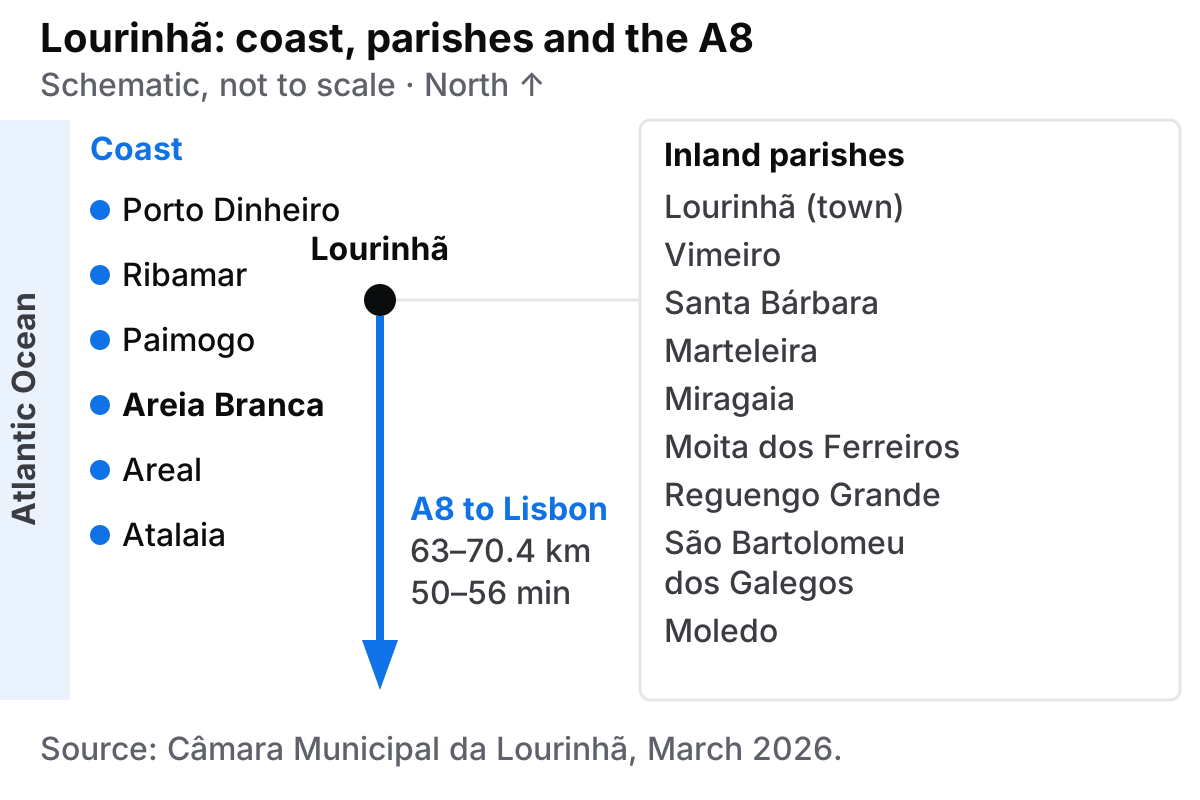
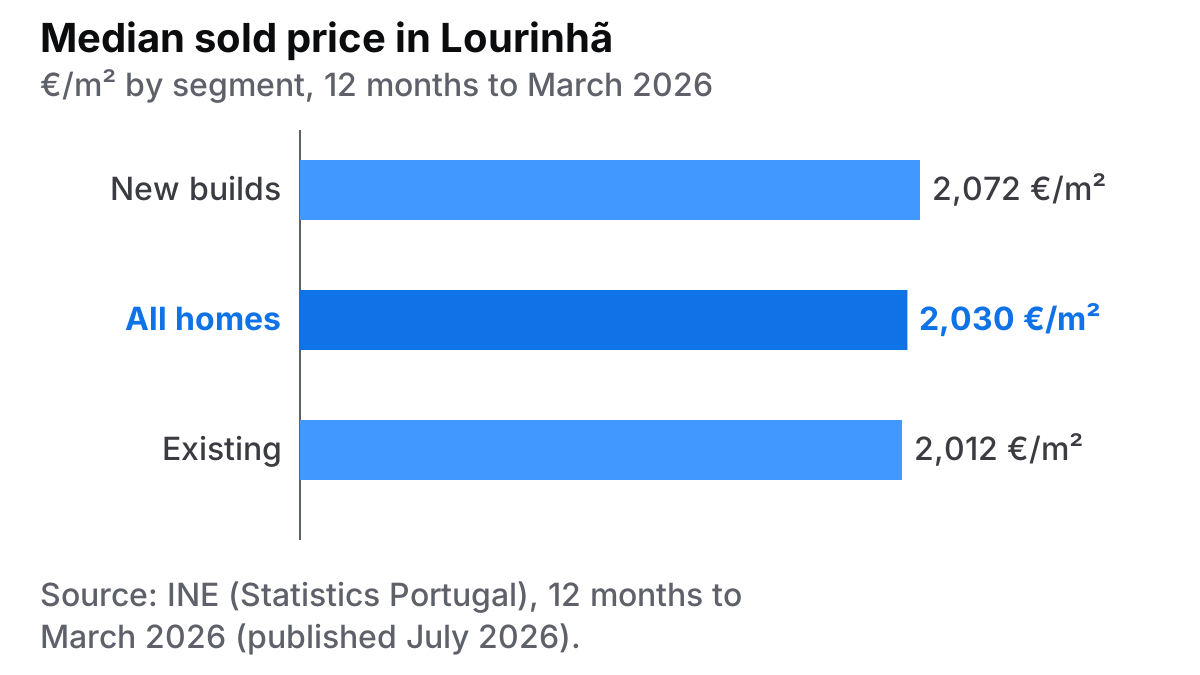
Lourinhã is a coastal municipality covering 147.17 km² on Portugal’s Silver Coast, situated 63 to 70 km north of Lisbon—a commute of roughly 50 to 56 minutes via the A8 motorway. Featuring 12 km of Atlantic coastline, nine parishes, and a population exceeding 28,400 (reaching 30,050 according to Statistics Portugal’s 2025 population density of 204.2 inhabitants/km²), Lourinhã offers a balance of coastal living and countryside charm. The median sold house price reached €2,030 per square metre in the 12 months to Q1 2026. ## Why are buyers and investors looking at Lourinhã property? Located in the heart of the Oeste region, Lourinhã attracts buyers seeking coastal living within easy reach of the capital. The local housing stock spans clifftop villas and ocean-view flats around Praia da Areia Branca, Areal, and Caniçal, as well as traditional stone cottages, historic quintas, and modern country houses with generous land across the interior. According to INE data reported via CasaDireta, the overall median sold price in Lourinhã stood at 2,030 €/m² during the 12 months to Q1 2026, reflecting a 20.0% year-on-year increase. New-build dwellings commanded a median of 2,072 €/m², while existing properties recorded 2,012 €/m². Real estate professionals monitor these transactional shifts down to parish level using CASAFARI Area Insights and the property valuation and market study tool to benchmark asking prices against local market realities. ## Where to buy in Lourinhã: coastal villages and inland parishes In March 2025, under Law no. 25-A/2025, the municipality completed an administrative de-aggregation that restored Atalaia and Lourinhã as separate entities, establishing nine administrative parishes (freguesias), as detailed in the Municipality of Lourinhã official profile. Coastal hotspots include the parish of Lourinhã (home to the popular resort beach of Praia da Areia Branca and Areal), Atalaia, and Ribamar, celebrated for its seafood gastronomy and coastal fishing shelters at Porto Dinheiro, Porto das Barcas, and Paimogo. Inland, buyers will find quieter village life and larger plots across Vimeiro, Santa Bárbara, Moita dos Ferreiros, Reguengo Grande, the União das Freguesias de Miragaia e Marteleira, and the União das Freguesias de São Bartolomeu dos Galegos e Moledo. Agents and buyers searching for specific residential developments across these micro-locations can utilise Property Sourcing on CASAFARI to search live supply across multiple sources. ## What is everyday life like in Lourinhã? Life in Lourinhã revolves around its 12 km Atlantic coastline, which features expansive sandy beaches such as Areia Branca, Areal, Paimogo, Porto Dinheiro, and Caniçal. Surfers benefit from close proximity to the world-famous surf breaks of Peniche immediately to the north and Ericeira to the south. Lourinhã is internationally renowned as Portugal’s Dinosaur Capital due to its rich palaeontological heritage. Local discoveries are showcased at the Museu da Lourinhã, founded by GEAL in June 1984, and at Dino Parque Lourinhã. Opened in February 2018, Dino Parque is Portugal’s largest open-air museum, spanning over 10 hectares and featuring around 200 life-size prehistoric models along six thematic trails. The region is also famous for its culinary traditions and spirit heritage. Created under Decree-Law no. 34/92 in March 1992, Lourinhã is Portugal’s only demarcated region exclusively for wine brandy (aguardente vínica DOC) and one of only three in Europe alongside Cognac and Armagnac, as highlighted in the Aguardente DOC Lourinhã official visitor guide. ## How well connected is Lourinhã for commuters and families? Commuting to Lisbon takes between 50 and 56 minutes by car via the A8 motorway (accessed via the EN 8-2, EN 247, and EN 361). For public transit users, regular express coach services operated by Rodoviária do Oeste (the ‘Rápida’ line to Campo Grande) and Rede Expressos (to Sete Rios) connect the municipality to Lisbon in 50 minutes to 1 hour 15 minutes. Families moving to the area are served by two public school clusters: the Agrupamento de Escolas da Lourinhã (which includes the Secondary School Dr. João Manuel da Costa Delgado, undergoing modernisation through 2025 and 2026) and the Agrupamento de Escolas e Jardins de Infância D. Lourenço Vicente. Primary medical care is provided by the Centro de Saúde da Lourinhã (encompassing USF D. Jordão, USF São Sebastião, UCSP, and UCC) along with local health extensions in Moita dos Ferreiros, Ribamar, and Reguengo Grande. Public hospital emergencies and specialized treatments are handled by the ULS do Oeste hospitals in nearby Torres Vedras and Caldas da Rainha. For a broader overview of legal processes, see our guide to buying property in Portugal and guide on investing in Portuguese real estate. ## What are the tax, residency, and short-let rules for Lourinhã buyers? For 2025 and 2026, Lourinhã sets its urban Municipal Property Tax (IMI) rate at 0.35%, remaining within the national 0.3% to 0.45% statutory bracket, according to the APFN municipal IMI rate directory. The council applies the ‘IMI Familiar’ scheme, offering fixed annual deductions of €30 for one dependant, €70 for two, and €140 for three or more dependants. Rural land (prédios rústicos) is taxed at the statutory 0.8% rate. Investors interested in short-term holiday lets benefit from Decree-Law no. 76/2024 (in force since November 2024), which repealed the nationwide coastal ban on new Alojamento Local (AL) licences imposed by previous legislation. New AL registrations can be submitted through the Balcão Único Eletrónico on gov.pt under standard municipal regulation, as detailed in the Turismo de Portugal Alojamento Local legal framework. Regarding residency, Law no. 56/2023 ended real estate investment as a qualifying pathway for the Portuguese Golden Visa (ARI). Furthermore, as documented in Statistics Portugal (INE) demographic indicators, Lourinhã’s density of 204.2 inhabitants/km² exceeds the 100 inhabitants/km² threshold under Ordinance no. 208/2017, meaning it does not qualify as a low-density territory for alternative non-real estate ARI schemes. Most international buyers moving to Lourinhã apply for residency via the D7 passive income visa or the D8 digital nomad visa. Whether assessing coastal acquisition opportunities or analyzing market trends, real estate professionals can sign in to the CASAFARI platform to access comprehensive property data across Portugal.
Frequently asked questions
How long does it take to travel from Lourinhã to Lisbon?
Driving from Lourinhã to Lisbon covers 63 to 70 km and takes roughly 50 to 56 minutes via the A8 motorway. For commuters using public transport, the Rodoviária do Oeste ‘Rápida’ express coach to Lisbon Campo Grande and Rede Expressos services to Sete Rios take between 50 minutes and 1 hour 15 minutes.
Can you get an Alojamento Local licence for a holiday let in Lourinhã?
Yes. Following the enactment of Decree-Law no. 76/2024 in November 2024, the previous nationwide suspension on new coastal short-term rental licences was revoked. Property owners in Lourinhã can apply for a new Alojamento Local (AL) registration online through the Balcão Único Eletrónico (gov.pt), as the municipality has not imposed a local containment ban.
What is the annual property tax (IMI) rate in Lourinhã?
For 2025 and 2026, the Municipality of Lourinhã applies an urban Imposto Municipal sobre Imóveis (IMI) rate of 0.35% on a property’s taxable patrimonial value (VPT), alongside fixed family deductions of €30 to €140 for households with dependants. Rural land is taxed at the standard national rate of 0.8%.
Does buying property in Lourinhã qualify for the Portugal Golden Visa?
No, purchasing real estate anywhere in Portugal no longer qualifies for the Golden Visa (ARI) following legislative changes under Law no. 56/2023. Additionally, for cultural or scientific investment routes, Lourinhã is not classified as a low-density territory under Ordinance no. 208/2017 because its population density exceeds 200 inhabitants per km².