CASAFARI’s present all around Italy
Get to know the most desirable locations.
Buying property in Italy in 2026 offers access to a resilient residential market, which recorded 766,757 transactions worth €124 billion in 2025 according to the Agenzia delle Entrate (OMI). However, navigating regional price disparities, the cadastral purchase tax system, 2026 short-let rules, and the €300,000 flat tax regime requires clear market visibility. International buyers and estate agents must evaluate micro-location data and tax status to secure long-term capital stability.
How is the Italian property market performing in 2026?
Italy’s residential real estate sector demonstrates steady momentum. Official data from the 2025 Residential Market Report by the Agenzia delle Entrate (OMI), published in May 2026, highlights that full-year 2025 residential sales rose by 6.4% year-on-year to 766,757 transactions (up from 719,578 in 2024). Overall transaction value reached €124 billion, an 8.8% increase compared to €114 billion in 2024. This liquidity reflects strong domestic commitment alongside sustained international interest.
Demographic figures from ISTAT for June to October 2026 record Italy’s resident population at 58,943,673. Homeownership remains deeply ingrained across the country: 73.3% of resident households live in a property they own, with only 17.6% holding an active mortgage. Meanwhile, 18.1% of households rent and 8.6% occupy homes under usufruct or rent-free agreements. Because domestic owners carry relatively low debt burdens, the market is largely protected from distressed forced-selling cycles, creating a secure environment for foreign equity buyers.
Where to buy in Italy: Milan, Rome, Florence and the lifestyle regions
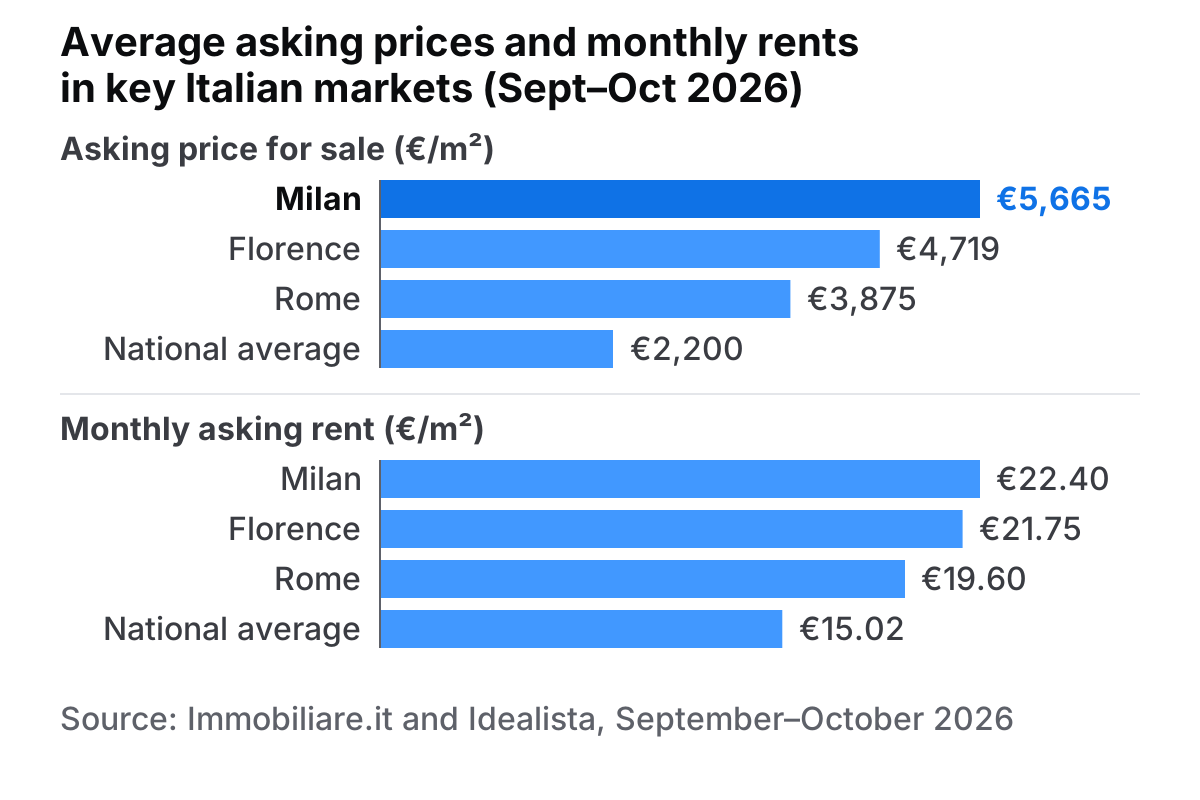
Regional dynamics across Italy vary significantly. Data from Immobiliare.it and Idealista for September and October 2026 places the national average asking price between €2,031 and €2,200 per square metre, with monthly residential rents averaging €15.00 to €15.02 per square metre.
Milan stands as Italy’s commercial and financial centre, commanding average asking prices of €5,191 to €5,665 per square metre and monthly rents of €22.32 to €22.40 per square metre. Demand is reinforced by corporate headquarters, higher education institutions, and high-net-worth individuals relocating under favourable tax regimes.
Florence leads cultural and lifestyle demand, with property prices reaching €4,597 to €4,719 per square metre and rental rates standing at €21.75 to €22.20 per square metre per month. Outside the urban core, Tuscan country estates continue to attract international capital seeking long-term preservation.
Rome provides capital-city scale at a lower acquisition entry point, averaging €3,875 per square metre for sales and generating strong rental yields at €19.13 to €19.60 per square metre per month. Further afield, coastal Liguria, the northern lakes, Puglia, and Sicily represent major focal points for holiday home buyers.
Because the Italian brokerage landscape is highly fragmented with frequent multi-agency property duplication, investors and agents rely on tools such as CASAFARI Area Insights and deduplicated Property Sourcing to evaluate real price trends across neighbourhoods. Learn more about accessing the whole Italian property market with CASAFARI or examine historical rental market trends in Northern Italy.
What taxes and fees apply when buying and owning property in Italy?
When purchasing residential property between private individuals, tax is calculated using the prezzo-valore (price-value) mechanism. Rather than assessing tax on the full purchase price, registration tax applies to the official cadastral value (valore catastale), which is usually lower than the agreed market price.
Tax obligations differ depending on property classification and buyer status:
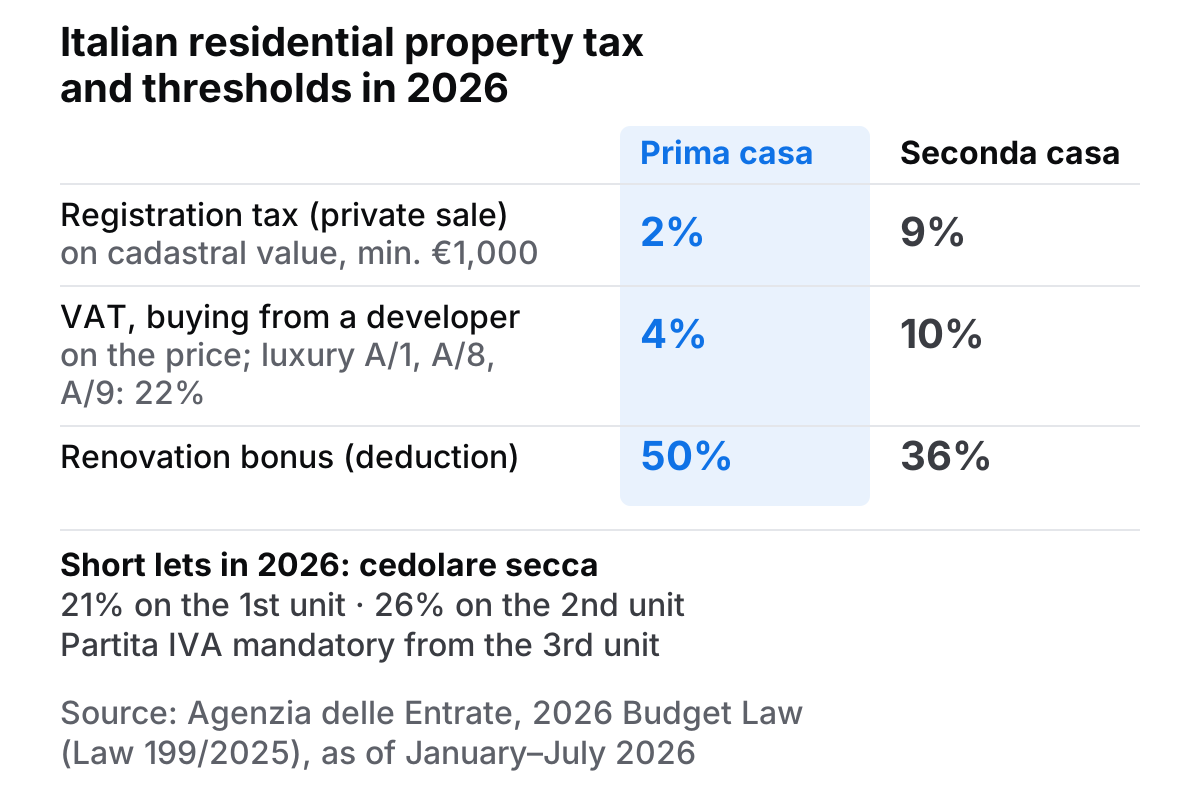
- Prima Casa (Primary Residence): Non-luxury properties (excluding cadastral categories A/1, A/8, and A/9) bought from a private seller incur a 2% registration tax (imposta di registro) on the cadastral value (minimum €1,000), plus fixed mortgage and cadastral taxes of €50 each. If buying from a VAT-registered developer, 4% VAT applies to the agreed price, plus €200 each for the three fixed taxes. Under Law 207/2024, buyers have a two-year window (increased from one year) to sell an existing primary home after purchasing a new one. Full details are set out in the Agenzia delle Entrate guide to Prima Casa purchase tax reliefs.
- Seconda Casa (Second Home or Luxury Property): Purchasing a second home or a luxury unit (categories A/1, A/8, or A/9) from a private seller requires a 9% registration tax on cadastral value (minimum €1,000) plus fixed mortgage and cadastral taxes of €50 each. From a developer, VAT rises to 10% on declared price (or 22% for luxury categories), plus €600 in combined fixed taxes.
- Annual Municipal Tax (IMU): Non-luxury primary residences are exempt from IMU. Second homes incur IMU on cadastral income revalued by 5% and multiplied by 160. Municipalities apply a base rate of 0.86%, which can be adjusted up to 1.06% (or 1.14% including historic TASI surcharges).
- Renovation Deductions: Under Law 207/2024 and Law 199/2025, tax credits for building renovations (Bonus Ristrutturazioni) and energy upgrades (Ecobonus) are set at 50% for primary residences and 36% for second homes across 2025 and 2026, capped at €96,000 expenditure per unit over ten annual instalments. Standalone fossil-fuel boilers are excluded from deductions as of 1 January 2025.
Accurate underwriting requires exact comparable benchmarking. Advisers use professional property valuation and market study tools to confirm transaction baselines prior to submitting offers.
What are the 2026 rules for short-term rentals, visas and the flat tax?
Short-term letting and tax residency rules underwent structural changes under the 2026 Budget Law (Law 199/2025):
- Short-Term Rentals (Cedolare Secca): For residential lets under 30 days, individual landlords can apply the optional flat tax (cedolare secca) at 21% on one designated property and 26% on a second property. Renting three or more properties short-term within the same tax year triggers mandatory business status (Partita IVA), excluding the owner from the cedolare secca framework.
- National Identification Code (CIN): In force under Decree-Law 145/2023 and fully operational via the Ministry of Tourism national database (BDSR) for the CIN code, every tourist or short-let unit must hold a CIN. It must be displayed outside the building, included on all digital listings, and declared on tax filings in 2026. Properties must be fitted with fire extinguishers and functional gas and carbon monoxide detectors. Fines reach €8,000 for operating without a CIN and €5,000 for failing to display it.
- Residency and Visas: Purchasing real estate in Italy does not grant residency and is not eligible under the Investor Visa for Italy (Art. 26-bis D.Lgs. 286/1998), which requires €250,000 in start-ups, €500,000 in corporate equity, or €2 million in government bonds, as outlined in the Italian Ministry of Foreign Affairs guidelines on the Investor Visa for Italy. Non-EU buyers who do not intend to work locally apply instead for the Elective Residence Visa (Visto per Residenza Elettiva), which requires proof of property ownership or a long lease, medical insurance, and documented passive income of at least €31,000 per year.
- High-Net-Worth Flat Tax (Art. 24-bis TUIR): Individuals establishing tax residency in Italy from 1 January 2026 (having been non-resident for at least 9 of the preceding 10 years) can pay a single annual substitute tax of €300,000 on foreign-source income for up to 15 years, plus €50,000 per family member. This regime grants exemption from foreign asset reporting (Quadro RW), foreign wealth taxes (IVIE/IVAFE), and inheritance tax on foreign assets. Review the official Agenzia delle Entrate rules on the flat tax regime for new residents.
To explore comprehensive data sets or integrate real estate market feeds, sign in to the CASAFARI platform or inspect the technical documentation via the Area Insights API documentation.
Frequently asked questions
What are the taxes on buying a house in Italy as a foreigner?
Foreign buyers pay the same purchase tax rates as Italian nationals, determined by whether the property is registered as a primary residence (prima casa) or a second home (seconda casa). For a second home bought from a private individual, buyers pay a 9% registration tax calculated on the official cadastral value, plus €100 in combined mortgage and cadastral fees. If purchased from a developer subject to VAT, the tax is 10% VAT on the agreed purchase price (22% for luxury properties) plus €600 in fixed administrative taxes.
Does buying property in Italy grant residency or a Golden Visa?
Buying real estate in Italy does not grant automatic residency and does not qualify for the Investor Visa for Italy, which requires investments in companies, start-ups, or government bonds. Non-EU buyers seeking to live in Italy without working locally must apply for the Elective Residence Visa. This visa requires proof of property ownership or a registered lease, comprehensive health insurance, and documented passive income of at least €31,000 per year for a single applicant.
What are the rules for short-term rentals in Italy in 2026?
Under the 2026 Budget Law (Law 199/2025), private landlords letting properties short-term (under 30 days) pay a flat cedolare secca tax of 21% on one property and 26% on a second property. Letting three or more units short-term in a single tax year requires registering for a business VAT number (Partita IVA). Additionally, all short-let units must obtain a National Identification Code (CIN) from the Ministry of Tourism, display it on all adverts and outside the building, and install carbon monoxide detectors, gas detectors, and fire extinguishers.
How does Italy’s flat tax for new residents work in 2026?
Under Article 24-bis of the Italian Tax Code, individuals who move their tax residence to Italy after being non-resident for at least 9 of the previous 10 years can opt for a substitute flat tax on all foreign-source income. For individuals transferring residency on or after 1 January 2026, the annual fee is €300,000 plus €50,000 per eligible family member, locked for up to 15 years. The regime exempts global wealth and income from standard Italian tax reporting, foreign wealth taxes (IVIE/IVAFE), and foreign asset inheritance taxes.