
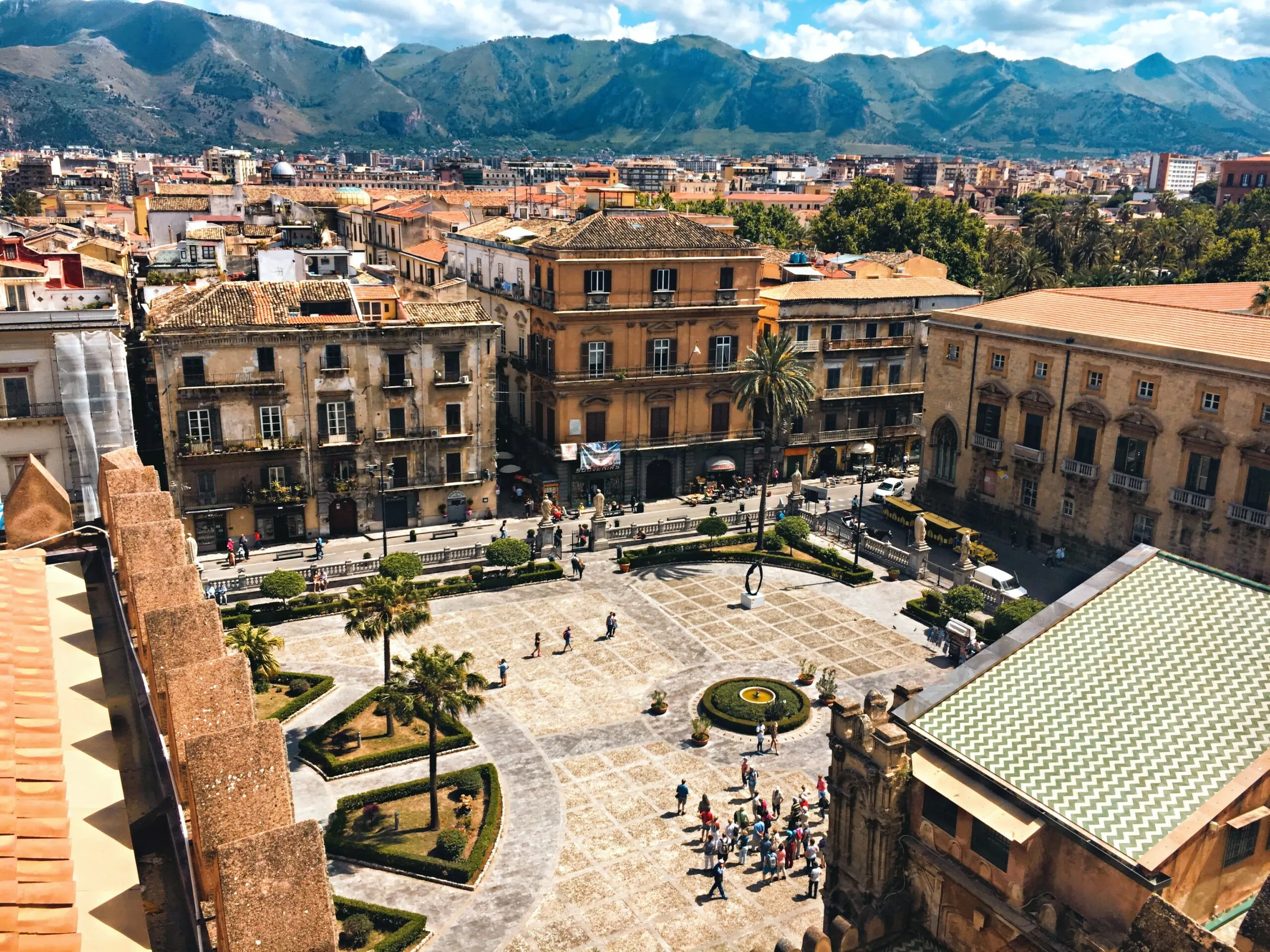
Palermo is the capital of Sicily and the administrative centre of a metropolitan area of 1,193,199 residents according to the ISTAT 2026 demographic balance (June 2026), with 626,273 inhabitants residing in the municipality itself as of January 2026. Combining a UNESCO-listed Arab-Norman historic core with a 23 km municipal coastline, the city offers property investors distinct opportunities shaped by updated 2026 purchase taxes, IMU property tax rates, and national short-let regulations.
Where is Palermo and how is its coastline structured?
Nestled in the Conca d’Oro plain on the Tyrrhenian coast of north-western Sicily, Palermo serves as the island’s primary financial, political and maritime hub. Its port provides critical passenger and freight traffic to Naples, Genoa, and North Africa, while highway and rail networks connect the capital to eastern and southern Sicily, including Catania, Syracuse, Trapani, and Agrigento.
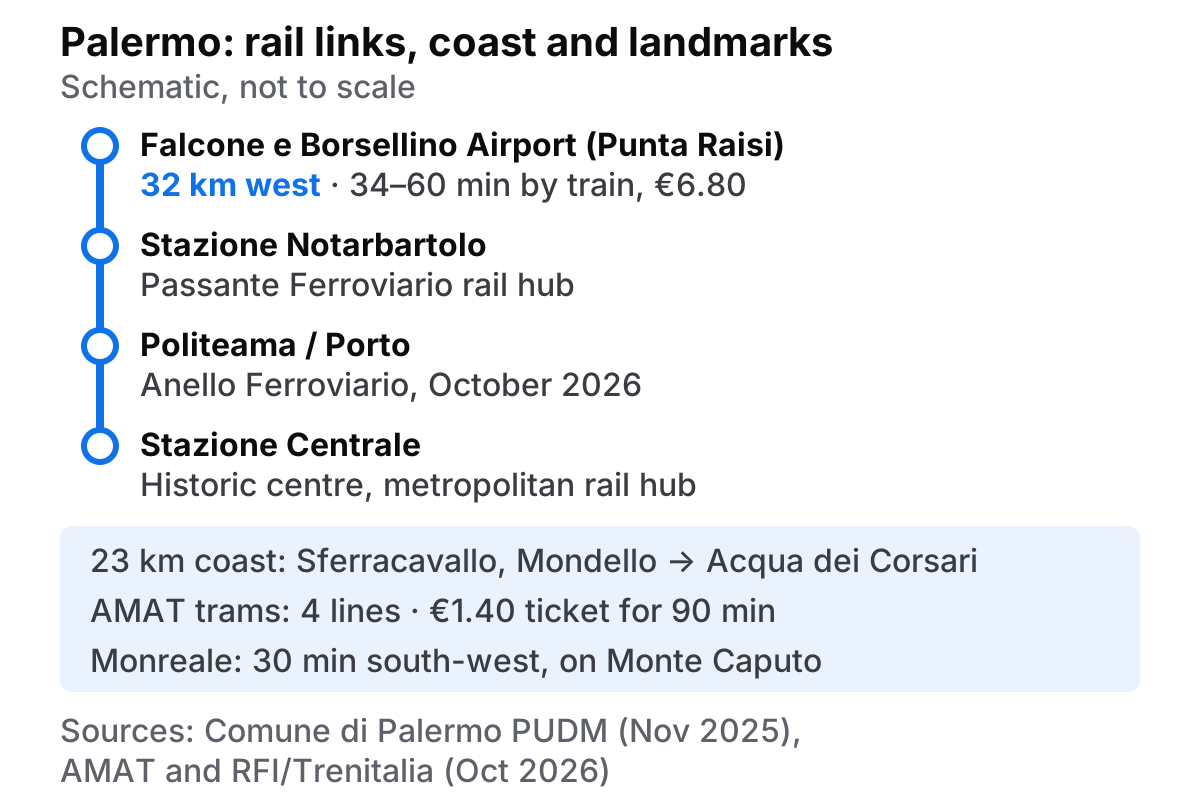
Geography plays a defining role in local real estate analysis. The Municipality of Palermo possesses 23 km of coastline (according to the municipal PUDM published in November 2025), stretching from the northern fishing hamlets of Sferracavallo and Mondello down to Acqua dei Corsari in the south-east. In contrast, the wider Metropolitan City of Palermo encompasses roughly 150 km of Tyrrhenian shoreline from Balestrate to Finale di Pollina, expanding to nearly 200 km when including the offshore island of Ustica.
What defines daily life, architecture and districts in Palermo?
Palermo’s urban fabric is layered with nearly three millennia of history, founded by Phoenicians in the 8th century BC and subsequently shaped by Roman, Byzantine, Arab, Norman, and Spanish rulers. This architectural blend is most prominent in the historic centre (Centro Storico), anchored by three historic markets—Ballarò, Il Capo, and La Vucciria—and iconic monuments.
Palermo Cathedral, founded between 1184 and 1185 by Anglo-Norman Archbishop Walter Ophamil (Gualtiero Offamilio), was inscribed as a UNESCO World Heritage Site on 3 July 2015 as part of the ‘Arab-Norman Palermo and the Cathedral Churches of Cefalù and Monreale’. Nearby, the Teatro Massimo Vittorio Emanuele stands as one of Europe’s grandest opera houses. Designed by Giovan Battista Filippo Basile in 1875 and completed by his son Ernesto Basile for its grand opening on 16 May 1897, the structure presents a neoclassical-eclectic exterior enhanced by Liberty (Art Nouveau) bronze work, kiosks, and interior design.
Beyond the historic centre, residential preferences branch into coastal and suburban zones. Mondello, situated between Monte Pellegrino and Monte Gallo, is renowned for its Belle Époque Liberty villas and sandy beach, while Sferracavallo offers a traditional seafood setting. Leafy 19th-century residential avenues surround public gardens such as Giardino Inglese and Villa Bonanno.
Daily life revolves around a rich culinary tradition, from street food specialties like arancine, pane e panelle, cannoli, and cassata to DOC wines produced across the province, such as Contea di Sclafani DOC. For real estate professionals evaluating micro-locations, leveraging tools like CASAFARI Area Insights provides precise context on demand dynamics across individual street corridors.
How does public transport work in Palermo and to the airport?
The historic centre of Palermo is largely walkable, bolstered by pedestrianised thoroughfares along Via Maqueda and Corso Vittorio Emanuele. The municipality operates the ‘Navetta Arancione’ (Free Centro Storico shuttle), offering complimentary electric transport between Piazza Indipendenza and Porta Felice.
Public transit across the municipality relies on a combination of bus networks, surface trams, and metropolitan railways:
- Tram Network: AMAT operates four active tram routes (Lines 1, 2, 3, and 4). A single 90-minute ticket costs €1.40 via the PalerMobilità/MyAMAT app or ticket resellers (€1.80 when bought on board) and is valid across both AMAT buses and tram lines, as confirmed by AMAT Palermo fares and tram network guidance (April 2026).
- Metropolitan Rail: Operated by Trenitalia/RFI, the urban rail system comprises two primary routes: the Passante Ferroviario (linking Punta Raisi Airport to Notarbartolo and Stazione Centrale) and the Anello Ferroviario. The underground extension connecting Giachery, Porto, and Politeama activates on 25 October 2026.
- Sightseeing & Taxis: Eight main taxi ranks operate across the city, supplemented by the regulated ‘Turismo Taxi’ service offering a fixed €120 three-hour itinerary covering key monuments and Monreale.
Airport transit to Falcone e Borsellino Airport at Punta Raisi (32 km west) is efficient. As detailed on the Trenitalia airport rail link platform (May 2026), regional express trains run directly to Notarbartolo and Stazione Centrale in 34 to 60 minutes for €6.80. Prestia e Comandè shuttle buses depart every 30 minutes (€6.00 online / €6.50 on board, 50-minute journey), while official airport taxis operate on capped fixed fares between €35 and €50 depending on the target urban zone.
Which towns and natural parks surround Palermo?
Several prominent municipalities and protected nature reserves sit within easy reach of the municipal boundary:
- Monreale: Situated on the slopes of Monte Caputo roughly 30 minutes south-west of central Palermo, Monreale overlooks the Conca d’Oro plain. The town is famous for its UNESCO-listed Norman Cathedral, constructed by King William II and adorned with over 6,300 square metres of golden Byzantine mosaics. The surrounding Monte Caputo formation consists of limestone and dolomite karst terrain.
- Cefalù: Located an hour east along the Tyrrhenian coast, Cefalù features a medieval old town, a twin-towered Norman cathedral (also part of the 2015 UNESCO listing), and prime coastal housing.
- Parco delle Madonie: Stretching across the eastern portion of the Metropolitan City, this regional natural park offers mountain villages, agricultural estates, and extensive hiking networks.
For foreign retirees considering relocation, location choice carries distinct fiscal consequences. While the Municipality of Palermo itself exceeds the population cap for tax incentives, surrounding provincial towns offer significant relief. Investors exploring opportunities across the island can benefit from accessing the entire Italian property market with CASAFARI to identify emerging investment pockets.
What are the property taxes and short-term rental rules in Palermo in 2026?
Acquiring and managing property in Palermo requires strict adherence to national and local fiscal regulations:
Purchase Taxes (Imposta di Registro)
When purchasing a residential property from a private seller, the registration tax rate depends on residency status:
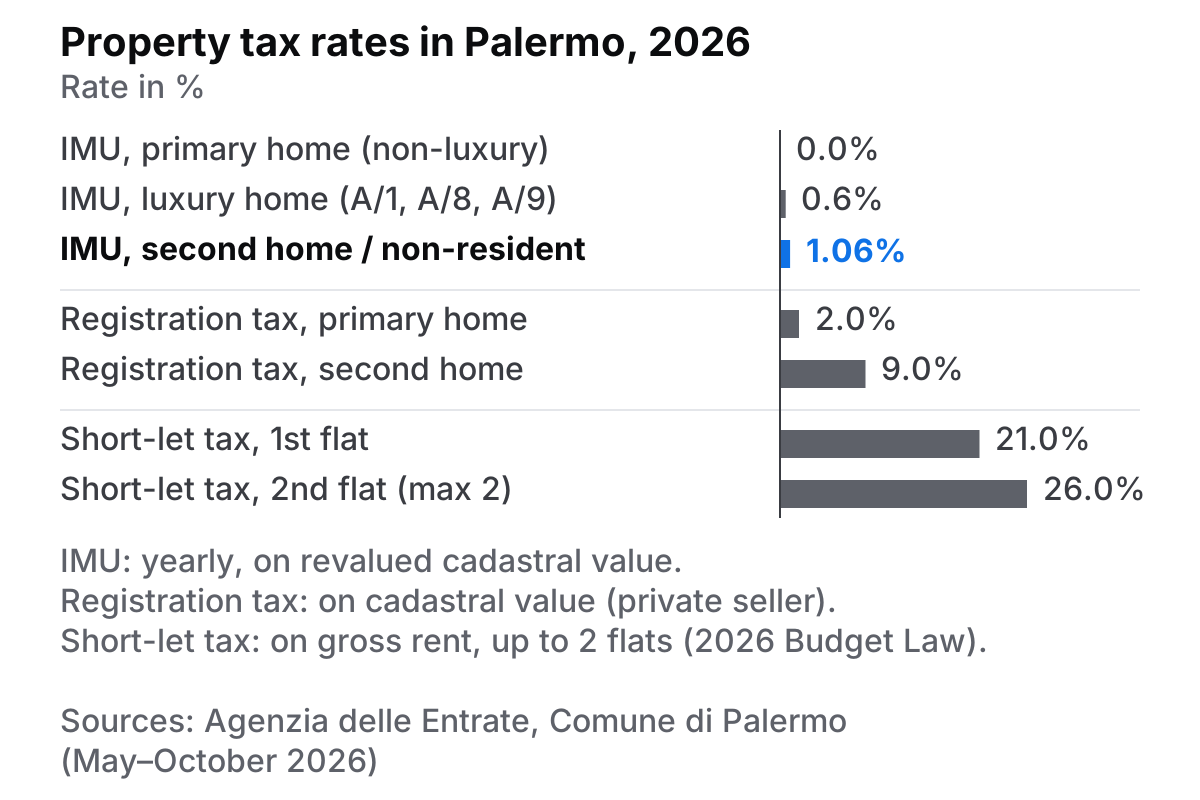
- Primary Residence (Prima Casa): 2% of the property’s cadastral value (rendita catastale), provided the buyer registers official residency within the Municipality of Palermo within 18 months of completion.
- Second Home or Non-Resident Purchase: 9% of the cadastral value.
Municipal Property Tax (IMU)
According to the Comune di Palermo IMU rates schedule (May 2026):
- Non-luxury primary residences are exempt from IMU.
- Luxury primary residences (cadastral categories A/1, A/8, and A/9) incur an annual rate of 0.6%.
- Second homes, holiday properties, and non-resident holdings pay the standard municipal rate of 1.06%.
Short-Term Rental Regulations (Affitti Brevi)
Under the 2026 Budget Law and Sicilian Regional Law 6/2025, operating a short-term rental in Palermo requires strict compliance:
- Dual Identification Codes: Properties must display both the Regional Identification Code (CIR) and the National Identification Code (CIN). Operating without a valid CIN incurs statutory fines between €800 and €8,000.
- Safety Standards: All units must be fitted with certified carbon monoxide/gas detectors and functioning fire extinguishers.
- Guest Reporting: Guest data must be transmitted to the State Police via the Alloggiati Web portal within 24 hours of arrival.
- Tax Regime Capping: Under Agenzia delle Entrate guidance on short-term rentals and cedolare secca, private non-business rental income (cedolare secca) is limited to a maximum of two apartments. The tax rate is 21% on the first property and 26% on the second. Letting three or more properties mandates full VAT registration (Partita IVA).
Retirement Incentives (7% Flat Tax)
Under Article 24-ter of TUIR, foreign pensioners moving their tax residence to southern Italy can access a 7% flat tax on foreign-sourced income for up to nine years. Following Law no. 34 of 11 March 2026 (effective 7 April 2026), as set out in the Agenzia delle Entrate 7% flat tax rules for foreign pensioners, the population cap for qualifying municipalities was increased from 20,000 to 30,000 inhabitants. While the Municipality of Palermo (626,273 residents) is excluded, numerous surrounding municipalities within the Metropolitan City fall under 30,000 residents and qualify for the scheme.
Whether assessing historical yield trends or conducting a rigorous property valuation and market study, real estate investors and agents rely on verified data to make informed decisions. You can streamline your portfolio analysis and search across all listings by using Property Sourcing. To begin exploring live market data and institutional analytics, sign in to the CASAFARI platform.
Frequently asked questions
What are the property purchase taxes and IMU rates in Palermo for foreign buyers?
Buyers purchasing residential property in Palermo from a private vendor pay registration tax (imposta di registro) at 2% of the cadastral value if they qualify for primary residence relief (prima casa) by establishing municipal residency within 18 months, or 9% for a second home. For annual municipal property tax (IMU), non-luxury primary homes are exempt, while luxury primary residences (categories A/1, A/8, and A/9) pay 0.6%. Second homes and non-resident property owners pay Palermo’s standard municipal rate of 1.06% as of May 2026.
What are the short-term rental rules and CIN requirements in Palermo in 2026?
Property owners offering short-term holiday lets in Palermo must display both the regional identification code (CIR, under Sicilian Regional Law 6/2025) and the national code (CIN), with statutory fines of €800 to €8,000 for non-compliance. Properties must be equipped with mandatory gas and carbon monoxide detectors and fire extinguishers, and guest details must be reported to the police via Alloggiati Web within 24 hours. Under Italy’s 2026 Budget Law, the non-business short-let regime applies to a maximum of two apartments, taxed via cedolare secca at 21% for the first property and 26% for the second, while operating three or more short-term rentals mandates VAT registration (Partita IVA).
Does Palermo qualify for Italy’s 7% flat tax for foreign retirees?
The Municipality of Palermo itself does not qualify for the 7% flat tax regime under Article 24-ter of TUIR, as its resident population exceeds the statutory threshold. However, Law no. 34 of 11 March 2026 raised the population cap for eligible municipalities in southern Italy from 20,000 to 30,000 inhabitants. Foreign retirees can access the tax incentive by establishing tax residency in qualifying smaller municipalities within the Metropolitan City of Palermo.
How is public transport connected between Palermo city centre and Falcone e Borsellino Airport?
Falcone e Borsellino Airport at Punta Raisi is located 32 km west of Palermo city centre. It is directly linked by Trenitalia regional trains along the Passante Ferroviario to Notarbartolo and Centrale stations, taking 34 to 60 minutes for €6.80. Alternatively, Prestia e Comandè shuttle buses depart every 30 minutes, taking 50 minutes at a cost of €6.00 online or €6.50 on board, alongside regulated fixed-fare taxis priced between €35 and €50 depending on the urban destination zone.