
CASAFARI’s present all around Portugal
Get to know the most desirable locations.
Portugal’s residential property market reached a national median transaction price of 2,445 €/m² in the second quarter of 2026, marking an 18.4% year-on-year increase according to figures published by the Instituto Nacional de Estatística (INE). Backed by an international resident population of 1.60 million people representing 14.0% of total residents at the end of 2025, the country combines sustained capital appreciation with a freshly updated fiscal and regulatory environment for foreign buyers, property investors and estate agents.
Why is Portugal attracting international property buyers and investors in 2026?
Demographic shifts and sustained cross-border demand have transformed Portugal from a seasonal second-home market into an established destination for long-term international capital and foreign residents. Data published by the Agência para a Integração, Migrações e Asilo (AIMA) in September 2026 reveals that 1,585,854 foreign citizens held valid residence titles or active applications at the close of 2025, reflecting a 2.7% increase year-on-year. Brazilian nationals represented the largest single community with 493,622 registered titles (31.1% of the total), alongside growing numbers of European and North American professionals.
This influx of high-earning residents and relocating families continues to interact with structural housing supply constraints across major metropolitan hubs and coastal corridors. While overall transaction volumes remain robust, navigating local micro-markets requires granular pricing and inventory data. Before deploying capital or advising clients, real estate professionals rely on CASAFARI Area Insights to evaluate hyper-local supply, historical pricing dynamics and realistic listing trends across individual municipalities and parishes.
How do property prices and rents compare across Portugal’s main regions?
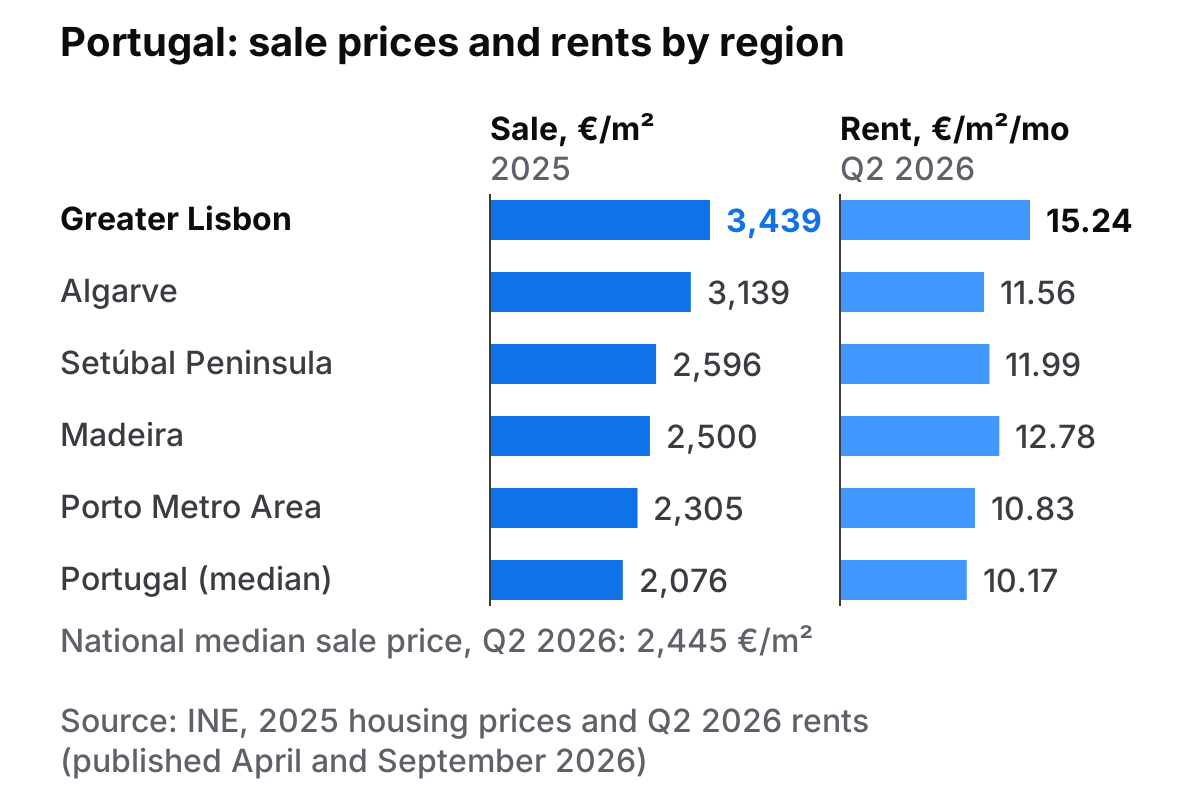
Across full-year 2025 and into mid-2026, property values and rental metrics displayed clear sub-regional variations, as detailed by the INE. For full-year 2025, the national median housing sale price stood at 2,076 €/m², climbing to a quarterly high of 2,445 €/m² by Q2 2026.
In Greater Lisbon, the 2025 median transaction price reached 3,439 €/m². Demand remains concentrated in premium coastal and urban municipalities: in Q2 2026, median prices reached 5,299 €/m² in Lisbon municipality, 5,200 €/m² in Cascais, and 4,704 €/m² in Oeiras. Rental markets reflect similar tightness; Instituto Nacional de Estatística (INE) Q2 2026 rental statistics show median new contract rents of 15.24 €/m² across Greater Lisbon and 17.79 €/m² within Lisbon municipality. Adjacent markets like the Setúbal Peninsula recorded 2025 median sales of 2,596 €/m² and Q2 2026 rents of 11.99 €/m², functioning as key commuter corridors.
In the North, the Porto Metropolitan Area posted a 2025 median sale price of 2,305 €/m², while Q2 2026 new lease rents averaged 10.83 €/m² across the region and 14.66 €/m² in Porto city. Strong technology sector expansion, university student demand, and commercial development continue to support yields across northern urban centres.
The Algarve recorded a 2025 median sale price of 3,139 €/m² and Q2 2026 rents of 11.56 €/m², supported by an August 2026 median bank valuation for flats of 3,010 €/m². In Madeira, median 2025 property sales reached 2,500 €/m², while Q2 2026 rents averaged 12.78 €/m²—the second highest regional rental benchmark in Portugal. Meanwhile, inland markets offer lower entry valuations; in July 2026, INE median bank valuations for flats stood at 1,739 €/m² in Centro and 1,778 €/m² in Alentejo, compared to an August 2026 national overall bank valuation record of 2,254 €/m².
How are new transport and infrastructure projects reshaping the property map?
Major national infrastructure commitments initiated or advanced in 2025 and 2026 are opening new residential and commercial growth hubs outside traditional city centres.
On 12 October 2026, groundworks officially commenced on Phase 1 Lot A of the Porto–Lisbon High-Speed Rail line (Linha de Alta Velocidade). Covering 71 kilometres between Porto Campanhã and Oiã (Aveiro) with an investment exceeding €2 billion under the AVAN Norte concession signed in July 2025, the project includes a new road-rail bridge over the Douro River and a high-speed interchange at Vila Nova de Gaia (Santo Ovídio). With Phase 1 completion targeted for 2030, travel times between Portugal’s two largest cities will drop significantly, boosting residential appeal in intermediate towns such as Aveiro and Coimbra.
In the south, airport operator ANA delivered its technical report in July 2026 for the new Lisbon international airport (Aeroporto Luís de Camões at Alcochete), designed for an initial capacity of 56 million passengers per year by 2035. Supported by the government’s 2026 rail accessibility plan, companion projects scheduled for completion by 2034—including the Third Tagus Crossing (Chelas–Barreiro), the high-speed Lisbon–Madrid rail link, and a 20-minute direct rail link to central Lisbon—are driving investment interest across the South Bank (Margem Sul).
What taxes and regulations apply to property buyers and landlords in 2026?
Understanding the legal frame is essential when investing in property in Portugal. Several statutory updates govern acquisition, property holding, long-term letting, and short-term rentals in 2026.
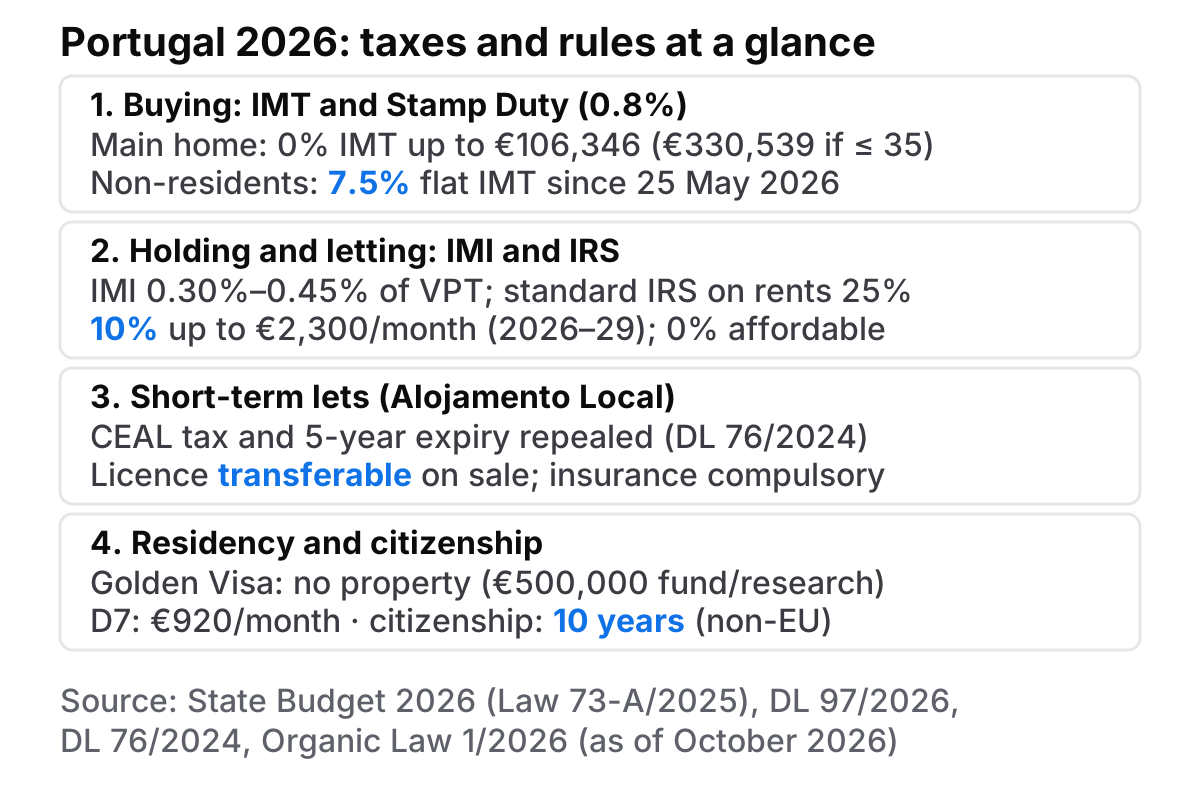
For residential acquisitions, the 2026 State Budget (Law No. 73-A/2025) updated standard resident primary-home Property Transfer Tax (IMT) progressive brackets by 2% (0% up to €106,346; progressive rates up to a 6% single rate between €660,982 and €1,150,853; and 7.5% above €1,150,853). The IMT Jovem framework offers full exemption on primary homes up to €330,539 for buyers aged 35 or under. However, under a major fiscal reform implemented on 25 May 2026, non-resident buyers of residential property pay a flat 7.5% IMT rate, unless they establish Portuguese tax residency within two years or place the home into a qualifying affordable long-term lease. Stamp Duty (Imposto do Selo) remains 0.8% on acquisition, while annual Municipal Property Tax (IMI) ranges from 0.30% to 0.45% of the property’s tax value (VPT).
Landlords benefit from significant tax relief under Decree-Law No. 97/2026 in the Diário da República, in force since May 2026 and retroactive to 1 January 2026 through 2029. Residential leases charging moderate rents (up to €2,300 per month) are taxed at a reduced 10% autonomous Personal Income Tax (IRS) rate, down from the 25% standard residential rate. Under the Simplified Affordable Rental Regime (RSAA, effective 1 September 2026), residential rental income is entirely exempt (0% IRS) if rents are set at least 20% below municipal median figures. For capital gains on residential property sales, 50% of the net gain is taxable at progressive IRS rates, with exemptions available if proceeds are reinvested into a primary residence or a long-term residential rental property.
Short-term holiday rentals operate under Decree-Law No. 76/2024 on Alojamento Local. In force since November 2024, this legislation repealed the CEAL extraordinary tax, eliminated mandatory five-year licence renewals, and restored licence transferability upon property sale (subject to municipal containment zones). Condominiums no longer hold automatic veto rights over residential flat registrations, although a two-thirds permillage vote can block future registrations, and a majority vote combined with proven repeated disturbance allows the local Mayor to cancel an existing registration.
Regarding residency, direct real estate investments remain ineligible for the Portugal Golden Visa following Law No. 56/2023. Investors seeking residency must select alternative routes, such as a €500,000 investment in qualifying non-real-estate funds or research programmes. Financially independent individuals can utilise the D7 Passive Income Visa (€920/month minimum income requirement in 2026 plus proof of accommodation). Under Organic Law No. 1/2026 (effective 19 May 2026), citizenship by naturalisation requires 10 years of legal residence for non-EU and non-CPLP nationals (7 years for EU and CPLP citizens), while permanent residency remains obtainable after 5 years. Qualifying skilled professionals can also evaluate the IFICI regime (NHR 2.0), which offers a 20% flat IRS rate on eligible Portuguese earned income and tax exemptions on foreign-source dividends, interest and capital gains for 10 years.
How can buyers, investors and agents analyse the Portuguese market with CASAFARI?
Moving from macro statistics to transaction-level accuracy requires robust technology. Estate agents, portfolio managers and private investors rely on CASAFARI to cross-reference listing prices against verified market data, monitor property absorption rates, and uncover multi-listed or off-market opportunities across Lisbon, Porto, the Algarve and emerging secondary markets.
By leveraging property valuation and market study tools, professionals can generate automated comparative market analyses (CMAs) that adjust for location, property type, condition and usable area. Meanwhile, agents managing buyer mandates use Property Sourcing to search real-time listings aggregated from thousands of portals and agency sites, eliminating duplicates and tracking price alterations instantaneously. For a detailed overview of conveyancing procedures, consult our step-by-step guide to buying property in Portugal.
For engineering and data analytics teams seeking direct programmatic access, detailed technical information is available in the Area Insights API documentation (written in English). Real estate professionals ready to streamline their acquisition workflows can sign in to the CASAFARI platform to access full market coverage.
Frequently asked questions
What property taxes do non-residents pay when buying in Portugal in 2026?
Since 25 May 2026, non-resident buyers purchasing residential property in Portugal pay a flat 7.5% Property Transfer Tax (IMT) rate, unless they establish tax residence in Portugal within two years or place the property into an affordable long-term rental programme. In addition, all property buyers pay 0.8% Stamp Duty (Imposto do Selo) on the purchase price or tax value (VPT), whichever is higher. Property owners are also subject to annual Municipal Property Tax (IMI), which ranges between 0.30% and 0.45% of the VPT for urban properties.
What are the current Alojamento Local short-term rental rules in Portugal?
Under Decree-Law No. 76/2024, applicable in 2026, the extraordinary CEAL tax and mandatory five-year licence renewals have been repealed, and Alojamento Local (AL) licences can once again be transferred when a property is sold, subject to local municipal containment rules. Prior condominium approval is no longer required to register a residential flat for short-term lets. However, a condominium can ban future registrations in its building rules with a two-thirds permillage vote, or petition the local Mayor to cancel an active licence following proven, repeated noise or security disturbances.
Can you still get a Portugal Golden Visa by buying property?
No, real estate purchases and real-estate-backed investment funds are no longer eligible for the Portugal Golden Visa (ARI), following restrictions enacted under Law No. 56/2023. Investors seeking residency through the Golden Visa must allocate capital to eligible non-real-estate options, such as €500,000 in qualifying investment funds or scientific research, or €250,000 in cultural heritage initiatives. Retirees and non-working buyers relocating to Portugal typically apply for the D7 Passive Income Visa, which requires a minimum passive income of €920 per month in 2026 alongside proof of Portuguese accommodation.
How is rental income and capital gains taxed in Portugal for foreign owners?
Under Decree-Law No. 97/2026 (retroactive to 1 January 2026 through 2029), long-term residential rental income charging up to €2,300 per month is taxed at a reduced 10% autonomous IRS rate for both residents and non-residents, down from the standard 25% residential rate. For property sales, capital gains are taxed on 50% of the net gain at progressive IRS rates ranging from 12.5% to 48% in 2026. Non-residents can claim capital gains tax exemptions if the proceeds are reinvested into a primary residence or a qualifying long-term residential rental property.