
BRAGA PROPERTY GUIDE
Full of fascinating Portuguese culture and history
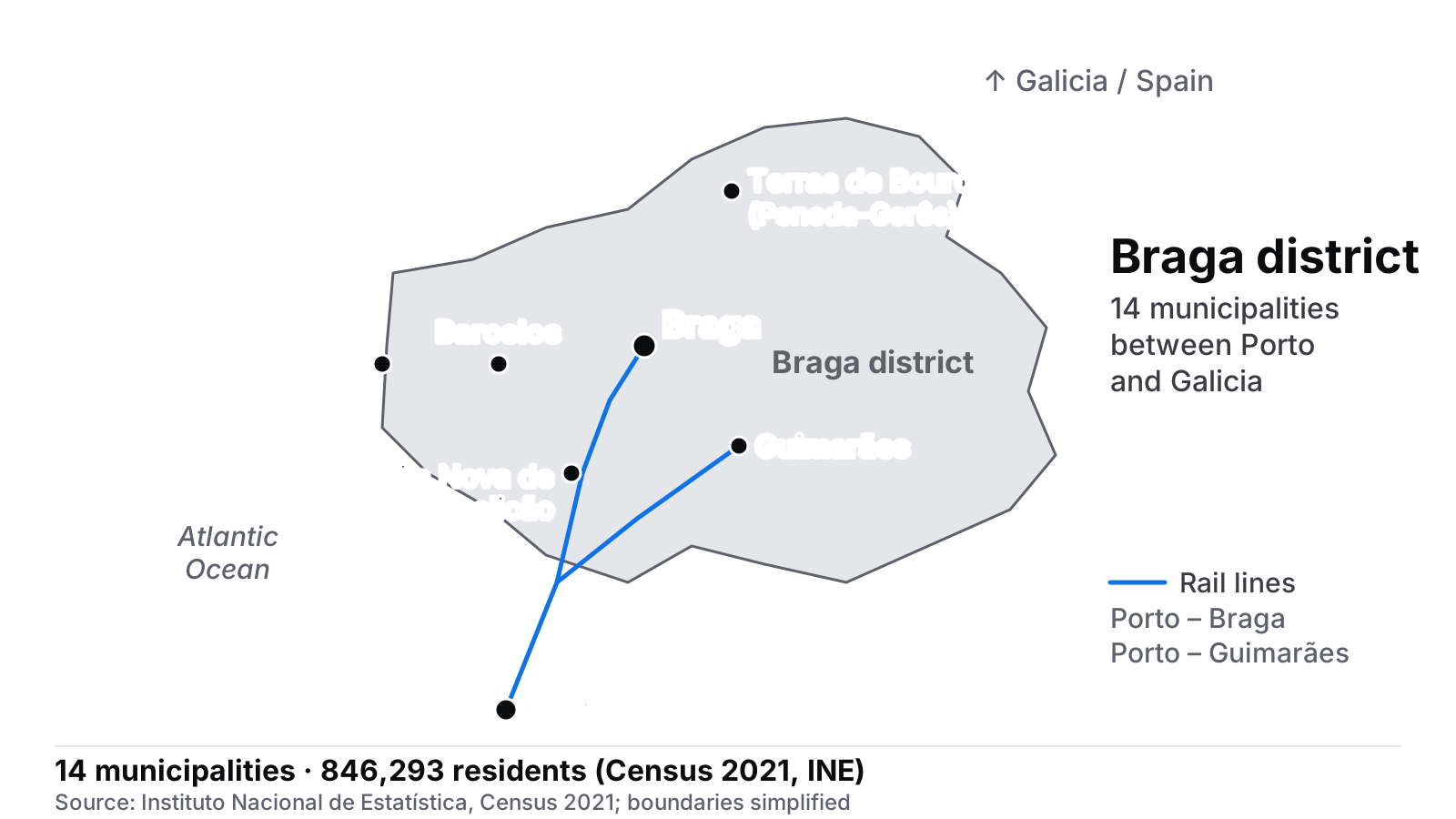
In northern Portugal, the Braga district spans 14 municipalities and was home to 846,293 residents at the 2021 census by the Instituto Nacional de Estatística (INE). Centred on Braga municipality (193,324 residents), the district offers university-driven growth, major heritage sites, and easy access to Porto, with a median transaction price of €2,240/m² in Q1 2026 according to INE. Real-time market liquidity and asking prices across the district are tracked directly through CASAFARI.
Where is Braga?
Located in the historic Minho region north of Porto, the Braga district encompasses the Cávado and Ave river valleys, extending from the Atlantic coastline at Esposende inland to the green mountain ranges near the Spanish border with Galicia.
According to official administrative divisions, the district comprises 14 municipalities: Amares, Barcelos, Braga, Cabeceiras de Basto, Celorico de Basto, Esposende, Fafe, Guimarães, Póvoa de Lanhoso, Terras de Bouro, Vieira do Minho, Vila Nova de Famalicão, Vila Verde and Vizela.
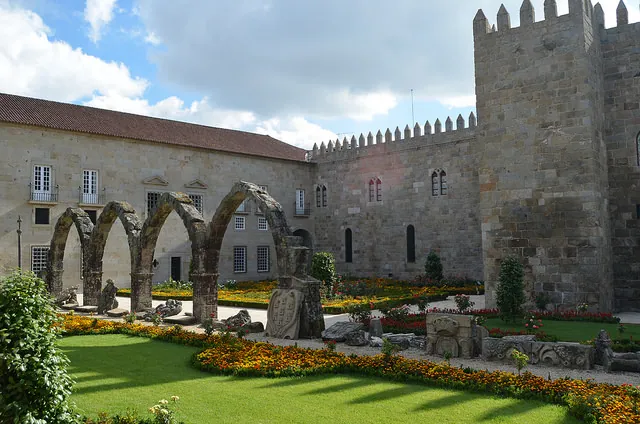
Braga city sits at the district’s geographical heart. Established in Roman times as Bracara Augusta, it is one of the oldest urban centres in Portugal, anchored by its historic cathedral, lively central plazas, and the hilltop Sanctuary of Bom Jesus do Monte. The presence of the University of Minho gives Braga a vibrant, youthful population and an expanding technology hub that sets it apart from purely tourism-led regions, explaining why Braga keeps appearing among Europe’s top destinations.
Which towns in the Braga district matter to buyers?
Different municipalities across the district cater to distinct lifestyle and investment objectives:
- Braga municipality: The principal commercial and administrative engine of the region. Braga is one of only seven Portuguese cities with over 100,000 residents where INE publishes transaction house prices down to a 500-metre grid level, providing exceptional transparency for valuation.
- Guimarães: Historically regarded as the traditional birthplace of Portugal, Guimarães features a UNESCO World Heritage historic centre, hosts a second University of Minho campus, and recorded rapid price growth in early 2026.
- Vila Nova de Famalicão and Barcelos: Major industrial and manufacturing centres offering competitive pricing for buyers seeking suburban residential housing.
- Esposende: The district’s single coastal municipality, offering maritime properties, sandy beaches, and water sports.
- Terras de Bouro, Vieira do Minho, Amares, and Vila Verde: Rural northern municipalities surrounding the national parklands, known for traditional stone houses and country estates. Market liquidity here is lower, requiring local expertise when analyzing comparable property sales.
How do you get to Braga, and how far is Porto?
Transport infrastructure connects the Braga district efficiently to the rest of Portugal and international hubs:
- Rail connections: Braga serves as the northern terminus for Comboios de Portugal’s (CP) flagship high-speed Alfa Pendular line, providing direct rail connections through Porto to Lisbon and Faro. CP also operates dedicated suburban services (Urbanos do Porto) along the Linha de Braga and Linha de Guimarães, running directly into Porto’s São Bento and Campanhã stations. Schedule details are available directly via CP timetables for the Braga and Guimarães lines.
- Road connections: Major expressways link the district: the A3 motorway connects Braga southwards to Porto and northwards to Valença at the Spanish border, while the A11 connects Guimarães, Braga, and coastal Esposende. Porto’s Francisco Sá Carneiro Airport provides the primary international airport for the entire district.
For real estate professionals, these direct rail and highway links mean commuting to Porto is straightforward, broadening the potential tenant and homebuyer demographic across the district.
Why choose Braga?
Braga offers an attractive balance of dynamic economic growth and high quality of life. Backed by thousands of university students and tech sector workers, the district combines historical landmarks—such as Guimarães’ historic quarter and nearby mountain nature reserves—with steady local employment.
It appeals to families relocating for work, remote professionals, and real estate investors looking for rental demand outside Portugal’s two largest metropolitan areas. While buyers specifically requiring southern resort amenities or year-round coastal heat may prefer the Algarve, Braga appeals strongly to buyers interested in culture, green landscapes, and solid capital growth. Investors examining broader market opportunities can read about six reasons investors look at Portugal.
What do the numbers say about the Braga property market?
Official housing transaction statistics published by INE highlight robust price expansion across the district:
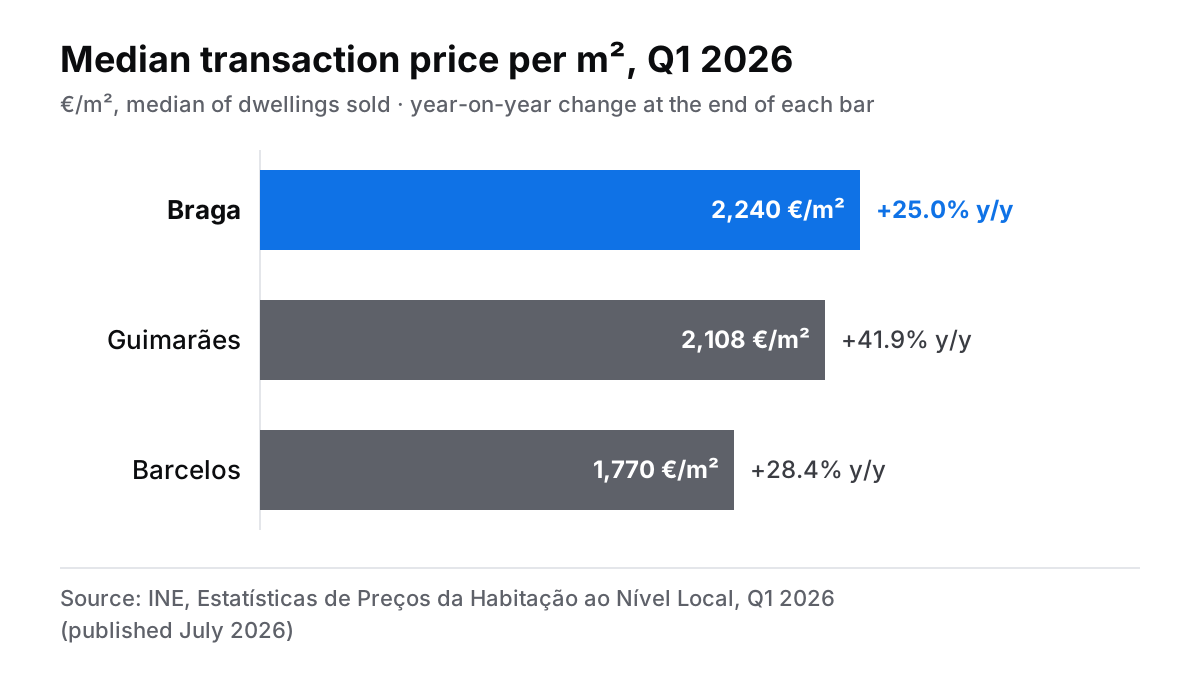
- In Q1 2026, the median transaction price of dwellings sold in Braga municipality reached €2,240/m², representing a 25.0% year-on-year increase according to INE’s local housing price statistics for Q1 2026.
- Guimarães saw accelerated price movement, reaching a median transaction price of €2,108/m² (+41.9% year-on-year) in Q1 2026.
- Barcelos recorded a median transaction price of €1,770/m² (+28.4% year-on-year) in Q1 2026.
- Nationally, median dwelling transaction prices across Portugal stood at €2,198/m² (+17.5% YoY) in Q4 2025, according to INE’s local housing price statistics for Q4 2025, having averaged €2,076/m² across full-year 2025.
Note that INE transaction data reflects completed sales prices registered with tax authorities, while real-time listing feeds show active asking prices. Real estate professionals seeking precise market comparisons can analyze parish-level market data in Area Insights. Technical teams building custom platforms can also access the Area Insights documentation for developers.
What rules apply when you buy or let in Braga?
Acquiring property in the Braga district follows standard Portuguese legal frameworks:
- Foreign buyers: Non-resident and international buyers face no legal restrictions when purchasing property in Portugal. Buyers require a Portuguese tax identification number (NIF) and typically open a domestic bank account. For step-by-step guidance, refer to the step-by-step guide to buying property in Portugal.
- Purchase taxes: Acquisitions incur Municipal Property Transfer Tax (IMT) and Stamp Duty (Imposto do Selo), followed by ongoing annual Municipal Property Tax (IMI).
- Short-term lets (Alojamento Local): Operating holiday rentals requires registering for an AL license with the local municipality. Under current regulations, local town halls retain discretionary authority to define local licensing limits and quotas.
- Valuations: When evaluating specific assets or managing property portfolios, agents can request a valuation or market study for a specific Braga property.
To explore current property listings and district analytics, sign in to CASAFARI to open Braga in Area Insights.
Frequently asked questions
Is Braga a good place to buy property in Portugal?
Braga offers a strong balance of lifestyle appeal and property value, driven by a large university population, modern infrastructure, and rich heritage. Official transaction data from INE shows median residential prices in Braga municipality reached €2,240/m² in Q1 2026, up 25.0% year on year. While prices have risen steadily, the district remains more accessible than Lisbon or Porto. Investors and home buyers should review parish-level transaction trends before committing.
How far is Braga from Porto and Porto airport?
Braga is situated directly north of Porto and is seamlessly connected by the A3 motorway and high-speed rail lines. CP operates regular urban trains along the Linha de Braga, as well as high-speed Alfa Pendular services connecting Braga to Porto and southern Portugal. Porto’s Francisco Sá Carneiro Airport serves as the main international gateway for the district and is easily reachable via motorway.
Can foreigners buy property in Braga?
Yes, foreign nationals can purchase real estate in Braga without restrictions, as Portuguese law treats non-resident buyers the same as local citizens. Buyers must obtain a Portuguese tax identification number (NIF) and typically open a local bank account to complete transactions. Standard property transfer taxes, including IMT and Stamp Duty, apply at purchase.
Can I run a short-term let (Alojamento Local) in Braga?
Operating a short-term holiday let in the Braga district requires registering the property with the local municipality to obtain an official Alojamento Local (AL) license number. Municipalities in Portugal hold full authority to establish local quotas and regulations governing new registrations. Property owners should consult local municipal guidelines before purchasing property specifically for short-term lets.