CASAFARI’s present all around Luxembourg
Get to know the most desirable locations.
The Luxembourg property market is defined by tight supply and high structural demand, with registered sales for existing flats averaging €7,795/m² and off-plan VEFA units reaching €9,809/m² in Q2 2026, according to Observatoire de l’Habitat and STATEC sales price data. In Luxembourg City, advertised asking prices averaged €10,949/m² in September 2026, reflecting the capital’s status as an international financial and institutional hub.
Why Does Luxembourg Remain One of Europe’s Most Resilient Property Markets?
As of 1 January 2026, the Grand Duchy of Luxembourg reached a population of 690,959 residents (STATEC, 2026), with 137,696 people residing in Luxembourg City (Ville de Luxembourg, December 2025). The capital exhibits a unique demographic profile: 69.48% of its population consists of foreign nationals, driven by the presence of European Union institutions, multinational corporate headquarters, private banking, and a world-leading investment fund sector. This steady influx of highly skilled expatriates creates persistent demand for prime residential accommodation.
Despite macroeconomic headwinds and higher interest rates during 2023–2024 that temporarily reduced transaction volumes, structural supply constraints continue to bolster underlying asset values. In Q2 2026, official transaction records compiled by the Observatoire de l’Habitat and STATEC revealed that national average prices for existing flats stood at €7,795/m² (-2.2% year-on-year). Off-plan sales (VEFA) registered an average of €9,809/m² (-6.7% year-on-year, or approximately €785,837 per apartment). Meanwhile, existing single-family houses in the Canton of Luxembourg commanded an average price of roughly €1.37 million—nearly 88% higher than comparable properties in the northern regions of the country.
While property transaction prices experienced slight adjustments, the private rental market expanded rapidly. Advertised apartment rents rose by +5.8% year-on-year across the Grand Duchy in Q2 2026, underscoring strong demographic absorption as buyers paused acquisition plans and turned to leasing.
Where to Buy or Rent in Luxembourg City: Key Districts Compared
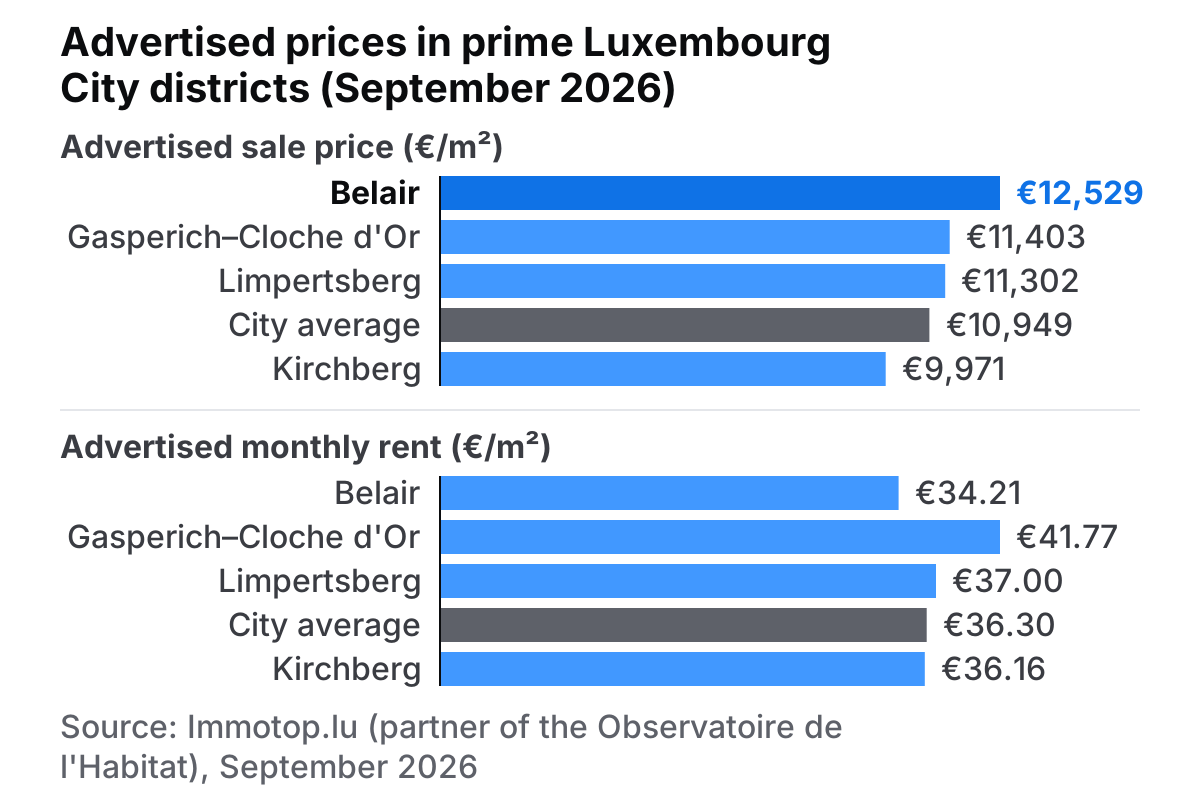
According to September 2026 market monitoring by Immotop.lu, the official data partner of the Observatoire de l’Habitat, advertised residential values in Luxembourg City averaged €10,949/m² for sales and €36.30/m² per month for rentals. However, values vary considerably depending on the neighbourhood character, school catchments, and public transport access.
Belair & Limpertsberg: Traditional Prime Residential Quarters
Belair remains the capital’s most prestigious residential address, commanding an average advertised sale price of €12,529/m² and monthly rents of €34.21/m² in September 2026. Characterised by tree-lined avenues, embassy residences, and proximity to Parc de Merl, it attracts senior corporate executives and diplomatic staff. Nearby Limpertsberg follows closely at €11,302/m² to purchase and €37.00/m² to rent. Favoured by families for its historic townhouses and educational institutions, Limpertsberg offers immediate walkability to the city centre.
Kirchberg: The European Financial District
Kirchberg functions as the administrative and financial engine of the Grand Duchy, housing the European Court of Justice, European Investment Bank, and international banking institutions. In September 2026, advertised prices averaged €9,971/m² for sales and €36.16/m² for rents. Connectivity is being enhanced by the 2.2 km ‘K2A’ tram extension along Boulevard Konrad Adenauer. Construction commenced in February 2025, with revenue service scheduled to start in late 2027 to serve the European School and the upcoming residential extension at Kuebebierg.
Gasperich & Cloche d’Or: The Modern Southern Hub
Cloche d’Or, located within the Gasperich district, represents Luxembourg City’s newest commercial and residential hub. Housing major professional services firms alongside the international Lycée Vauban campus, it achieved an average advertised sale price of €11,403/m² in September 2026. Driven by strong corporate demand for modern energy-efficient flats, Cloche d’Or registered the highest advertised rents in the capital at €41.77/m².
How Transport and Infrastructure Shape Property Values Across the Grand Duchy
Public transport across the entirety of Luxembourg is entirely free of charge for passengers, elevating tram and rail corridors into major drivers of long-term real estate growth. Commuters and investors routinely target locations with direct rapid transit links into the primary employment hubs of Kirchberg and Cloche d’Or.
A significant milestone was reached on 2 March 2025, when Luxtram Line 1 entered full operational service through to Findel Airport via the new 3.9 km extension from Luxexpo and the Héienhaff Park & Ride facility (Ministry of Mobility Luxtram network extensions). Following the earlier opening of the southern terminus at Stade de Luxembourg in Cloche d’Or in July 2024, the complete line now links the airport directly to the financial center and southern business parks.
This infrastructure connectivity has broadened buyer demand into outer commuting communes across the Canton of Luxembourg and surrounding railway routes, where buyers seeking family houses find alternative options to the capital’s central districts.
What Taxes, Subsidies and Tenancy Rules Apply to Buyers and Investors in 2026?
Navigating real estate transactions in Luxembourg requires a clear understanding of acquisition duties, tax incentive schemes, and residential tenancy legislation.
Purchase Taxes and the Bëllegen Akt Allowance
Standard real estate transfer tax in Luxembourg totals 7% of the purchase price (comprising 6% registration duty and 1% transcription duty). To assist private purchasers acquiring a primary residence, the government provides a tax allowance known as the ‘Bëllegen Akt’. Under Guichet.lu guide to the Bëllegen Akt tax credit rules, owner-occupiers who commit to residing in the property for at least two years receive a tax credit of up to €40,000 per individual purchaser (or €80,000 for a joint couple), subject to a minimum statutory duty payable of €100. As part of the ‘Booster fir de Wunnengsbau’ housing package introduced in July 2026, the government announced an intended increase of this tax allowance to €45,000 per person.
Tax Incentives for Investors and Off-Plan Purchases
While temporary tax stimulus measures introduced in 2024 expired on 30 June 2025 (with final deed execution deadlines on 30 September 2025), new measures were implemented on 16 July 2026 under the ‘Booster fir de Wunnengsbau’ package. To stimulate residential construction, the government introduced the ‘3x6’ accelerated depreciation regime, allowing investors to write off 6% per annum over six years on an amortisable base up to €600,000 for new rental property acquisitions. In addition, off-plan (VEFA) buyers benefit from a 0% registration duty rate applied to the unbuilt or under-construction share of the property.
Residential Tenancy Reform and Rental Dynamics
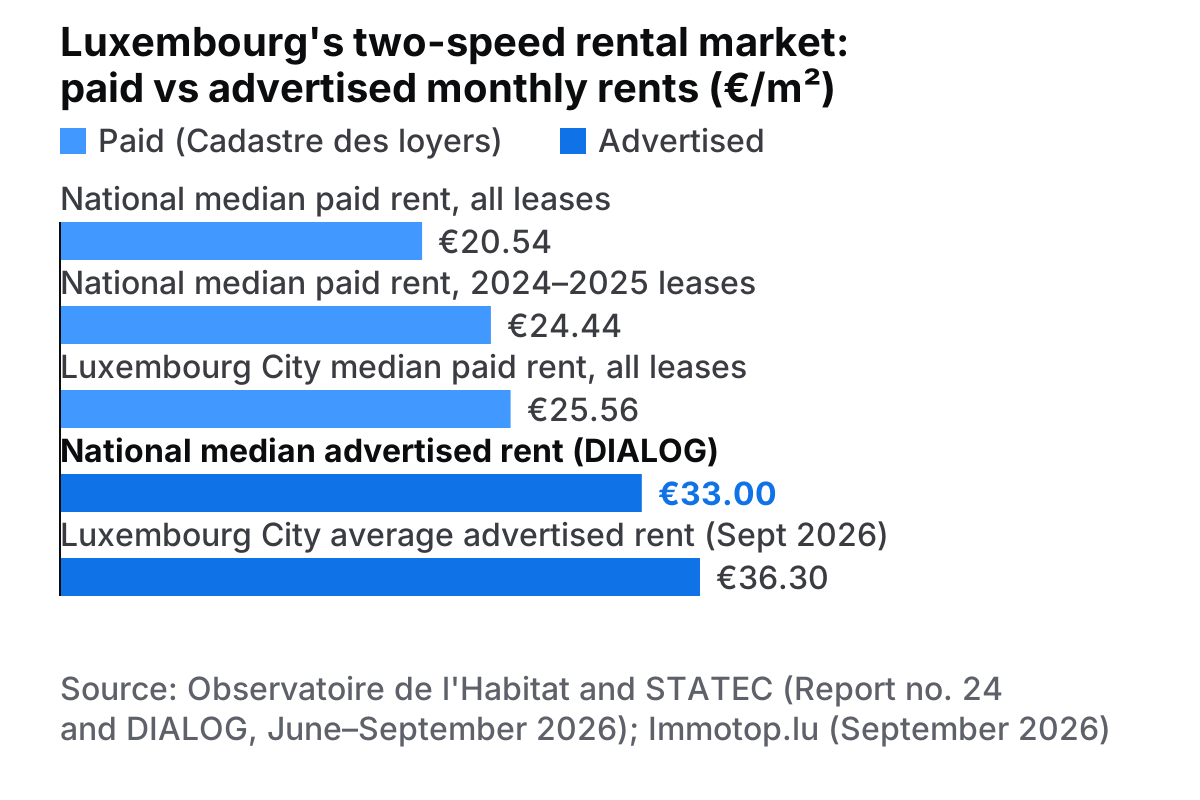
Data from the Observatoire de l’Habitat rental market report highlights a structural divergence between sitting-tenant lease rates and fresh market listings. According to the national rent register (Cadastre des loyers), the median actual rent paid across all existing contracts was €20.54/m² nationwide and €25.56/m² in Luxembourg City. Conversely, median advertised rents on listing portals reached €33.00/m² nationally and over €36/m² in the capital.
Under the consolidated Tenancy Law of 23 July 2024 (in force since 1 August 2024), key landlord-tenant parameters are strictly regulated:
- Rent Ceiling: Annual rent remains capped at 5% of the revalued, discounted capital invested in the residential unit.
- Adjustment Frequency: Rent increases can occur no more than once every two years, with increments capped at a maximum of 10% per adjustment.
- Tenant Deposits: Security deposits are legally limited to a maximum of two months’ rent.
- Agency Fees: Estate agency brokerage fees must be divided equally (50/50) between the landlord and the tenant.
Short-Term Tourist Letting Restrictions (Airbnb)
Since 1 September 2023, property owners who let accommodation for a cumulative total of 90 nights or more per calendar year across their property portfolio are classified as commercial accommodation operators. Achieving compliance requires obtaining an official business permit (autorisation d’établissement) and completing mandatory training within six months. Furthermore, in municipal residential primary zones (zone d’habitation 1), short-term tourist lets are strictly capped at 89 days per year. Local administrative filings and guest registration forms apply from the first night of rental activity.
How to Analyse the Luxembourg Market with CASAFARI
Given the absence of a vertical cadastre for individual houses and significant variance between portal asking figures and registered notary prices, property professionals operating in Luxembourg require clean, consolidated market intelligence.
Tools such as CASAFARI Area Insights aggregate and deduplicate listings across portals and estate agency websites throughout Luxembourg. By tracking price histories, market duration, and inventory shifts, professionals can analyze urban trends with district-level precision. Understanding why hyper-localised data matters in real estate is essential when assessing high-value European markets.
Furthermore, institutional investors and estate agents rely on the property valuation and market study tool to benchmark existing flats against new off-plan developments, providing transparent valuation assessments to international buyers. Professionals searching for stock across multiple channels can also leverage Property Sourcing across all portals to identify deduplicated opportunities instantly.
To explore market analytics or integrate real estate intelligence into your workflow, you can sign in to the CASAFARI platform or inspect the technical parameters in the Area Insights API documentation.
Frequently asked questions
Can foreigners and non-residents buy property in Luxembourg?
Yes, Luxembourg imposes no nationality or residency restrictions on purchasing freehold residential or commercial real estate. However, property ownership does not confer automatic residence rights or visa privileges, as real estate is explicitly excluded from investor residence permit schemes. To qualify for the Bëllegen Akt tax credit or state homeownership grants, non-EU buyers must hold a valid residence permit for longer than three months, register at their local commune, and occupy the property as their primary residence.
What are the property purchase taxes and Bëllegen Akt allowances in Luxembourg?
Standard property transfer taxes in Luxembourg total 7% of the total transaction value, consisting of a 6% registration duty and a 1% transcription duty. Private buyers acquiring a primary home to live in for at least two years receive a tax credit called the Bëllegen Akt of up to €40,000 per person (€80,000 for a couple purchasing jointly), subject to a minimum statutory duty payable of €100. In July 2026, under the ‘Booster fir de Wunnengsbau’ legislative package, the government announced a planned increase of this allowance to €45,000 per individual buyer.
How does the Luxembourg rent cap and tenancy law work for landlords?
Under the reformed Tenancy Law of 23 July 2024 (in force since 1 August 2024), maximum annual rental income is capped at 5% of the revalued, discounted capital invested in the property. Landlords may only review rent once every two years, with any upward adjustment capped at a maximum increase of 10%. Additionally, tenant security deposits are restricted to two months’ rent, written lease contracts are mandatory, and estate agency commission fees must be split equally (50/50) between the landlord and tenant.
What are the rules for short-term Airbnb rentals in Luxembourg?
Since 1 September 2023, individuals who lease tourist accommodation for a cumulative total of 90 nights or more per calendar year across all held units are classified as commercial hospitality operators. These operators must secure a formal business permit (autorisation d’établissement) and complete required professional training within six months. Furthermore, in designated residential zones (zone d’habitation 1), short-term letting is capped at 89 nights per calendar year, with mandatory municipal declarations and guest registration forms required from the first night.