
BRAGANÇA PROPERTY GUIDE
A quiet way of life tucked away in the Portuguese interior
Bragança district, situated in Portugal’s far north-eastern Trás-os-Montes region along the Spanish border, comprises 12 municipalities and recorded 122,804 residents in the 2021 census. As mainland Portugal’s quietest property market, it offers accessible entry prices, two grand natural parks, and low tourist density, making it ideally suited to patient second-home buyers, country lifestyle seekers, and long-term investors value-sourcing rural real estate.
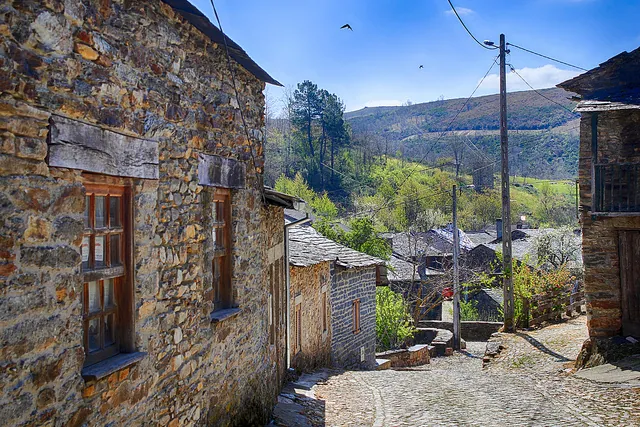
In a granite village tucked into the foothills of Montesinho, a traditional stone house stands with wooden shutters drawn, largely untouched since its owners moved west decades ago. This scenario represents a typical rural listing in Bragança district. It illustrates both the opportunity for quiet restoration and the realities of a market where transaction volumes are low.
Get to know Bragança district
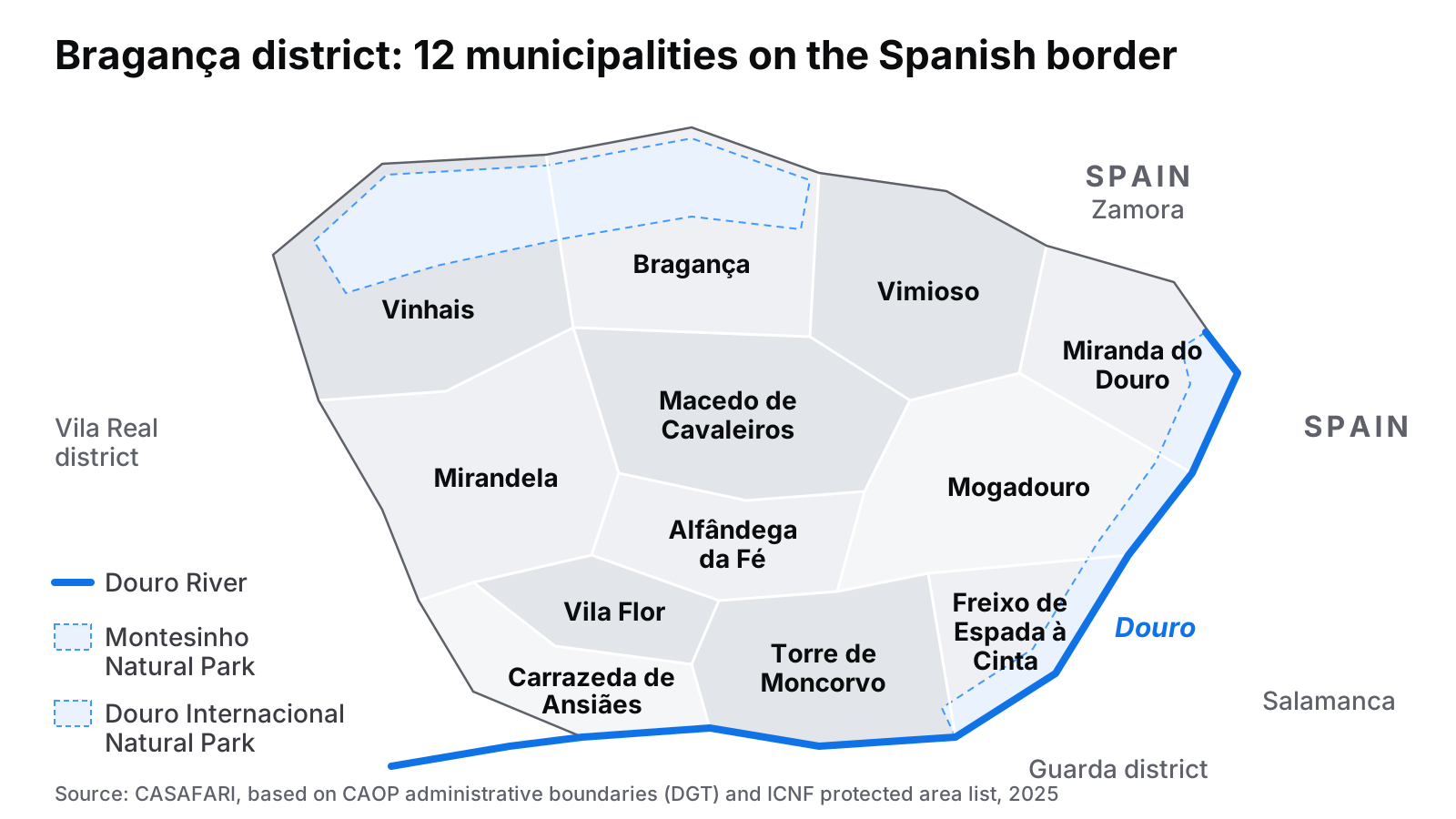
Bragança district forms the north-eastern corner of Portugal in the historical Trás-os-Montes region, bordered by Spain on its northern and eastern flanks. It consists of 12 municipalities: Alfândega da Fé, Bragança, Carrazeda de Ansiães, Freixo de Espada à Cinta, Macedo de Cavaleiros, Miranda do Douro, Mirandela, Mogadouro, Torre de Moncorvo, Vila Flor, Vimioso, and Vinhais.
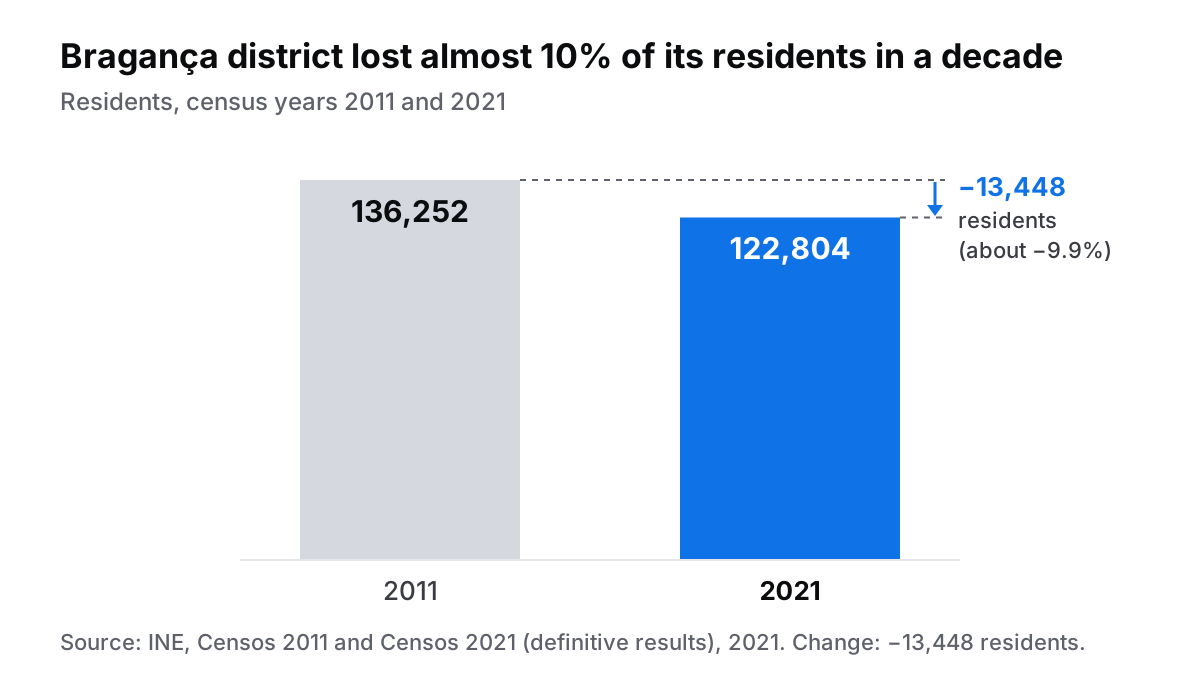
Demographic context is critical when evaluating real estate here. According to INE Censos 2021 population figures for Bragança district, the district held 122,804 residents in 2021. Between the 2011 and 2021 censuses, the district lost 13,448 residents (a decline of roughly 9.9%), with all 12 municipalities registering a population reduction. This structural trend shapes a thin property market characterized by slow resale timelines, aging homeownership, and a substantial supply of inherited stone village houses.
Bragança city serves as the district capital and primary commercial center, housing civic institutions and higher educational facilities. Elsewhere, Miranda do Douro sits along the dramatic Douro gorge, where the co-official Mirandese language is preserved, while Mirandela acts as an agricultural hub along the Tua River. Housing stock ranges from schist and granite village dwellings requiring extensive structural modernisations to urban apartments in Bragança and Mirandela.
Buyers in the region primarily include returning Portuguese emigrants, second-home purchasers from Porto or neighboring Spanish provinces, and a small international cohort seeking solitude. Student enrollment at local polytechnic institutions also maintains a modest, steady rental market for urban apartments in Bragança city.
What has changed for buyers in Bragança district
Investors reviewing older guides should note key regulatory changes that affect cross-border buyers in Portugal:
- Golden Visa (ARI) changes: Under Law 56/2023 (Mais Habitação), in force since October 2023, purchasing real estate no longer qualifies for Portugal’s Golden Visa program anywhere in the country. The former inland low-density incentives that previously favoured rural districts like Bragança have been repealed. Detailed background is provided in this analysis on what Law 56/2023 changed for the Golden Visa.
- Tax regimes: The original Non-Habitual Resident (NHR) tax framework closed to new applicants at the end of 2023. Prospective buyers should consult a qualified tax advisor to understand current residency incentives before making purchase decisions.
- Local lodging (Alojamento Local): Short-term holiday rentals remain permitted, but regulation is overseen directly by municipal authorities (câmaras municipais). Investors planning to operate short lets should confirm local registration policies with the target municipality prior to purchase.
- Transaction costs: Standard property acquisition taxes apply, including IMT (Municipal Property Transfer Tax), Stamp Duty, and notary registration fees, as detailed in our guide to buying property in Portugal.
In and around Bragança district
Unlike the mild coastal regions of Portugal, Bragança experiences a continental climate characterized by hot, dry summers and cold winters with frequent frost and occasional snowfall in high-altitude zones.
Environmental protection covers large portions of the district, defining local planning rules and landscape preservation:
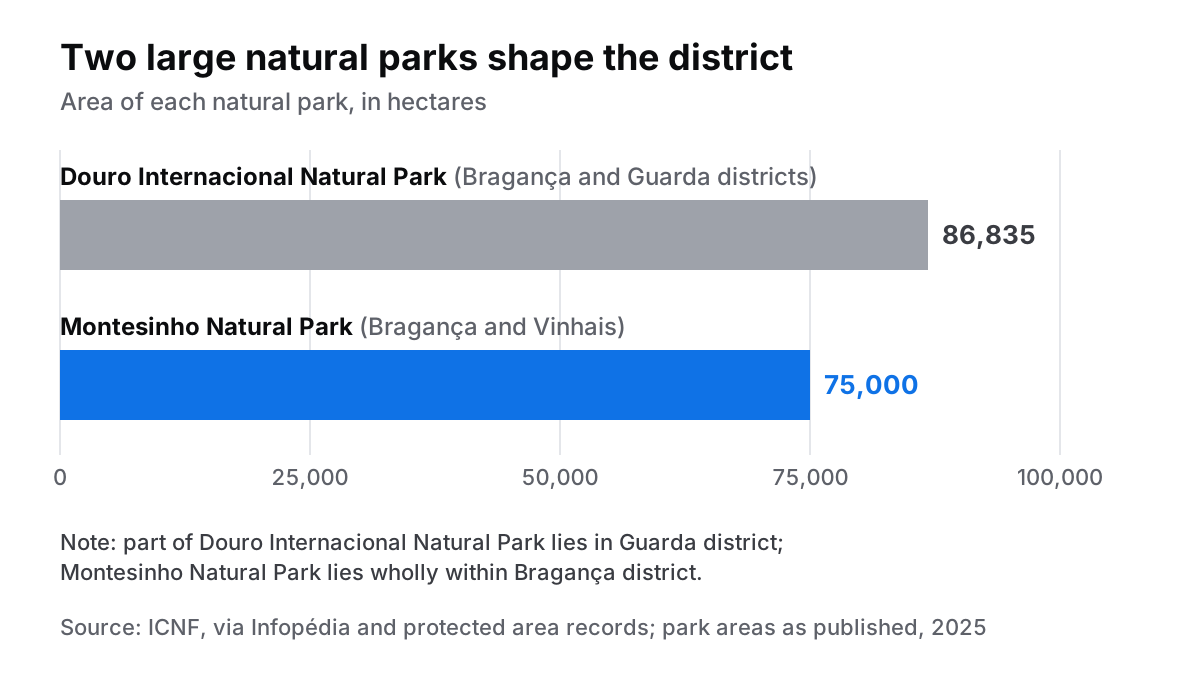
- Montesinho Natural Park: Established on 30 August 1979 (Decreto-Lei 355/79), this park covers approximately 75,000 hectares entirely within the municipalities of Bragança and Vinhais. According to official records for Montesinho Natural Park, it adjoins the Spanish Sierra de la Culebra but lies fully within Portuguese territory.
- Douro Internacional Natural Park: Created in 1998, this park spans roughly 86,835 hectares along the rugged Douro River gorge across Bragança and Guarda districts. As noted in documentation for Douro Internacional Natural Park, the Portuguese park lies opposite Spain’s Arribes del Duero Natural Park.
Road transport centers on the A4 motorway, connecting Bragança westwards to Vila Real and Porto. Regional air travel is available through Sevenair’s Bragança–Portimão regional service, a scheduled public-service flight linking Bragança to Vila Real, Viseu, Cascais, and Portimão. The nearest major international passenger airport is in Porto, while cross-border road trips connect residents to Spanish destinations such as Zamora and Salamanca.
How to research the Bragança market with CASAFARI
Because transaction volume in inland border regions is low, relying solely on asking prices can lead to inaccurate valuations. Accessing real-time market analytics ensures buyers and professionals make informed decisions.
- Analyze municipal trends: Use Area Insights for price distribution and time on market by municipality to evaluate local stock dynamics and supply velocity across all 12 municipalities.
- Verify transactional baseline: Perform a valuation and market study with real comparables to benchmark listing prices against realistic sales values. Learn where to see comparables with real closing prices in our knowledge base.
- Source rural stock efficiently: Real estate professionals sourcing scattered village listings can utilize Property Sourcing across Portuguese portals to aggregate private and broker listings in one interface.
- Review investment fundamentals: Understand broader market drivers by reading about why investors look at Portugal.
Developers and analytics teams can integrate regional market metrics directly via the Area Insights API documentation (in English) and Comparables and valuation documentation (in English).
To start analyzing listings, pricing data, and market metrics across Bragança district, visit the CASAFARI platform.
Frequently asked questions
Is Bragança a good place to buy property in Portugal?
Bragança is well suited to buyers seeking an affordable, quiet rural home or retirement property near natural parks with minimal tourist congestion. However, buyers expecting rapid capital appreciation or quick liquidity should proceed cautiously. The district lost nearly 10% of its population between 2011 and 2021 according to INE census data, meaning resales can take longer than in major coastal cities.
How do you get to Bragança from Porto or Lisbon?
From Porto, Bragança is reached by road via the A4 motorway. From Lisbon and the south, regional air travel is available through Sevenair’s scheduled public-service route connecting Bragança with Cascais, Viseu, Vila Real, and Portimão. There is no active passenger rail connection directly to Bragança city.
Can I still get a Golden Visa by buying a house in Bragança district?
No. Under Law 56/2023 (Mais Habitação), effective since October 2023, real estate acquisitions no longer qualify for Portugal’s Golden Visa program anywhere in the country. The former inland low-density carve-out has been fully eliminated. Prospective residents must explore non-property residency options, such as D-series visas, or eligible investment fund routes.
Can I run a holiday let (Alojamento Local) in Bragança district?
Generally yes, as short-term rental registrations remain accessible in inland municipalities. However, operational conditions and registration rules are governed directly by each local municipal council (câmara municipal). Buyers should verify local planning policies and registration requirements with the destination municipality before concluding a property purchase.