Setúbal District
Spectacular beaches and natural parks south of Lisbon
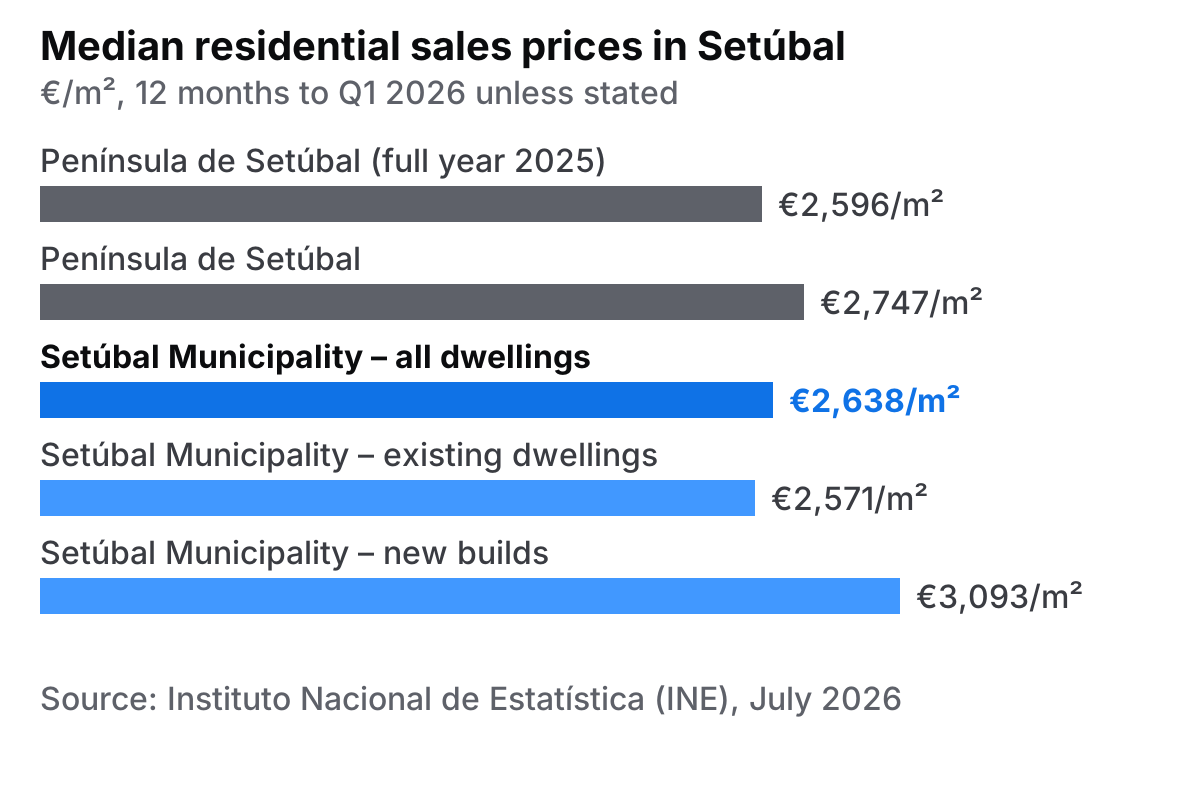
Located 40 kilometres south of Lisbon along the Sado River estuary, Setúbal District blends coastal living with straightforward connectivity to the capital. Home to 902,863 residents across the district (INE demographic statistics, 2023 estimate) and 141,266 in Setúbal Municipality (INE, 2025 estimate), the area offers a 49-to-58-minute Fertagus train commute into central Lisbon. In the 12 months to Q1 2026, median residential sales transaction prices reached €2,638/m² in Setúbal Municipality according to INE housing market data, presenting an appealing alternative to Greater Lisbon’s urban core.
Why are buyers and investors looking south of the Tagus to Setúbal District?
As property valuations across Greater Lisbon escalated, relocating families, lifestyle buyers, and yield-focused real estate investors increasingly turned their attention across the 25 de Abril Bridge to the Península de Setúbal. The region delivers a distinct quality of life defined by Atlantic beaches, nature reserves, and historic maritime towns, while maintaining direct transport links to Lisbon.
Official transaction statistics published by the Instituto Nacional de Estatística (INE) reflect this steady demand. Across the Península de Setúbal sub-region, the median completed sales price for residential property reached €2,747/m² in the 12 months ending Q1 2026 (up from €2,596/m² across full-year 2025). Within Setúbal Municipality itself, overall median transaction prices stood at €2,638/m² over the same 12-month window. Market segment dynamics show a clear tiering: existing dwellings transacted at a median of €2,571/m², whereas new build developments reached €3,093/m² in Q1 2026.
For property professionals and private buyers evaluating investment options, understanding price variations at the parish level is essential. Evaluating market conditions between historic city parishes, coastal stretches, and rural countryside requires granular real-time tracking. Real estate professionals frequently rely on CASAFARI Area Insights to monitor micro-market supply, days on market, and pricing dynamics across specific zip codes, while utilizing property valuation and market study tooling to benchmark asking valuations against historical sales transaction benchmarks.
Where does the Serra da Arrábida meet Setúbal’s maritime heritage?
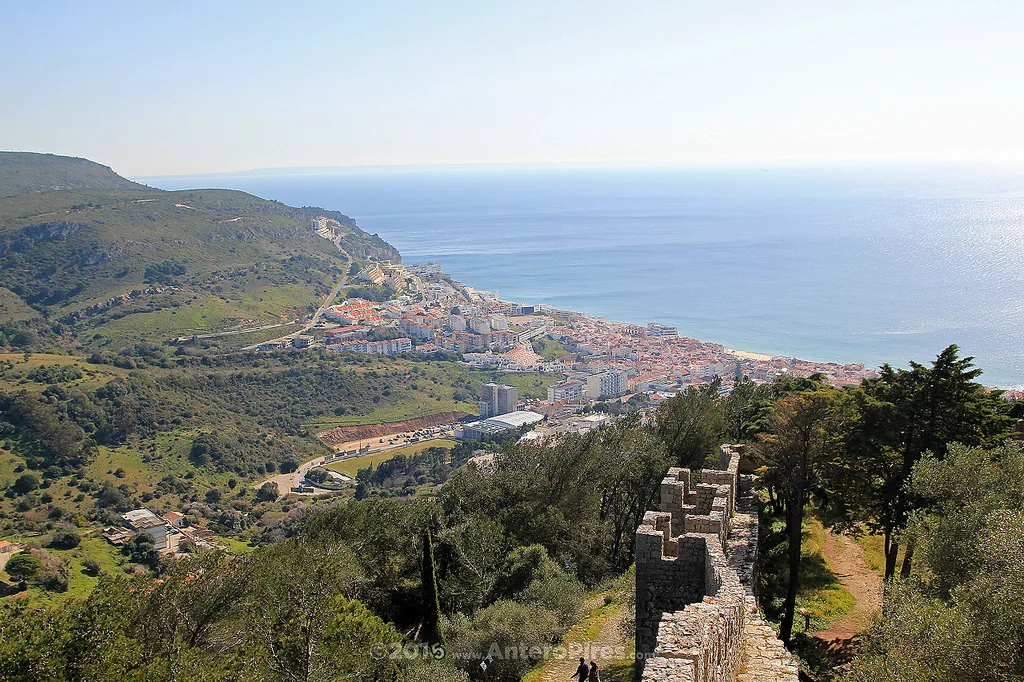
The geographical identity of Setúbal District is framed by two dramatic natural features: the sheltered Sado River estuary to the east and the limestone cliffs of the Parque Natural da Arrábida to the west. The Sado estuary, recognized for its resident pod of wild bottlenose dolphins and traditional oyster farming, lends Setúbal its deep-rooted seafaring legacy. The fishing harbor remains an active economic engine, feeding a renowned culinary culture centered around traditional marisqueiras and regional specialties such as choco frito (fried cuttlefish) and flame-grilled sardines.
Dining establishments in the municipality range from waterfront taverns to established regional destinations. For example, local seafood house Pérola da Mourisca, situated at Rua Baía do Sado, n.º 9 in the parish of Gâmbia-Pontes-Alto da Guerra, remains a classic culinary stop for authentic estuary seafood (open Wednesday to Monday).
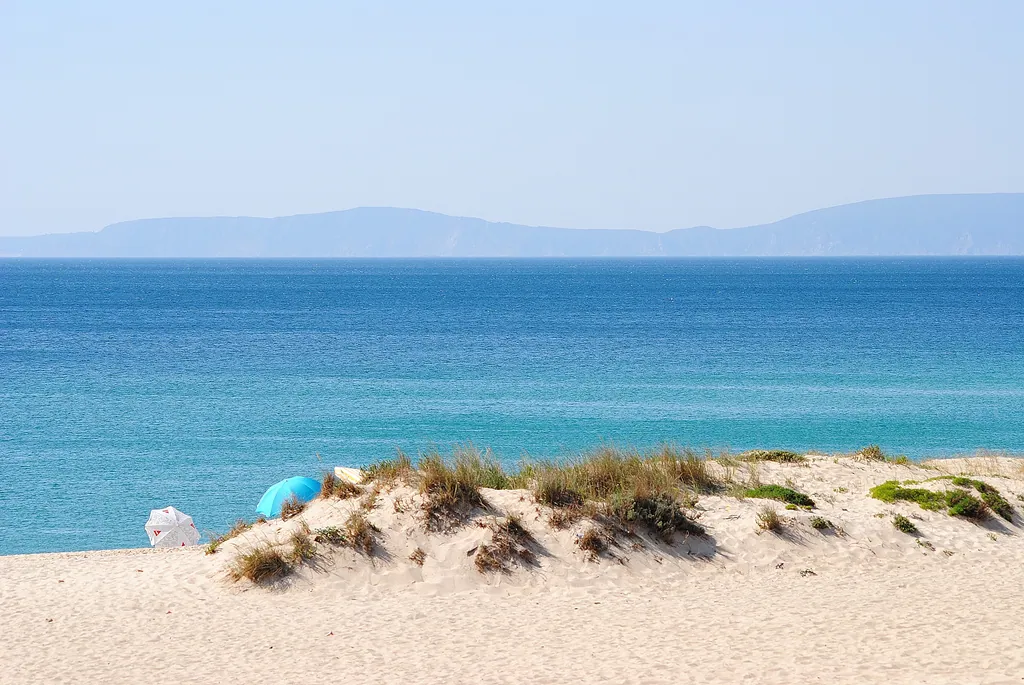
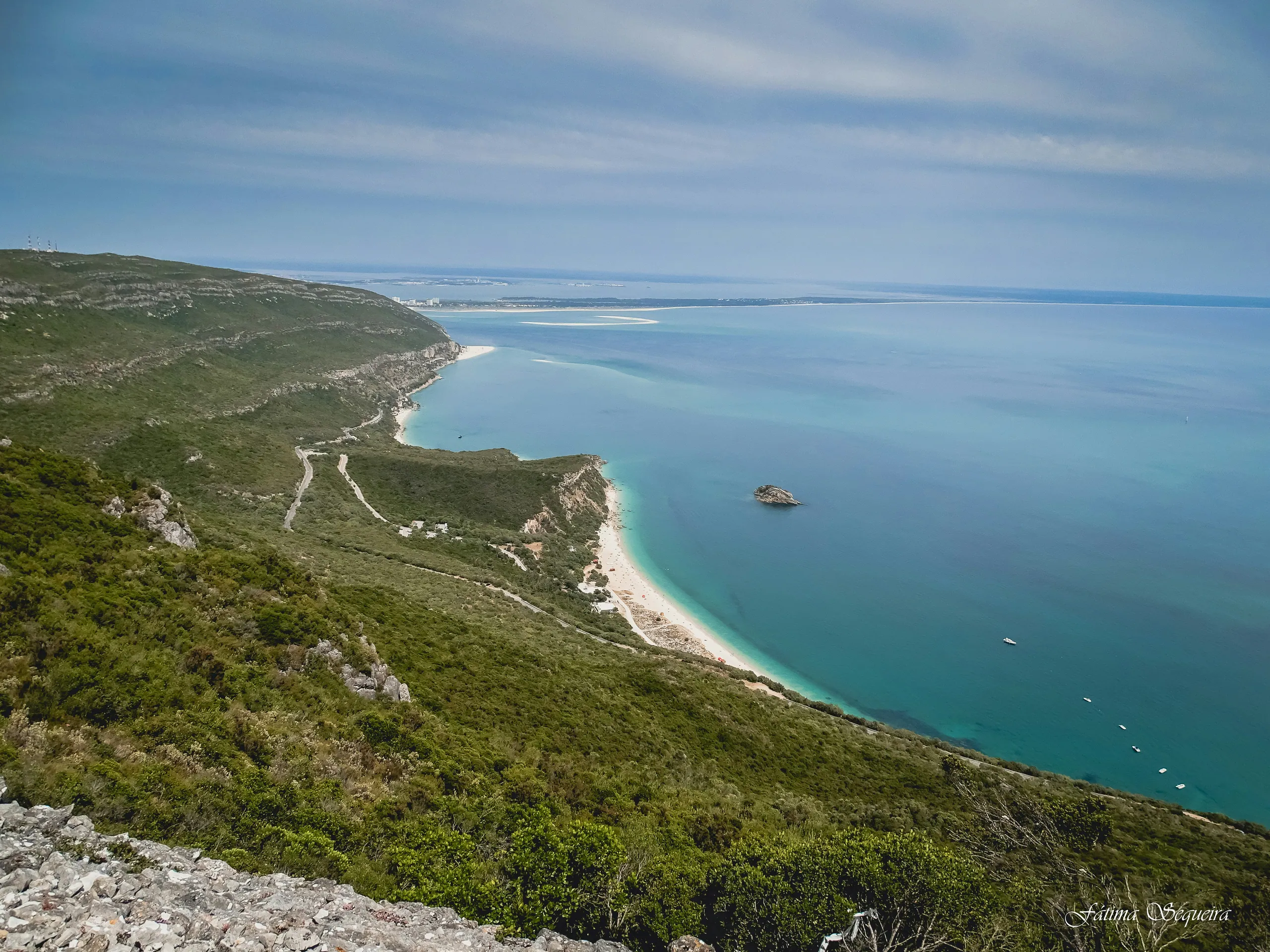
Directly west of the city, the Serra da Arrábida provides a protected sanctuary where Mediterranean forest meets turquoise water. Nestled beneath steep pine-covered slopes lies Praia dos Galapinhos, which earned international acclaim when voted ‘Best Beach in Europe’ by European Best Destinations. Access to these sheltered coves is carefully managed to protect the national park’s biodiversity, rewarding residents with pristine coastal scenery less than a 20-minute drive from Setúbal’s historic city centre. Buyers exploring adjacent coastal living options may also wish to read our Sesimbra area spotlight for comparison.
How does the commute from Setúbal to Lisbon work, and what are the schooling options?
A central advantage of living in Setúbal District is its direct, high-capacity rail linkage to central Lisbon via the Fertagus train network. The double-decker commuter line spans 14 stations, connecting 10 south-bank communities—including Setúbal, Palmela, Pinhal Novo, and Pragal—directly across the 25 de Abril Bridge into Lisbon.
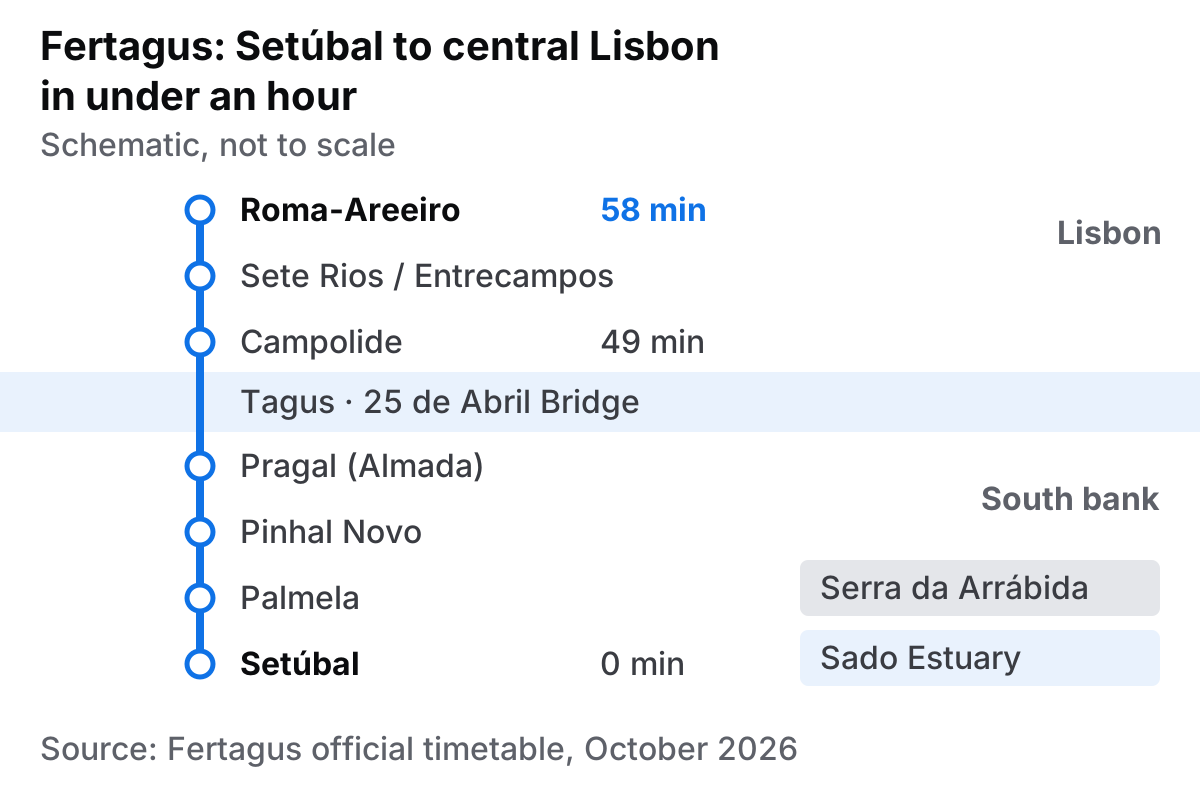
According to the official Fertagus Setúbal–Lisbon train timetable, the journey from Setúbal terminus to Lisbon Campolide takes 49 minutes, reaching Lisbon Roma-Areeiro in 58 minutes. Intermediate stops such as Sete Rios and Entrecampos provide direct interchanges to Lisbon’s Metro network and CP long-distance rail lines, making daily commuting highly feasible for professionals working in the capital.
For international families relocating to the area, educational infrastructure is anchored in the neighboring municipality of Palmela:
- St. Peter’s International School: Located in Palmela (part of the Inspired Education group), this co-educational school educates pupils aged 4 months to 18 years. It offers bilingual early childhood education and dual secondary tracks following either the Portuguese National Curriculum or Cambridge IGCSE and the International Baccalaureate (IB) Diploma Programme.
- International School of Palmela: Situated in Quinta do Anjo, this school caters to students aged 5 to 18, delivering a British Curriculum alongside dual-language instruction in English and Portuguese.
Additionally, families requiring access to American, French, or German educational curricula can easily reach Greater Lisbon’s extensive selection of international institutions via the A2 motorway or Fertagus rail line.
What are the tax, residency and short-let rules for buying in Setúbal in 2026?
Navigating real estate acquisition in Portugal requires a clear understanding of current tax frameworks and municipal property regulations. Overseas buyers should note several important policy updates in effect for 2026.
Residency and Income Tax: The IFICI Regime
The classic Non-Habitual Resident (NHR) framework closed to new applicants at the end of 2023 (with final transitional filings concluding in March 2025). It has been succeeded by the Tax Incentive for Scientific Research and Innovation (IFICI, frequently referenced as ‘NHR 2.0’), regulated under Portaria n.º 352/2024/1 under Article 58.º-A of the Estatuto dos Benefícios Fiscais. Eligible individuals becoming Portuguese tax residents—who were not taxed in Portugal during the preceding five years—can secure a 20% flat IRS tax rate on qualifying professional and self-employment income from high-value, scientific, or technological activities. In addition, eligible foreign-sourced income (excluding foreign pensions) benefits from an exemption for a 10-year duration.
Acquisition Taxes: IMT and Stamp Duty
When purchasing residential property in Mainland Portugal, real estate transfer taxes apply based on updated 2026 tax brackets issued by the Portal das Finanças:
- Stamp Duty (Imposto do Selo): A flat 0.8% tax applied to the purchase price or rateable value.
- Property Transfer Tax (IMT): For primary permanent residences (HPP), properties are exempt from IMT up to €106,346. Above this threshold, progressive rates apply (2% up to €145,470; 5% up to €198,347; 7% up to €330,539; 8% up to €660,982; 6% flat between €660,982 and €1,150,853; and 7.5% above €1,150,853).
- IMT Jovem: Buyers aged 35 or under purchasing their first primary residence benefit from a full exemption from both IMT and Stamp Duty up to €330,539, with partial relief on property values up to €660,982.
For a broader step-by-step overview of legal steps and conveyancing, review our detailed guide to buying property in Portugal.
Short-Term Rental Regulations (Alojamento Local)
For buy-to-let investors reviewing short-term rental opportunities, Decree-Law n.º 76/2024 restored municipal flexibility across Portugal. The former nationwide ban on new licences, mandatory five-year expiry terms, and the CEAL extraordinary tax were repealed. Local municipal councils now hold exclusive powers to establish containment zones or sustainable growth areas within their boundaries. Furthermore, short-term rental licences can once again be transferred upon the sale of a property, subject to local municipal bylaws.
Whether you are sourcing investment opportunities or advising relocating clients, CASAFARI Property Sourcing provides complete market visibility across all active property listings in Setúbal District. To explore live inventory and perform detailed transaction analysis, sign in to the CASAFARI platform.
Frequently asked questions
How long does it take to commute from Setúbal to Lisbon by train?
The Fertagus commuter train takes 49 minutes from Setúbal station to Lisbon Campolide and 58 minutes to Lisbon Roma-Areeiro, as per official timetable data from Fertagus in October 2026. The route serves 10 south-bank stations, including Palmela, Pinhal Novo and Pragal, before crossing the 25 de Abril Bridge into four central Lisbon transit hubs. Trains run frequently throughout the day, providing direct, reliable access to the capital’s central business districts.
Is the Non-Habitual Resident (NHR) tax regime still available when moving to Setúbal?
The classic Non-Habitual Resident (NHR) regime was repealed at the end of 2023, with final transitional applications closing on 31 March 2025. It has been replaced by the Tax Incentive for Scientific Research and Innovation (IFICI, or ‘NHR 2.0’), regulated by Portaria n.º 352/2024/1. Under IFICI, eligible new tax residents receive a 20% flat IRS rate on qualifying high-value Portuguese professional income and benefit from a 10-year exemption on most foreign-sourced non-pension income.
Can property buyers obtain an Alojamento Local (AL) short-let licence in Setúbal?
Yes, subject to local municipal regulations. Decree-Law n.º 76/2024, in force since 1 November 2024, repealed the national suspension on new short-term rental registrations, eliminated the 5-year mandatory renewal and the CEAL extraordinary tax, and restored licence transferability upon property sale. Local municipal councils now hold full authority to designate containment or sustainable growth zones within their boundaries.
Which international schools are located in the Setúbal district?
The primary international educational institutions in the district are located in the neighboring municipality of Palmela. St. Peter’s International School serves pupils aged 4 months to 18 years, offering both the Portuguese National Curriculum and Cambridge IGCSE alongside the IB Diploma Programme. Nearby in Quinta do Anjo, the International School of Palmela caters to students aged 5 to 18 with a British Curriculum delivered in English and Portuguese.