
TRÓIA PROPERTY GUIDE
The Tróia Peninsula is a 25-kilometre sandy spit in the parish of Carvalhal, within the municipality of Grândola. Situated just a 15-to-25-minute ferry crossing from Setúbal—roughly one hour total from Lisbon—Tróia offers a distinct coastal micro-market. According to Instituto Nacional de Estatística (INE) data from Q2 2026, median new residential lease rents in Grândola reached €11.13/m², supported by low municipal property taxes with IMI fixed at 0.30%.
Why are buyers and investors drawn to the Tróia Peninsula?
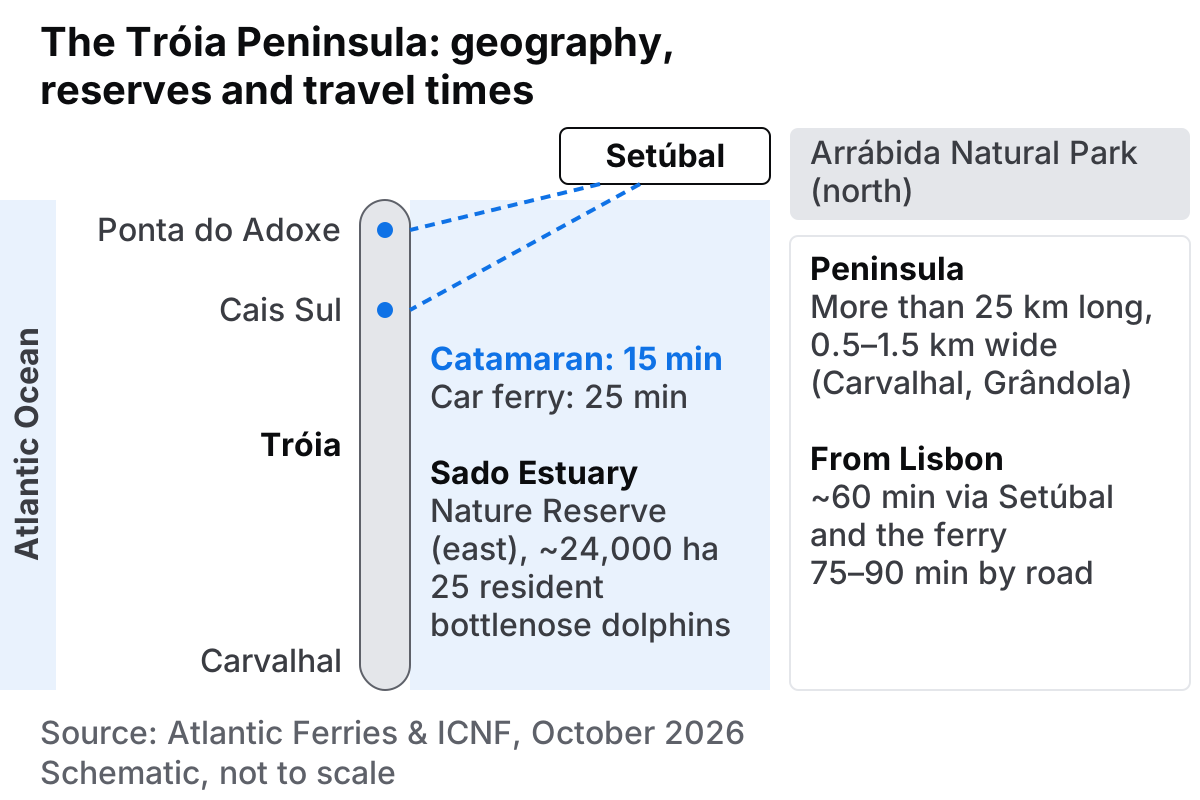
Extending over 25 kilometres in length and ranging between 0.5 and 1.5 kilometres in width, the Tróia Peninsula is a unique geographic formation—a narrow sandspit (restinga) located in the parish of Carvalhal, inside the municipality of Grândola. Flanked by the Atlantic Ocean to the west and the Sado Estuary Nature Reserve to the east, the peninsula looks directly north across the river mouth toward the Serra da Arrábida. The Sado Estuary itself encompasses nearly 24,000 hectares of protected wetland, hosting a celebrated resident population of 25 bottlenose dolphins (Tursiops truncatus) as recorded by the Instituto da Conservação da Natureza e das Florestas (ICNF) in October 2026.
Accessibility remains one of Tróia’s strongest features for international buyers and Lisbon residents alike. Crossing from Setúbal via Atlantic Ferries takes 15 minutes on the passenger catamaran to Ponta do Adoxe, or 25 minutes on the car ferry to Cais Sul. When travelling from central Lisbon across the 25 de Abril Bridge, the combined drive and ferry connection takes approximately one hour in total. Alternatively, a complete road journey via Alcácer do Sal and Comporta requires between 1 hour 15 minutes and 1 hour 30 minutes.
For prospective investors and estate agents evaluating local supply, accessing detailed pricing models across Carvalhal, Comporta and Setúbal is vital. Professionals rely on CASAFARI Area Insights to monitor hyper-local inventory dynamics, pricing trends, and comparative valuations across the region. If you are building automated analytical tools, review the Area Insights API documentation for developer specifications.
What types of property and resorts make up the Tróia market?
The built environment on the Tróia Peninsula comprises discrete master-planned communities and high-end residential developments. Key anchor sites include Troia Resort, the 100-hectare Pestana Tróia Eco-Resort & Residences—which features over 180 low-impact sustainable villas built in harmony with coastal pinewoods—and the iconic Tróia Design Hotel overlooking the marina.
The market experienced significant institutional investment and consolidation in 2026. Arrow Global completed the acquisition of the Tróia Design Hotel, while in July 2026, former Editory properties were rebranded under the Details hospitality management platform into three distinct destinations: The Pearl Troia, The Anchor Troia, and Troia Residences. This institutional capital further solidifies Tróia’s integration into the broader luxury corridor of the Costa da Comporta, alongside developments such as Terras da Comporta (comprising Dunas and Torre), Pinheirinho Comporta, Sublime Comporta, and Na Praia.
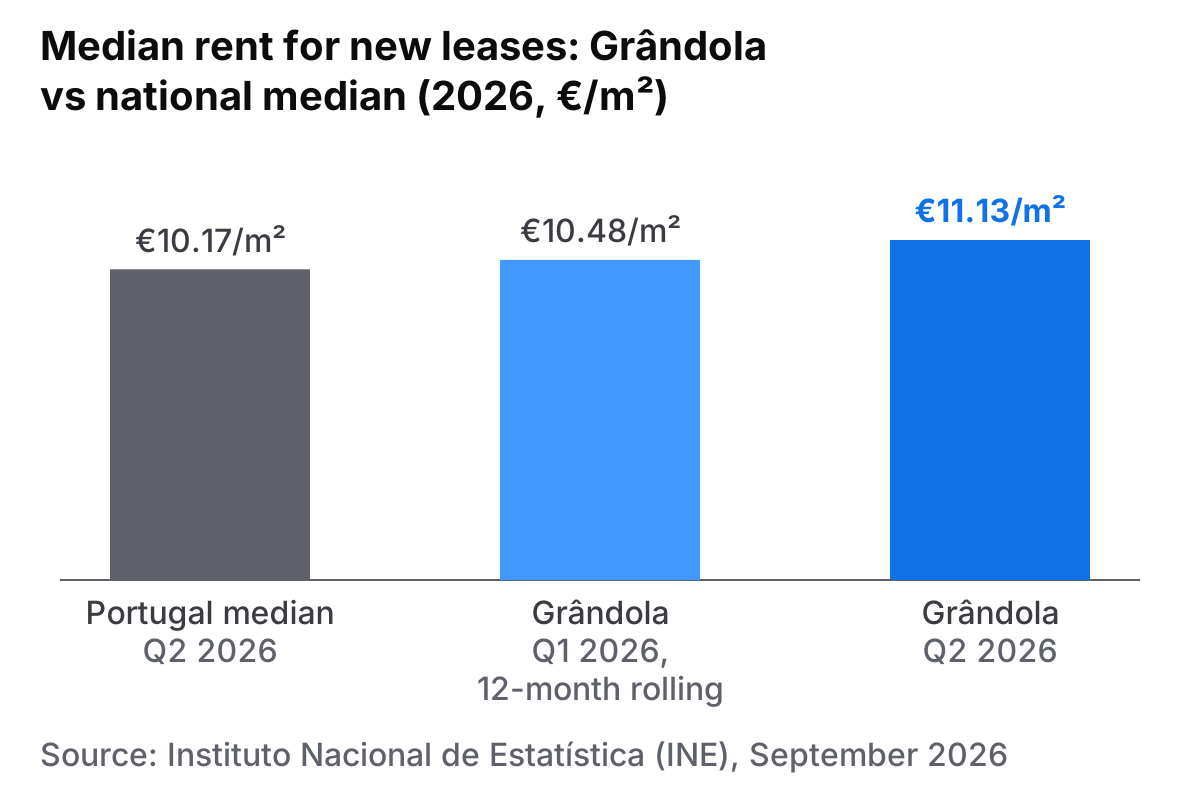
Strong underlying demand is reflected in municipal yield indicators. Data from the Instituto Nacional de Estatística (INE) shows that median rental values for new family housing leases in the municipality of Grândola rose from €10.48/m² in Q1 2026 to €11.13/m² in Q2 2026. This performance comfortably exceeds the national median of €10.17/m², confirming robust rental appetite for quality homes along this stretch of coast. Real estate professionals can leverage specialized property valuation and market study tools to benchmark individual luxury units against hyper-local yield curves.
What leisure and natural attractions define life in Tróia?
Lifestyle in Tróia is shaped by a balance of high-end leisure infrastructure and strictly preserved natural reserves. The Tróia Marina provides full nautical services, complemented by fine dining and the Tróia Casino. Immediately adjacent lie the delicate coastal ecosystems of the Tróia Dunes Botanical Reserve and the expansive Sado Estuary Nature Reserve, a designated Ramsar site of international importance for migratory waterbirds.
Golf enthusiasts should note recent developments surrounding Tróia Golf. Designed by renowned architect Robert Trent Jones Senior and opened in 1980, the course was ranked 4th in Portugal in the 2025/2026 Top 100 Golf Courses rankings. In 2026, the course entered an ownership and management transition period during which play was temporarily closed. Once reopened following restructuring, it remains one of Europe’s most challenging championship link layouts.
Beyond the fairway, nature observation is a daily attraction. The ICNF census of October 2026 confirmed 25 resident bottlenose dolphins in the estuary following the birth of three calves during the summer, offering rare wildlife experiences right off the peninsula’s shore. To compare coastal lifestyle hubs across the river, read our spotlight on Sesimbra and the Arrábida coast across the Sado.
What are the tax, short-let and residency rules in Tróia for 2026?
Understanding local fiscal and legal frameworks is critical prior to acquiring real estate in Portugal. Here is how key regulations apply to Tróia property purchases in 2026:
- Short-Term Rentals (Alojamento Local): Under Decreto-Lei n.º 76/2024, Portugal repealed the national suspension on coastal short-let licences and eliminated prior condominium veto powers, returning regulatory authority to individual municipal councils. As of May 2026, the parish of Carvalhal (which encompasses Tróia) represents 58% of all active Alojamento Local (AL) registrations in the municipality of Grândola.
- Acquisition Taxes (IMT and Stamp Duty): Stamp Duty (Imposto do Selo) is fixed at 0.8% of the purchase price on property deeds. Effective 25 May 2026, non-tax-resident buyers face a flat Property Transfer Tax (IMT) rate of 7.5%. For tax residents buying a primary residence, IMT exemptions apply up to €106,346 (or up to €330,539 for buyers aged 35 or under via IMT Jovem), with progressive rates up to 8%. Tax residents purchasing a secondary residence pay IMT starting from 1%, reaching a flat 6% between €660,982 and €1,150,853, and 7.5% above €1,150,853.
- Annual Property Tax (IMI): The municipality of Grândola maintains the legal minimum municipal property tax rate of 0.30% for urban properties, calculated against the asset’s registered tax value (Valor Patrimonial Tributário or VPT).
- Residency and Golden Visa (ARI): Direct real estate acquisitions have been ineligible for the Golden Visa since October 2023. Non-EU investors seeking Portuguese residency must select eligible capital transfer options, such as a minimum €500,000 investment in CMVM-regulated funds excluding direct real estate assets. Furthermore, under Lei Orgânica n.º 1/2026 (in force since 19 May 2026), the period required for naturalisation citizenship expanded to 10 years for non-EU/CPLP citizens (7 years for EU/CPLP), while permanent residency remains attainable after 5 years.
To search comprehensively across fragmented resort inventory and off-market listings, brokers use Property Sourcing across every portal. For broader details on cross-border legal structures, refer to our complete guide to buying property in Portugal.
Summary
The Tróia Peninsula offers an exceptional coastal environment supported by strong institutional resort investments, efficient transport links to Lisbon, and favorable municipal IMI tax rates in Grândola. Whether you are searching for a personal retreat in Pestana Eco-Resort or evaluating rental yield potential in Carvalhal, accurate real-time data is essential. You can sign in to CASAFARI to explore live market data in Tróia and Grândola and make confident, data-driven real estate decisions.
Frequently asked questions
How long does it take to travel from Lisbon to the Tróia Peninsula?
Travelling from central Lisbon to Tróia takes approximately 1 hour when driving to Setúbal via the 25 de Abril Bridge and taking the Atlantic Ferries crossing. The ferry option takes 15 minutes by passenger catamaran to Ponta do Adoxe or 25 minutes by car ferry to Cais Sul. Alternatively, driving the entire distance by road via Alcácer do Sal and Comporta takes between 1 hour 15 minutes and 1 hour 30 minutes.
What property taxes apply when buying a home in Tróia in 2026?
Buyers pay Stamp Duty (Imposto do Selo) at 0.8% of the purchase price alongside Property Transfer Tax (IMT). Since 25 May 2026, buyers who are non-tax residents in Portugal pay a flat IMT rate of 7.5%, whereas tax residents buying a secondary home pay progressive rates starting at 1% up to 7.5%. Annually, Grândola applies the legal minimum municipal property tax (IMI) rate of 0.30% on urban property tax valuations.
Can I obtain a short-term rental (Alojamento Local) licence in Tróia?
Yes, subject to municipal approval. Decreto-Lei n.º 76/2024 repealed the national suspension on coastal Alojamento Local (AL) licences and removed condominium prior veto powers, restoring regulatory authority to local municipal councils. As of May 2026, the parish of Carvalhal—which includes Tróia—accounts for 58% of all active short-let registrations in the municipality of Grândola.
Does buying property in Tróia qualify for the Portuguese Golden Visa?
No, direct real estate investments ceased to qualify for the Golden Visa (ARI) in October 2023. Non-EU investors can still obtain residency by investing a minimum of €500,000 in CMVM-regulated investment funds that do not hold direct real estate assets. Under Lei Orgânica n.º 1/2026, permanent residency remains obtainable after 5 years, while citizenship by naturalisation requires 10 years of legal residence for non-EU/CPLP nationals.