
COMPORTA PROPERTY GUIDE
Buying property in Comporta requires navigating two distinct municipalities across Setúbal district: Alcácer do Sal and Grândola. Across this 45 km stretch of white-sand coastline, strict Sado Estuary Nature Reserve planning laws cap residential density, driving 2026 asking prices to €5,039/m² in Alcácer do Sal and €5,520/m² in Grândola (reaching €14,286/m² in prime coastal luxury enclaves), while local closed sales medians reflect lower-priced inland housing stock.
Where is Comporta, and how is the property market divided between Alcácer do Sal and Grândola?
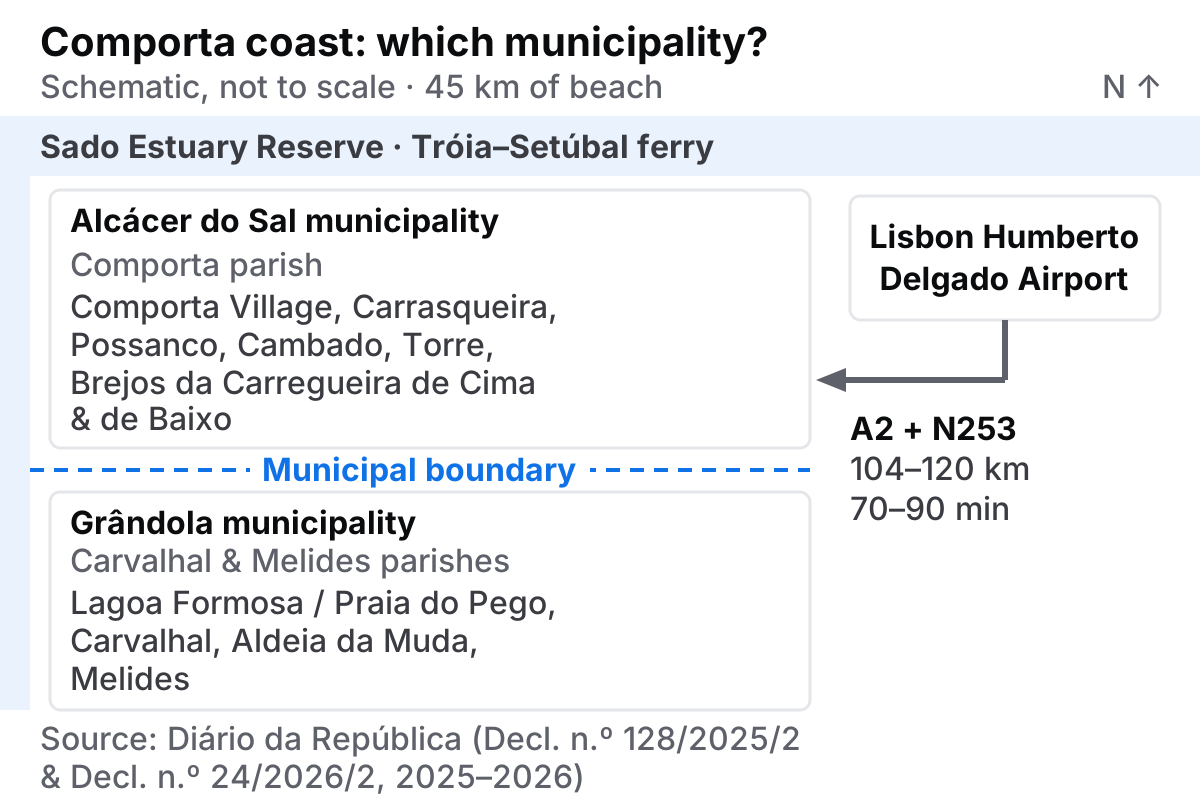
While international buyers and investors frequently refer to the entire coastal corridor south of the Tróia Peninsula as Comporta, the real estate market is split administratively across two municipalities in Setúbal district.
To the north, within the municipality of Alcácer do Sal, lies the official parish (freguesia) of Comporta. According to the Statistics Portugal (INE) 2021 Census data, the parish records a permanent population of 1,094 inhabitants. This northern sector encompasses Comporta village, Possanco, Carrasqueira, Cambado, Torre, Murta, and the hamlet of Brejos da Carregueira de Cima and de Baixo.
Directly to the south lies the municipality of Grândola, as detailed in the Município de Grândola PDM declaration (April 2026). Grândola governs the parish of Carvalhal—which includes Carvalhal village, Praia do Pego, and Aldeia da Muda—as well as Melides further down the coast.
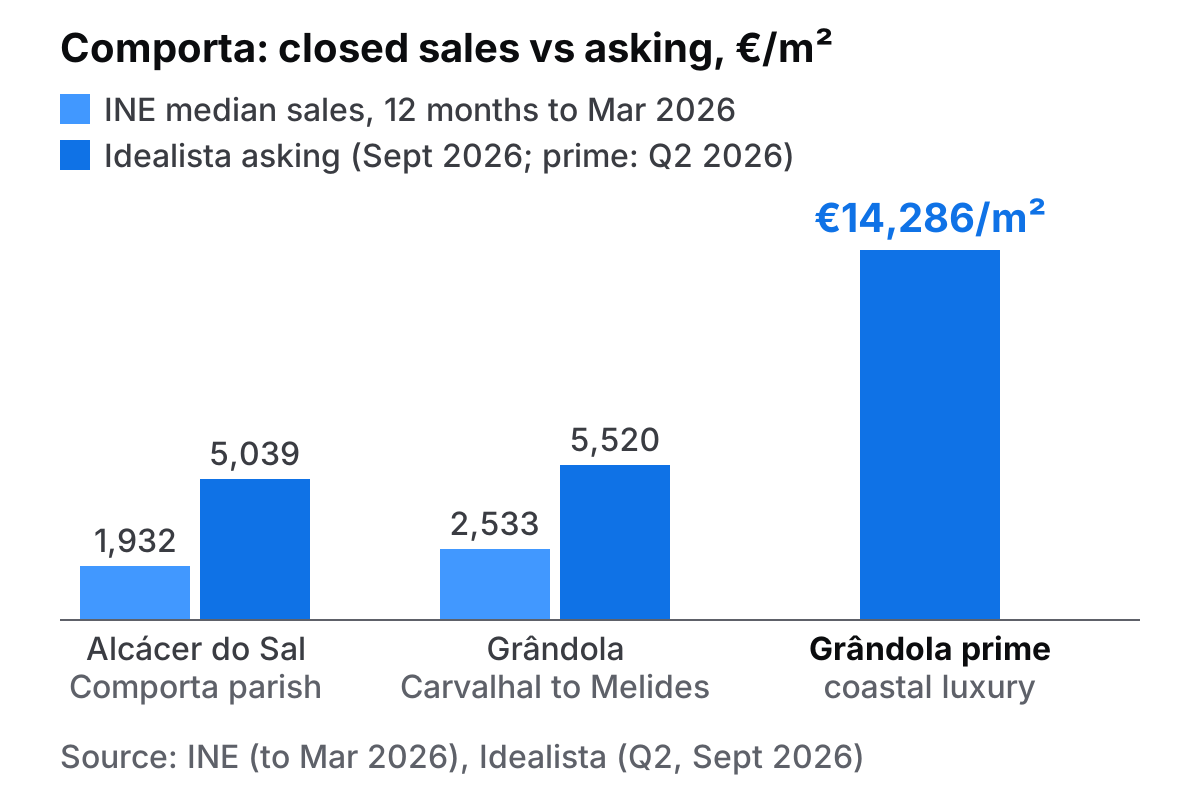
Because both municipalities cover vast rural hinterlands alongside prime coastal strips, standard official statistics show a marked split between inland transaction prices and beachfront asking values. According to Statistics Portugal (INE) 2021 Census data updated for closed sales in the 12 months to March 2026, median closed transaction prices stood at €1,932/m² in Alcácer do Sal and €2,533/m² in Grândola.
By contrast, the Idealista Setúbal district price report (September 2026) shows average asking prices of €5,039/m² in Alcácer do Sal and €5,520/m² in Grândola, with prime coastal estate listings in Carvalhal and Melides reaching €14,286/m² in Q2 2026. Real estate professionals use CASAFARI Area Insights and the property valuation and market study tool to isolate these coastal micro-markets from municipal inland averages.
What makes Comporta’s coastline, architecture and lifestyle distinct?
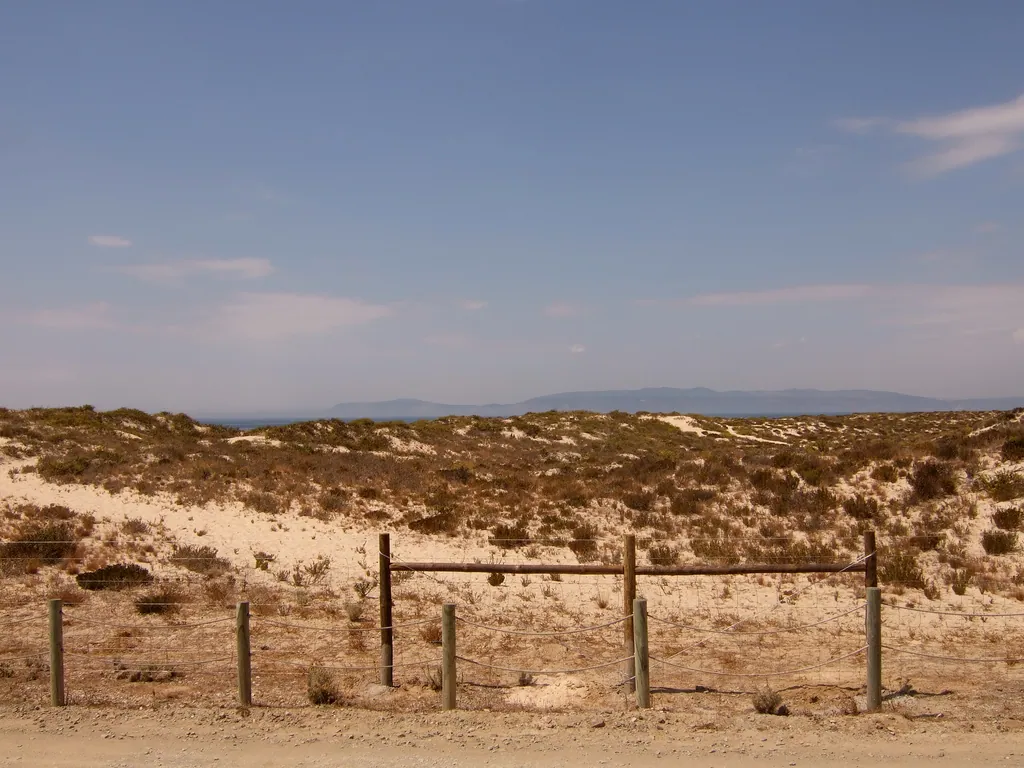
Rather than a isolated enclave, Comporta forms part of an uninterrupted 45 km white-sand beach arc running from the tip of the Tróia Peninsula down to Melides, extending towards Cape Sines as documented in the PlayOcean coastal guide for Praia do Pego and Tróia–Melides. The central Tróia–Comporta–Carvalhal–Pego coastal section spans roughly 24.5 km of dune systems.
The region’s architectural identity stems from its agricultural heritage. Paddy fields, umbrella pine forests, and the wooden stilt piers of Carrasqueira along the Sado Estuary Nature Reserve (RNES) set the backdrop for traditional casas da Comporta—low-slung cabanas constructed with thatched roofs, weathered timber, and open living spaces. In developments across Brejos da Carregueira and Aldeia da Muda, contemporary villas build upon this vernacular with single-storey layouts, private pine-wood decks, and low-density footprint restrictions.
Over the past decade, Comporta has transitioned from a seasonal summer retreat into a year-round destination for global family offices, technology entrepreneurs, and international buyers seeking privacy and environmental protection.
How do you get to Comporta, and what international schools are nearby?
Comporta is situated between 104 km and 120 km south of Lisbon Humberto Delgado Airport, depending on the specific parish destination. According to AlmaLusa Comporta travel and route information, driving time via the A2 motorway (Autoestrada do Sul) and the N253 highway via Alcácer do Sal takes between 1 hour 10 minutes and 1 hour 30 minutes. An alternative coastal route combines driving with the Atlantic Ferries car ferry or passenger catamaran from Setúbal across the Sado Estuary to the Tróia Peninsula.
For families relocating to the region, local and regional schooling options are structured across age brackets:
- Primary & Middle Schooling (Ages 3–14): Foz School, located locally in the Comporta and Alcácer do Sal area, provides a bilingual (English and Portuguese) curriculum grounded in nature-based learning and project methodologies.
- Secondary & International Baccalaureate (Ages 4 months–18 years): Positioned 35 to 50 minutes away via the A2 motorway or Tróia ferry, St. Peter’s International School in Palmela offers Cambridge IGCSE and International Baccalaureate (IB) programmes, alongside weekly and full boarding for pupils aged 14 and above. The International School of Palmela (ISP) also serves the northern Setúbal axis, as indexed in the International Schools Database for the Setúbal region.
What planning, tax and short-let rules apply when buying in Comporta in 2026?
Property acquisitions in Comporta require strict legal and urbanistic due diligence due to environmental protections and tax classifications.
Urban Planning and Sado Estuary Building Rules
Development across Comporta and Grândola is strictly controlled under the Sado Estuary Nature Reserve plan (PORNES/PERNES), National Agricultural Reserve (RAN), National Ecological Reserve (REN), Natura 2000 network, and municipal master plans—specifically the Alcácer do Sal Municipal Master Plan (PDM, September 2025) and the Município de Grândola PDM declaration (April 2026).
New residential construction is prohibited on strict nature reserve land outside defined urban boundaries or approved Tourist Development Areas (ADT/NDT, such as Carvalhal ADT3 and Aldeia da Muda). On rural land (solo rústico) where building is permitted, key constraints include:
- Minimum Plot Size: Typically 4 to 7.5 hectares for new residential permissions.
- Footprint Caps: Soil occupation indices between 0.02 and 0.04, capping single-family residential construction at 500 m².
- Height Limits: Restricted to 1 or 2 storeys (6.5 m to 7 metres maximum height).
- Statutory Approvals: Mandatory binding approvals from the Institute for Nature Conservation and Forests (ICNF) and the Portuguese Environment Agency (APA).
Short-Term Rental Regulations (Alojamento Local)
Under Decree-Law n.º 76/2024 on Alojamento Local (in force since 1 November 2024), the national ban on new coastal short-term rental licences was repealed, the extraordinary CEAL tax was abolished, and licence transferability upon property sale was restored. Regulatory oversight sits with the municipal councils of Alcácer do Sal and Grândola, which are required to deliberate on localized containment rules only if registered short-let units exceed 1,000 within a municipal territory.
Acquisition and Holding Taxes (IMT, Stamp Duty, IMI, AIMI)
According to the Portal das Finanças IMT rates (Article 17), property purchases in 2026 are subject to the following tax structure:
- IMT (Property Transfer Tax): For second homes, progressive rates apply up to €633,931, a flat 6% rate applies between €633,931 and €1,150,853, and a flat 7.5% rate applies to values above €1,150,853. Since 25 May 2026 (Decree-Law n.º 97/2026), non-tax-resident buyers pay a flat 7.5% IMT rate regardless of property value (10% for residents in blacklisted jurisdictions).
- Stamp Duty (Imposto do Selo): A flat 0.8% applied to the purchase price or tax registration value (VPT).
- Annual Property Tax (IMI): Between 0.3% and 0.45% of VPT for urban properties, and 0.8% for rural plots.
- Additional IMI (AIMI): Applies to aggregate urban residential VPT exceeding €600,000 per individual (€1.2 million for joint taxpayers) at rates of 0.7%, 1% (above €1 million), and 1.5% (above €2 million).
Golden Visa Framework
Under rules confirmed by the AIMA Residence Permit for Investment (ARI) rules, direct or indirect real estate purchases no longer qualify for the Portuguese Golden Visa. Capital allocations must instead be directed into qualifying non-real-estate investment funds (minimum €500,000), scientific research, or cultural production.
For a broader step-by-step overview of legal steps and conveyancing in Portugal, review our complete guide to buying property in Portugal and explore comparative market trends in our Sesimbra property market spotlight. Estate agents and investment professionals searching across off-market and portal listings in Comporta can aggregate available properties directly through CASAFARI Property Sourcing or access real-time data on the CASAFARI platform.
Frequently asked questions
Which municipality does Comporta belong to for property tax and planning?
The wider Comporta property market spans two distinct municipalities in Setúbal district: Alcácer do Sal and Grândola. The parish of Comporta (encompassing Comporta village, Brejos da Carregueira, Possanco, and Carrasqueira) belongs to Alcácer do Sal, whereas Carvalhal, Praia do Pego, Muda, and Melides fall under Grândola, according to the Município de Grândola PDM declaration (April 2026). Buyers must check which council holds jurisdiction over a plot, as each municipality enforces its own Municipal Master Plan (PDM) and annual IMI property tax rates.
What are the building restrictions in the Sado Estuary Nature Reserve and Comporta?
Under the Sado Estuary Nature Reserve plan (PORNES) and municipal planning regulations (Alcácer do Sal Municipal Master Plan (PDM, September 2025); Município de Grândola PDM declaration (April 2026)), new construction is prohibited in protected reserve zones outside existing urban boundaries or approved Tourist Development Areas (such as Carvalhal ADT3 and Aldeia da Muda). On eligible rural land, building typically requires minimum plot sizes of 4 to 7.5 hectares, a maximum building height of one to two storeys (6.5 m to 7 m), and strict floor-area caps (0.02 to 0.04 of plot area, or 500 m² for residential use). All development on rural land requires binding clearance from the Institute for Nature Conservation and Forests (ICNF) and the Portuguese Environment Agency (APA).
Can you get a short-term rental licence (Alojamento Local) in Comporta and Grândola?
Yes. Under Decree-Law n.º 76/2024 on Alojamento Local, which entered into force on 1 November 2024, the Portuguese government repealed the previous national ban on new coastal short-let licences, abolished the extraordinary CEAL tax, and restored licence transferability upon property sale. Licensing regulation now rests with the municipal councils of Alcácer do Sal and Grândola, which are required to evaluate containment measures only if registered units exceed 1,000 within a specific municipality.
Does buying property in Comporta qualify for the Portuguese Golden Visa?
No. Since Law n.º 56/2023 took effect in October 2023, direct or indirect real estate purchases anywhere in Portugal no longer qualify for the Residence Permit for Investment (ARI / Golden Visa) managed by AIMA Residence Permit for Investment (ARI) rules. Investors seeking Portuguese residency must use non-real-estate investment routes, such as committing at least €500,000 to qualifying non-real-estate venture capital or investment funds, creating jobs, or allocating €250,000 to cultural heritage projects.