

COIMBRA PROPERTY GUIDE
Home to one of Europe’s oldest and grandest universities
Located along the Mondego River midway between Lisbon and Porto, Coimbra anchors a central district of 408,551 residents (INE 2021 Census) and a growing municipality of 146,899 inhabitants (INE/Pordata, 2024). Property buyers and investors target Coimbra for its robust real estate fundamentals: over 41,000 higher education students generate consistent rental demand, while Portugal’s highest concentration of medical professionals—34.7 doctors per 1,000 residents—underpins a resilient regional economy.
Where is Coimbra and how is the district connected?
The District of Coimbra stretches across central Portugal from the Atlantic coastline at Figueira da Foz to the mountainous interior in the east. Municipalities like Oliveira do Hospital and Arganil border the Serra da Estrela Natural Park, with Oliveira do Hospital recognised as part of the UNESCO Estrela Geopark network.
Transport infrastructure connects Coimbra to Portugal’s major urban centres. By road, the A1 motorway puts both Francisco Sá Carneiro Airport in Porto and Humberto Delgado Airport in Lisbon within roughly two hours. Local mobility entered a new phase with the arrival of the Metro Mondego electric bus rapid transit (BRT) network. This 42-kilometre, 42-station system links Coimbra with Miranda do Corvo and Lousã. Suburban operations between Serpins and Portagem began in December 2025, followed by urban lines reaching Coimbra-B railway station and Praça da República in September 2026, as noted by the Câmara Municipal de Coimbra.
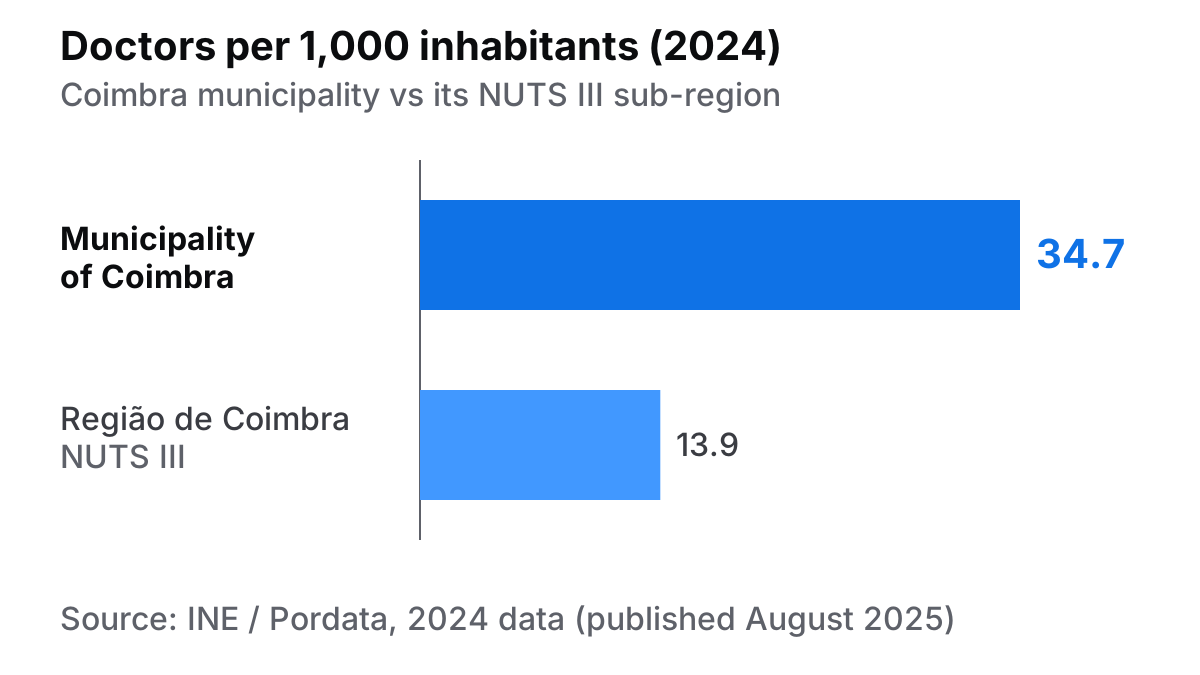
Healthcare remains a cornerstone of the regional economy. Reorganised in January 2024 into the Unidade Local de Saúde de Coimbra (ULS de Coimbra), the local medical hub serves as a key employer and clinical reference centre. Official INE healthcare statistics published in August 2025 show that the municipality of Coimbra leads the country with 34.7 doctors per 1,000 residents (approximately one doctor per 29 inhabitants), while the broader Região de Coimbra sub-region leads all Portuguese NUTS III areas at 13.9 doctors per 1,000 residents.
What drives Coimbra’s culture, heritage and rental market?
As a former medieval capital, Coimbra is home to the University of Coimbra. Founded on 1 March 1290 by King Dinis, the university’s historic core—the “University of Coimbra – Alta and Sofia” ensemble—was inscribed as a UNESCO World Heritage Site in June 2013. The city’s cultural profile is tied to its 18th-century baroque Biblioteca Joanina and its distinct student fado tradition.
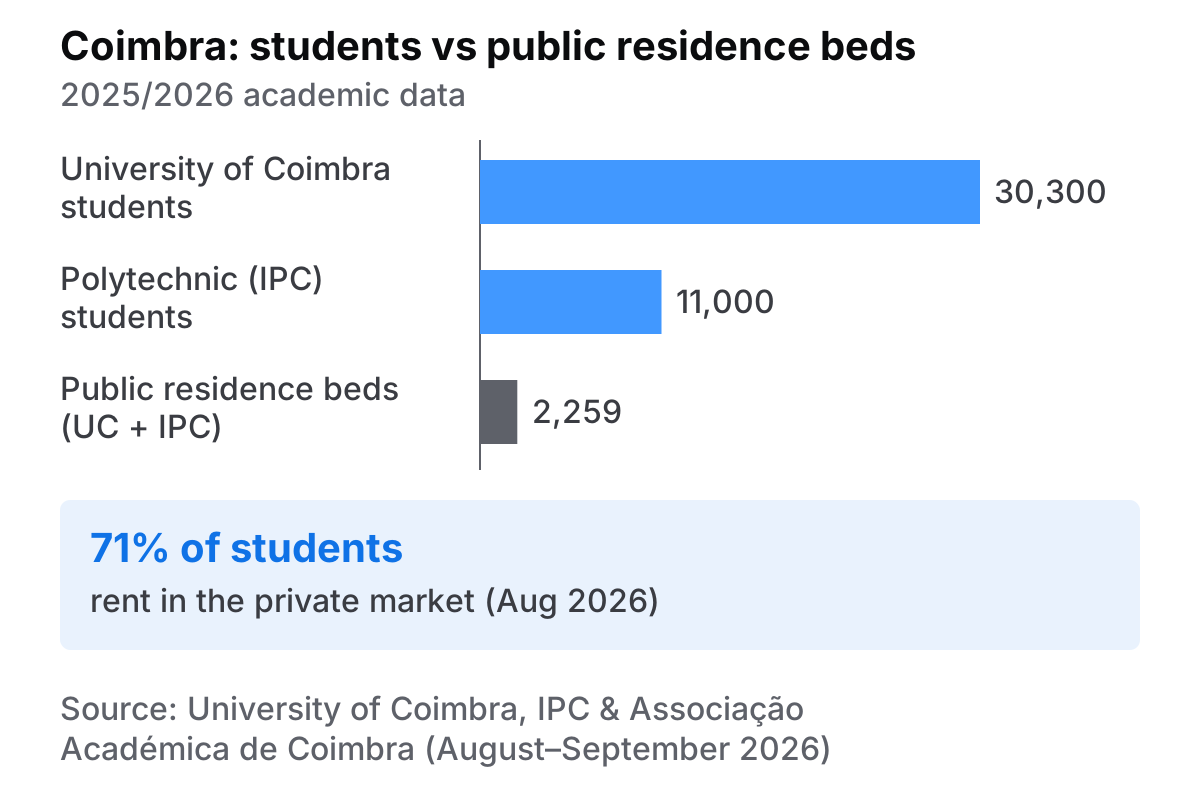
Academic activity directly shapes private rental dynamics. Between the University of Coimbra (~30,300 students) and the Polytechnic of Coimbra (~11,000 students), the city hosts over 41,000 higher education students. Public student accommodation covers only about 1,500 beds at the university and 759 beds at the polytechnic. An August 2026 housing study by the Associação Académica de Coimbra reported by ECO revealed that 71% of students rely on the private rental market, where average room rents reached €312 per month.
Beyond the city centre, the district holds substantial historic heritage, including the Roman ruins of Conímbriga in nearby Condeixa-a-Nova, classified as a National Monument since June 1910.
Investors evaluating residential acquisitions across neighbourhoods such as Alta, Baixa, Celas, Solum, and Vale das Flores can track rental supply and micro-location yield data using CASAFARI Area Insights and benchmark asset pricing with property valuation and market study tools. Real estate agencies sourcing available listings across the district can rely on CASAFARI Property Sourcing to eliminate duplicates.
How do taxes, residency and short-let rules work for buyers in Coimbra?
International buyers should note key legislative updates affecting residence visas, tax incentives, and short-term letting regulations in Portugal:
- Golden Visa changes: Under the Mais Habitação framework (Law No. 56/2023, effective 7 October 2023), real estate acquisitions no longer qualify non-EU buyers for the Golden Visa (ARI), as detailed in the Mais Habitação Golden Visa legislative summary. Residence-by-investment remains accessible through non-real-estate funds, scientific research contributions (€500,000), or job creation.
- Tax incentives (IFICI): The Non-Habitual Resident (NHR) regime was closed to new applicants at the end of 2023 (with transitional submissions ending March 2025). It was replaced by the Tax Incentive for Scientific Research and Innovation (IFICI, Article 58-A EBF). As outlined in Santander’s overview of the IFICI tax regime for new residents, qualifying academics, scientific researchers, and technology professionals benefit from a 20% flat personal income tax rate on eligible Portuguese employment and self-employment income for 10 years.
- Short-term rental rules (Alojamento Local): Decree-Law No. 76/2024 and Decree-Law No. 151/2026 (July 2026) ended the national suspension on new Alojamento Local (AL) registrations and restored transferable licences. As noted in the Turismo de Portugal technical guide to Alojamento Local, new licences are permitted in Coimbra and Figueira da Foz, subject to a 60-day municipal verification period, mandatory civil liability insurance of at least €75,000, and compliance with local municipal frameworks (Figueira da Foz initiated its specific AL municipal regulations in September 2026).
Coast, mountains and gastronomy: what is everyday life like in the Coimbra district?
Living in the Coimbra District offers a balance between regional urban convenience and natural surroundings. Residents can travel west to the coastal resort of Figueira da Foz for wide Atlantic beaches and the historic Casino Figueira, or head east towards the granite peaks bordering the Serra da Estrela range.
The region’s culinary culture ranges from traditional tascas serving chanfana (slow-cooked goat in red wine) in Coimbra to regional Bairrada roast suckling pig (leitão). In neighbouring Mealhada, the restaurant Rei dos Leitões retained its Michelin Guide Recommended status in both the 2025 and 2026 editions.
Buyers and investors researching property options across central Portugal can read our complete guide to buying property in Portugal and review key reasons to invest in property in Portugal. To analyze current listings and transactions across Coimbra, sign in to the CASAFARI platform.
Frequently asked questions
Can you still get a Portuguese Golden Visa by buying property in Coimbra?
No. Since Law No. 56/2023 (Mais Habitação) came into force on 7 October 2023, purchasing real estate no longer qualifies for the Portuguese Golden Visa. Non-EU citizens seeking residency can apply through alternative routes, such as qualifying non-real-estate investment funds, scientific research contributions of at least €500,000, job creation, or cultural heritage projects.
What replaced the NHR tax regime for foreigners relocating to Coimbra?
The Non-Habitual Resident (NHR) scheme was repealed at the end of 2023, with transitional registrations closing on 31 March 2025. It was replaced by the Tax Incentive for Scientific Research and Innovation (IFICI) under Article 58-A of the Tax Benefits Statute. Eligible individuals working in higher education, scientific research, technology, or certified high-value professions receive a 20% flat tax rate on qualified Portuguese employment and self-employment income for 10 years.
Can you get a new Alojamento Local (short-term rental) licence in Coimbra and Figueira da Foz?
Yes. Following Decree-Law No. 76/2024 and Decree-Law No. 151/2026 (July 2026), the national suspension on new short-term rental registrations was lifted and licences are once again transferable without five-year expiry limits. Both Coimbra and Figueira da Foz allow new registrations subject to a 60-day municipal review, mandatory €75,000 civil liability insurance, and local municipal rules.
Why is Coimbra considered a strong market for student buy-to-let investment?
Coimbra hosts more than 41,000 higher education students across the University of Coimbra and the Polytechnic of Coimbra, while public residences provide fewer than 2,300 beds combined. According to an August 2026 study by the Associação Académica de Coimbra, 71% of students rent in the private market, pushing the average room rent to €312 per month.