
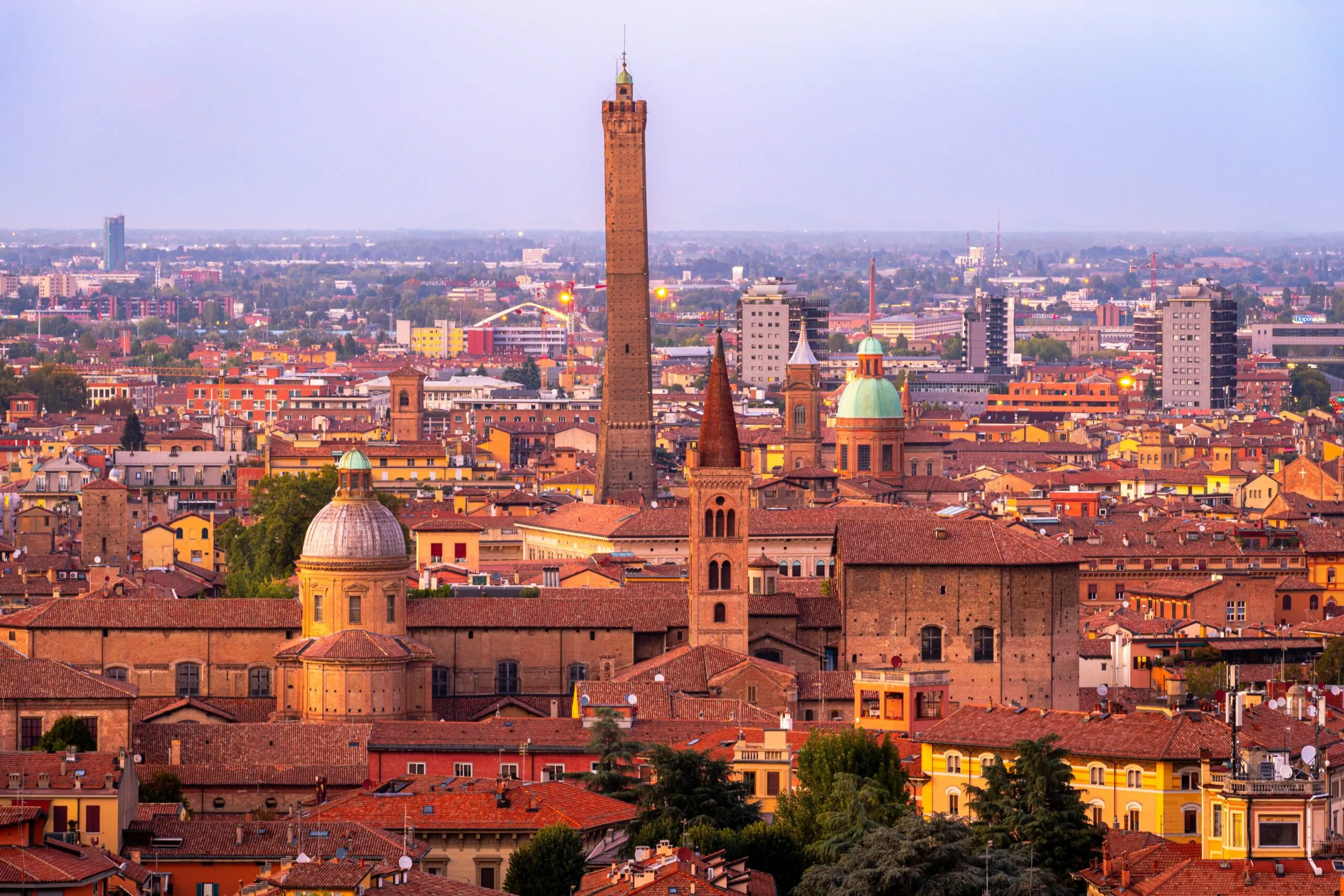
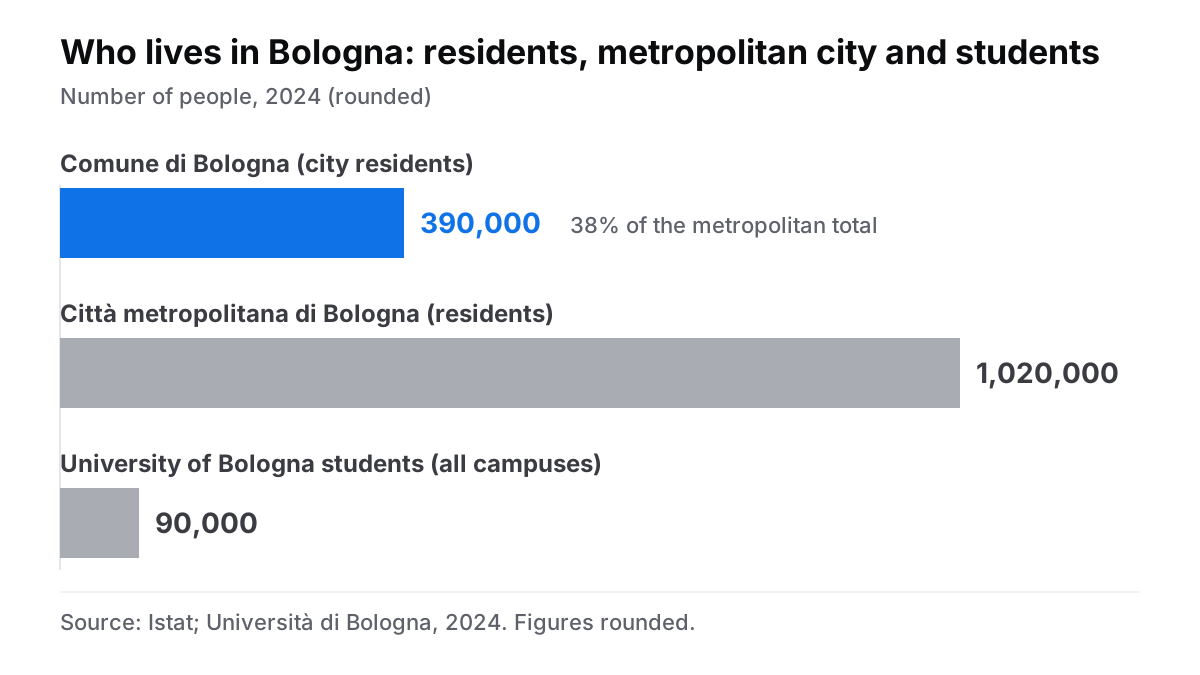
Bologna is the regional capital of Emilia-Romagna, sitting within a metropolitan territory of over one million residents, located roughly one hour from Milan and under two hours from Rome by high-speed rail. Driven by Europe’s oldest university, a major international trade fair, and regional logistics hubs rather than seasonal tourism alone, the city offers high residential stability. For current average property values and local performance indicators across the city, refer to the live market ticker above.
Where is Bologna and why does it matter to property buyers?
Bologna is the capital of the Emilia-Romagna region in northern Italy. Administrated as the Città metropolitana di Bologna—which officially replaced the former provincial entity on 1 January 2015 under Law 56/2014 (Città metropolitana di Bologna)—the city sits at the foot of the Apennine Mountains at an elevation of 54 metres above sea level. It is located approximately 80 kilometres inland from the Adriatic coast at Ravenna and Cervia.
The city experiences a humid subtropical climate characterised by warm summers and cool, damp winters. Positioned at the geographical heart of northern Italy, Bologna serves as the nation’s primary railway junction, connecting the northern industrial corridors with Central and Southern Italy.
For real estate professionals and buyers, this connectivity makes Bologna a major hub for corporate relocations, academic stays, and logistics operations. You can monitor regional market metrics using Area Insights or filter available listings across portals via Property Sourcing.
What is Bologna like to live in?
Bologna’s urban identity is defined by its extensive historic porticoes. In July 2021, UNESCO inscribed ‘The Porticoes of Bologna’ onto the World Heritage List, recognising 12 representative component parts spanning roughly 62 kilometres of porticoes across the municipality, with about 40 kilometres located in the historic centre.
At the city’s center lies Piazza Maggiore, bounded by Palazzo d’Accursio and the Basilica di San Petronio, whose construction began in 1390. Nearby, the skyline is marked by the Asinelli Tower, standing at 97.2 metres in height. Please note that public visits up the Asinelli Tower are currently suspended while preservation and monitoring works take place around the adjacent Garisenda Tower.
Residential property in Bologna spans distinct municipal districts (quartieri):
- Santo Stefano & Porto-Saragozza: Central districts containing prime period properties, historic arcades, and close proximity to administrative services.
- Navile & San Donato-San Vitale: Northern districts undergoing commercial and research-led urban renewal, appealing to young professionals and institutional tenants.
- Borgo Panigale-Reno & Savena: Outer residential areas providing mid-density housing stock with direct transport links to key industrial parks.
Green space includes the 26-hectare Giardini Margherita, opened in 1879, which serves as the principal public park near the historic centre. For walking and recreation, the Portico of San Luca extends 3.8 kilometres with 666 arches, running from Porta Saragozza up to the Sanctuary of the Madonna di San Luca on Colle della Guardia at 280 metres above sea level.
How do you get around Bologna, and how connected is it?
Public transit inside the urban area is operated by TPER (Trasporto Passeggeri Emilia-Romagna), utilizing integrated bus routes and contactless payment options across the network.
Bologna Centrale is one of Southern Europe’s primary railway hubs. From the underground high-speed platforms, passengers can travel directly via Frecciarossa or Italo services to:
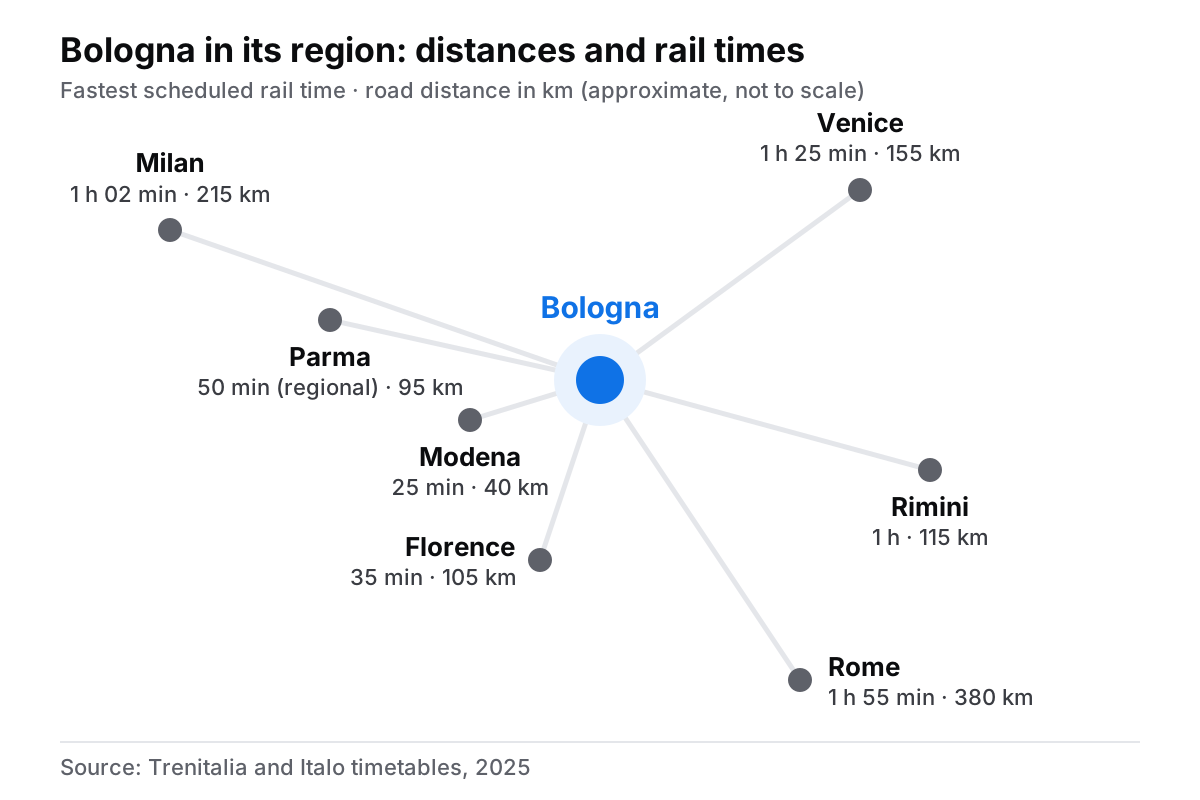
- Florence: 35 to 37 minutes
- Milan: Approximately 1 hour and 2 minutes
- Rome: 1 hour 55 minutes to 2 hours 10 minutes
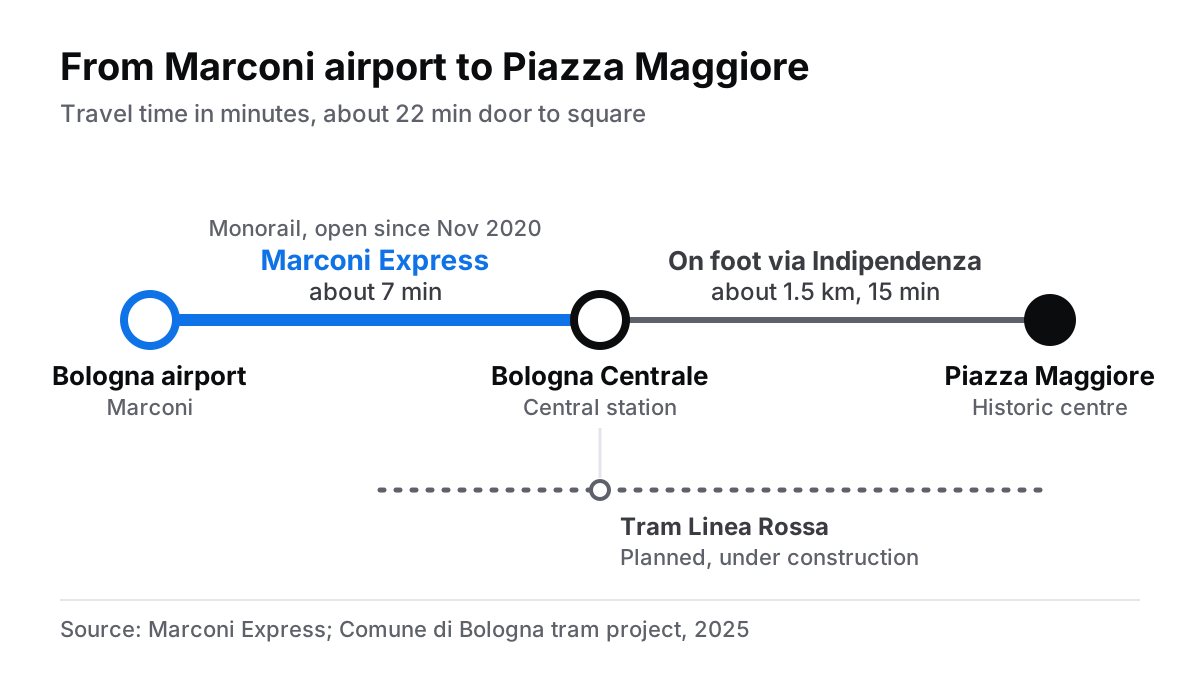
Air transit is provided by Bologna Guglielmo Marconi Airport, situated approximately 6 kilometres north-west of the city centre. Since November 2020, the dedicated Marconi Express monorail links the airport directly to Bologna Centrale in 7 minutes, replacing previous bus shuttle services.
What should buyers and investors check before buying in Bologna?
Purchasing real estate in Italy involves specific tax considerations regulated nationally by the tax authority (Agenzia delle Entrate):
- Resale Purchase Taxes: Registration tax (imposta di registro) is levied at 2% of the property’s cadastral value for primary residences (prima casa), or 9% for secondary or investment homes. Land registry and mortgage taxes are fixed at €50 each.
- New-Build VAT: Direct purchases from a developer are subject to VAT (IVA) at 4% for a primary home or 10% for secondary properties, calculated on the agreed sales price.
- Short-Term Rental Regulations: Under Article 13-ter of Decree-Law 145/2023, every short-term rental property in Italy must hold and display a National Identification Code (CIN), obtainable through the Ministero del Turismo BDSR platform. Additionally, under Law 213/2023 (Budget Law 2024), the substitute tax (cedolare secca) on short-term residential leases is set at 21% for the first property rented out and 26% for additional residential units.
To evaluate yield profiles and long-term rental market trends, read CASAFARI’s overview of rents in northern Italy. If you need a professional valuation for a specific home, request a valuation and market study or review the Area Insights developer docs in English for API integrations.
What is there to see around Bologna?
Bologna acts as an ideal base for exploring the surrounding Emilia-Romagna region by rail:
- Modena: Located 20 to 30 minutes away by regional train (Trenitalia), known for its historical centre and automotive industry.
- Parma: Reached in 50 to 60 minutes on regional services or under 40 minutes on high-speed rail, recognized for its culinary heritage and cathedral art.
- Apennine Foothills: The Porrettana rail line links Bologna to the thermal town of Porretta Terme in roughly 1 hour and 15 minutes.
- Adriatic Coast & San Marino: Coastal towns such as Ravenna are about 80 kilometres east. Visiting the Republic of San Marino requires taking a 1-hour train to Rimini, followed by a local bus connection, taking approximately 2 hours in total.
To explore real-time property market data, historical transaction trends, and detailed district metrics across Bologna, sign in to try Area Insights on the CASAFARI platform.
Frequently asked questions
Is Bologna a good place to buy property?
Bologna is an employment- and university-driven property market supported by economic anchors such as the University of Bologna, trade fair activity, and logistics hubs. This provides balanced residential demand across both rental and purchase sectors throughout the year. For current average values and regional yield benchmarks, refer to the live market ticker above or explore Area Insights.
Can I rent out my flat on Airbnb in Bologna?
Yes, provided national and municipal regulations are followed. Since 1 January 2025, every short-let property in Italy must hold and display a National Identification Code (CIN) issued by the Ministero del Turismo. Under current Italian tax law, short-term rental income is taxed under the cedolare secca framework at 21% for the first property and 26% for additional units.
How far is Bologna airport from the city centre?
Bologna Guglielmo Marconi Airport is located approximately 6 kilometres north-west of the city centre. The Marconi Express monorail, opened in November 2020, connects the terminal directly to Bologna Centrale train station in about 7 minutes. From the central station, the historic core is roughly a 10- to 15-minute walk down Via dell’Indipendenza.
How long does the train take from Bologna to Rome and Milan?
High-speed trains from Bologna Centrale reach Milan in approximately 1 hour and 2 minutes, Florence in 35 to 37 minutes, and Rome in 1 hour 55 minutes to 2 hours 10 minutes (Trenitalia and Italo timetables, 2025). These short transit times make Bologna a strategic location for professionals and cross-regional commuters.