
Milan
The world capital of fashion and design on the north of Italy
Milan is Italy’s economic and financial capital, housing 1,362,863 residents within the municipality as of January 2026 and 3,246,455 across the wider Metropolitan City. Driven by eight major universities enrolling 232,000 students, the fully operational M4 metro line connecting Linate Airport, and major 2026 Olympic urban regeneration projects, Milan represents Southern Europe’s most dynamic and liquid residential real estate market for international buyers and investors.
Where is Milan situated and how is it connected?
Situated in the western Po Valley, Milan serves as the primary financial, industrial, and cultural gateway of Lombardy and Northern Italy. The city sits north of the Apennines and south of Lake Como and the Swiss border, flanked by Turin to the west and Bergamo and Venice to the east. Topographically, Milan rests at an average altitude of 122 metres above sea level (with 138 metres recorded at the official city hall benchmark). Positioned in the fertile plain between the Ticino river to the west and the Adda river to the east, the city itself is crossed by the Lambro, Olona, and Seveso rivers, as well as an intricate historic network of navigable canals including the Naviglio Grande, Naviglio Pavese, and Naviglio della Martesana.
According to Comune di Milano and ISTAT demographic statistics, the Municipality of Milan (Comune di Milano) reached 1,362,863 resident inhabitants at the start of 2026. At the broader regional level, Città Metropolitana di Milano resident population data records 3,246,455 residents as of January 2025. This dense urban core is supported by one of Europe’s most sophisticated transport infrastructures.
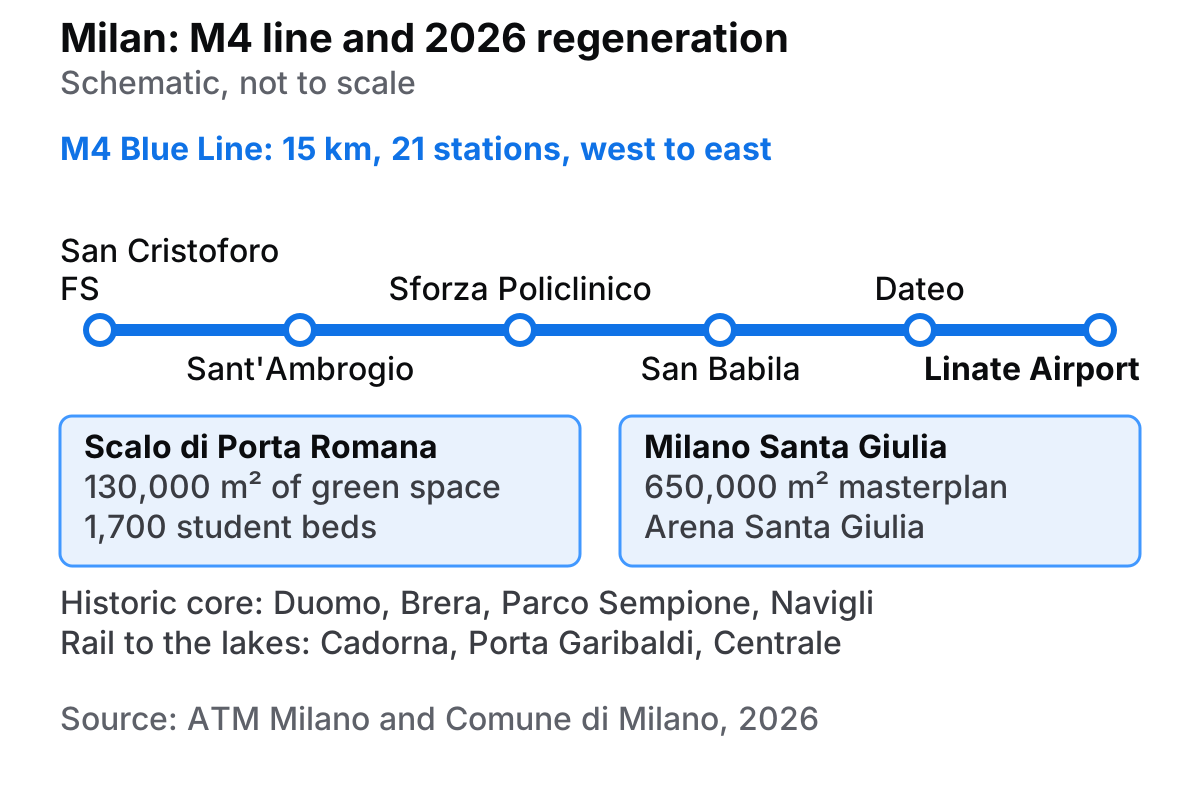
For international buyers and investors, transit connectivity defines local property catchments. The complete rollout of the M4 metro line (‘Blue Line’) has reshaped residential demand along its 15-kilometre driverless route. Operated by ATM, the M4 features 21 stations connecting Linate Airport directly to San Babila in the historic centre in under 15 minutes, continuing through key interchanges at Sforza Policlinico and Sant’Ambrogio before terminating at San Cristoforo FS in the south-west. Details regarding line connections and schedules can be verified via the ATM M4 Blue Line route and stations portal.
What to see in Milan: culture, historic districts and urban regeneration
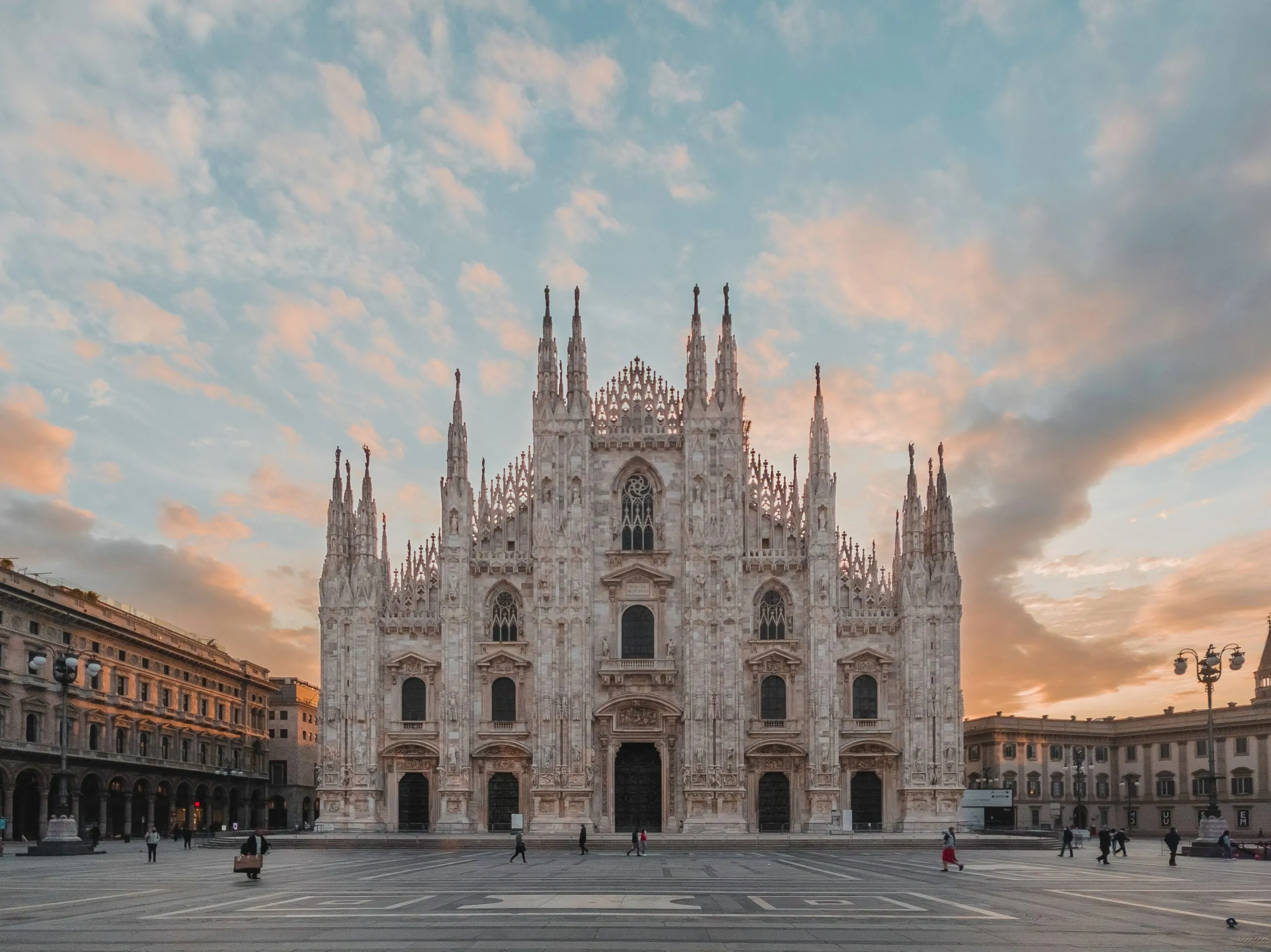
Milan seamlessly pairs its identity as Italy’s capital of finance, media, fashion, and design with rich architectural landmarks. At the geographic centre stands the Gothic Duomo di Milano, framing the historic core. A short walk north leads into the prestigious Brera district and the historic Palazzo di Brera. This landmark complex houses the Pinacoteca di Brera—one of Italy’s premier fine art galleries showcasing masterworks of ancient and modern painting—alongside the Braidense National Library, the 5,000-square-metre Brera Botanical Garden, the Brera Academy of Fine Arts, and the Astronomical Observatory. Beyond Brera lie iconic cultural institutions such as Teatro alla Scala, Parco Sempione, and the museum quarter surrounding Porta Venezia and Palestro, home to the Natural History Museum (Museo Civico di Storia Naturale) and the Gallery of Modern Art (GAM).
To the south-west, the historic Navigli district—centred around Alzaia Naviglio Grande, Naviglio Pavese, and the restored Darsena basin—remains the hub of Milanese social life, world-class dining, and vibrant residential rental interest.
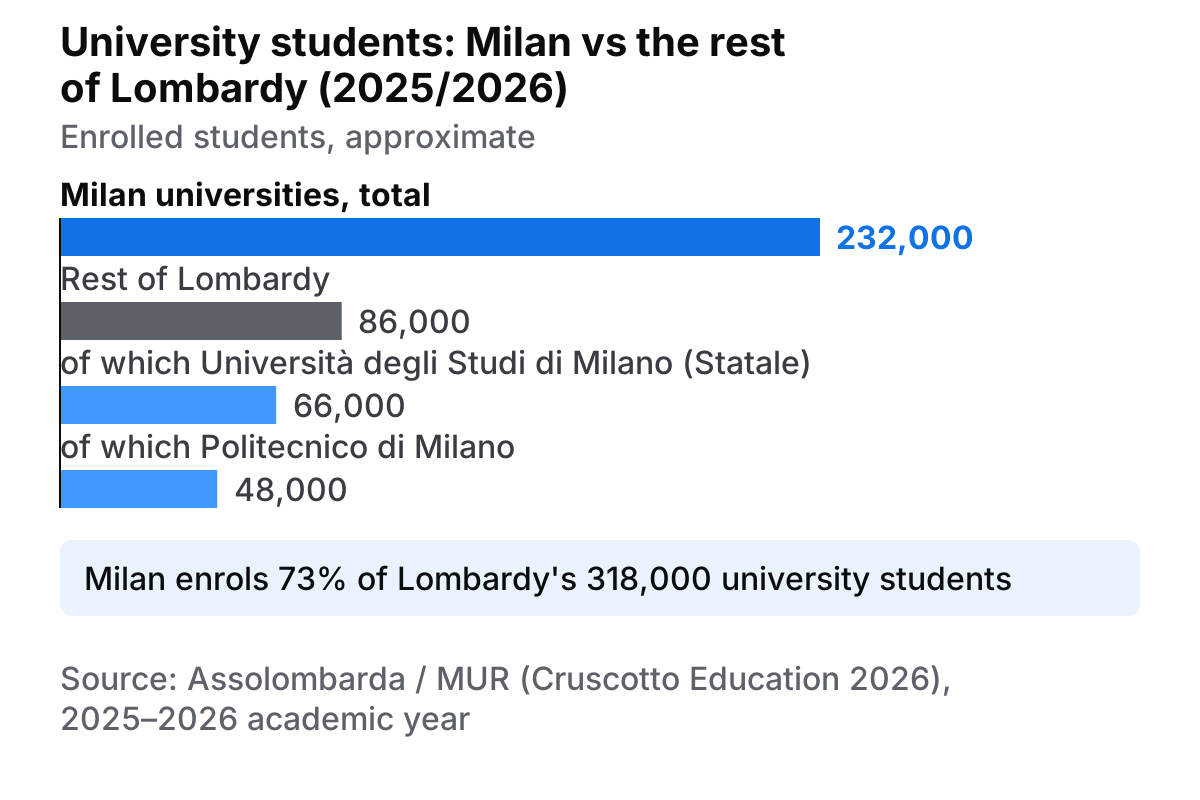
Underlying Milan’s real estate resilience is a massive academic ecosystem. According to the Assolombarda 2026 education report, Milan hosts eight major universities enrolling approximately 232,000 students out of 318,000 across Lombardy. Key institutions include Università degli Studi di Milano (Statale) with ~66,000 students, Politecnico di Milano with ~48,000 students, Bocconi University, Università Cattolica, Milano-Bicocca, IULM, San Raffaele, and Humanitas. This concentration provides structural rental demand in quarters like Città Studi, Porta Romana, and Bovisa, as detailed in our study of the rental market in Northern Italy.
Urban growth is further accelerated by post-2026 Winter Olympics redevelopment. Two landmark masterplans anchor this transformation:
- Scalo di Porta Romana: A transformation of over 190,000 square metres of former rail yards into a sustainable district featuring more than 130,000 square metres of green and public spaces. The 60,000-square-metre Milano-Cortina 2026 Olympic Village is designed to convert post-Games into Italy’s largest student residence, providing approximately 1,700 beds.
- Milano Santa Giulia: A 650,000-square-metre mixed-use masterplan in the south-east, anchored by the new Arena Santa Giulia designed by David Chipperfield Architects and Arup, creating extensive new residential quarters and urban parks.
Understanding how micro-locations perform around these major infrastructure projects is essential for capital allocation, illustrating why hyper-localised property data matters when benchmarking emerging districts against established prime zones.
For investors managing short-term rental portfolios, tax compliance changed significantly on 1 January 2026 under Italy’s Budget Law. Private landlords may now rent out a maximum of two apartments on short-term contracts (under 30 days) before mandatory business registration (Partita IVA) applies, reduced from the previous four-property threshold. The flat-rate tax (cedolare secca) is set at 21% for the first designated property and 26% for the second, as outlined in the Agenzia delle Entrate guidance on the cedolare secca regime. Furthermore, operators must display a National Identification Code (CIN) alongside the regional CIR, install mandatory safety detectors, and collect Milan’s €9.50 per night tourist tax.
For high-net-worth individuals relocating tax residence to Milan, Italy’s updated Neo-Residenti flat tax regime (Article 24-bis TUIR) provides significant tax stability. As detailed in the Agenzia delle Entrate overview of the new-resident tax regime, individuals transferring residency to Italy from 1 January 2026 onwards pay an annual substitute tax of €300,000 on all foreign-sourced income (plus €50,000 per qualifying family member) for up to 15 years, offering full exemption from foreign wealth and inheritance taxes.
What to see in Milan’s surroundings: lakes, Monza and Franciacorta
Milan’s geographic position allows residents and international executives to reach premier alpine, lake, and wine destinations within an hour’s journey:
- Lake Como and Lake Maggiore: Situated directly north, both lakes are accessible without a car via regional rail operator Trenord. Direct services run from Milano Cadorna, Milano Centrale, and Milano Porta Garibaldi to destinations such as Como Lago, Varenna-Esino, and Laveno Mombello Lago, connecting directly with lake ferry networks.
- Monza: Located immediately north-east, Monza is famed for the neoclassical Villa Reale, its vast historic walled park, and the Autodromo Nazionale Monza Formula 1 circuit.
- Franciacorta: Situated east towards Lake Iseo, Franciacorta offers rolling vineyard countryside renowned for producing Italy’s finest sparkling wines.
To evaluate property opportunities, pricing distribution, and yields across Milan’s historic core and expanding regeneration zones, property professionals rely on CASAFARI Area Insights and our tools for accurate property valuations and market studies. Developers can also review the Area Insights API documentation (in English).
To analyse real-time market trends and property availability across Milan’s neighbourhoods, sign in to the CASAFARI platform to explore Italian property market data directly.
Frequently asked questions
What are the rules and taxes for short-term rentals in Milan in 2026?
Under Italy’s 2026 Budget Law, effective 1 January 2026, private landlords in Milan can rent out a maximum of two residential properties on short-term contracts before being required to set up a business structure (Partita IVA). The flat-rate tax regime (cedolare secca) applies a rate of 21% to the first designated property and 26% to the second. Property owners must also register for a National Identification Code (CIN) alongside the Lombardy CIR, install carbon monoxide and gas detectors alongside fire extinguishers, and collect Milan’s €9.50 per night tourist tax.
How does Italy’s flat tax for new residents apply to buyers relocating to Milan?
Under Article 24-bis of the Tax Code (TUIR), individuals relocating their tax residence to Italy who were not tax resident for at least nine of the prior ten years can opt for a single flat tax on foreign-sourced income. For individuals transferring residency to Milan from 1 January 2026 onwards, this substitute tax is set at €300,000 per year, plus €50,000 per eligible family member, locked for up to 15 years. The scheme grants exemptions from Italian wealth taxes on foreign assets (IVIE and IVAFE) and foreign inheritance tax, making Milan an attractive destination for high-net-worth investors.
How has the M4 metro line improved connectivity across Milan?
The fully operational 15-kilometre driverless M4 metro line (‘Blue Line’) connects Linate Airport directly to central Milan at San Babila in under 15 minutes, before continuing through Sforza Policlinico and Sant’Ambrogio to San Cristoforo FS in the south-west. Spanning 21 stations, the line intersects with the M1, M2, and M3 metro networks and major suburban rail links. This connectivity has significantly elevated accessibility and residential real estate appeal along the eastern and south-western transit corridors.
Which Milan neighbourhoods are benefitting from the 2026 Winter Olympics regeneration?
The primary beneficiaries of the Milano-Cortina 2026 urban regeneration legacy are Scalo di Porta Romana in the south-central district and Milano Santa Giulia in the south-east. At Scalo di Porta Romana, a 190,000-square-metre former railway yard includes over 130,000 square metres of green space and the 60,000-square-metre Olympic Village, which is converting after the Games into a 1,700-bed student accommodation hub. In Santa Giulia, a 650,000-square-metre masterplan combines broad parklands and residential quarters with the new Arena Santa Giulia designed by David Chipperfield Architects and Arup.