
Rome
Art, culture and gastronomy on the birthplace of western civilization
Rome stands as Italy’s largest municipal housing market, with 2,745,062 residents recorded in January 2026 across its 1,287.36 km² territory. In 2025, the capital logged 37,293 residential sales (+6.2% year-on-year according to the Agenzia delle Entrate OMI report), while Immobiliare.it figures for September 2026 set average city-wide asking prices at €3,875/m² and rents at €19.13/m² per month.
Where is Rome situated and how is its territory structured?
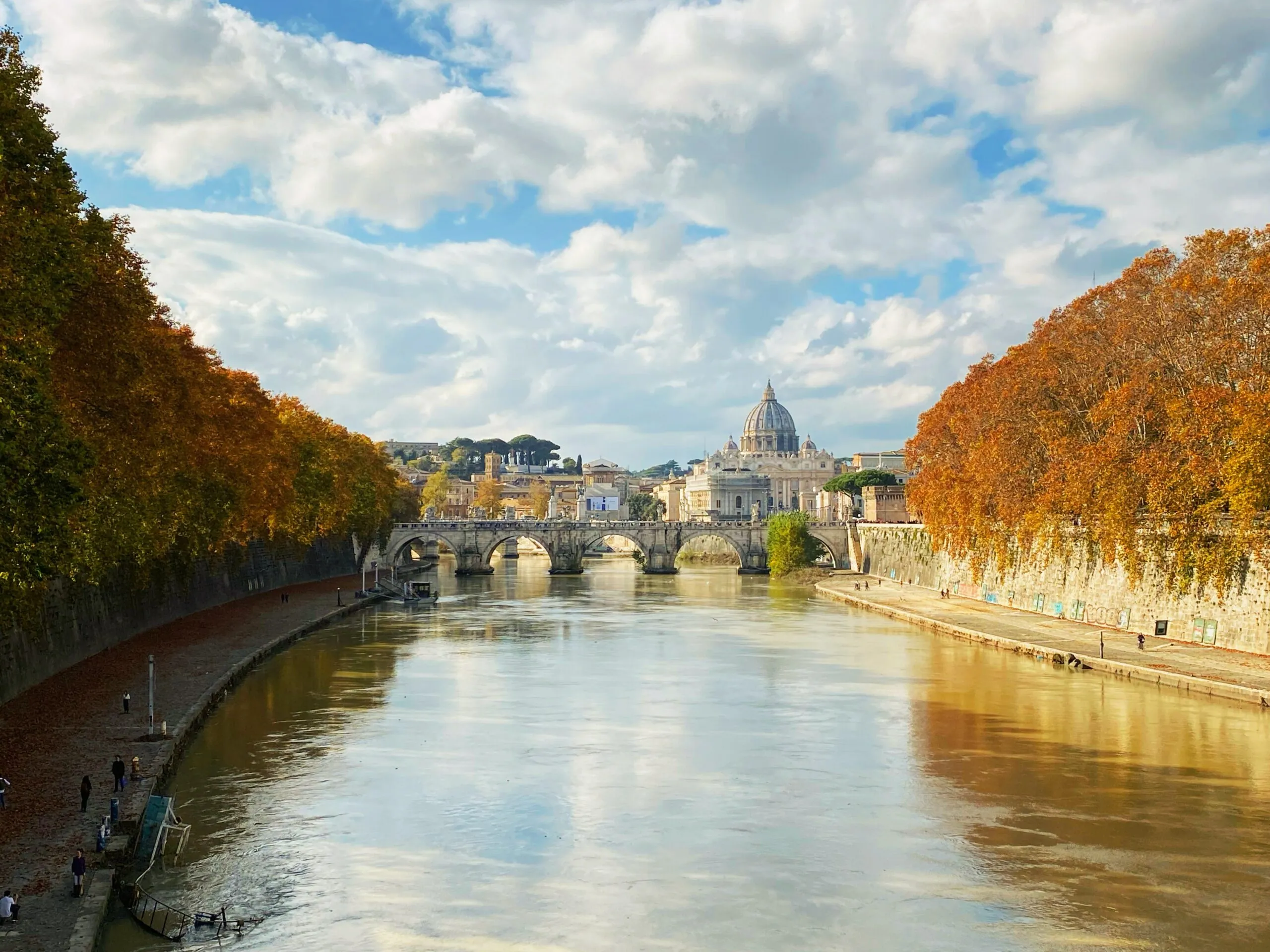
Situated in the Lazio region of central-western Italy, Rome sits along the banks of the River Tiber (Tevere). Flowing 405 km from the Apennines to the Tyrrhenian Sea, the Tiber is Italy’s third-longest river, following the Po (652 km) and the Adige (410 km). Understanding Rome’s administrative boundaries is essential for property buyers and institutional investors, as market dynamics, planning jurisdictions, and municipal taxes vary across its tiers.
According to ISTAT demographic statistics, the Municipality of Rome (Comune di Roma) spans 1,287.36 km² with 2,745,062 inhabitants as of January 2026. It includes roughly 20 km of coastline at Ostia. Surrounding the municipal core is the wider Metropolitan City of Rome Capital (Città Metropolitana di Roma Capitale), covering 5,352 km² and home to 4,225,989 residents as of June 2026. This administrative territory extends across 130 to 140 km of Tyrrhenian coastline, from the border of Viterbo province in the north down to Latina province in the south.
Rome offers excellent domestic and international connectivity for residents and commuters. Fiumicino Airport (Leonardo da Vinci) is linked directly to Roma Termini by the non-stop Leonardo Express rail service, taking 32 minutes every 15 minutes at €14, alongside regional FL1 trains. Ciampino Airport is connected to Termini via the Ciampino Airlink bus-and-rail service for €2.70. Within the capital, urban mobility received a major upgrade on 16 December 2025 when Roma Capitale announced the opening of the Porta Metronia and Colosseo-Fori Imperiali archaeological stations on Metro C. This milestone extended Line C to 24 stations over 22 km and established a direct underground interchange with Metro B at the Colosseum.
A guide to Rome’s culture, lifestyle and main attractions
Rome’s urban grid still reflects the ancient consular roads—such as the Via Appia, Via Flaminia, and Via Aurelia—that once converged on the forum. Today, the city seamlessly weaves thousands of years of architectural heritage into daily modern life. Historic monuments like the Colosseum, the Pantheon, and the Trevi Fountain share space with vibrant business corridors, top-tier research universities, and diplomatic headquarters.
The enclave of Vatican City and its renowned Vatican Museums sit within the heart of the capital, drawing millions of international visitors annually. This perpetual tourist stream, coupled with large student populations at institutions like La Sapienza and LUISS, creates robust, year-round rental demand across central and academic districts. Beyond heritage, Rome is a major European center for film production at Cinecittà, healthcare, and public administration.
Rome’s culinary landscape remains a cornerstone of its lifestyle appeal. Traditional Roman trattorias serving classic dishes such as carbonara, amatriciana, and cacio e pepe operate alongside contemporary Michelin-starred establishments, vegan bistros, and international dining spots. This rich cultural identity continues to attract lifestyle buyers, expatriates, and buy-to-let investors alike.
How is the Rome property market performing in 2026?
According to the Agenzia delle Entrate OMI 2026 Residential Real Estate Report, the Municipality of Rome recorded 37,293 normalised residential transactions (NTN) in 2025, representing a 6.2% increase compared to 2024. This made up the bulk of the 57,502 transactions across the broader province and contributed to Italy’s national total of 766,757 sales.
Data from the Immobiliare.it Rome market observatory indicates that in September 2026, average residential asking prices in the capital reached €3,875/m², reflecting a 6.40% year-on-year growth. Simultaneously, average monthly asking rents climbed to €19.13/m², an increase of 5.23% over the previous twelve months, continuing trends highlighted in our earlier study of the rental market in Central Italy. Real estate professionals seeking granular sub-market data can use CASAFARI Area Insights or consult our Area Insights API documentation for developer integration.
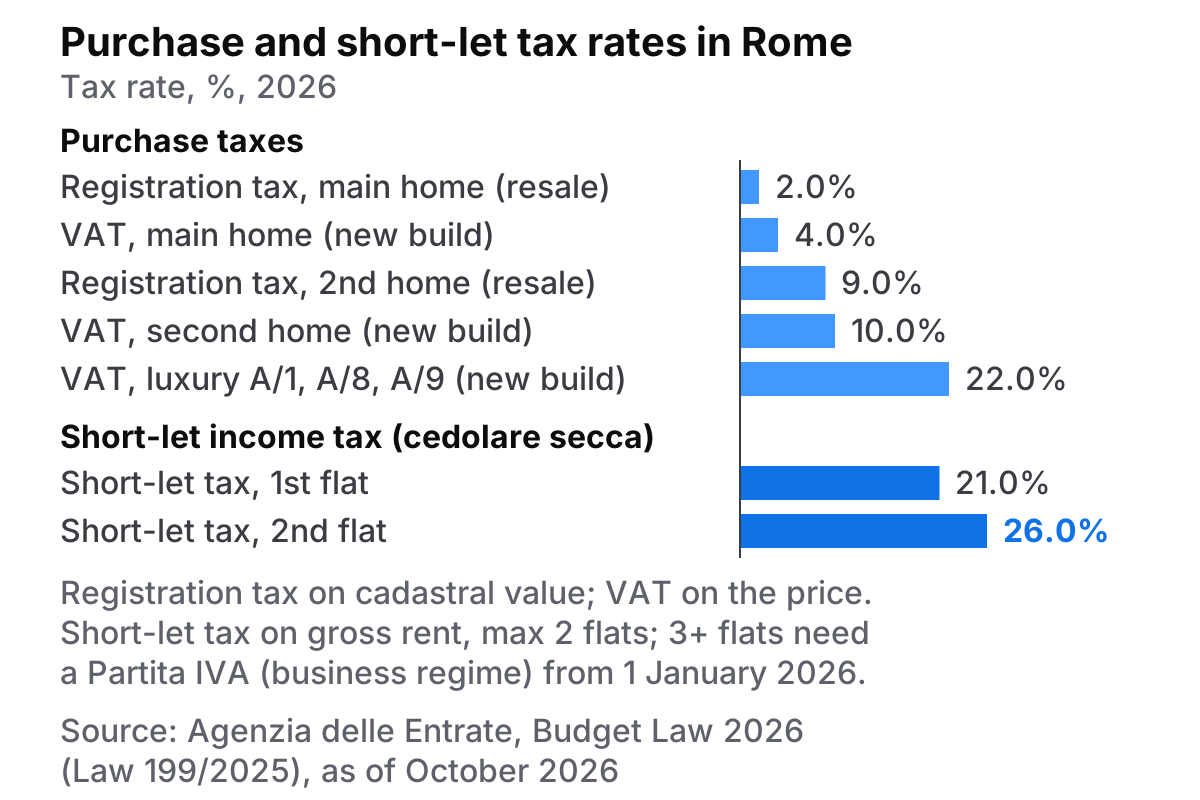
Acquiring and managing property in Rome requires navigating specific fiscal rules. Under the Agenzia delle Entrate guide to Italian property purchase taxes, resale purchases from private sellers incur a registration tax (imposta di registro) calculated on the cadastral value: 2% for a primary residence (prima casa, minimum €1,000) or 9% for a second home, plus €50 each for mortgage and cadastral taxes. Purchases directly from developers attract VAT on the agreed purchase price at 4% for a primary residence, 10% for a second home, or 22% for luxury properties (cadastral categories A/1, A/8, and A/9), with registration, mortgage, and cadastral taxes set at €200 each. Annual municipal property tax (IMU) exempts non-luxury primary residences, while second homes pay a standard rate of 1.06% in Rome.
For investors eyeing short-term rentals (affitti brevi, up to 30 days), Italy’s 2026 Budget Law (Law 199/2025) enforces clear limits. Landlords may operate a maximum of two short-let apartments under the flat-tax regime (cedolare secca), taxed at 21% on the first nominated property and 26% on the second. Operating three or more short-let properties triggers mandatory business status (Partita IVA) and a formal SCIA filing with Roma Capitale’s SUAR office. All short lets must display a National Identification Code (CIN), maintain gas/CO detectors and fire extinguishers, log guests on Alloggiati Web within 24 hours, and collect Rome’s €6/night tourist tax (up to 10 nights).
To aggregate listings and eliminate duplicates across all major Italian portals, agents and sourcing specialists rely on our Property Sourcing platform. Valuations and pricing studies can be performed using our property valuation and market study tool.
What to see in Rome’s surroundings and wider Lazio
Rome serves as an ideal base for exploring the diverse landscapes and historic towns of the Lazio region. Four notable day trips offer distinct cultural and natural experiences:
- Giardino di Ninfa: Located in the municipality of Cisterna di Latina (Province of Latina) at the foot of the Lepini Mountains, this world-renowned botanical garden sits roughly 65 km south-east of Rome (about an hour’s drive). Built among medieval ruins, it presents a unique blend of flora and history.
- Tivoli: Perched on the Sabine hills 30–35 km east of Rome within the Metropolitan City, Tivoli is an ancient hilltop settlement predating Rome itself. It is home to UNESCO World Heritage sites including Hadrian’s Villa (Villa Adriana) and the Renaissance gardens of Villa d’Este.
- Viterbo: Known as the “City of the Popes,” Viterbo is the provincial capital of Tuscia in northern Lazio, situated approximately 80 km north of the capital. It preserves one of Europe’s best-preserved 13th-century medieval quarters (San Pellegrino) alongside historic thermal baths.
- Cascata dell’Inferno: Nestled inside the Veio Regional Natural Park in the municipality of Formello (Metropolitan City of Rome), this picturesque waterfall and hiking trail lies just 15 km from the Grande Raccordo Anulare (GRA) ring road, approximately 30 to 40 minutes by car from central Rome.
Whether you are acquiring a historic apartment in the Centro Storico or managing a residential portfolio in Lazio, access to real-time market data is vital for sound decision-making. You can sign in to the CASAFARI platform to evaluate listing trends, benchmark cadastral values, and streamline your property search across Italy.
Frequently asked questions
What are the short-term rental rules in Rome in 2026?
Under Italy’s 2026 Budget Law (Law 199/2025), private landlords in Rome may let a maximum of two residential properties on short-term contracts (up to 30 days) without opening a VAT number (Partita IVA), paying the flat-rate tax (cedolare secca) at 21% on the first chosen property and 26% on the second. Letting three or more properties is legally presumed to be a business activity, requiring a VAT number and a SCIA filing with Roma Capitale’s SUAR office. All hosts must display a National Identification Code (CIN), fit gas and carbon monoxide detectors and fire extinguishers, register guests on Alloggiati Web within 24 hours, and collect Rome’s €6 per person per night tourist contribution (up to 10 nights).
What taxes do you pay when buying a property in Rome?
When buying a resale home from a private seller (or a VAT-exempt company), buyers pay registration tax (imposta di registro) on the property’s cadastral value at 2% for a non-luxury primary residence (minimum €1,000) or 9% for a second home, plus fixed mortgage and cadastral taxes of €50 each. When buying a new-build directly from a developer subject to VAT, buyers pay VAT on the agreed purchase price at 4% (primary residence), 10% (second home), or 22% (luxury categories A/1, A/8, and A/9), alongside fixed registration, mortgage, and cadastral taxes of €200 each. Once owned, non-luxury primary residences are exempt from annual municipal property tax (IMU), whereas second homes in Rome are taxed at a standard rate of 1.06% (up to 1.14% where the former TASI surcharge applies).
Does buying property in Rome qualify for the Italian Investor Visa or Flat Tax?
Buying residential or commercial property in Italy does not qualify for the Investor Visa for Italy (Article 26-bis of Legislative Decree 286/1998), which requires a minimum investment of €2 million in government bonds, €500,000 in an operating Italian company, €250,000 in an innovative start-up, or €1 million in philanthropy. However, high-net-worth buyers who relocate their tax residency to Rome (having lived outside Italy for at least nine of the previous ten years) can opt into Italy’s neo-resident regime (Article 24-bis TUIR) and purchase property alongside it. For individuals establishing residency from 1 January 2026 onwards under Law 199/2025, this flat tax on foreign-sourced income is set at €300,000 per year, plus €50,000 per eligible family member.
How well connected is Rome for international commuters and residents?
Rome is served by two international airports: Leonardo da Vinci–Fiumicino, linked to Roma Termini station by the non-stop Leonardo Express train in 32 minutes (running every 15 minutes for €14) as well as FL1 regional trains, and Ciampino Airport, connected to Termini via the integrated Ciampino Airlink bus-and-rail service for €2.70. Within the city, the opening of the Porta Metronia and Colosseo-Fori Imperiali archaeological stations on 16 December 2025 extended Metro C to 24 stations over 22 km and created a direct underground interchange with Metro B in the historic centre.