
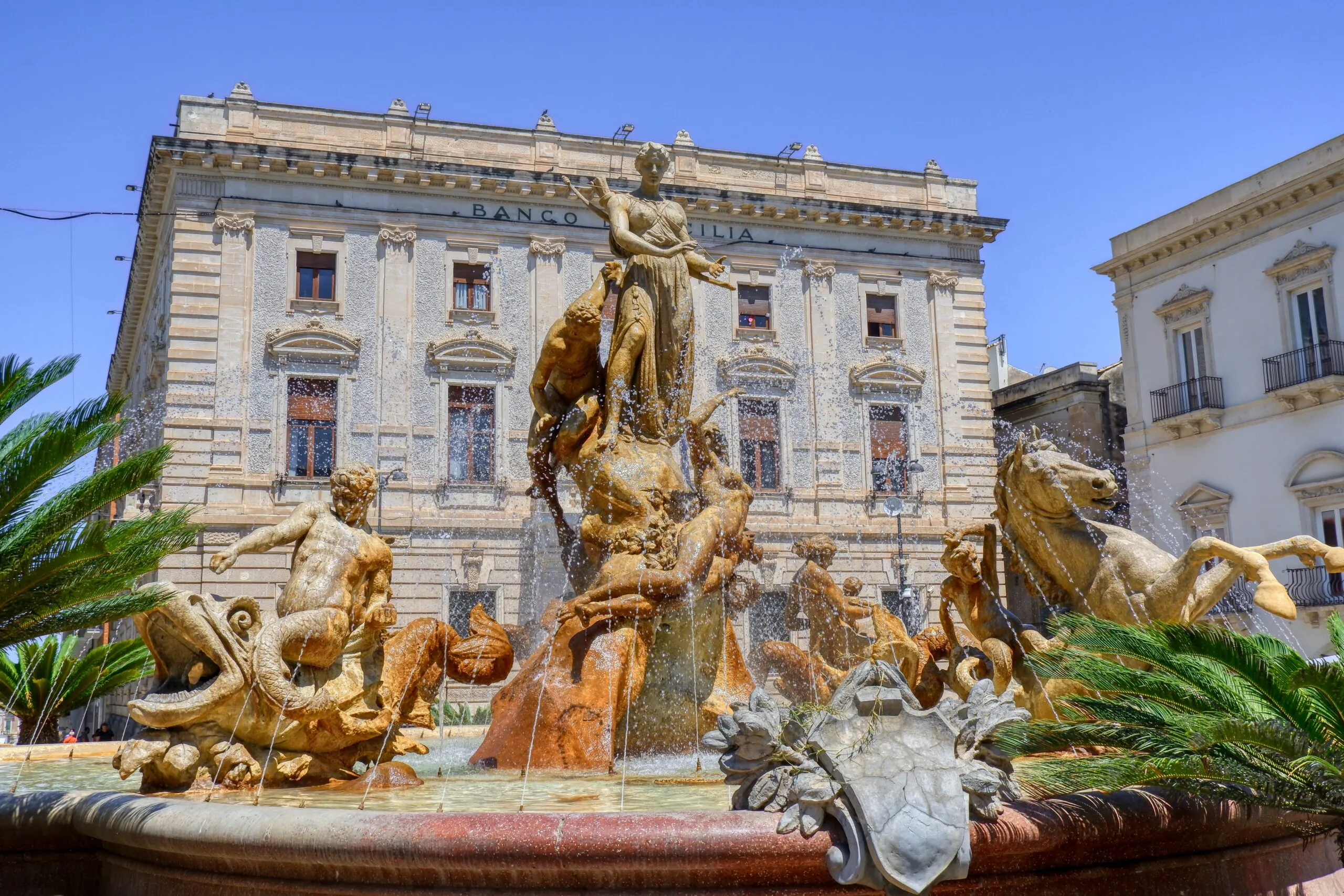
Syracuse (Siracusa) is Sicily’s fourth largest municipality with 115,515 residents as of January 2026 (ISTAT), located on the south-eastern Ionian coast 60–65 km south of Catania Fontanarossa Airport. Inscribed as a UNESCO World Heritage Site in 2005, the city combines the pedestrianised Baroque island of Ortigia with mainland neighbourhoods and coastal resorts, making it a compelling destination for lifestyle buyers and property investors.
Where is Syracuse and why is it on international buyers’ radar?
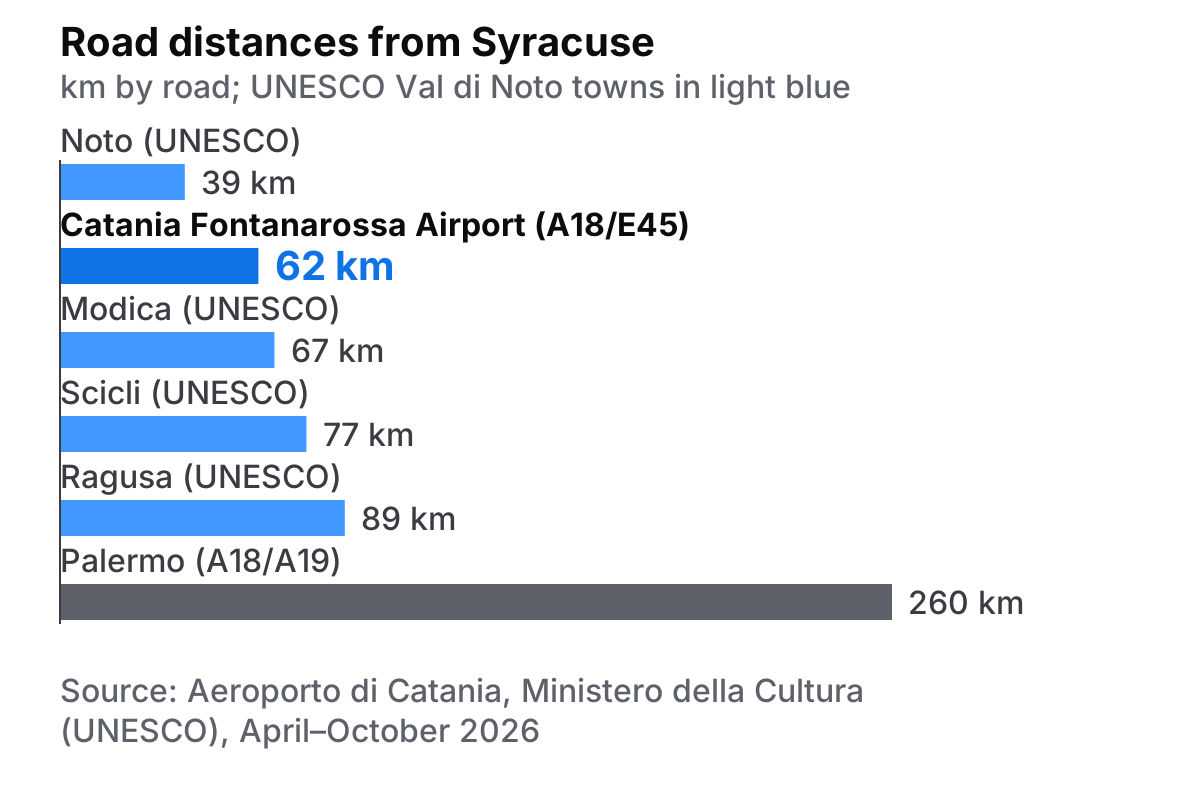
Located on the south-eastern coast of Sicily along the Ionian Sea, Syracuse is bounded by the Anapo and Ciane rivers. According to Aeroporto di Catania (October 2026), the city sits 60–65 km south of Catania Fontanarossa Airport via the A18/E45 motorway, while Palermo lies 258–269 km to the north-west via the A18 and A19 motorways.
The region enjoys a Mediterranean climate characterised by mild winters and hot summers, regularly refreshed by sea breezes yet periodically touched by warm Scirocco winds from North Africa. Looking north across the Gulf of Augusta, Mount Etna forms a dramatic backdrop; following the extensive eruptive activity of the Voragine crater in 2024–2026, the volcano reached a historic record peak elevation of 3,403 metres (11,165 ft) above sea level, as reported by INGV Vulcani in August 2026.
Living in Syracuse: heritage, culture and daily life
Founded by Greek colonists from Corinth in 734–733 BC, Syracuse grew into one of the ancient Mediterranean’s most powerful city-states. In July 2005, it was recognised on the UNESCO World Heritage List as “Syracuse and the Rocky Necropolis of Pantalica”, celebrating a 3,000-year architectural tapestry where ancient Greek foundations, Roman structures, Swabian fortresses like Castello Maniace, and post-1693 Sicilian Baroque architecture stand side by side.
In the historic heart of Ortigia, the magnificent Piazza del Duomo highlights this overlay: the Baroque façade of Syracuse Cathedral incorporates the 5th-century BC Doric columns of the Temple of Athena within its stone walls, set beside the Town Hall at Palazzo Vermexio. Nearby, the freshwater Fountain of Arethusa remains one of only two places in Europe where wild papyrus grows natively.
On the mainland, the Archaeological Park of Neapolis houses the ancient Greek Theatre. While the original cavea seated approximately 15,000 spectators in antiquity, modern performances organised by the Istituto Nazionale del Dramma Antico (INDA) host between 4,400 and 5,000 spectators per show, supplemented by a 4,000-seat summer venue near the Altar of Hieron II (Comune di Siracusa, April 2026).
Beyond history, daily life is anchored in the rich agricultural hinterland, famous for Siracusa lemons, almonds, olives and Nero d’Avola grapes. Ortigia’s morning street market offers fresh seafood, local cheeses and spices. Traditional cuisine includes fried pasta alla siracusana, matalotta fish soup, stewed snails (vavaluci), carob caponata (gghiotta), alongside Sicilian pastries such as cannoli, cassata and granita with almond milk.
Which Syracuse neighbourhoods suit buyers and investors?
Choosing the right neighbourhood depends on your goals, whether seeking a boutique holiday home, a year-round residence, or a residential investment property.
- Ortigia: The historic island core connected to the mainland by two bridges. Dominated by narrow lanes, grand palazzi, and sea views, Ortigia operates under strict ZTL traffic restrictions. It commands strong interest for luxury second homes and holiday rentals.
- Borgata Santa Lucia: Situated just north of Ortigia across the harbour, this historic grid-pattern district surrounds the Basilica of Santa Lucia al Sepolcro and Piazza Santa Lucia. It comes alive on match days around the 5,946-seat Stadio Comunale ‘Nicola De Simone’—inaugurated in 1932 as Stadio Vittorio Emanuele III and renamed in 1979 (Comune di Siracusa, September 2026). Borgata offers charming period properties and faster mainland access at lower acquisition prices.
- Seaside Resorts (Fontane Bianche, Arenella, Ognina): Located 10 to 15 km south of the city centre, these coastal enclaves are renowned for white sandy beaches, rocky coves and detached villas, appealing to lifestyle buyers seeking seaside living or seasonal rental yields.
To navigate local real estate pricing and trends across these varied districts, real estate professionals and private investors rely on CASAFARI Area Insights and our property valuation and market study tool to benchmark listing data and analyse supply dynamics. Agents sourcing properties across Sicilian portals also benefit from CASAFARI Property Sourcing. As seen in broader trends regarding housing demand across Southern Europe, international buyer interest in prime Mediterranean locations remains robust.
Property taxes, residency and short-term rental rules in Syracuse (2026)
Navigating Sicilian property acquisitions requires understanding Italian purchase taxes, local municipal rules and national tax frameworks.
According to guidance from the Agenzia delle Entrate (May 2026), purchase taxes depend on whether you buy from a private individual or a developer:
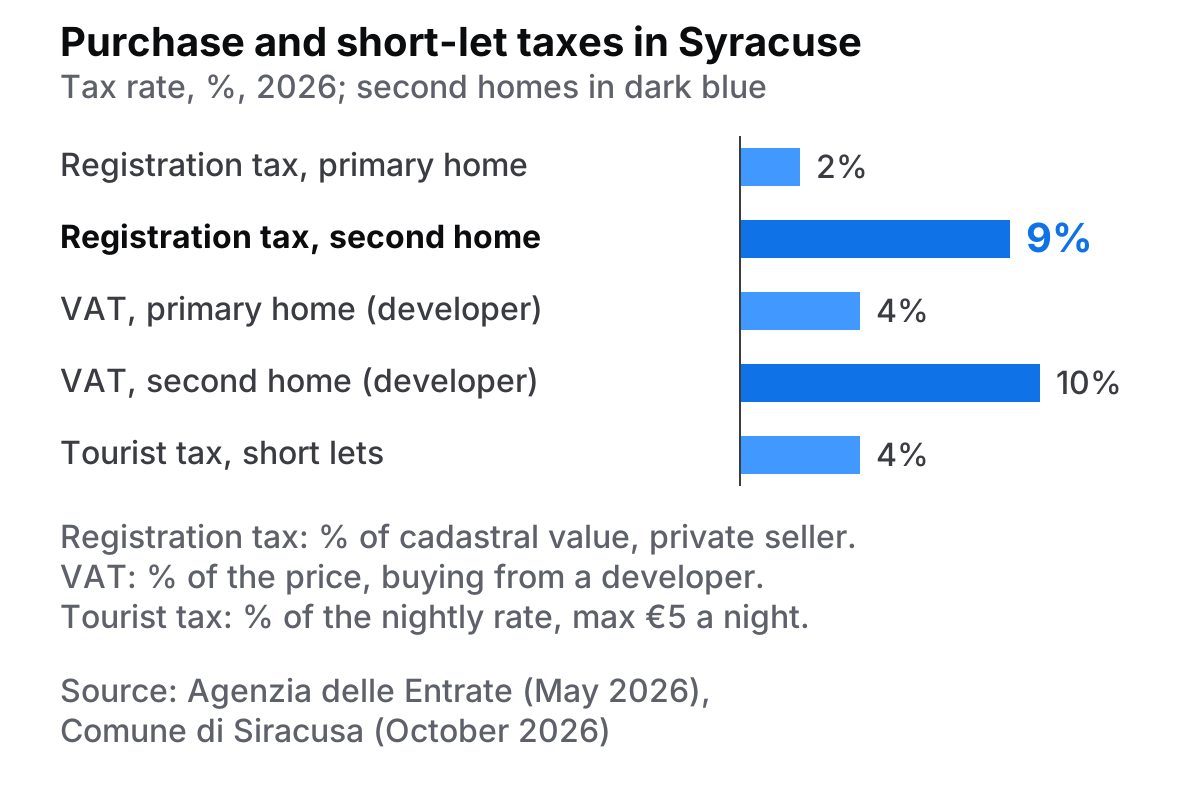
- Private Sale (VAT-exempt): Registration tax (imposta di registro) is set at 2% of the cadastral value for a primary residence (prima casa) or 9% for a second home, plus €50 each for mortgage and cadastral taxes.
- Developer Sale (Subject to VAT): VAT is 4% for a primary residence or 10% for a second home (22% for luxury properties registered under categories A/1, A/8, or A/9), along with three fixed taxes of €200 each for registration, mortgage and cadastral fees.
- Annual Municipal Tax (IMU): Non-luxury primary residences are exempt from IMU, while second homes and holiday properties are subject to annual IMU payments based on local rates.
The 7% Flat Tax Regime for Retirees
Under Article 24-ter of the Italian Income Tax Code (TUIR), foreign retirees can access a reduced 7% flat tax on foreign pension and investment income. However, Law no. 34 of 11 March 2026 (in force since 7 April 2026) raised the municipal population limit from 20,000 to 30,000 inhabitants. Because the municipality of Syracuse has 115,515 residents (ISTAT, January 2026), Syracuse itself does not qualify. Pensioners seeking this tax incentive must instead establish tax residency in eligible smaller municipalities within the province of Syracuse that remain under the 30,000-resident cap.
Short-Term Rental Compliance (CIN & CIR)
Operating a holiday let in Syracuse is governed by Sicilian Regional Law no. 6 of 25 February 2025 and subsequent Assessorial Decrees up to no. 3314 of 1 October 2026. Hosts must obtain both a Regional Identification Code (CIR) and a National Identification Code (CIN), equip properties with mandatory safety items (fire extinguishers and gas/carbon monoxide detectors), and file Annex B compliance documentation.
Additionally, under Municipality of Syracuse tourist tax regulations (City Council Resolution no. 43/2024, confirmed for 2025–2026), short-term rental hosts must collect a municipal tourist tax (imposta di soggiorno) equal to 4% of the net nightly room rate (capped at €5.00 per person per night for up to 7 consecutive nights). Collected funds must be declared and remitted to the municipality by the 16th day of the following month.
Transport and exploring the Val di Noto
Syracuse is easily reached from Catania Fontanarossa Airport via the A18/E45 motorway, a journey of approximately 45–55 minutes by car or direct intercity coach. Train services from Syracuse railway station provide direct connections to Catania, Messina, and mainland Italy.
Within the city, local public transport and the electric shuttle network serving Ortigia—including Line 110 around the island perimeter, Line 105, and routes to the Elorina and Von Platen park-and-ride facilities—are operated by SAIS Autolinee under a nine-year municipal concession awarded in 2026 (Comune di Siracusa, August 2026).
Syracuse also serves as the gateway to the UNESCO-listed Late Baroque towns of the Val di Noto (inscribed in June 2002). Rebuilt following the 1693 earthquake, these nearby historic towns showcase honey-coloured limestone architecture and offer excellent day-trip opportunities:
- Noto: 39 km south-west (35–40 minutes via the A18 motorway)
- Modica: 67 km via the SS115
- Scicli: 77 km via the SS115
- Ragusa: 89 km via the A18 and SS115
Whether you are looking for an Ortigia apartment, a period renovation in Borgata, or a coastal villa in Fontane Bianche, reliable property data is essential. You can sign in to CASAFARI to access comprehensive real estate analytics across south-eastern Sicily.
Frequently asked questions
What are the short-term rental rules and tourist taxes in Syracuse?
Under Sicilian Regional Law no. 6/2025 and Assessorial Decrees up to no. 3314 of 1 October 2026, short-term rental properties in Syracuse must display both a regional CIR code and a national CIN code, install fire extinguishers and gas/carbon monoxide detectors, and complete Annex B filing. Hosts are also required to collect the Municipality of Syracuse’s tourist tax (imposta di soggiorno) of 4% of the net nightly rate, capped at €5.00 per person per night for up to 7 consecutive nights. These funds must be declared and remitted to the municipality by the 16th day of each following month.
Does Syracuse qualify for Italy’s 7% flat tax for foreign retirees?
No, the municipality of Syracuse does not qualify for Italy’s 7% flat tax regime because its population of 115,515 residents exceeds the legal limit. Under Article 24-ter of the Italian Tax Code, as updated by Law no. 34 of 11 March 2026, the 7% flat tax on foreign pension income is restricted to foreign retirees relocating to southern Italian municipalities with no more than 30,000 residents. Buyers seeking this tax benefit must look instead at smaller qualifying towns within the surrounding province of Syracuse.
What taxes do you pay when buying a property in Syracuse, Italy?
When purchasing from a private seller, the registration tax is 2% of the cadastral value for a primary residence (prima casa) or 9% for a second home, plus €50 each for mortgage and cadastral taxes. When buying a new build from a developer subject to VAT, you pay 4% VAT on a primary home or 10% VAT on a second home (22% for luxury properties), along with three fixed administrative fees of €200 each. Following completion, second homes are subject to annual IMU property tax, whereas non-luxury primary residences are exempt.
How do you get from Catania Airport to Syracuse and around Ortigia?
Syracuse is located 60 to 65 km south of Catania Fontanarossa Airport along the A18/E45 motorway, taking about 45 to 55 minutes by car or direct intercity bus. Within Syracuse, city buses and electric shuttles connecting pedestrianised Ortigia with mainland park-and-ride car parks like Elorina and Von Platen are operated by SAIS Autolinee under a nine-year municipal concession awarded in 2026.