

As the suburban train reaches the terminus at Azambuja, the urban density of Lisbon gives way to wide alluvial plains, riverside paths, and vineyard-covered hills. Located about 45 km north-east of the capital on the right bank of the Tejo, Azambuja is a rural municipality of around 21,500 residents according to INE Census 2021 results. It represents the quiet, easternmost edge of the Lisbon commuter zone, where buyers find farmhouses, village homes, and country estates at a distinct price advantage to inner Lisbon.

Azambuja property at a glance: where it is and who buys here
Azambuja sits in the administrative district of Lisbon, bordering the district of Santarém to the north and east. According to the Câmara Municipal de Azambuja, its neighbouring municipalities include Vila Franca de Xira to the south, Alenquer and Cadaval to the west, Cartaxo and Rio Maior to the north, and Salvaterra de Magos and Benavente across the Tejo river.
From a data perspective, international investors should note an important administrative detail: Azambuja is not part of the official Área Metropolitana de Lisboa. Statistical profiles and regional planning place it within the Comunidade Intermunicipal da Lezíria do Tejo. Because of this, official housing statistics published for metropolitan Lisbon usually omit Azambuja. Buyers comparing market trends at the local level can use Area Insights for Azambuja at parish level to evaluate inventory, median asking prices, and time on market.
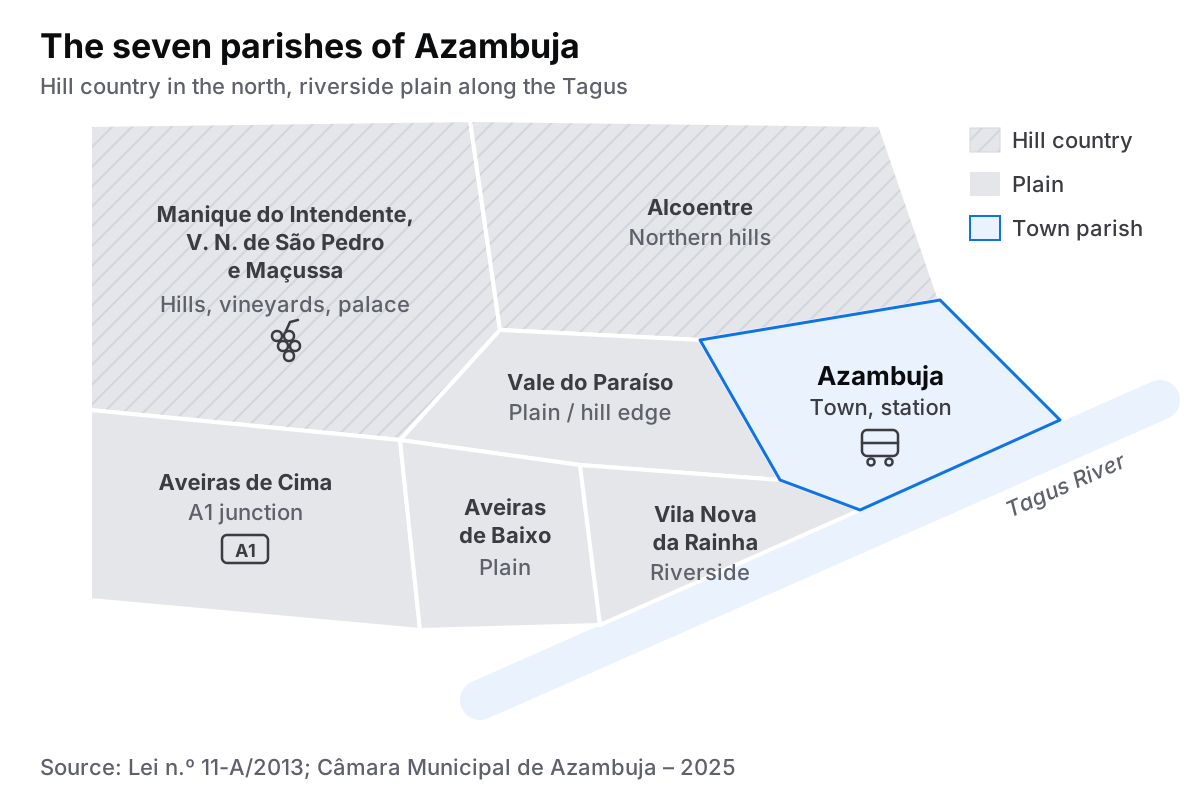
The municipality comprises seven civil parishes created during the 2013 administrative restructuring, codified in Lei n.º 11-A/2013:
- Azambuja: The primary commercial town, housing the central train station, health services, and everyday amenities.
- Vila Nova da Rainha: A riverside plain parish dominated by logistics hubs and quiet residential quarters.
- Aveiras de Baixo & Aveiras de Cima: Aveiras de Cima provides direct access to the A1 motorway, hosting significant industrial infrastructure alongside residential areas.
- Vale do Paraíso: A peaceful rural parish transition zone between the river plain and northern hills.
- Alcoentre: A northern parish set against rolling hills, suitable for buyers seeking country estates and farm properties.
- União das Freguesias de Manique do Intendente, Vila Nova de São Pedro e Maçussa: Historic hill villages known for heritage architecture, vineyards, and traditional quintas.
Buyers in Azambuja typically fall into three groups: commuters seeking space near Lisbon, lifestyle buyers looking for vineyard estates (quintas), and buy-to-let investors serving the regional logistics workforce.
How well connected is Azambuja to Lisbon?
Transport infrastructure is a primary driver of property demand in Azambuja. The town serves as the northern terminus for CP’s Linha da Azambuja suburban rail network. Direct urban trains connect Azambuja station to key Lisbon hubs, including Lisboa-Oriente and Lisboa-Santa Apolónia. Detailed travel times and schedules are maintained on the CP timetable for the Linha da Azambuja.
By road, Azambuja connects directly to the A1 motorway via the junction at Aveiras de Cima, as well as the national N3 road along the Tejo. Humberto Delgado Airport in Lisbon is situated approximately 45 km to the south-west, allowing off-peak driving times of around 45 minutes. The presence of the Plataforma Logística de Azambuja along the main road arteries makes the area a strategic logistics hub, generating stable local employment and consistent demand for long-term rental housing.
What can international buyers still count on in 2026: Golden Visa, NHR and IFICI
International buyers researching Azambuja property must navigate updated Portuguese residency and tax legal frameworks.
Property acquisition no longer confers eligibility for the Portuguese Golden Visa (ARI). Following the entry into force of Lei n.º 56/2023 (Mais Habitação) in the Diário da República on 7 October 2023, all real estate investment routes were permanently removed. Foreign buyers seeking residence must look to alternative options, such as qualifying investment funds, job-creation initiatives, or standard residency paths like the D7 (passive income) or D8 (digital nomad) visas.
Tax frameworks have similarly evolved. The Non-Habitual Resident (NHR) status closed to new applicants on 1 January 2024. It was succeeded by the IFICI incentive for scientific research and innovation, governed by Portaria n.º 352/2024 regulating IFICI. IFICI offers a 20% flat tax rate on qualifying Portuguese employment or self-employment income for ten years, but applies strictly to specific eligible sectors rather than residential property buyers.
Standard acquisition taxes apply to all real estate purchases in Azambuja:
- IMT (Municipal Property Transfer Tax): Progressive tax up to 7.5% for residential properties, or a flat 6.5% for other urban real estate.
- Stamp Duty (Imposto do Selo): Fixed rate of 0.8% on the purchase price.
- IMI (Municipal Property Tax): Annual tax ranging between 0.3% and 0.45% of the property’s Taxable Value (VPT).
Under-35 first-time buyers residing in Portugal may qualify for specific exemptions from IMT and Stamp Duty. Standard tax rate details can be verified on the IMT and IMI tables on the Portal das Finanças. For a detailed overview of conveyancing, consult our guide to buying property in Portugal.
Can I let my Azambuja property as a short-term rental?
Short-term holiday lets (Alojamento Local or AL) are subject to refreshed regulatory rules under Decreto-Lei n.º 76/2024 on Alojamento Local, published in November 2024. The legislative update revoked the nationwide freeze on new AL licenses and eliminated mandatory license expirations.
Municipalities retain authority to set localized registration limits. In Azambuja, short-term rental activity is modest compared to coastal tourist hotspots. Investors evaluating rental income often focus on long-term residential lettings supported by the regional logistics sector. To understand broader investor motivations across the country, see why investors keep looking at Portugal.
Life in Azambuja: vineyards, the Tejo and the hills of Montejunto
Azambuja offers a authentic Ribatejo lifestyle defined by agricultural heritage, wine production, and proximity to nature.
The municipality lies within the protected Tejo wine region (DOC Tejo). Working wine estates, such as Quinta de Vale de Fornos, sit alongside active farms throughout the region. Across the river in Muge, historical properties like Casa Cadaval at Muge showcase regional agricultural traditions and Lusitano horse breeding.
To the west, the landscape rises towards the Serra de Montejunto, a protected natural region managed under the ICNF page on the Serra de Montejunto Protected Landscape. Reaching an altitude of 666 metres, the range provides hiking trails, climbing routes, and views across the Tejo valley.
Architectural heritage is prominent in northern parishes like Manique do Intendente, which features the neo-classical, unfinished Palácio Pina Manique commissioned in the late 18th century. Along the Tejo banks, historical structures such as the Palácio das Obras Novas recall the era when river transit linked interior estates directly to Lisbon.
Local families are served by state educational facilities under the Agrupamento de Escolas de Azambuja, while primary medical care is handled through local health centres, with regional hospital services provided nearby in Vila Franca de Xira.
How to research Azambuja property with CASAFARI
Navigating rural property markets requires accurate pricing context, as listing volume per parish can vary significantly. CASAFARI provides property professionals and private buyers with tools to analyze rural market dynamics:
- Area Insights: Analyze supply levels, price distributions, and market momentum at the municipality and parish level.
- Comparables: Generate real-time valuations for unique country houses and quintas by leveraging historical market listings. Learn more about Comparables and market studies for rural properties.
- Property Sourcing: Locate and track available listings across multiple portals in one centralized interface.
Developers building custom market workflows can review the Area Insights developer docs (in English) or check which locations Market Analytics covers. To access raw market data and valuation tooling, sign in to the CASAFARI platform.
Frequently asked questions
How far is Azambuja from Lisbon, and is there a direct train?
Azambuja is located approximately 45 km north-east of Lisbon by road via the A1 motorway. It serves as the terminus for CP’s suburban Linha da Azambuja, offering direct rail connections to central Lisbon stations, including Lisboa-Oriente and Santa Apolónia. Driving off-peak to Lisbon Airport takes around 45 minutes.
Can I still get a Portuguese Golden Visa by buying a house in Azambuja?
No, real estate purchases no longer qualify for the Portuguese Golden Visa. Lei n.º 56/2023 ended all property-based routes to residence across Portugal in October 2023. Foreign buyers interested in living in Azambuja can consider alternative residence options, such as the D7 passive income visa or the D8 digital nomad visa.
Is Azambuja part of the Lisbon metropolitan area?
While Azambuja belongs to the administrative district of Lisbon, it is not part of the official Área Metropolitana de Lisboa. Administratively and statistically, it falls within the Comunidade Intermunicipal da Lezíria do Tejo. Consequently, standard metropolitan housing datasets often exclude Azambuja.
What are the parishes of Azambuja and which is best for a country house?
Azambuja consists of seven civil parishes: Azambuja, Aveiras de Cima, Aveiras de Baixo, Vale do Paraíso, Vila Nova da Rainha, Alcoentre, and the union of Manique do Intendente, Vila Nova de São Pedro e Maçussa. Buyers seeking traditional country estates and quintas generally focus on northern hill parishes like Alcoentre and Manique do Intendente, while apartments and townhouses are centred in Azambuja town.