
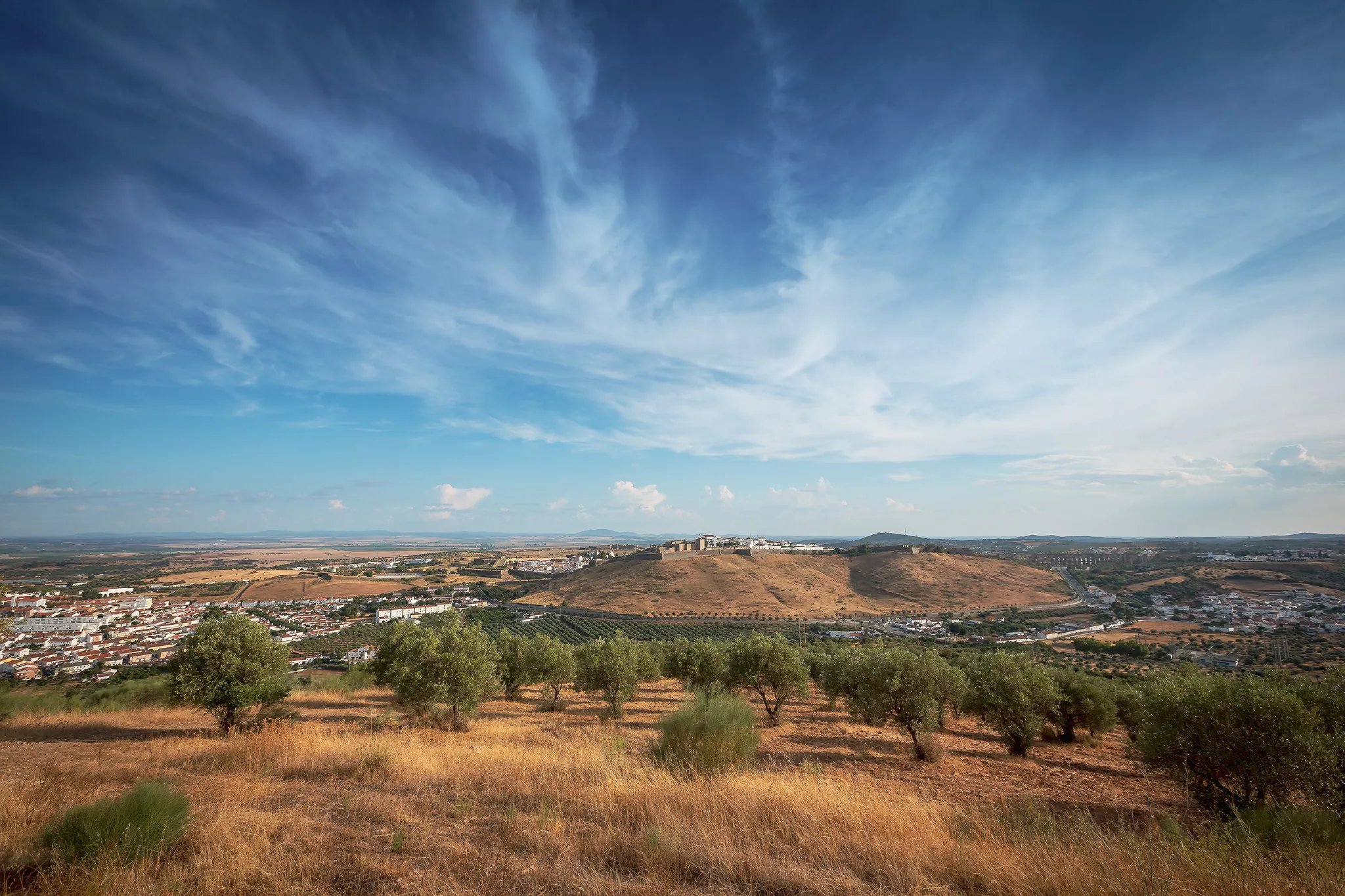
Home to 201,590 residents across 10 civil parishes according to the Instituto Nacional de Estatística (INE) housing price and rental statistics 2021 Census update, Loures is a major municipality in Greater Lisbon. In Q1 2026, the median residential sale price reached €3,191 per m², while median new lease rents rose to €13.03 per m² in Q2 2026. Combining dense commuter hubs in the south with historic wine country in the north, Loures offers strategic proximity to central Lisbon at accessible capital values.
What defines the Loures property market in Greater Lisbon?
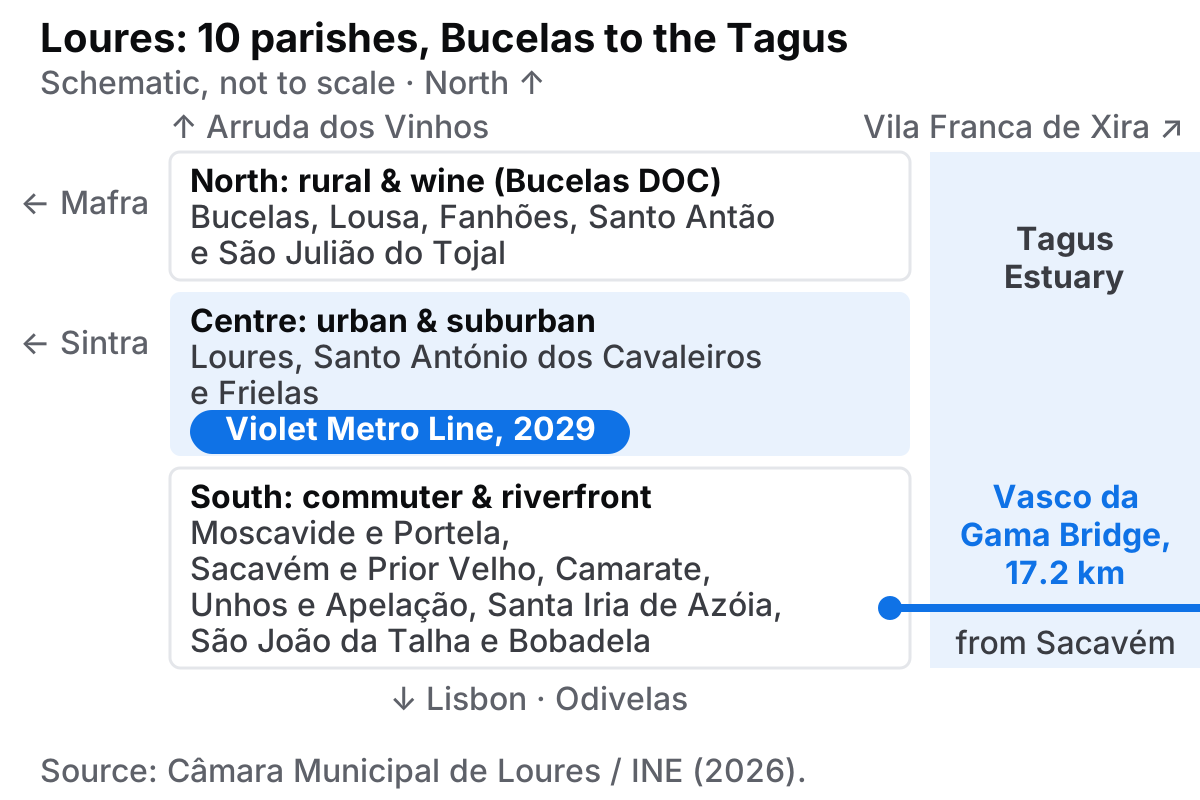
Situated directly north and northeast of Lisbon, the municipality of Loures spans 10 reorganized civil parishes (freguesias) that blend high-density urban living with countryside quintas. Contrary to common geographical misconceptions, Loures does not border Amadora; its borders are defined by Lisbon and Odivelas to the south and southwest, Sintra and Mafra to the west, Arruda dos Vinhos to the north, Vila Franca de Xira to the northeast, and the Tagus River Estuary to the east.
For investors consulting our guide to buying property in Portugal, Loures functions as a two-speed real estate ecosystem. The southern parishes along the riverfront and airport boundary act as immediate, lower-cost extensions of Lisbon’s Parque das Nações district, attracting domestic commuters, young professionals, and short-to-medium-term tenants. Meanwhile, the northern interior parishes offer lower density, scenic landscape, and character properties. Market participants tracking micro-level supply and demand rely on tools like CASAFARI Area Insights to evaluate pricing variations and inventory across these distinct parish clusters.
Southern Loures: urban living in Moscavide, Portela and Sacavém
The southern tier of the municipality—comprising the parish unions of Moscavide e Portela, Sacavém e Prior Velho, Camarate, Unhos e Apelação, and Santa Iria de Azóia, São João da Talha e Bobadela—forms the core urban engine of Loures. These neighbourhoods share direct physical and commercial ties with Lisbon’s northeastern sector.
Key regional transit infrastructure anchors this urban belt:
- Humberto Delgado Airport: While the airport terminal is located primarily within Lisbon’s Olivais parish, its northern boundary extends directly into Camarate, Unhos e Apelação, and Sacavém e Prior Velho. This makes southern Loures a prime location for aviation staff, logistics enterprises, and frequent business travellers.
- Vasco da Gama Bridge: Spanning 17,185 metres in total length (comprising 12,345 metres of bridge structure and viaducts alongside 4,840 metres of dedicated access roads), this landmark crossing connects Sacavém and Parque das Nações directly to Alcochete and Montijo on the south bank of the Tagus, providing continuous motorway links towards Setúbal, the Alentejo, and the Algarve.
- Rail and Metro Infrastructure: Southern Loures already benefits from the Lisbon Metro Red Line at Moscavide and Encarnação, alongside the CP Azambuja suburban rail line serving Sacavém, Bobadela, and Santa Iria. Commuter transit will expand further with the Violet Line (Linha Violeta) light rail. Cleared by the European Commission in April 2026 following its April 2025 public tender, the light rail network is scheduled for completion in 2029, establishing a fast connection between Loures and Odivelas.
Southern Loures also maintains a strong cultural identity rooted in its industrial past. The Museu de Cerâmica de Sacavém opened on 7 July 2000 on the historical grounds of the renowned Fábrica de Loiça de Sacavém, which operated from the 1850s and shaped local urban development.
Northern Loures: vineyards, heritage and rural homes in Bucelas and Lousa
Travelling north from the urban core reveals a dramatic shift in property typology. Parishes such as Bucelas, Lousa, Fanhões, and Santo Antão e São Julião do Tojal feature rolling hills, lower population densities, and a landscape dominated by detached family homes and historic country estates (quintas).
Bucelas holds an esteemed position in Portuguese viticulture as a demarcated DOC wine region famed for its crisp white wines made from the Arinto grape variety. The region’s history is preserved at the Museu do Vinho e da Vinha in Bucelas, inaugurated on 26 July 2013 by the Câmara Municipal de Loures. For buyers looking into investing in Portuguese real estate for lifestyle, multi-generational living, or eco-tourism, northern Loures provides expansive land parcels within a 30-minute drive of Lisbon’s city centre.
How are residential sales, valuations and rents performing in Loures?
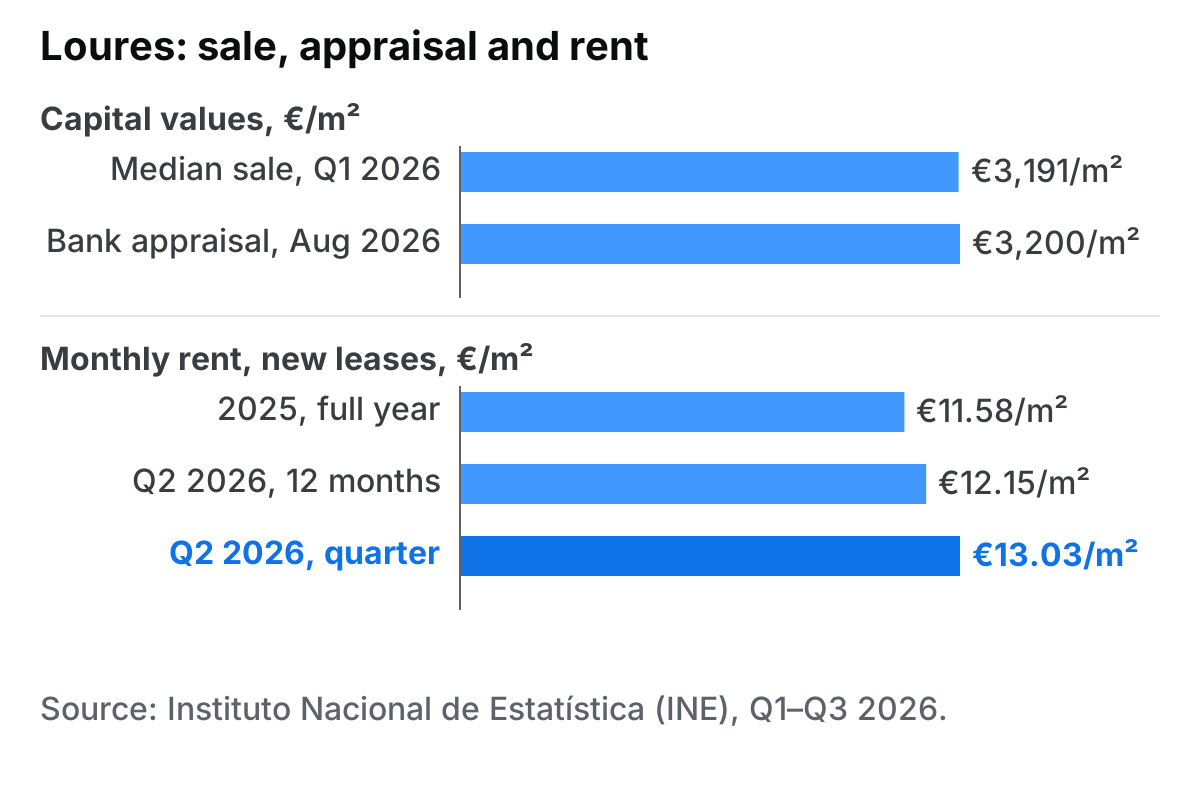
Transaction metrics compiled by the Instituto Nacional de Estatística (INE) housing price and rental statistics show sustained capital and rental growth across Loures. In Q1 2026, the 12-month rolling median residential sale price stood at €3,191 per m². Bank appraisals mirror this transaction floor, reaching a median value of €3,200 per m² in August 2026.
The residential rental market reflects strong structural demand driven by Lisbon’s broader housing tight supply. According to official INE data, median new lease rents rose from €11.58 per m² for the full year 2025 to €12.15 per m² on a 12-month rolling basis in Q2 2026, peaking at €13.03 per m² for standalone Q2 2026 lease contracts.
Municipal taxation and short-term letting frameworks set by the Câmara Municipal de Loures tax and Alojamento Local regulations remain competitive:
- Property Tax (IMI): The municipal council lowered the urban property tax (IMI) rate to 0.361% in 2026 (down from 0.362% in 2025). Fixed family IMI deductions apply for primary residences (€30 for one dependant, €70 for two, and €140 for three or more).
- Corporate Surcharge (Derrama): The municipal Derrama rate stands at 1.5% on taxable profit, with exemptions available for companies with turnover up to €150,000.
- Short-Term Rentals (AL) and Tourist Tax: Short-term accommodation operates under the Municipal Alojamento Local Regulation and carries a municipal tourist tax of €1.50 per night per guest aged 13 and over (capped at 7 consecutive nights).
Real estate agencies and institutional asset managers utilize our property valuation and market study tool and CASAFARI Property Sourcing to cross-reference active portal ask prices against verified transactional data across Loures’s 10 parishes. For advanced custom data integration, developers can review the Area Insights API documentation.
To analyse active market opportunities, track price movements, and access real-time valuation metrics across Loures and Greater Lisbon, sign in to the CASAFARI platform to explore Loures market data in real time.
Frequently asked questions
How is Loures connected to central Lisbon by public transport?
Southern parishes such as Moscavide and Sacavém are served by the Lisbon Metro Red Line and the CP Azambuja suburban railway line into Gare do Oriente and Santa Apolónia. In addition, the Metropolitano de Lisboa Violet Line (Linha Violeta) light rail project—cleared by the European Commission in April 2026—is scheduled for completion in 2029 to link Loures with Odivelas and the wider metro network.
What are the property tax (IMI) and short-let rules in Loures?
For 2026, the Câmara Municipal de Loures fixed the urban property tax (IMI) rate at 0.361% (down from 0.362% in 2025), alongside family deductions of €30 for one dependant, €70 for two, and €140 for three or more. Short-term rentals operate under the Municipal Alojamento Local Regulation and are subject to a municipal tourist tax of €1.50 per person per night for guests aged 13 and over, capped at 7 consecutive nights.
How does southern Loures compare with northern parishes like Bucelas?
Southern parishes such as Moscavide, Portela, and Sacavém are dense urban extensions of northeastern Lisbon, dominated by apartment blocks serving commuters and airport or Parque das Nações staff. Northern parishes like Bucelas, Lousa, and Fanhões offer a rural landscape of hills, detached houses, and estates within the historic Bucelas DOC wine region.
Where is Humberto Delgado Airport located in relation to Loures?
Lisbon’s Humberto Delgado Airport lies predominantly within the municipality of Lisbon in the civil parish of Olivais, but its northern perimeter extends directly into the Loures parishes of Camarate, Unhos e Apelação and Sacavém e Prior Velho. This gives southern Loures immediate road and metro access to the terminals.