
AMADORA PROPERTY GUIDE
Close enough but far enough from the Portuguese capital
Amadora is a compact, urban municipality of 23.79 km² bordering Lisbon to the north-west, housing 171,454 residents at the 2021 Census (Câmara Municipal da Amadora). Situated along the suburban railway and Lisbon Metro network, it serves as a core commuter base for the capital. This guide explores transport links, buying costs, local infrastructure, and rental regulations across the municipality.
Amadora at a glance: where it is and who lives there
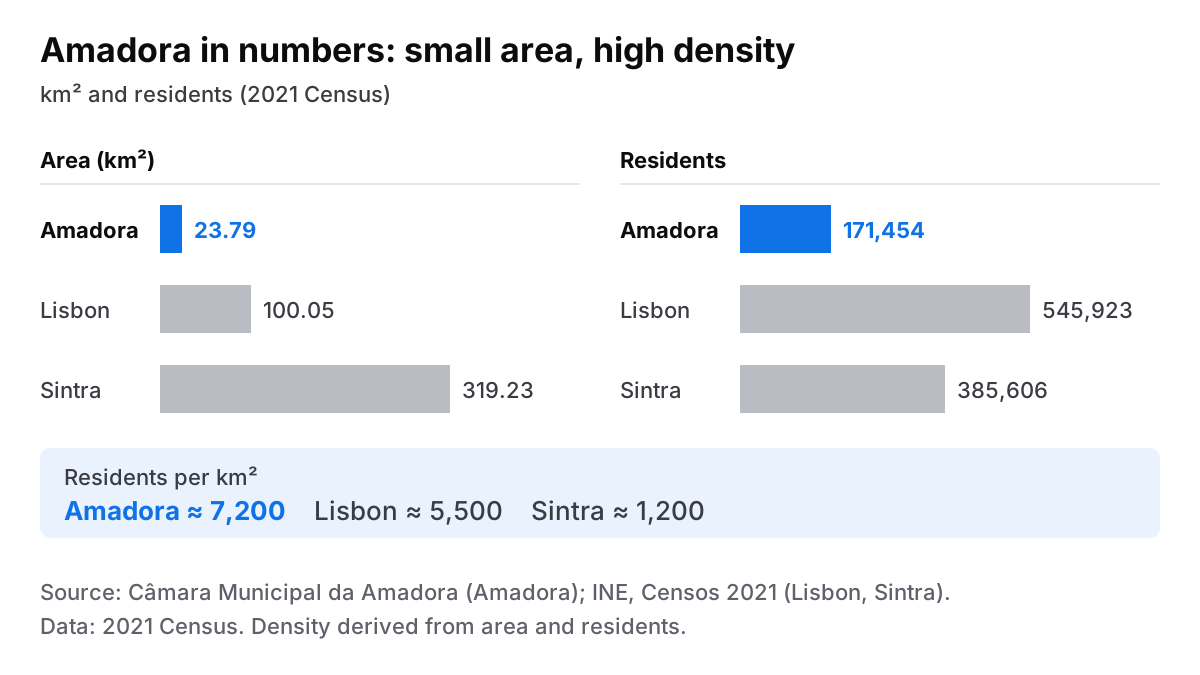
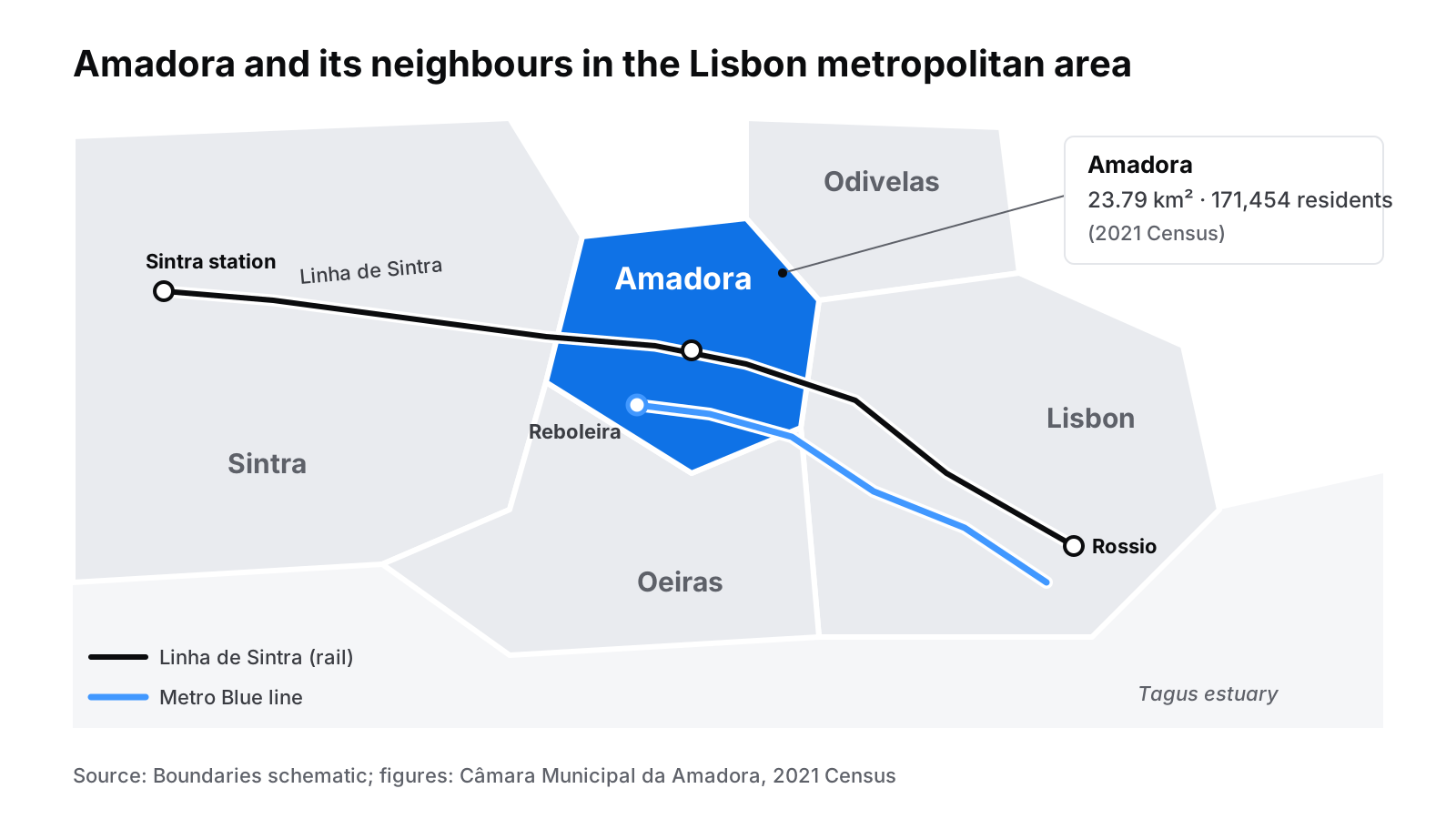
Positioned directly north-west of Lisbon between the capital, Sintra, Oeiras, and Odivelas, Amadora became an independent municipality on 11 September 1979 (Câmara Municipal da Amadora). Covering 23.79 km² with 171,454 residents at the 2021 Census, it is the most densely populated municipality in Portugal, with roughly 7,200 inhabitants per square kilometre.
The municipality’s housing stock consists predominantly of mid-to-late 20th-century apartment buildings. For buyers and investors comparing the area against the neighbouring Lisbon area guide or Sintra area guide, Amadora offers functional residential space and urban transport connectivity at lower entry prices than central Lisbon. Buyers here typically include commuters working in Lisbon, first-time homeowners, and buy-to-let investors focused on rental yield.
How do you get from Amadora to Lisbon?
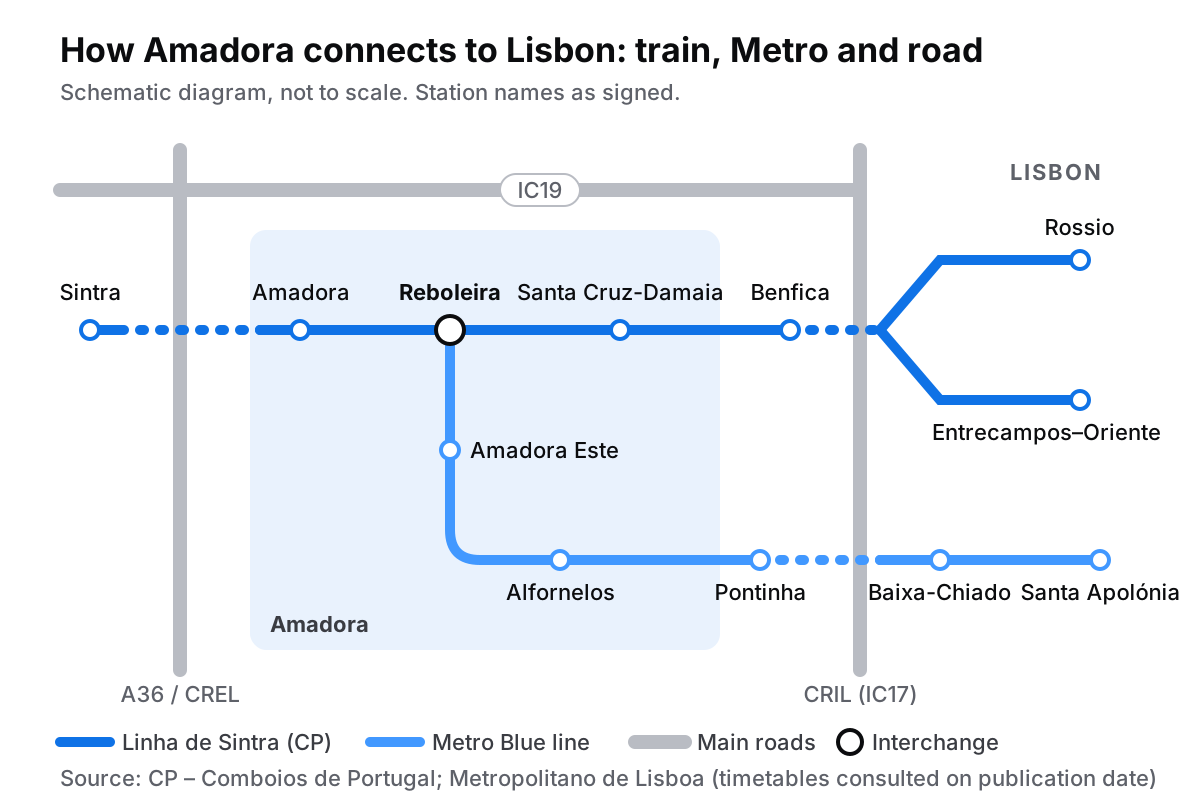
Transport infrastructure is Amadora’s defining feature. The suburban railway (Linha de Sintra), operated by CP, runs through the municipality, connecting local stations directly to central Lisbon hubs such as Rossio and Entrecampos (CP timetables).
For underground connections, Reboleira station serves as the western terminus of the Lisbon Metro Blue line (Linha Azul), providing a direct transport interchange between the suburban rail network and the capital’s metro system (Lisbon Metro).
Road connections are anchored by the IC19 highway leading towards Sintra, the CRIL (IC17) orbital motorway, and the CREL (A36) outer ring road, connecting driver routes across the Lisbon metropolitan region. Local bus transit is handled by the Carris Metropolitana network.
What is daily life like in Amadora: shopping, schools, health and leisure
Daily life in Amadora centres on major commercial and civic anchors. Retail activities are led by the UBBO shopping centre in the Alfragide and Venda Nova area, which houses retail stores and family entertainment facilities including KidZania Lisboa. The Alfragide business district also hosts major commercial parks.
Education and healthcare services include public school facilities alongside private alternatives such as PaRK International School’s Alfragide campus, which opened in 2019. Public general healthcare for the area is provided by the Hospital Prof. Doutor Fernando Fonseca (widely known as the Amadora-Sintra hospital).
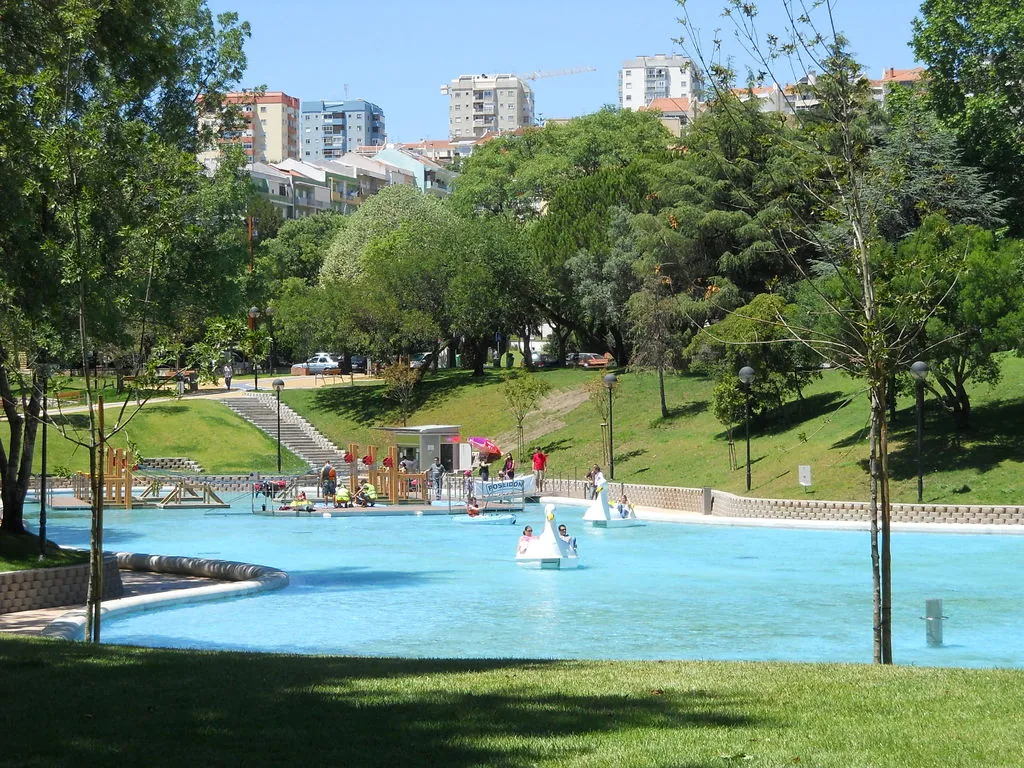
Cultural and green spaces include the Parque Central and municipal facilities such as Recreios da Amadora. The municipality also hosts the annual Amadora BD international comics festival every autumn. Nearby green space includes the expansive Monsanto Forest Park on the border with Lisbon.
Buying a property in Amadora: costs, taxes and who can buy
Foreign individuals can purchase property in Portugal without nationality restrictions. Buyers must acquire a Portuguese tax identification number (NIF), open a local bank account, and complete the transaction before a public notary (our step-by-step guide to buying property in Portugal).
Property transfer taxes include IMT (Imposto Municipal sobre as Transmissões Onerosas de Imóveis), calculated on a progressive scale with exemptions for primary residences, and Stamp Duty (Imposto do Selo) levied at 0.8% of the purchase price. Municipalities also collect annual property tax (IMI) within legal rate bands set by the central tax authority (Portal das Finanças).
Important legal shifts apply to international buyers:
- Golden Visa: The residential real estate investment route to residency was officially repealed in October 2023 under Lei n.º 56/2023.
- Non-Habitual Resident (NHR) regime: The NHR tax framework closed to new applicants at the start of 2024, replaced by the more specialised IFICI regime for scientific research and qualified roles.
Letting a flat in Amadora: long lets and short lets
Long-term residential letting (arrendamento) represents the primary strategy for property investors in Amadora, driven by sustained demand from Lisbon commuters. Investors can review market dynamics and evaluate how to find rental yield with CASAFARI. Prior to entering a lease or contract, property owners must secure an energy performance certificate.
For short-term holiday lets (Alojamento Local - AL), national registration (RNAL) is mandatory. Following Decreto-Lei n.º 76/2024, which repealed the 2023 national freeze on new licences, regulatory authority over short-term lets rests primarily with local municipal councils.
How CASAFARI data helps you read the Amadora market
Real estate professionals and private investors use Area Insights to analyse real-time market trends, active property supply, and listing rates across Amadora. Developers and technical teams can inspect the Area Insights developer documentation in English, or try CASAFARI on the platform to conduct property searches and valuations.
Frequently asked questions
Is Amadora a good place to live if you work in Lisbon?
Yes, Amadora is a practical choice for Lisbon commuters due to its direct transport connections. The Linha de Sintra suburban rail line and the Lisbon Metro Blue line terminus at Reboleira link the municipality straight into central Lisbon. While its high density (171,454 residents on 23.79 km² at the 2021 Census) means housing consists mainly of mid-century apartment blocks, buyers trade architectural charm for lower entry prices and strong transport connectivity.
Can foreigners buy property in Amadora?
Yes, there are no nationality restrictions on purchasing property in Portugal. Foreign buyers require a Portuguese tax identification number (NIF), a Portuguese bank account, and the formal execution of the deed before a notary. Note that buying real estate no longer qualifies for the Golden Visa program following legal changes under Lei n.º 56/2023 in October 2023.
What taxes do you pay when buying a flat in Amadora?
When purchasing a flat, buyers pay property transfer tax (IMT) based on progressive rates and property usage, alongside Stamp Duty at 0.8% of the transaction price. Following the purchase, owners pay annual municipal property tax (IMI) based on the property’s rateable value. Detailed tax tables and updated rate bands are published on the Portal das Finanças.
Can I rent out an Amadora flat on Airbnb?
Short-term lets require a valid Alojamento Local (AL) registration number. While national restrictions on new licences were updated under Decreto-Lei n.º 76/2024, short-let rules and local containment limits are overseen by individual municipal councils. Landlords must also ensure the property holds a valid energy performance certificate prior to letting.