

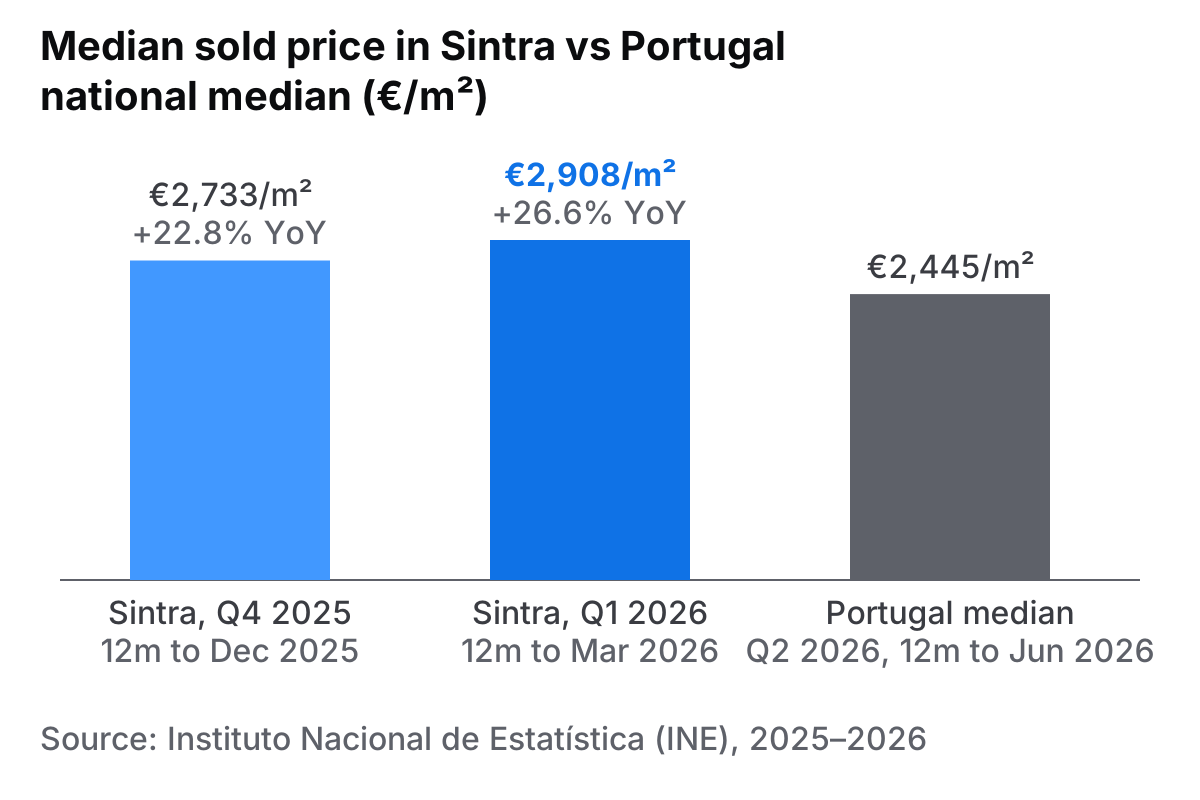
Sintra combines a 946-hectare UNESCO Cultural Landscape, Atlantic coastline, and a high-volume housing market serving 400,947 residents. According to the Instituto Nacional de Estatística (INE) housing price statistics, Sintra reached a median sold property price of €2,908/m² in Q1 2026, up 26.6% year-on-year, with 5,934 residential transactions completed in the 12 months to June 2026. Direct rail connections reach central Lisbon in 39 minutes.
Why is Sintra property attracting both international families and Lisbon commuters?
The municipality of Sintra occupies a unique position in the Lisbon Metropolitan Area. Home to 400,947 residents according to the 2024 INE estimates, it balances dense urban commuter hubs along its eastern rail corridor with protected pine forests, romantic 19th-century estates, and wild Atlantic beaches. This geographic diversity creates distinct real estate micro-markets that appeal to different buyer profiles.
At the historic core, Vila de Sintra and its surrounding hills showcase grand manor houses and historic estates (quintas), anchored by landmarks such as the Pena National Palace and Monserrate Palace. Towards the south-east, resort communities like Quinta da Beloura and Penha Longa offer modern gated villas, private security, and championship golf courses. Meanwhile, the eastern parishes bordering Amadora and Oeiras provide accessible apartment housing for Lisbon professionals seeking rapid transport connections.
Compared to neighboring Cascais to the south or central Lisbon to the east, Sintra offers larger plot sizes, lower price points per square metre, and immediate proximity to nature. Real estate professionals using CASAFARI Area Insights track strong transaction velocity across these micro-markets, reflecting sustained domestic and international demand. For those evaluating broader market dynamics across the country, our complete guide to buying property in Portugal provides essential regulatory background.
Where is Sintra located and how fast is the commute into Lisbon?
Sintra sits in the western section of the Lisbon Metropolitan Area, bordered by the Atlantic Ocean to the west, Cascais to the south, and Oeiras, Amadora, and Loures to the east. Its landscape is dominated by the Serra de Sintra mountain range, which creates a cooler coastal microclimate distinct from central Lisbon.
Commuters relying on public transport benefit from direct rail services operated by Comboios de Portugal. According to the Comboios de Portugal (CP) Linha de Sintra timetable, urban trains run regularly from Sintra station to central Lisbon’s Rossio station in 39 minutes, making 15 intermediate stops. Trains linking Sintra to Lisbon’s primary business district and transport hub at Lisboa - Oriente complete the trip in approximately 47 minutes.
For road connections, the A16 motorway links Sintra directly to the A5 Cascais-Lisbon highway, while the IC19 dual carriageway provides direct vehicular access into central Lisbon. Driving durations vary significantly depending on peak-hour traffic conditions.
A central feature of the municipality is the UNESCO Cultural Landscape of Sintra, which was inscribed as a World Heritage Site on 6 December 1995. The designation protects a 946-hectare core zone alongside a 3,641-hectare buffer zone, safeguarding the architectural harmony between historic palaces and natural terrain.
Which international schools and family neighbourhoods stand out in Sintra?
Sintra has emerged as one of the premier international education hubs in Portugal, driven by the concentration of top-tier schools within the Linhó and Penaferrim area. This cluster attracts expatriate families and international executives who prioritize proximity to high-caliber schooling.
Three prominent international schools operate directly within the municipality of Sintra:
- Carlucci American International School of Lisbon (CAISL): Founded in 1956 and located in Linhó, CAISL is an independent non-profit school serving students from age 3 through Grade 12. It offers an American curriculum culminating in the International Baccalaureate (IB) Diploma.
- TASIS Portugal: Established in 2020 in the Penaferrim/Linhó area, TASIS Portugal provides American and international curricula, including IGCSE and IB Diploma programmes, from Pre-K to Grade 12.
- Prime School International: Operating a campus in Sintra alongside its other locations, Prime School delivers Cambridge-certified bilingual international education tailored for students aged 3 to 14.
This concentration of international schools has transformed surrounding neighbourhoods like Linhó, Quinta da Beloura, and Penha Longa into highly sought-after residential zones. Detached family homes and condominium apartments in these areas maintain high rental yields and low vacancy rates. Buyer’s agents searching for listed properties across all agency feeds frequently utilize CASAFARI Property Sourcing to locate off-market and active listings near school catchment areas.
What is daily life like between the Sintra-Cascais Natural Park and the Atlantic coast?
Beyond its architectural monuments, Sintra offers access to exceptional natural landscapes. A substantial portion of the municipality falls within the ICNF Sintra-Cascais Natural Park data protection area, which covers 14,412 hectares of terrestrial habitat extending across the Serra de Sintra to the dramatic cliffs of Cabo da Roca, the westernmost point of continental Europe.
Along the Atlantic coast, the parish of Colares is famous for its coastal villages and wave conditions. Surf and bodyboard enthusiasts gather at oceanfront beaches such as Praia Grande, Praia Pequena, and Praia das Maçãs, where traditional tram links connect the coastline back to Sintra town during summer months.
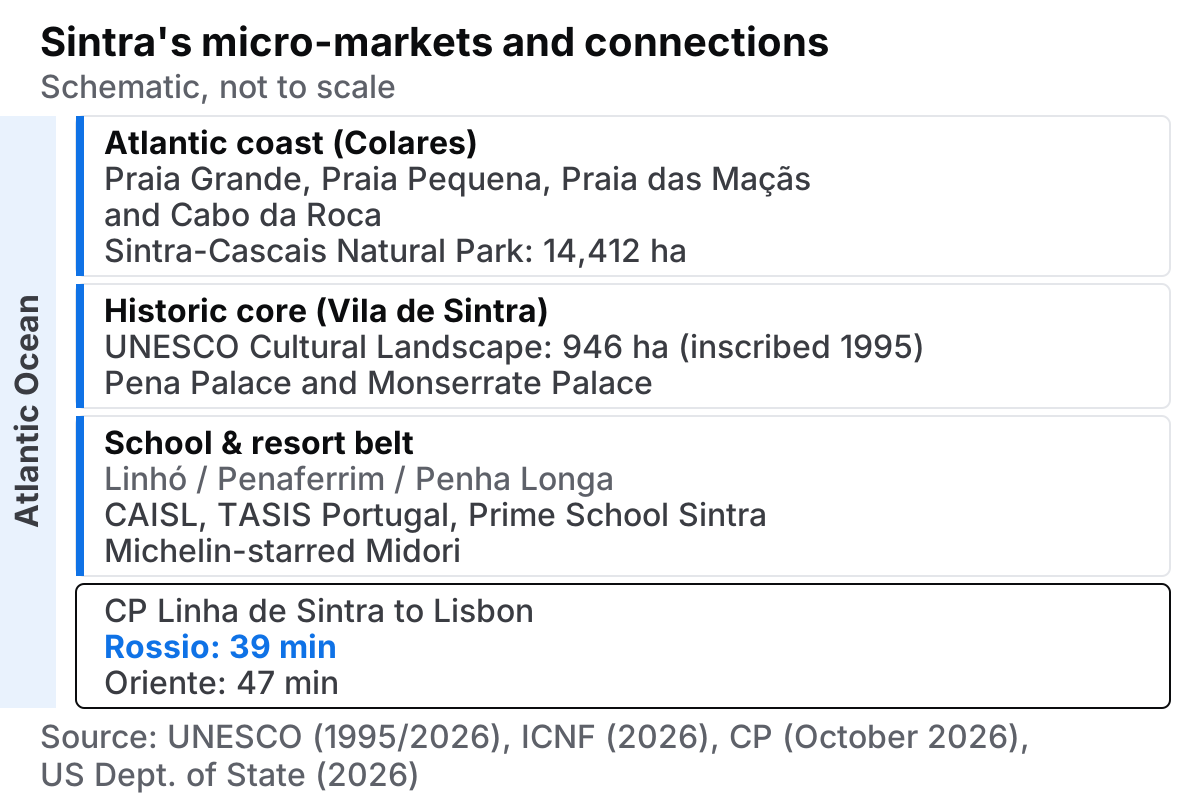
Sintra also offers world-class dining. Fine dining options include Midori in the Michelin Guide Portugal, situated within the Penha Longa Resort. Led by chef Pedro Almeida, Midori holds 1 Michelin Star for its innovative Japanese-Portuguese fusion menu. For traditional coastal dining, oceanfront establishments like Nortada on Avenida Alfredo Coelho at Praia Grande serve fresh Atlantic fish and seafood against panoramic views of the ocean. Investors exploring the long-term lifestyle appeal of the area can read more in our guide to investing in Portuguese real estate.
What do buyers and investors need to know about taxes, visas and short-let rules in 2026?
Navigating real estate acquisition in Sintra requires an understanding of local municipal taxes and national legal frameworks:
Property Taxation (IMI and IMT)
Sintra maintains an investor-friendly property tax structure. For 2025 and 2026, the local municipal assembly set the urban Municipal Property Tax (Imposto Municipal sobre Imóveis or IMI) at the statutory minimum rate of 0.30%. Families residing in their primary home also benefit from the IMI Familiar rate reduction based on the number of dependents.
Property transfer tax (Imposto Municipal sobre as Transmissões Onerosas de Imóveis or IMT) follows the updated progressive tables published in the 2026 IMT property transfer tax tables (Ofício Circulado No. 40129/2026). First-time home buyers aged up to 35 purchasing a primary residence continue to benefit from the IMT Jovem exemption up to statutory property thresholds.
Short-Term Rental Rules (Alojamento Local)
Following national legislative changes under Decree-Law No. 76/2024 on Alojamento Local, authority over short-term holiday rentals (Alojamento Local or AL) was returned to individual municipal councils. In 2026, the Municipality of Sintra implemented restrictions and suspensions on new AL registrations across its historic center and high-density tourist parishes to protect local long-term housing supply. Investors should verify current parish-level regulations before acquiring property intended for short-stay rentals.
Visa and Residency Frameworks
Residential real estate purchases no longer grant eligibility for Portugal’s Golden Visa (ARI) following the enactment of Law No. 56/2023. Golden Visa options in 2026 are restricted to non-real-estate vehicles, such as €500,000 investments in qualifying venture capital funds, scientific research, or job creation projects, and €250,000 cultural heritage contributions.
Non-EU buyers planning to reside in Sintra generally utilize alternative residence routes:
- D7 Passive Income Visa: Requires proof of stable passive income equal to at least 100% of the national minimum wage (€920 per month in 2026).
- D8 Digital Nomad Visa: Designed for remote workers and freelancers earning at least four times the national minimum wage (approximately €3,480 to €3,680 per month in 2026).
To conduct precise valuation analysis or track pricing trends across Sintra’s micro-markets, professionals rely on CASAFARI’s property valuation and market study tools. Real estate agents and investment managers are invited to sign in to the CASAFARI platform to access live portal coverage and comparable market data, while technical teams can explore our Area Insights API documentation in English.
Frequently asked questions
How long does it take to commute from Sintra to Lisbon?
According to the Comboios de Portugal (CP) timetable in October 2026, urban trains on the Linha de Sintra reach central Lisbon’s Rossio station in 39 minutes, stopping at 15 stations along the route. Services to Lisboa - Oriente take approximately 47 minutes. By road, the A16 and IC19 motorways connect Sintra to Lisbon and Cascais, though driving times vary significantly depending on peak traffic conditions.
Which international schools are located in Sintra?
Sintra hosts three major international schools within its municipal boundaries as of 2026. The Carlucci American International School of Lisbon (CAISL, established in 1956) and TASIS Portugal (established in 2020) are both located in the Linhó and Penaferrim areas, offering US, IGCSE, and IB programmes from Pre-K to Grade 12. Additionally, Prime School International operates a dedicated Sintra campus providing a Cambridge-certified bilingual curriculum for students aged 3 to 14.
What are the property taxes and short-let rules in Sintra?
For 2025 and 2026, Sintra maintains its urban Municipal Property Tax (IMI) at the statutory minimum rate of 0.30%, alongside the IMI Familiar deduction for dependents. Property purchases follow the updated 2026 IMT transfer tax brackets, with IMT Jovem exemptions available for eligible first-time buyers up to 35 years of age. Regarding short-term rentals, local powers under Decree-Law No. 76/2024 allowed the Municipality of Sintra to introduce restrictions on new Alojamento Local registrations in its historic and high-demand tourist parishes in 2026.
Can you still get a Portuguese residency visa when buying in Sintra?
Direct residential real estate purchases no longer qualify for Portugal’s Golden Visa (ARI) under Law No. 56/2023. Golden Visa options in 2026 require €500,000 investments in approved non-real-estate funds, scientific research, or business creation, or €250,000 in cultural heritage. Non-EU buyers relocating to Sintra typically apply for the D7 passive income visa, requiring a minimum monthly income of €920 in 2026, or the D8 digital nomad visa, requiring €3,480 to €3,680 per month.