
SOBRAL DE MONTE AGRAÇO PROPERTY GUIDES
Relaxed lifestyle and interesting history
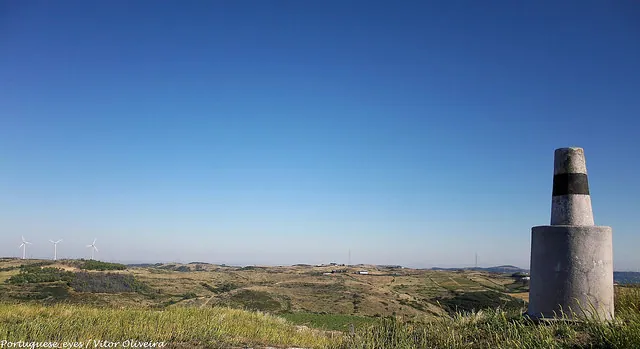
Sobral de Monte Agraço is a rural municipality in Lisbon’s northern commuter belt, situated 42.1 km to 43.1 km north of Lisbon—a direct 30 to 34-minute drive via the A8 and A10 motorways. Covering 52.10 km² with a resident population of 11,858 as of December 2025, it offers an attractive low-tax environment with an urban property tax (IMI) rate set at the legal minimum of 0.30%, ideal for countryside housing and renovation investments.
Where is Sobral de Monte Agraço and how connected is it to Lisbon?
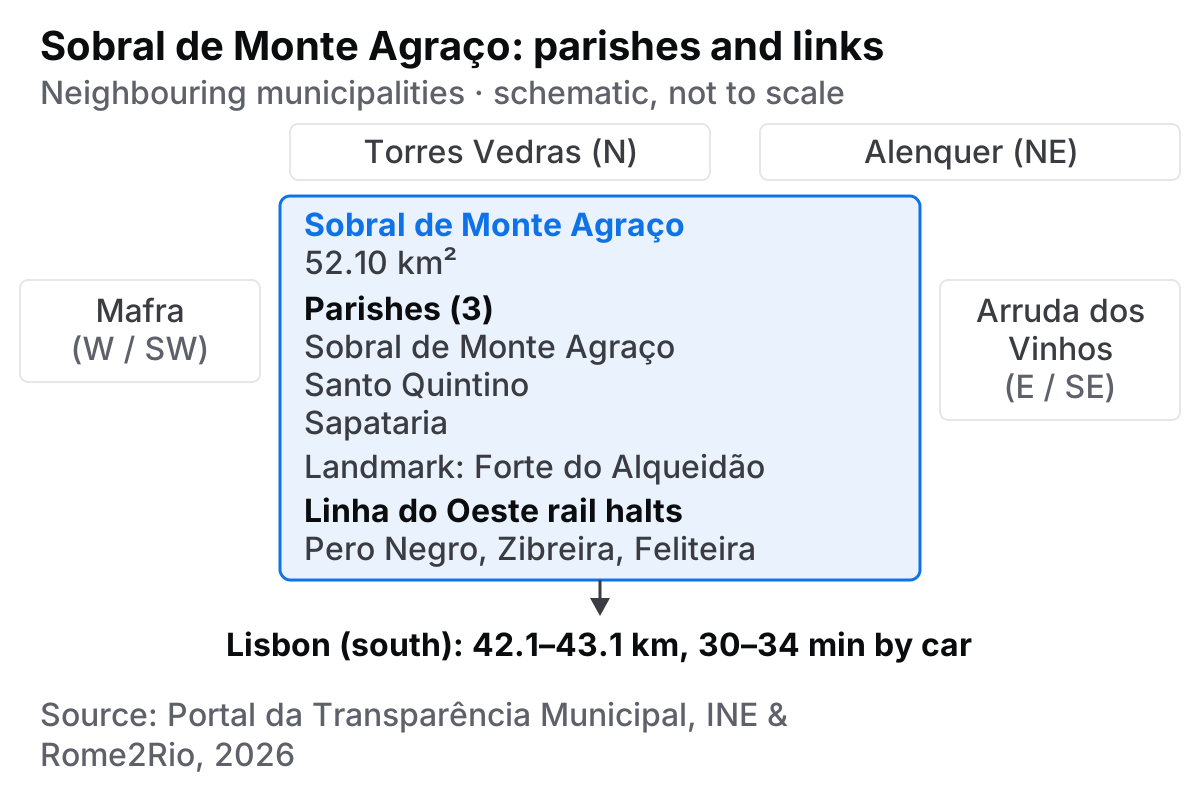
Occupying 52.10 km² in the heart of the Oeste region, Sobral de Monte Agraço is one of the most compact municipalities in Lisbon’s northern commuter area. According to Statistics Portugal (INE) 2025 population estimates, the municipality reached 11,858 residents in December 2025—up from 10,540 in the 2021 Census—yielding a population density of 227.6 inhabitants per km².
Administratively, the municipality borders four neighbouring territories: Torres Vedras to the north, Alenquer to the northeast, Arruda dos Vinhos to the east and southeast, and Mafra to the southwest and west. It is structured into three civil parishes (freguesias):
- Sobral de Monte Agraço: The primary urban and administrative seat of the municipality.
- Santo Quintino: Home to key historical monuments and extensive rural hamlets.
- Sapataria: A peaceful southern parish characterised by agricultural landscapes and single-family homes.
For commuters and international investors looking into buying property in Portugal, connectivity to the capital is straightforward. Driving south to central Lisbon covers between 42.1 km and 43.1 km, typically taking 30 to 34 minutes in clear traffic conditions. By comparison, public rail transport via CP – Comboios de Portugal operates along the Linha do Oeste line with local halts at Pero Negro, Zibreira, and Feliteira. Rail journeys to Lisbon take between 1 hour 54 minutes and 2 hours 16 minutes, requiring an interchange at Mira Sintra-Meleças or an integrated bus connection.
What is it like living in Sobral de Monte Agraço?
Life in Sobral de Monte Agraço revolves around a historic core centred on Praça Dr. Eugénio Dias. This central square houses the Interpretation Centre of the Lines of Torres Vedras (CILT), which documents the municipality’s pivotal military role during the Peninsular War. Situated on Serra do Olmeiro, the Forte do Alqueidão (Great Redoubt of Sobral) served between 1809 and 1810 as the Duke of Wellington’s primary command post along the First Line of Defence. Today, visitors can explore the surrounding military architecture via the Municipality of Sobral de Monte Agraço – Circuito do Alqueidão, connecting Forts Machado, Novo, and Simplício with panoramic views stretching toward the Atlantic coast.
Beyond military history, the municipality possesses rich cultural and architectural heritage. Highlights include:
- Igreja de São Quintino: A Manueline and Renaissance church classified as a National Monument, located in the parish of Santo Quintino.
- Religious Heritage: The 18th-century Igreja Matriz de Nossa Senhora da Vida, the Romanesque-Gothic Chapel, and the Capela de São Salvador do Mundo.
- Cine-Teatro de Sobral de Monte Agraço: An Art Deco venue originally opened in June 1946, meticulously restored in May 2006, and formally accredited under the Portuguese Theatre Network (RTCP) since 2022, as highlighted by the Cine-Teatro de Sobral de Monte Agraço cultural schedule.
- Scenic Viewpoints: Natural lookouts at Alto da Forca, Casais de Santo Quintino, and Forte do Alqueidão.
The broader Oeste region, managed by OesteCIM, is internationally recognised for environmental and heritage conservation. In March 2018 at ITB Berlin, Green Destinations awarded the region and neighbouring Torres Vedras first place worldwide in the ‘Best of Cities, Communities & Culture’ category as a top QualityCoast destination.
For families, everyday infrastructure is well-supported. Public education is organised under the Agrupamento de Escolas Joaquim Inácio da Cruz Sobral (AEJICS), with primary and secondary facilities spanning Sobral, Santo Quintino, Sapataria, and Pêro Negro. Healthcare services are provided locally by the Centro de Saúde (UCSP Sobral de Monte Agraço) under the ULS do Oeste regional health authority. Local leisure amenities include municipal swimming pools, a indoor sports pavilion, a municipal library, and a public skate park.
What characterises the Sobral de Monte Agraço property market?
The housing stock in Sobral de Monte Agraço is heavily oriented toward single-family residential living. Data from the municipal Local Housing Strategy (Estratégia Local de Habitação), based on 2021 Census benchmarks, identifies 4,230 residential buildings and 5,475 individual dwellings across the three parishes. Detached villas (moradias) and historic country estates (quintas) dominate Santo Quintino and Sapataria, while low-rise apartment buildings line the urban core of the main town.
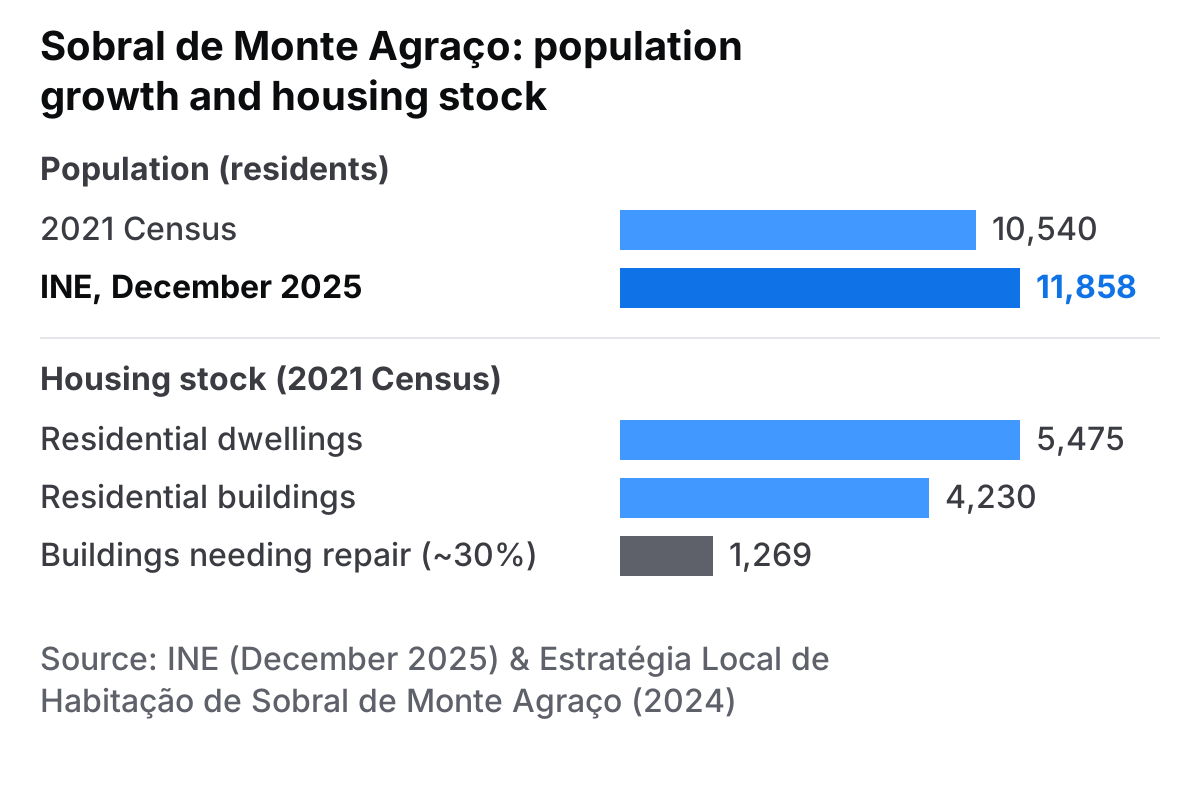
For buyers considering investing in property in Portugal, the municipality offers significant scope for building refurbishment. Residential structures have an average age of 38 years, with approximately 30% of existing buildings requiring structural or cosmetic repair. Refurbishment projects benefit from dedicated local incentives, notably within the official Urban Rehabilitation Area (ARU) of Sobral de Monte Agraço in Diário da República (Edital n.º 634/2016). This designation unlocks municipal tax concessions and reduced VAT rates for qualifying restoration work, supported by a municipal housing strategy running through 2028.
In addition to renovation benefits, property owners enjoy long-term holding tax advantages. The Municipal Assembly fixed the local urban Municipal Property Tax (IMI) rate at the statutory minimum of 0.30% for both 2025 and 2026, as confirmed by the official 0.30% municipal IMI tax rate for 2025 and 2026 notice.
Real estate professionals, investors, and home buyers can leverage market intelligence tools to evaluate local opportunities. Using CASAFARI Area Insights, agents track parish-level supply and pricing dynamics. Meanwhile, buyers searching for restoration projects use Property Sourcing, and investors rely on Valuation & Market Study to benchmark post-renovation values across the Oeste region.
To explore current real estate listings and benchmark property valuations in Sobral de Monte Agraço, sign in to the CASAFARI platform.
Frequently asked questions
How far is Sobral de Monte Agraço from Lisbon?
Sobral de Monte Agraço is located between 42.1 km and 43.1 km north of Lisbon, taking approximately 30 to 34 minutes by car via major motorway connections. Public transport is available via the Linha do Oeste rail line, where trains departing from local halts such as Pero Negro take between 1 hour 54 minutes and 2 hours 16 minutes to reach Lisbon.
What are the parishes of Sobral de Monte Agraço?
The 52.10 km² municipality is divided into three civil parishes: Sobral de Monte Agraço (the primary urban seat), Santo Quintino, and Sapataria. Geographically, it is bordered by the neighbouring municipalities of Torres Vedras, Alenquer, Arruda dos Vinhos, and Mafra.
What is the IMI property tax rate in Sobral de Monte Agraço?
For both 2025 and 2026, the Municipal Assembly of Sobral de Monte Agraço set the urban property tax (Imposto Municipal sobre Imóveis, or IMI) at 0.30%. This represents the lowest legal tax rate permitted for urban real estate under Portuguese national tax law.
Are there renovation tax incentives in Sobral de Monte Agraço?
Yes, property owners who undertake renovation work within the designated Urban Rehabilitation Area (ARU da Vila de Sobral de Monte Agraço) are eligible for municipal and national tax benefits. Given that approximately 30% of the municipality’s 4,230 residential buildings require repair, these incentives support structural refurbishment across the region.