SOLLER PROPERTY GUIDE
North-western region set in the Golden Valley with fabulous landscapes all around
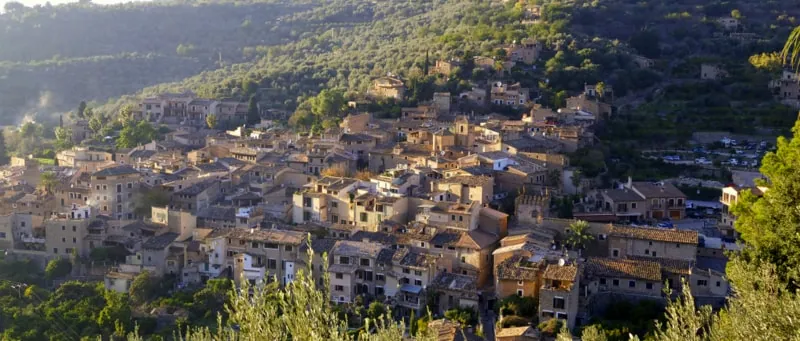
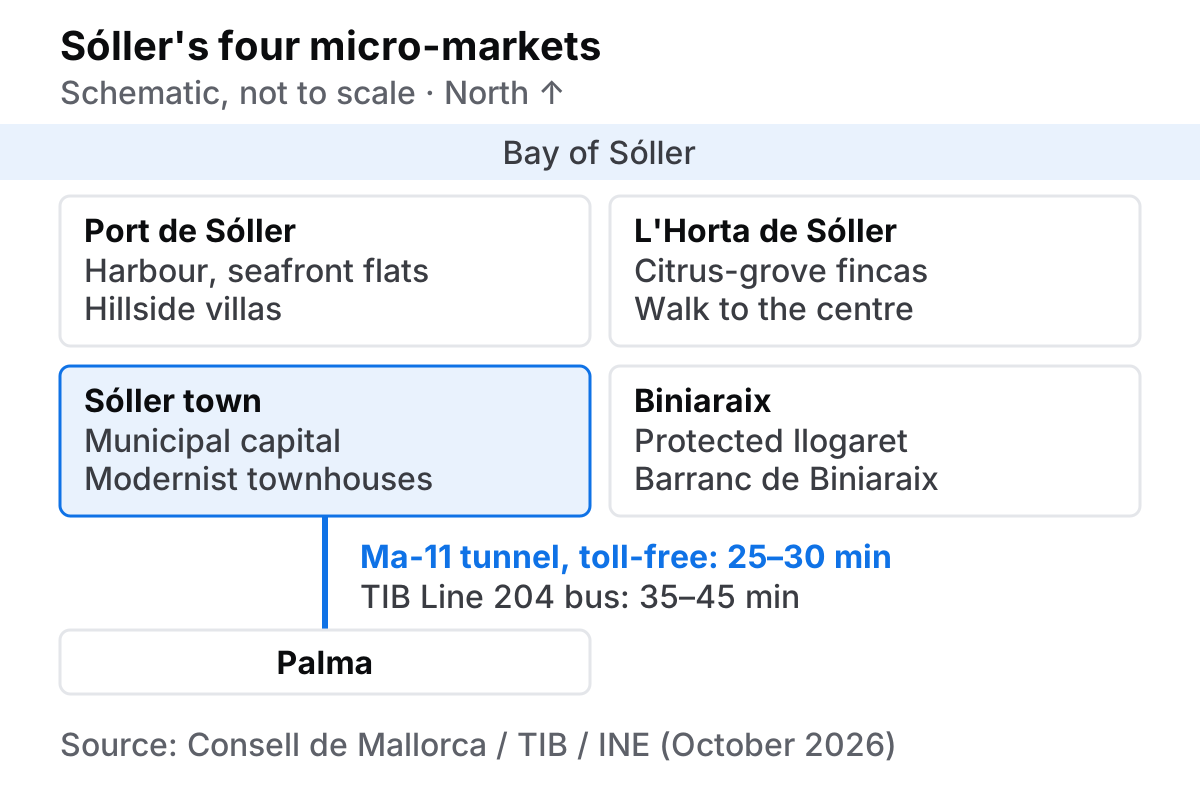
Nestled in Mallorca’s northwest, the municipality of Sóller serves as the commercial and cultural capital of the UNESCO-protected Serra de Tramuntana comarca. Home to 13,882 residents according to the Instituto Nacional de Estadística (INE) municipal register (2025/2026 data), the valley features average asking prices of €5,481/m² on Idealista and €5,615/m² on Indomio as of October 2026. Micro-market dynamics vary across its four primary settlements: historic Sóller town, maritime Port de Sóller, agricultural L’Horta, and the secluded hamlet of Biniaraix.
Why do international buyers and investors target the Sóller valley?
Long-term demand in the Sóller valley is defined by structural scarcity. The surrounding peaks of the Tramuntana mountain range, coupled with strict Balearic territorial preservation laws (ANEI and ARIP), severely restrict new residential construction across the municipality. This finite housing stock protects asset valuations for international homeowners and institutional investors alike.
Accessibility transformed the valley’s economy following the elimination of the Ma-11 tunnel toll, bringing Palma city centre within a 25 to 30-minute drive. Despite this proximity to the capital, Sóller retains a distinct identity influenced by 19th-century citrus export wealth to France. French-influenced modernist townhouses, traditional stone fincas, and waterfront villas offer a architectural character distinct from the modern developments of southwest Mallorca.
For buyer’s agents and investment managers conducting detailed comparative analyses, tracking micro-market liquidity and pricing trends across the Tramuntana region requires granular data. Real estate professionals leverage CASAFARI Area Insights to monitor stock availability, average price movements, and listing durations. Developers building bespoke analytical workflows can also reference the Area Insights API documentation for integration details.
Towns and villages of the Sóller municipality: where to buy?
The municipality of Sóller contains four official population centres, alongside the rural enclaves of Alconàsser and Rocafort. As noted by the Mancomunitat de la Serra de Tramuntana (September 2026), Sóller serves as the central hub for the 13-municipality Tramuntana comarca, which spans from Andratx to Pollença.
Sóller Town (El Pueblo)
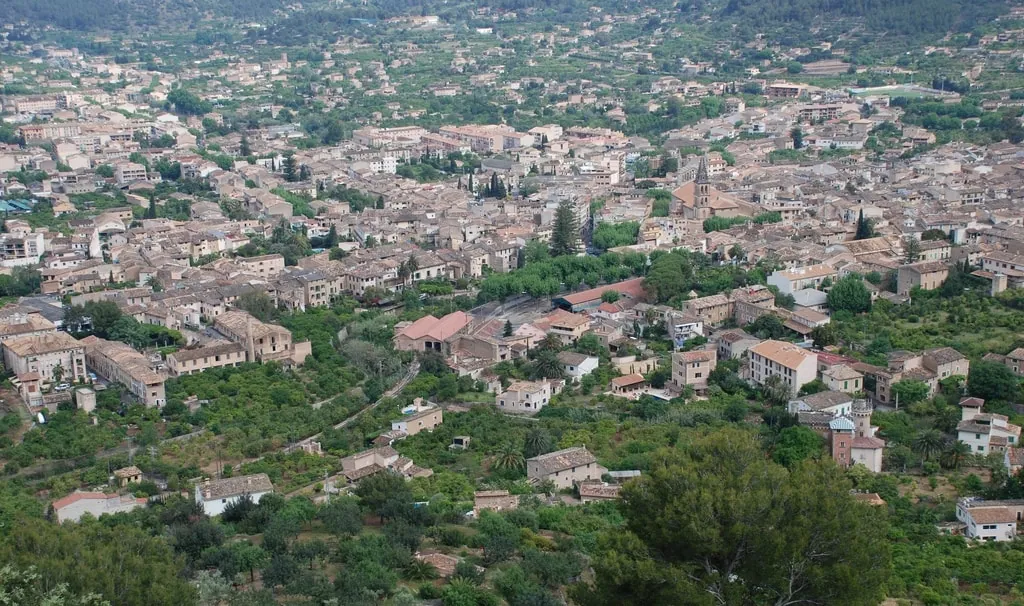
The municipal capital revolves around the lively Plaça de la Constitució and the imposing Sant Bartomeu church. Prominent thoroughfares like Carrer de sa Lluna display grand 19th-century modernist façades, designed by architects such as Joan Rubió. Residential properties here consist primarily of multi-storey stone townhouses with internal courtyard gardens (patios). High year-round occupancy makes the town popular with permanent residents and long-term relocations.
Port de Sóller (Puerto de Sóller)
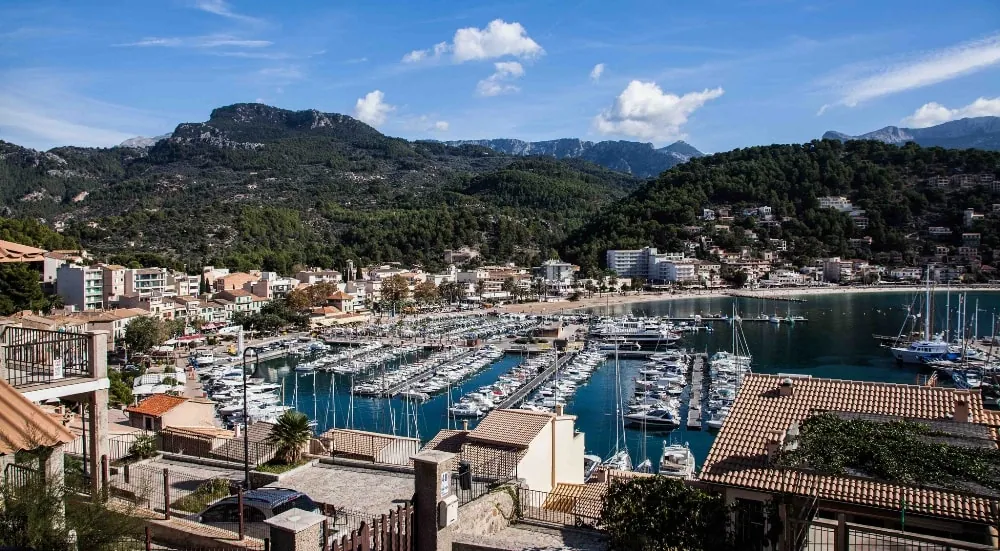
Situated three kilometres from the main town and connected by the historic 1913 wooden tram, Port de Sóller is the only natural sheltered harbour on Mallorca’s northwest coast. The waterfront features apartment complexes and frontline dining, while the surrounding hillsides of Es Través and Santa Catalina offer elevated single-family villas with bay views. According to Idealista data (October 2026), municipality rental values average between €19.68/m²/month and €21.57/m²/month (€18.00/m²/month on Indomio), supported by strong seasonal and long-term residential demand.
L’Horta de Sóller
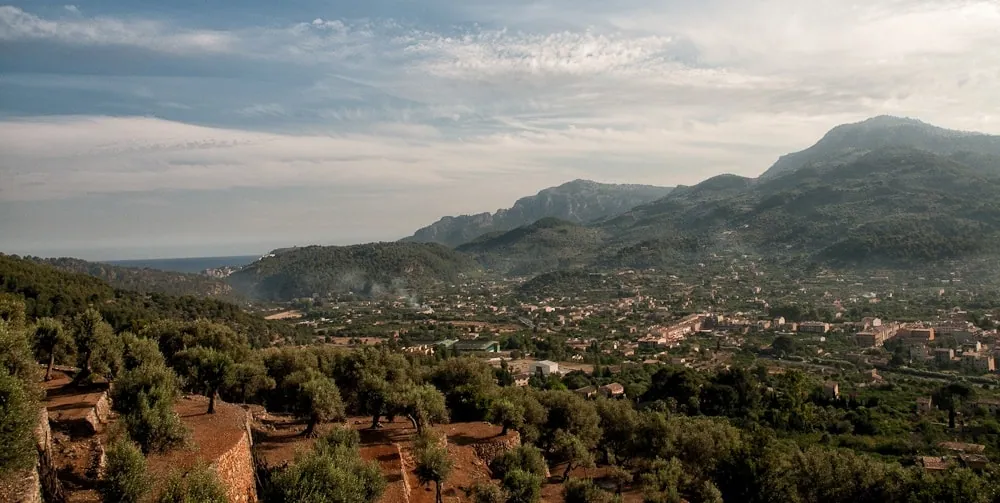
Stretching across the flat valley floor between the town and the mountains, L’Horta is characterized by citrus groves, olive orchards, and rural fincas. It offers country living within walking distance of the municipal centre. Properties here appeal to buyers seeking plot privacy, historic water rights (aljibes), and agricultural land.
Biniaraix and Rural Enclaves
The historic hamlet (llogaret) of Biniaraix sits at the foot of the Barranc de Biniaraix canyon. Highly protected under heritage statutes, its narrow stone lanes and historic stone cottages represent one of the quietest micro-markets in the valley. Further along the coastline, the cliffside hamlet of Alconàsser offers rustic retreats with coastal views.
Evaluating valuation differences between a town-centre townhouse and a rural finca requires cross-portal comparison. Agents utilize CASAFARI Property Sourcing to aggregate supply and employ property valuation and market study tools to calculate accurate pricing metrics.
How well connected is Sóller to Palma, schools and daily amenities?
Transport connectivity between the valley and the rest of Mallorca relies on three main infrastructure corridors:
- Ma-11 Highway & Tunnel: The toll-free tunnel cuts through the Serra de Alfàbia, reducing the drive to Palma to 25–30 minutes. Drivers seeking scenic routes can still take the winding Ma-11a Coll de Sóller mountain pass.
- TIB Express Bus (Line 204): Following a 15% frequency update in March 2026, the public bus service operates 38 daily departures each way. Buses run every 25 minutes on weekdays, connecting Sóller to Palma Estació Intermodal in 35 to 45 minutes, as detailed on the TIB Line 204 Sóller–Palma timetable.
- Ferrocarril de Sóller: Operating since 1912, the wooden train provides a scenic one-hour connection to Palma’s Plaza de España across 4 to 7 daily departures (€23 single, €30 return for non-residents).
For families relocating to the valley, local educational institutions include state primary schools (CEIP Es Fossaret, CEIP Ses Marjades, and CEIP Pere Cerdà in Port de Sóller), the state secondary school IES Guillem Colom Casasnoves, and the concertado school Col·legi Sagrats Cors. International schools are located outside the valley; campuses such as The Academy International School in Marratxí, Bellver International College, Queens College, and Baleares International College are situated 22 to 35 km away, requiring a 25 to 35-minute commute via the Ma-11 tunnel.
Property taxes, planning laws and holiday-let rules in Sóller (2026)
Navigating property acquisitions in Mallorca requires understanding Balearic tax structures and environmental planning laws.
Balearic Property Transfer Tax (ITP) & Stamp Duty (AJD)
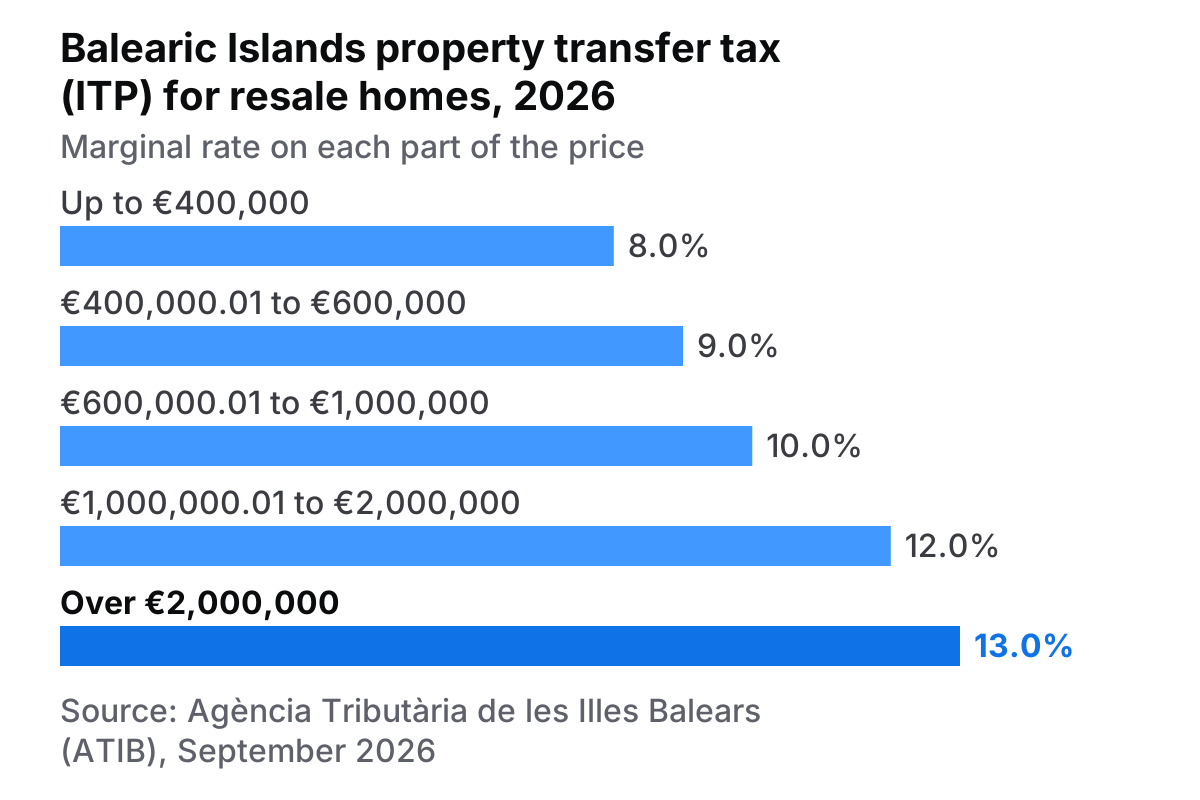
When purchasing resale residential property in the Balearic Islands, buyers pay progressive Property Transfer Tax (ITP) rates published by the Agència Tributària de les Illes Balears (ATIB) ITP rates (September 2026):
- Up to €400,000: 8%
- €400,000.01 to €600,000: 9%
- €600,000.01 to €1,000,000: 10%
- €1,000,000.01 to €2,000,000: 12%
- Over €2,000,000: 13%
New-build properties incur 10% Value Added Tax (IVA) plus 1.5% Stamp Duty (AJD), which rises to 2% for transaction values of €1,000,000 or higher. For legal details on transaction execution, consult our guide to the Spanish property contract and escritura deed.
Wealth Tax Thresholds (Impuesto sobre el Patrimonio)
Under Balearic Law 12/2023 (in force in 2026), tax allowances stand at €3,000,000 per individual taxpayer, as outlined in the ATIB Balearic Wealth Tax guidelines. This threshold applies to both Balearic tax residents and non-residents holding local real estate. Non-resident taxpayers can also utilize the 60% combined income and wealth tax limit under Ministerial Order HAC/652/2026.
Tourist Rental Licences (ETV)
Under Tourism Law 8/2012, Decree-Law 4/2025, and the Consell de Mallorca’s PIAT guidelines, new holiday rental licences (ETV) for apartments or multi-family residential buildings are prohibited across the Balearics. Single-family detached homes in designated zones may apply for licence quotas through the Consorcio Bolsa de Alojamientos Turísticos (CBAT) exchange pool at €3,500 per bed space (€291.67 for 60-day ETV60 primary residence licences). Strict ANEI/ARIP zoning excludes many Tramuntana properties from new allocations, making existing transferable ETV licences highly valuable. Learn more about market yields in our analysis of owning a rental property in Mallorca and Ibiza.
Serra de Tramuntana Planning Rules & UNESCO Protection
Planning statutes managed by the Consell de Mallorca (October 2026) strictly prohibit new residential builds on ANEI (Natural Areas of Special Interest), AANP, and wooded ARIP rustic land. On buildable general rustic land (Suelo Rústico General), construction requires a minimum plot size between 14,000 m² and 50,000 m² (with no plot subdivisions permitted after 13 October 1999). Architectural designs must incorporate stone cladding and Arabic roof tiles. Pre-1991 non-compliant rural structures can access the Balearic urban regularisation pathway, provided no building volume expansion occurs.
Non-EU Residency Routes Post-Golden Visa
Spain’s €500,000 real estate Golden Visa was permanently repealed on 3 April 2025 by Organic Law 1/2025. In 2026, UK and non-EU citizens buying property in Mallorca rely on alternative immigration pathways, such as the Non-Lucrative Visa (requiring proof of passive financial resources) or the Digital Nomad Visa (requiring verified remote employment income of at least 200% of the SMI, equal to €2,442 per month in 2026).
To explore current property listings, pricing metrics, and real estate market trends in Sóller and across the Balearic Islands, professionals can sign in to the CASAFARI platform.
Frequently asked questions
Can you get a holiday rental licence (ETV) for a property in Sóller?
Under Balearic Tourism Law 8/2012, Decree-Law 4/2025, and the Consell de Mallorca PIAT, new tourist rental licences (ETV) are prohibited for apartments and multi-family buildings across the Balearic Islands. Detached single-family homes in permitted zones can acquire licences through the Consorcio Bolsa de Alojamientos Turísticos (CBAT) zero-growth exchange pool at €3,500 per bed space, or €291.67 for 60-day primary-residence leases. However, strict environmental protections across the Serra de Tramuntana, including ANEI and ARIP zoning, exclude vast portions of the Sóller valley from new approvals.
What are the property purchase taxes and wealth tax rules in Mallorca?
For resale property acquisitions in the Balearic Islands, Property Transfer Tax (ITP) follows a progressive scale ranging from 8% on values up to €400,000 to 13% for amounts exceeding €2,000,000, according to the Agència Tributària de les Illes Balears (ATIB). New-build properties are subject to 10% IVA plus 1.5% Stamp Duty (AJD), which increases to 2% for properties priced at €1,000,000 or above. Under Law 12/2023, both residents and non-residents benefit from a €3,000,000 individual tax-free Wealth Tax threshold, alongside a 60% combined income and wealth tax limit.
Can UK and non-EU buyers still get residency by buying property in Spain?
No, Spain’s €500,000 real estate Golden Visa scheme was officially abolished on 3 April 2025 under Organic Law 1/2025. Non-EU nationals, including British property buyers, seeking to reside in Mallorca for more than 90 days per 180-day window must utilize alternative immigration pathways. The most popular options in 2026 are the Non-Lucrative Visa for self-funded residents and retirees, or the Digital Nomad Visa, which requires proof of remote professional income equivalent to at least €2,442 per month.
What are the rules for renovating or building on rustic land in the Serra de Tramuntana?
New residential construction is strictly prohibited on high-protection ANEI, AANP, and wooded ARIP rustic land under the Serra de Tramuntana’s territorial regulations and UNESCO heritage guidelines. On eligible general rustic land (SRG) or non-wooded ARIP plots, single-family home development requires a minimum plot size between 14,000 m² and 50,000 m² that has not been subdivided since 13 October 1999. Any new structure or legalised renovation must adhere strictly to traditional Mallorcan architecture, including stone façade cladding and Arabic tile roofing, with zero allowable volume expansion on protected terrain.