
FORNALUTX PROPERTY GUIDE
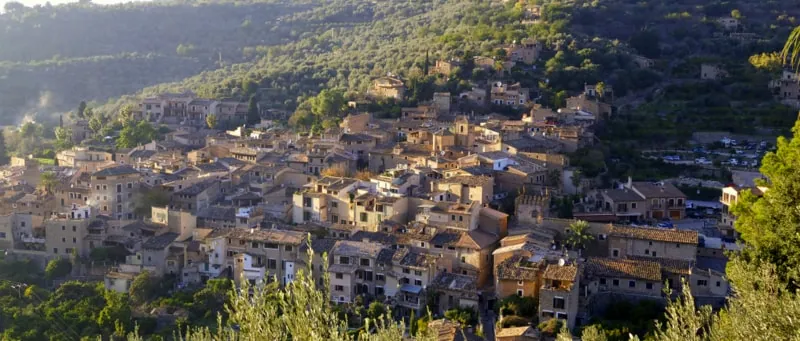
Pretty rural village in the west of Mallorca
Buying property in Fornalutx means acquiring real estate in an independent mountain village of 743 inhabitants (INE, 2025) within Mallorca’s UNESCO-protected Serra de Tramuntana. High international demand—where foreign residents comprise roughly 25% of the municipal register—combines with strict ANEI rustic planning laws and a total freeze on new tourist rental licences to keep housing inventory structurally scarce and long-term values resilient.
What makes the Fornalutx property market unique in Mallorca?
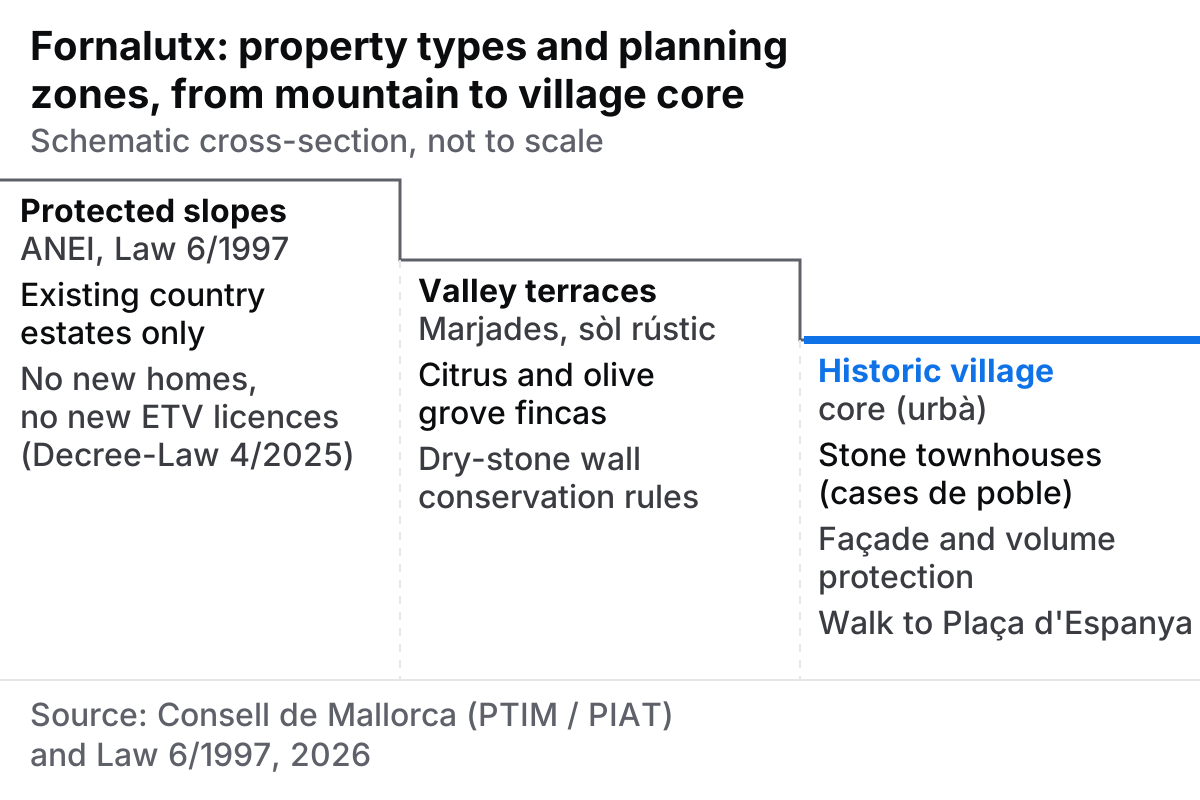
Fornalutx occupies a distinct niche in the Balearic real estate landscape. Set in the upper reaches of the Sóller valley beneath Puig Major, the municipality combines dramatic mountain scenery with meticulous architectural preservation. The local property stock divides into three main categories: classic stone townhouses (cases de poble) with traditional green wooden shutters lining the stepped village streets, rustic fincas positioned on terraced olive and citrus groves (marjades), and substantial country estates tucked into the valley folds.
Supply is permanently restricted by geographic and legal constraints. The village streetscape has long been recognised for its conservation standards, receiving the Silver Plaque for the Defence and Maintenance of the Village from the Fomento del Turismo de Mallorca and the Second National Prize for Embellished and Maintained Villages in Spain from the General Secretariat of Tourism in 1983. Because strict heritage regulations prevent outward urban expansion, new developments are virtually non-existent. Buyers and real estate professionals can monitor live inventory levels and pricing metrics across the valley using CASAFARI Area Insights.
History, architecture and village life around Plaça d’Espanya
Originally a medieval Moorish farmstead (alqueria), Fornalutx expanded following the 13th-century Catalan conquest and established its definitive municipal independence from neighbouring Sóller in 1837. The historical depth of the village is reflected in its key landmarks. At the top of the village stands the Parish Church of the Nativitat de la Mare de Déu, which features 13th-century Gothic origins and Baroque additions completed in 1639. Nearby, the 17th-century defense tower of Can Arbona now serves as the Casa de la Vila (Town Hall). Throughout the village, carefully preserved eaves feature traditional painted roof tiles (teules pintades), an enduring regional craft depicting geometric and protective symbols.
Daily life centres on Plaça d’Espanya, a shaded square surrounded by local cafés, small grocery stores, and a bakery. The village hosts several popular dining establishments, including Café Med on Carrer de sa Plaça 7, known for seasonal Mediterranean dishes, and Calzone Pizzeria on Carrer Arbona-Colom 4. Community events peak during the annual patron saint festivities on 8–9 September. While Fornalutx offers essential everyday services, residents rely on the larger town of Sóller, situated three kilometres down the valley, for secondary schools, banking centres, and medical facilities.
Transport links, hiking trails and access to Palma and the coast
Despite its tranquil mountain setting, Fornalutx maintains practical transport connections to the rest of Mallorca. Highway access via the Ma-11 road connects the valley directly to Palma. Travel times improved significantly after the Túnel de Sóller became toll-free on 29 December 2017. The road distance to Palma city centre is approximately 30 km (a 46-minute drive), while Palma de Mallorca Airport (PMI) is located 35 to 38 km away (roughly 46 to 63 minutes by car depending on traffic).
Public transport is provided by the regional TIB network. The TIB line 232 bus timetable between Fornalutx and Sóller links the village directly to Sóller and Port de Sóller, where passengers can connect at the Sóller Nord hub to direct bus line 204 into central Palma. For coastal relaxation, the sandy beach and horseshoe bay of Port de Sóller sit roughly 9 km down the valley road, reachable also via the vintage wooden tram operating from Sóller. For hikers and outdoor enthusiasts, Fornalutx serves as an immediate gateway to GR-221 trail routes, including the famous ascent through the neighbouring hamlet of Biniaraix and its stone-paved gorge, the Barranc de Biniaraix.
Taxes, planning rules and residency: what buyers must know in 2026
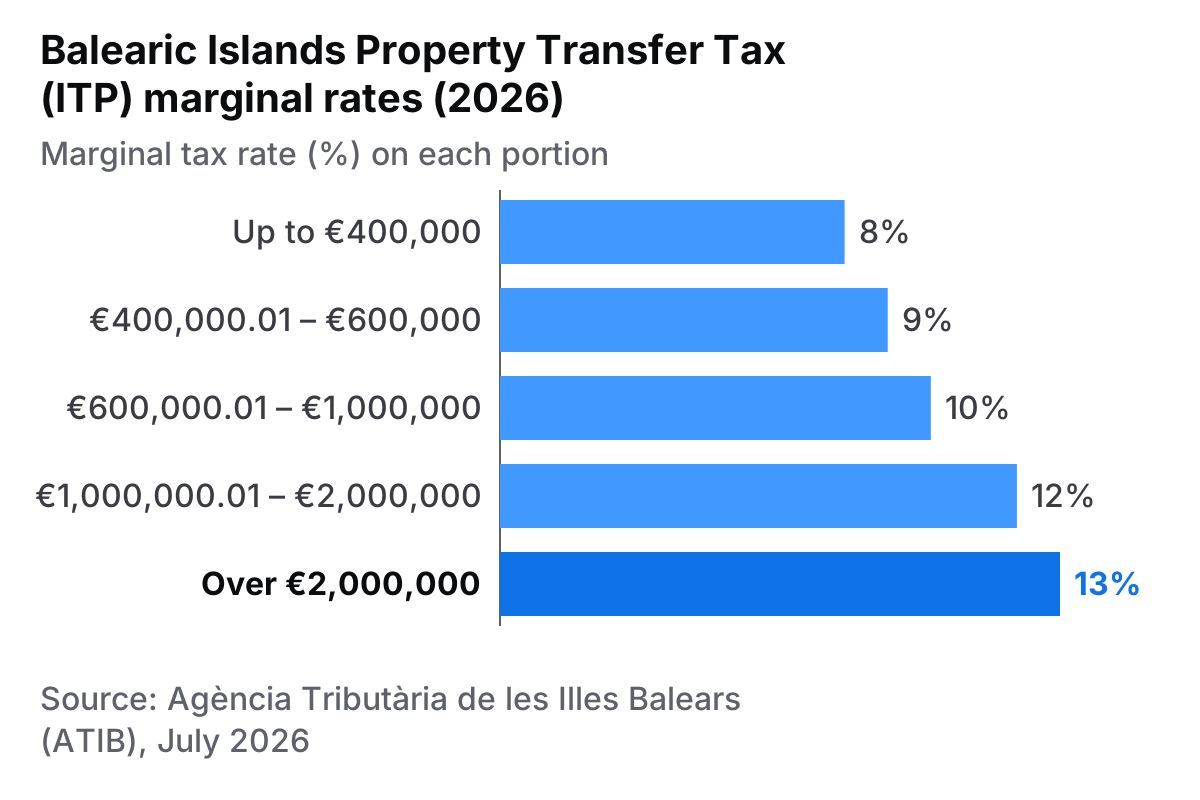
Acquiring a home in Fornalutx requires careful navigation of Balearic tax schedules and stringent regional land-use laws. For resale properties, buyers must pay the Balearic Property Transfer Tax (Impuesto sobre Transmisiones Patrimoniales - ITP). According to current guidance from the Agència Tributària de les Illes Balears (ATIB) ITP tax brackets, the tax is levied on a progressive scale based on the property value:
- Up to €400,000: 8%
- €400,000.01 to €600,000: 9%
- €600,000.01 to €1,000,000: 10%
- €1,000,000.01 to €2,000,000: 12%
- Over €2,000,000: 13%
Planning restrictions in the Serra de Tramuntana are among the strictest in Spain. Under Law 6/1997 and the Island Territorial Plan (PTIM), rural land surrounding Fornalutx is designated as ANEI (Área Natural de Especial Interés). On ANEI land, constructing new residential buildings is prohibited. Any renovations of existing legal structures must strictly preserve original volumes, stone façades, green timber shutters, and traditional Arab roof tiles. Buyers considering unapproved or historic out-of-ordinance structures should note that Law 7/2024 established an extraordinary three-year window in February 2025 allowing certain pre-1991 non-compliant rural buildings to be legalised under specific technical conditions. Buyers should order a detailed comparables-based property valuation and market study and consult our guide to the Spanish purchase contract and escritura before exchanging contracts.
Short-term holiday letting laws are equally stringent. Under the Consell de Mallorca Tourist Intervention Plan (PIAT) and Decree-Law 4/2025 enacted in April 2025, tourist rental licences (ETV) are banned for multi-family apartment buildings across the Balearic Islands, and no new tourist registrations are permitted on protected ANEI rustic land. Licences for detached single-family homes can only be obtained if the property meets legal eligibility criteria and acquires existing places retired into the Consell de Mallorca 1:1 exchange pool. Prospective investors should examine the broader context of owning a rental property in Mallorca and Ibiza prior to purchasing.
Finally, non-EU buyers (including UK nationals) must plan residency routes independently of property investment. As confirmed by the Ministry of Inclusion notice on the repeal of the Investor Visa (Law 1/2025), Spain officially abolished the real estate Golden Visa on 3 April 2025 under Organic Law 1/2025. Buyers without EU citizenship wishing to spend more than 90 days per 180-day period in Mallorca must now apply for standard residency options, such as the Non-Lucrative Visa or the Digital Nomad Visa.
To explore current listings and analyze micro-market valuations in Fornalutx, property professionals can use Property Sourcing across every portal in Mallorca or sign in to the CASAFARI platform to access comprehensive real estate data.
Frequently asked questions
Can you get a tourist rental licence (ETV) in Fornalutx?
Obtaining a new ETV tourist licence in Fornalutx is strictly regulated under Mallorca’s PIAT framework and Decree-Law 4/2025. New licences are prohibited for multi-family apartments and properties situated on protected rustic land (ANEI) throughout the Serra de Tramuntana. Buyers seeking rental income must acquire a single-family home with a valid existing licence or secure de-registered places on a 1:1 basis from the Consell de Mallorca pool.
What are the rules for renovating a property in the Serra de Tramuntana?
Most rustic land surrounding Fornalutx is designated as ANEI protected land under Law 6/1997, where new residential construction is completely banned. Renovations of existing legal structures are restricted to preserving original building volumes, exterior stone cladding, Arab roof tiles, and dry-stone terrace walls. However, Law 7/2024 established a temporary three-year window beginning in February 2025 to legalise certain pre-1991 out-of-ordinance rural structures under strict architectural conditions.
What is the property transfer tax (ITP) in Mallorca?
When purchasing a resale residential home in Mallorca, buyers pay the Balearic Property Transfer Tax (ITP) managed by ATIB. The tax is calculated on a progressive scale starting at 8% for the first €400,000, 9% between €400,000.01 and €600,000, 10% between €600,000.01 and €1,000,000, 12% between €1,000,000.01 and €2,000,000, and 13% on any portion exceeding €2,000,000.
Can non-EU buyers still get a Spanish Golden Visa through property?
No, Spain officially abolished the Golden Visa for real estate investors on 3 April 2025 following the passage of Organic Law 1/2025. Non-EU citizens buying property in Fornalutx can no longer obtain Spanish residency simply by investing €500,000 in real estate. Buyers wishing to reside in Spain for longer than 90 days in any 180-day period must instead apply through non-lucrative or digital nomad visa pathways.