
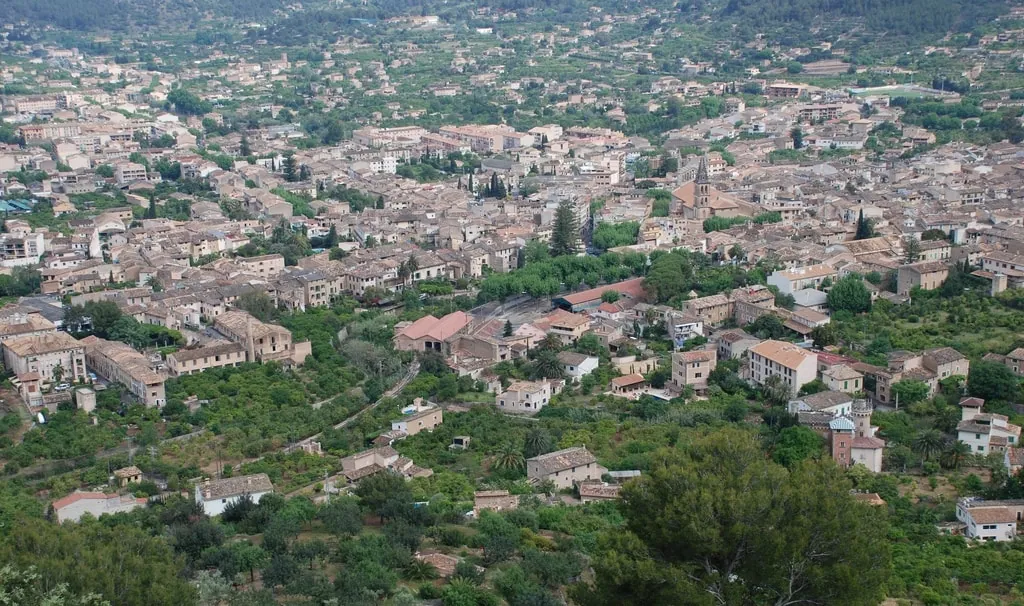
Sóller town
Sóller Town is a self-contained municipality of 13,882 inhabitants (Instituto Nacional de Estadística (INE), January 2025) in Mallorca’s Serra de Tramuntana, located 30 to 40 minutes from Palma via the toll-free 3-kilometre Ma-11 tunnel. Its residential housing stock combines early-20th-century French-influenced Modernist townhouses with traditional stone fincas, supported by a year-round local community, active municipal services, and strict heritage protections.
Why Does Sóller Town Attract Year-Round Property Buyers?
Nestled in a fertile valley surrounded by orange and lemon groves, Sóller offers a genuine living community rather than a seasonal tourist enclave. During the late 19th and early 20th centuries, local agricultural trade with southern France—especially Marseilles—generated substantial wealth. Returning residents, known locally as sollerics, invested their profits back into the valley, financing elegant residential avenues and civic architecture.
Unlike many coastal villages across the Balearics that quieten outside summer, Sóller retains a vibrant year-round atmosphere. Pedestrianised commercial thoroughfares such as Carrer de sa Lluna showcase independent bakeries, artisanal craft stores, and essential services. Every Saturday, the traditional municipal market brings local producers and residents to the central squares, reinforcing the town’s year-round appeal for international buyers seeking primary or secondary residences.
How Did Modernisme Shape Plaça de la Constitució and Sóller’s Architecture?
Plaça de la Constitució serves as the architectural and social focal point of Sóller Town. Shaded by mature plane trees and surrounding a central fountain, the square comes alive as the historic electric tram line passes through its centre. Surrounding the square are landmark buildings designed by Joan Rubió i Bellver, a prominent Catalan architect and disciple of Antoni Gaudí.
Rubió i Bellver designed the striking Modernist stone façade of the 13th-century Parish Church of Sant Bartomeu in 1904, incorporating intricate rose windows and dramatic soaring arches. Immediately adjacent stands the former Banc de Sóller, designed in 1909 and opened in 1912, featuring delicate wrought-iron craftsmanship and sculpted stone curves. Further along Carrer de sa Lluna sits Can Prunera, a grand residential estate constructed between 1904 and 1911. Opened as the Can Prunera Museu Modernista in August 2009, the museum displays period furniture alongside the Serra Art Collection, which includes works by Joan Miró, Pablo Picasso, Paul Klee, Henri de Toulouse-Lautrec, Fernand Léger, Miquel Barceló, and Santiago Rusiñol. Nearby, the 15th-century Casa de sa Lluna features a stone moon relief that gives the town’s main shopping street its name.
What Is Daily Life Like: Gastronomy, Es Firó and Cultural Institutions?
Daily life in the Sóller valley combines cultural institutions, local festivities, and regional gastronomy. Fine dining reflects the area’s agricultural heritage. Establishments such as Ca’n BoQueta, set in a traditional townhouse courtyard, offer contemporary Mallorcan menus, while Ca’n Blau inside the 19th-century Gran Hotel Sóller serves Mediterranean dishes. Meanwhile, the historic cliffside restaurant Béns d’Avall concluded its 50-year chapter in 2026 to prepare an entirely new concept for 2027.
On the outskirts of town on the Camp d’en Prohom estate, the MUCBO foundation unites the Jardí Botànic de Sóller (opened in 1985) and the Museum of Balearic Natural Sciences (opened in 1992). The botanical garden preserves native flora from the Balearic and Mediterranean islands across terraced grounds. The town’s flagship cultural celebration is Es Firó, instituted in 1855 and celebrated on the Monday following the second Sunday of May (11 May 2026). The festival reenacts the historical defence of 11 May 1561, when Captain Joan Angelats and the local Valentes Dones defended the valley against invading corsairs.
How Connected Is Sóller to Palma, the Coast and the Serra de Tramuntana?
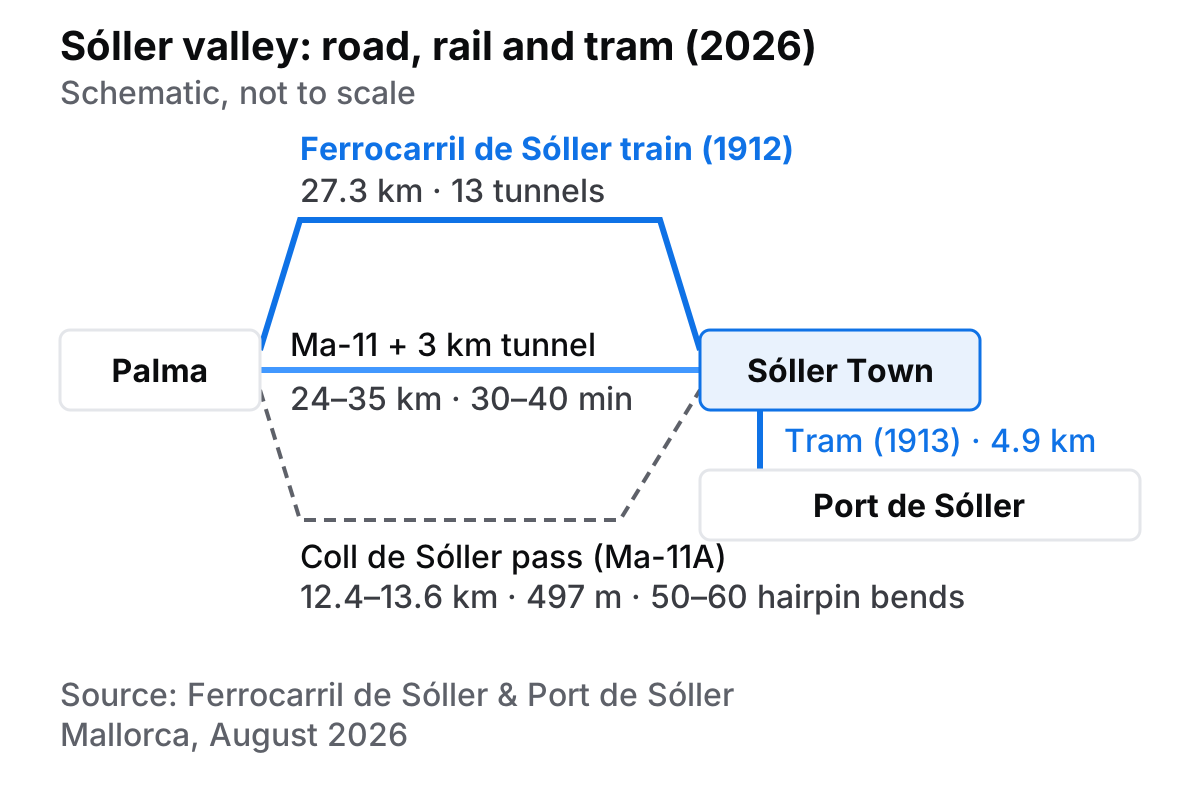
Connecting the valley to Palma is a modern road network alongside historic transit routes. Driving the 24 to 35-kilometre distance to Palma takes 30 to 40 minutes via the 3-kilometre Ma-11 Túnel de Sóller, which has been toll-free since late 2017. Cyclists and leisure motorists often prefer the historic Ma-11A Coll de Sóller mountain pass, which climbs to an elevation of 497 metres across 50 to 60 hairpin bends.
Public and heritage transport options are equally distinct. The Ferrocarril de Sóller, inaugurated on 16 April 1912, operates scenic wooden trains along a 27.3-kilometre narrow-gauge route to Palma, traversing 13 mountain tunnels, including the 2.8-kilometre Túnel Mayor. For coastal connections, a 4.9-kilometre electric tramway inaugurated on 4 October 1913 carries passengers directly from Plaça de la Constitució to Port de Sóller. Located 3 to 4.9 kilometres from the town centre, the port features two distinct beaches: Platja d’en Repic (250 to 270 metres long) and Platja des Través (610 to 800 metres long), adjacent to the marina. Hikers and outdoor enthusiasts also benefit from direct trails through the Biniaraix ravine toward the Cúber and Gorg Blau mountain reservoirs.
What Should Buyers Know About Property Taxes and Rental Rules in Sóller?
Acquiring property in Sóller requires understanding Balearic property taxes and local licensing rules. When buying a resale townhouse or finca, purchasers pay the progressive Property Transfer Tax (Impuesto sobre Transmisiones Patrimoniales, or ITP), regulated by the Agència Tributària de les Illes Balears (ATIB).
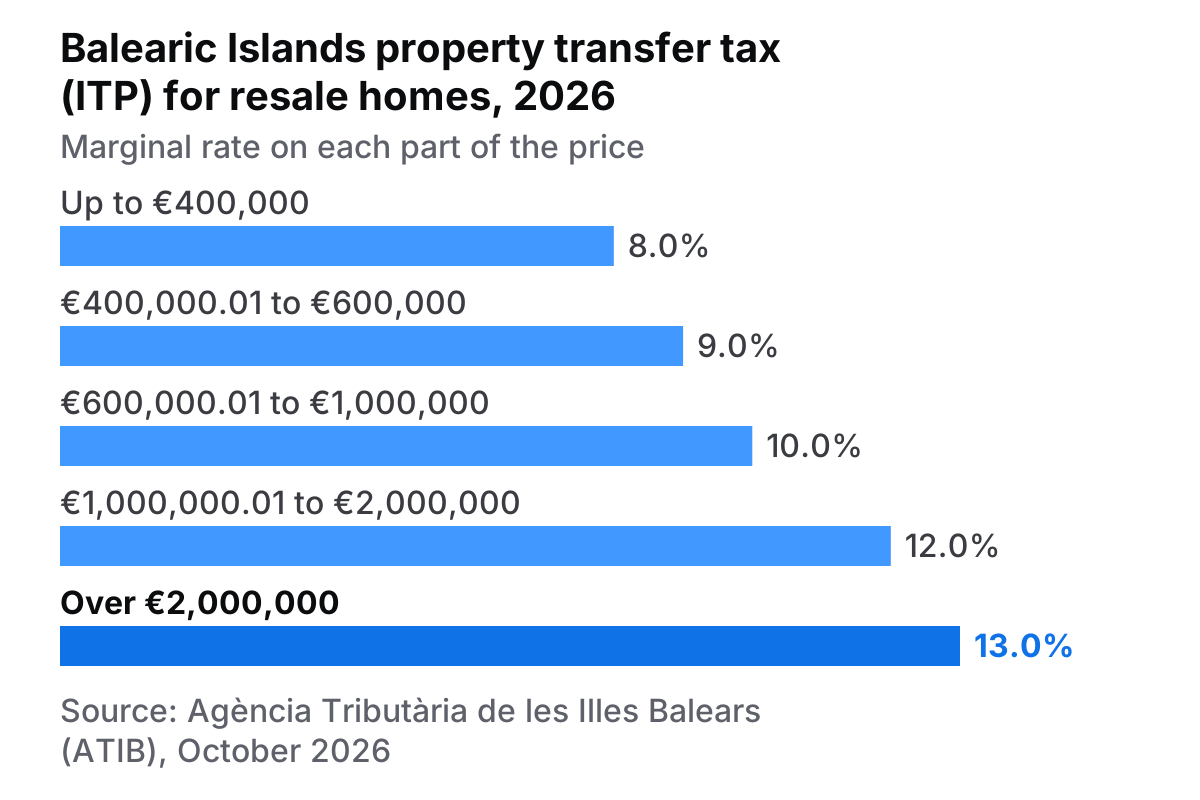
The progressive ITP tax brackets for resale properties in the Balearic Islands apply as follows:
- 8% on the purchase price portion up to €400,000
- 9% on the portion between €400,000.01 and €600,000
- 10% on the portion between €600,000.01 and €1,000,000
- 12% on the portion between €1,000,000.01 and €2,000,000
- 13% on any amount exceeding €2,000,000
For a primary home purchase under €270,151.20, a reduced 4% rate may apply under specific personal criteria. Buyers should review Spanish purchase contracts and the escritura deed prior to completion.
Short-term holiday letting is strictly regulated under Balearic Law 3/2022 and Decree-Law 4/2025. New tourist rental licences (ETV) are permanently prohibited for apartments in multi-family residential buildings. For detached houses and townhouses, new licences can only be acquired if a property already possesses an active ETV registration, or by applying to the Consorci Borsa d’Allotjaments Turístics (CBAT) during public allocation ballots for de-registered places, such as the spring 2026 call offering 1,069 places. Investors evaluating owning a rental property in Mallorca and Ibiza must verify licence validity early in their search.
Real estate buyers, investors, and local estate agents rely on CASAFARI data tools to assess the valley’s property dynamics. Professionals use CASAFARI Area Insights to examine hyper-local supply and listing histories across the Serra de Tramuntana, while developers and data teams can reference the Area Insights API documentation (in English) for direct integration. Agents benchmarking unique townhouses utilize CASAFARI’s property valuation and market study models, while investors source unlisted and active listings via Property Sourcing.
To explore real-time property market analytics and streamline your sourcing in Mallorca, sign in to CASAFARI.
Frequently asked questions
How long does it take to travel from Sóller to Palma de Mallorca?
By car via the Ma-11 highway and the 3-kilometre Túnel de Sóller (which has been toll-free since late 2017), the 24 to 35-kilometre journey between Sóller and Palma takes 30 to 40 minutes. Alternatively, the historic Ferrocarril de Sóller wooden train, inaugurated on 16 April 1912, runs a scenic 27.3-kilometre route through 13 mountain tunnels between the two towns.
What are the Property Transfer Tax (ITP) rates when buying a resale home in Sóller?
In the Balearic Islands (ATIB, 2026), resale residential purchases are subject to a progressive Property Transfer Tax (Impuesto sobre Transmisiones Patrimoniales, or ITP). The standard rates are 8% on the first €400,000, 9% between €400,000.01 and €600,000, 10% between €600,000.01 and €1,000,000, 12% between €1,000,000.01 and €2,000,000, and 13% on any amount above €2,000,000. A reduced rate of 4% is available for qualifying primary residences under €270,151.20.
Can you obtain a tourist rental licence (ETV) for a property in Sóller?
Under Balearic Law 3/2022 and Decree-Law 4/2025, new tourist rental licences (ETV) are permanently prohibited for apartments in multi-family buildings across Mallorca. For single-family houses or townhouses, buyers must acquire a home with an existing licence or apply through public ballots managed by the Consorci Borsa d’Allotjaments Turístics (CBAT). For instance, a spring 2026 CBAT public allocation made 1,069 de-registered places available to eligible applicants.
How far is Sóller Town from the beaches and marina at Port de Sóller?
Sóller Town sits 3 to 4.9 kilometres inland from the bay of Port de Sóller. Residents can drive to the coast in under 10 minutes or ride the historic 4.9-kilometre electric tramway, inaugurated on 4 October 1913. The tram connects Plaça de la Constitució directly to the harbour, serving both Platja des Través (610 to 800 metres long) and Platja d’en Repic (250 to 270 metres long).