Madrid
The Spanish capital, full to the brim with colour and character
Madrid is Spain’s largest metropolitan economy, with 3.51 million residents in the city and 7.14 million in the region (INE, February 2026). According to CASAFARI Area Insights, apartment asking prices averaged €6,896/m² (+1.6% year on year) and monthly asking rents averaged €28.5/m² (-7.2% year on year) in Q3 2026. This resilience is driven by steady domestic capital and evolving urban frameworks. Explore broader trends in our guide to buying property in Spain.
Why is Madrid attracting European and global property capital?
Madrid combines robust macroeconomic fundamentals with exceptional physical connectivity. The Adolfo Suárez Madrid-Barajas Airport anchors its position as the premier gateway between Europe, Latin America and the Middle East, while the high-speed AVE rail network connects Chamartín and Atocha stations directly to the Iberian Peninsula. Encircling the historic core, the M-30 motorway defines the prime urban envelope where demand consistently outstrips available residential inventory.
In late 2026, large-scale urban transformations are reshaping the city’s boundaries and internal mobility. In Madrid Nuevo Norte—Europe’s largest urban regeneration project—initial demolition works commenced in Las Tablas Oeste in April and May 2026, followed by the formal establishment of the coordinating urban entity (EUCC) on 23 July 2026. Simultaneously, transport infrastructure is expanding: the tunnel boring machine Mayrit has advanced past Palos de la Frontera on the southern stretch of Metro Line 11 towards Conde de Casal (with civil works scheduled for completion in 2027), while six major consortiums submitted bids in October 2026 for the €880.6 million northern extension linking Mar de Cristal to Valdebebas Norte by 2030.
Beyond transit and commerce, the capital offers a peerless quality of life. More than 300 days of annual sunshine, world-class art collections along the Paseo del Prado, prestigious international schools, and exceptionally low street crime rates continue to draw executives, diplomats, and international families to the region.
Where to buy in Madrid: housing stock and key districts inside the M-30
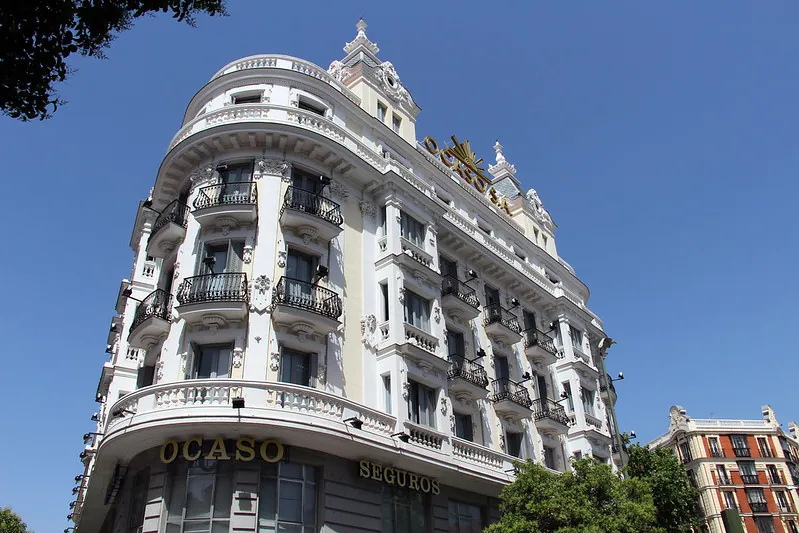
Residential architecture in Madrid ranges from 19th- and early 20th-century classical buildings featuring intricate wrought-iron balconies and grand stone facades to mid-century bourgeois apartment blocks equipped with resident concierges (fincas con portero) and central heating. Turn-key designer refurbishments have become standard in prime areas, combining heritage exteriors with contemporary open-plan layouts.
Buyers focused on the prime inner core typically concentrate on four flagship districts inside the M-30:
- Salamanca: Madrid’s premier luxury grid, encompassing Recoletos, Castellana, Goya and Lista. Known for high-end retail along Calle Serrano, it commands the highest concentration of wealth and international buyers.
- Chamberí: Celebrated for aristocratic architecture and authentic neighbourhood character across Almagro, Trafalgar and Ríos Rosas, highly favoured by domestic corporate leaders and European families.
- Retiro: Park-side living defined by the stately properties of Jerónimos and the vibrant family avenues of Ibiza and Niño Jesús, offering immediate access to the 125-hectare El Retiro park.
- Madrid Centro: The historic quarters of Justicia, Cortes, Palacio and Sol, offering lively cultural venues, boutique refurbishments, and stringent heritage preservation rules.
While domestic buyers account for the vast majority of transactions across the broader Community of Madrid, international purchasers—who represented 6.08% of regional transactions in Q2 2026 according to data from the Colegio de Registradores—alongside corporate transferees from Latin America, Europe, and North America, concentrate heavily within these central neighbourhoods.
How are property prices and rents performing in Madrid in 2026?
Market analysis requires distinguishing carefully between asking prices advertised by vendors and registered closing prices recorded at the Land Registry. According to CASAFARI Area Insights, the average asking price for apartments for sale in Madrid reached €6,896/m² in Q3 2026, marking a 1.6% increase compared to €6,787/m² in Q3 2025 (location id 11737). This indicates firm price consolidation at elevated levels across indexed listings.
In the rental sector, CASAFARI Area Insights recorded an average monthly asking rent of €28.5/m² in Q3 2026, representing a 7.2% decrease year on year from €30.7/m² in Q3 2025. This correction reflects both affordability ceilings taking effect among local tenants and an influx of supplementary stock entering the long-term rental market from adjacent property segments.
Closing prices present a distinct baseline. Official data published by the Colegio de Registradores (Estadística Registral Inmobiliaria) shows that registered closing prices for residential property averaged €4,477/m² across the Community of Madrid in Q2 2026—up from €4,091/m² across the full year of 2025—while registered closing prices in Madrid city reached €5,283/m² in Q4 2025. Notary deed figures from autumn 2026 place city closing prices tightly between €5,161/m² and €5,249/m².
Understanding this spread between asking averages (€6,896/m²) and registered closing prices (~€5,200–€5,283/m²) is critical for accurate valuation. Highly polished, refurbished units in prime micro-locations push asking metrics upward, making granular comparable market analysis essential before submitting offers.
What taxes, residency rules and rental laws apply to Madrid buyers now?
Taxation in the Community of Madrid remains among the most competitive in Spain. For resale homes, the general Property Transfer Tax (ITP) rate is 6%. This yields an effective rate of 5.4% for primary residences valued up to €250,000, and drops to 4% for large families (familias numerosas), with further regional reductions announced for buyers under 40 in the upcoming 2027 budget. New-build homes attract 10% national Value Added Tax (IVA) plus a regional Stamp Duty (AJD) ranging between 0.4% and 0.75%.
Wealth taxation and new resident incentives also shape investment strategies. Madrid applies a 100% regional rebate on Wealth Tax for net estates falling below the state Solidarity Tax threshold (€3,000,000, or up to €3,700,000 including standard exemptions and main-home allowances). Meanwhile, Law 4/2024 (the so-called ‘Ley Mbappé’) provides a 20% regional personal income tax (IRPF) deduction on qualifying financial investments—such as shares and bonds—for individuals establishing tax residency in Madrid after 1 January 2024 who were not resident in Spain during the preceding five years.
Regulatory frameworks for residency and rentals have undergone significant shifts. Spain’s real estate Golden Visa programme, which granted residency for property investments of €500,000 or more, was officially repealed by Organic Law 1/2025 (BOE), entering into force on 3 April 2025. Non-EU buyers now utilise the Digital Nomad Visa, Non-Lucrative Visa, or corporate transfer arrangements.
In the rental market, the Community of Madrid has consistently declined to declare ‘stressed residential market zones’ (zonas de mercado residencial tensionado) under State Housing Law 12/2023, meaning long-term residential leases remain free from statutory rent caps. Conversely, municipal short-term rentals are strictly governed by Plan RESIDE, introduced by Madrid City Council. In force since late 2025, Plan RESIDE completely bans new licences for scattered tourist apartments (VUT) in residential buildings across the historic centre (APE 00.01), restricting tourist letting to entire dedicated buildings. Outside the historic core, VUT licences in residential buildings are restricted exclusively to ground- or first-floor units possessing independent street access.
How to source, value and analyse Madrid property with CASAFARI
Navigating Madrid’s fragmented portal landscape requires professional intelligence tools. Real estate agents, private investors, and institutional valuers rely on CASAFARI Property Sourcing, which deduplicates listings across web portals and agency sites to present an unvarnished audit trail of asking price adjustments and days on market.
To benchmark asking figures against verified registry deeds, professionals combine CASAFARI Area Insights with CASAFARI Valuation & Market Study, evaluating asking prices directly against Notary and Land Registry closing benchmarks at street and barrio level. For urban land analysis, retail expansion or footfall studies, developers and commercial teams leverage location data via Claro AI documentation.
Explore our detailed guide to the Spanish purchase contract and escritura or read more about how transactional closing-price data works in CASAFARI. To begin analysing verified market data directly, sign in to the CASAFARI platform.
Frequently asked questions
What are the property transfer taxes when buying a home in Madrid?
Buyers of resale residential property in the Community of Madrid pay a general Property Transfer Tax (ITP) rate of 6%, representing the lowest standard rate among Spain’s major autonomous regions. This results in an effective rate of 5.4% for a primary residence priced up to €250,000, and 4% for qualifying large families. Purchasers of new-build homes instead pay 10% national VAT (IVA) alongside regional Stamp Duty (AJD) ranging from 0.4% to 0.75%.
Can you get a tourist licence for a short-let apartment in Madrid?
Under Madrid City Council’s Plan RESIDE, which came into force in late 2025, new licences for scattered tourist apartments (VUT) in residential buildings are completely prohibited across the historic centre (APE 00.01), where short-term letting is confined to dedicated whole buildings. Outside the historic core, residential buildings can only secure a tourist licence for ground-floor or first-floor units that feature an independent entrance directly from the street, subject to stringent regional suitability certificates.
Can non-EU buyers still get residency by buying property in Spain?
No. Spain officially abolished the real estate Golden Visa—which previously granted residency for property acquisitions of €500,000 or more—under Organic Law 1/2025, effective 3 April 2025. While non-EU citizens remain entirely free to purchase real estate in Madrid without restrictions, those seeking residency now typically rely on the Digital Nomad Visa, Non-Lucrative Visa, or corporate transfer permits.
Are rents capped in Madrid under Spain’s Housing Law?
No, long-term residential rents are not capped in Madrid. Although Spain’s State Housing Law (Ley 12/2023) empowers regional authorities to cap rental prices within designated ‘stressed market zones’, the Community of Madrid has declined to designate any municipal areas as stressed zones as of October 2026. Consequently, initial rents on new long-term tenancy agreements are determined freely by market supply and demand.
Why is there a difference between advertised asking prices and actual closing prices?
Asking prices reflect the vendor’s initial expectation, which averaged €6,896/m² in Q3 2026, while official registered closing prices recorded at the Land Registry offer a more concrete market baseline. In Madrid, this gap often arises because highly polished, refurbished units in prime locations push asking metrics upwards, whereas notary deed figures for the city generally sit in the range of €5,161/m² to €5,283/m². It is therefore essential to evaluate both metrics to reach an accurate property valuation.
How are transport and urban developments expected to impact the city’s future?
Madrid is currently undergoing significant large-scale transformations, most notably the Madrid Nuevo Norte urban regeneration project and the extension of Metro Line 11. These transport initiatives, including the projected northern extension linking Mar de Cristal to Valdebebas Norte by 2030, are actively reshaping the city’s boundaries and internal mobility. Such major infrastructure investment continues to attract global capital and long-term interest in the evolving districts.