
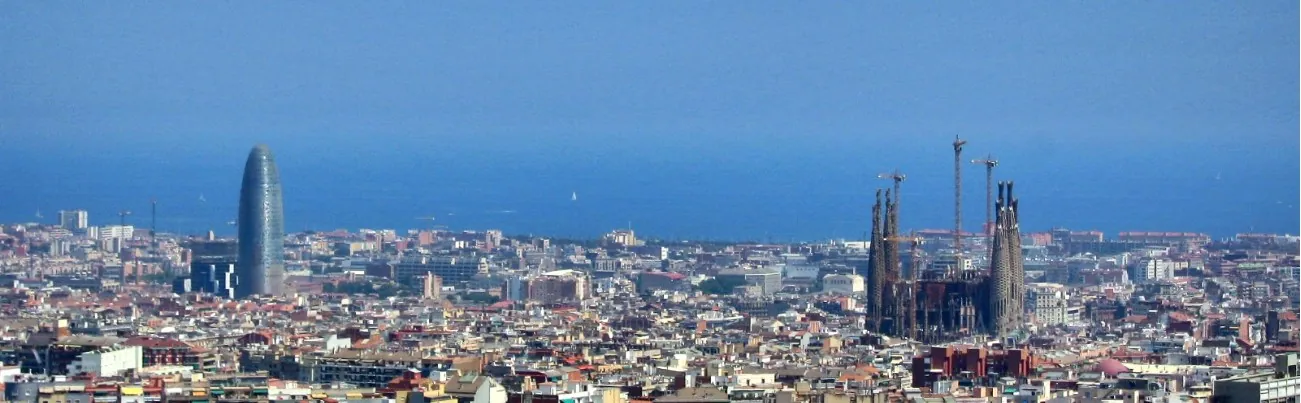
Sant Antoni forms the south-western quadrant of Barcelona’s Eixample district, covering 80.4 hectares with a population of 38,978 residents as of October 2026, according to the Ajuntament de Barcelona (Padró municipal / BCN Dades). According to CASAFARI Area Insights (location id 10556, queried 2026-10-25), apartments for sale command an average asking price of €5,871/m² in Q3 2026 (virtually flat year on year compared with €5,875/m² in Q3 2025, a -0.1% change), while average asking rents stand at €29.5/m²/month in Q3 2026 (down 4.2% from €30.8/m²/month in Q3 2025). Official registered closing prices from the Generalitat de Catalunya and Ajuntament de Barcelona averaged €5,151/m² in Q1 2026, offering buyers classic Eixample architecture alongside a consolidated pedestrian-first urban fabric.
Where is Sant Antoni and how is it connected?
Sant Antoni is clearly defined by historic thoroughfares. It is bordered by Gran Via de les Corts Catalanes to the north-west, Ronda de Sant Antoni and Ronda de Sant Pau to the east (separating it from El Raval in Ciutat Vella), and Avinguda del Paral·lel to the south-west (separating it from Poble-sec in Sants-Montjuïc). For those navigating the broader metropolitan context, our Eixample property guide provides district-wide comparisons, while our broader Barcelona property market guide situates the neighbourhood within the city.
Walkability is exceptional. The neighbourhood is served by Metro L2 (Sant Antoni, positioned directly beside the market), L1 (Urgell, Rocafort and Espanya on its upper edges), and L3 (Paral·lel and Poble Sec along its southern boundary), complemented by orthogonal bus routes and segregated cycle lanes along Gran Via, Paral·lel and Manso. For airport connections, verified 2026 figures show that the Aerobús (A1/A2) picks up along Sepúlveda–Urgell towards Barcelona-El Prat Airport and drops off on Gran Via–Comte Borrell on the return journey for a €7.45 single or €12.85 return fare. Metro L2 connects via L1 and L9 Sud for €5.90 using an airport ticket, whereas a metered taxi takes 25 to 35 minutes and costs between €35 and €46, inclusive of the €4.60 airport supplement and the €21 minimum airport fare.
What is it like to live in Sant Antoni today?
Sant Antoni has fully matured beyond the infrastructural transformations of the late 2010s. The historic, wrought-iron Mercat de Sant Antoni reopened in May 2018 following a comprehensive restoration, housing fresh food stalls, non-food markets, the Sunday book and coin fair, and archaeological remains including the Roman Via Augusta and a 17th-century bastion wall in its basement. Furthermore, the Ronda de Sant Antoni between Comte d’Urgell and Floridablanca reopened on 31 May 2025 as a permanent pedestrian promenade.
Urban revitalisation continued in May 2026 when the city awarded contracts to transform the tactical urbanism along Carrer del Comte Borrell, Carrer del Parlament and Carrer d’Aldana into 22,600 m² of permanent pedestrian-priority streets and green spaces, anchored by a major public plaza at the intersection of Comte Borrell and Parlament. Daily life blends historic vermuterias, specialist bakeries and independent bookshops with cultural fixtures such as Fàbrica Moritz on Ronda de Sant Antoni and traditional horchaterias like Sirvent. Along Avinguda del Paral·lel, the high-end dining strip has also evolved, with the former Tickets and Teatro Kitchen & Bar premises at Paral·lel 164 transitioning into a new gastronomic project led by chef Paolo Casagrande and the Orobianco group.
What is the housing stock like, and who buys in Sant Antoni?
The residential fabric consists primarily of classic late-19th and early-20th-century Cerdà Eixample chamfered blocks, known locally as fincas regias. These buildings feature high ceilings, hydraulic mosaic tiles, Catalan vaulted ceilings, street-facing wrought-iron balconies, and bright rear galleries looking onto quiet interior block courtyards. Mid-20th-century brick apartment buildings closer to Avinguda Mistral and Paral·lel complete the inventory.
Micro-street dynamics matter significantly for valuers and buyers. Apartments situated directly on the pedestrianized axes of Parlament and Comte Borrell or overlooking the market command strong lifestyle demand, whereas upper-floor flats on Gran Via or Paral·lel offer expansive light and rapid transit access. Quieter residential side streets such as Tamarit, Manso and Viladomat remain sought after by families seeking tranquillity. The buyer profile combines established local Catalan families and professionals upgrading within the district with international owner-occupiers—particularly from the UK, France and wider northern Europe—who appreciate Eixample proportions and light at a lower entry cost per square metre than Dreta de l’Eixample. International buyers can also consult our guide to buying property in Spain for details on legal steps.
How is the Sant Antoni property market performing in 2026?
Understanding market performance requires strict separation between asking prices from portal listings and official registered closing prices. According to CASAFARI Area Insights (location id 10556, queried 2026-10-25), the average asking price for apartments for sale in Sant Antoni stands at €5,871/m² in Q3 2026, remaining virtually flat year on year compared with €5,875/m² in Q3 2025 (-0.1%). In contrast, official registered closing prices from the Generalitat de Catalunya and Ajuntament de Barcelona stood at €5,151/m² in Q1 2026, revealing a negotiating and quality spread of roughly 12% to 14% between unrenovated stock closing near the official average and turn-key renovated properties listed near €6,000/m².
On the rental side, CASAFARI Area Insights records an average asking rent of €29.5/m²/month in Q3 2026, marking a 4.2% decrease from €30.8/m²/month in Q3 2025. This contrasts with official INCASÒL deposit data for signed long-term leases in Sant Antoni, which averaged €1,128 per month (€16.39/m² for an average 74 m² flat) in Q1 2026, following €1,118 per month (€16.30/m²) across 2025. This structural gap exists because active portal listings skew heavily toward furnished or temporary lets, whereas signed long-term residential contracts are bound by Catalonia’s stressed-zone reference price caps.
What taxes, rental caps and residency rules apply to buyers in 2026?
Property acquisition and holding are shaped by stringent regional regulations. Under Decree-Law 5/2025 (in force since 27 June 2025), resale home buyers pay a progressive Property Transfer Tax (ITP) scaled across four brackets: 10% up to €600,000; 11% from €600,000.01 to €900,000; 12% from €900,000.01 to €1,500,000; and 13% on any amount exceeding €1,500,000, alongside a general Stamp Duty (AJD) of 1.5%. Large property holders owning five or more residential properties in a stressed zone or ten across Catalonia, as well as buyers of entire residential buildings, face a flat 20% ITP rate. Conversely, buyers aged 35 or under purchasing a primary residence with a taxable income cap of €36,000 benefit from a reduced 5% ITP and 0% AJD.
Short-term rentals face severe restrictions: Barcelona’s PEUAT bans new tourist apartment licences in the Eixample, and under Catalan Decree-Law 3/2023 (upheld by the Constitutional Court in March 2025), all existing tourist apartment licences in the city expire on 24 November 2028. Furthermore, since April 2025 under Organic Law 1/2025, any short-term rental activity requires a three-fifths majority approval from the homeowners’ association, alongside registration in the national single registry (NRUA) introduced in July 2025. Long-term and seasonal leases are equally regulated; as Barcelona is designated a stressed residential market zone, Catalan Law 11/2025 (in force since 1 January 2026) subjects seasonal contracts—unless strictly recreational or holiday-based—and room rentals to state Reference Price Index caps, requiring landlords to file documentary proof of temporary cause with INCASÒL.
Finally, international non-EU investors must note that Spain abolished the €500,000 real estate investor residency visa on 3 April 2025 under Organic Law 1/2025, meaning property acquisitions no longer grant residency rights.
How to analyse and source Sant Antoni property with CASAFARI
Professionals operating in this micro-market rely on accurate, deduplicated market data. Analysts use CASAFARI Area Insights to track historical asking price and rent trajectories, deploy Property Sourcing to scan clean portal and agency inventory across Sant Antoni for price adjustments, and execute a property valuation and market study to benchmark asking listings against registered transactions. Technical analysts can also query these datasets programmatically via the Area Insights API documentation or connect AI workflows using Casafari MCP. To explore live datasets directly, sign in to the CASAFARI platform.
Frequently asked questions
Can I buy an apartment in Sant Antoni for short-term or holiday rentals?
New tourist apartment licences are strictly prohibited in the Eixample under Barcelona’s PEUAT regulations, and all existing tourist licences in the city are scheduled to expire on 24 November 2028 under Catalan Decree-Law 3/2023. Additionally, under Catalan Law 11/2025, seasonal lets for work, study or medical reasons and room-by-room rentals are subject to the same stressed-zone rent caps as permanent leases, requiring mandatory documentary proof to be filed with INCASÒL.
What taxes do you pay when buying a resale property in Sant Antoni in 2026?
Under Catalonia’s Decree-Law 5/2025, resale properties are subject to a progressive Property Transfer Tax (ITP) structure: 10% on the first €600,000, 11% between €600,000.01 and €900,000, 12% between €900,000.01 and €1,500,000, and 13% for amounts above €1,500,000. Large property holders and whole-building purchasers pay a flat 20% ITP, while buyers aged 35 or under acquiring a main residence with qualifying income limits benefit from a reduced 5% ITP and 0% Stamp Duty.
Does buying a €500,000 apartment in Sant Antoni still qualify for a Spanish Golden Visa?
No, Spain officially abolished the Golden Visa route for real estate investment on 3 April 2025 following the enactment of Organic Law 1/2025. Purchasing property in Sant Antoni no longer confers residency rights, requiring non-EU buyers to pursue alternative pathways such as the Digital Nomad Visa or Non-Lucrative Visa.
Why is there such a large gap between asking rents and official contract rents in Sant Antoni?
CASAFARI Area Insights tracks active portal listing asking rents, which averaged €29.5/m²/month in Q3 2026 for furnished or short-horizon properties advertised by landlords. Conversely, official INCASÒL deposit data recorded signed residential lease agreements averaging €16.39/m²/month in Q1 2026, which are legally bound by Barcelona’s stressed-zone reference index caps. Real estate professionals must underwrite long-term yields using capped contractual figures rather than unverified listing asking prices.
Which specific architectural features should a prospective buyer look for in a classic Sant Antoni finca regia?
These historic, late-19th and early-20th-century blocks typically showcase original hydraulic mosaic tiles and intricate Catalan vaulted ceilings. Most feature high ceilings and street-facing balconies with traditional wrought-iron detailing. Buyers should also inspect the rear galleries, which provide access to the quiet interior block courtyards characteristic of the Cerdà Eixample grid.
How do local street-level dynamics affect the suitability of a property for a family home versus an investment purchase?
Quiet residential side streets such as Tamarit, Manso and Viladomat are particularly sought after by local families seeking long-term tranquillity away from major thoroughfares. Conversely, those focused on the rental or lifestyle market often prefer apartments on the pedestrianised axes of Parlament and Comte Borrell or those overlooking the Mercat de Sant Antoni. Properties located on the main arteries of Gran Via or Paral·lel offer distinct advantages regarding expansive natural light and immediate access to the district’s extensive transit network.