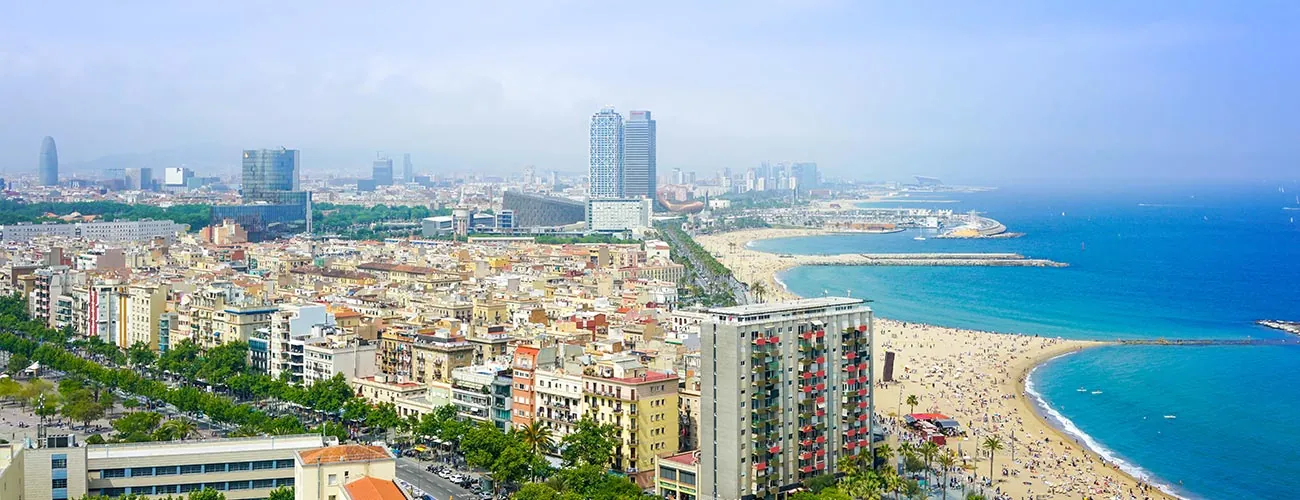
Barcelona
Spain’s major Mediterranean port and commercial center, famed for its individuality and cultural interest
Imagine standing on a light-filled balcony in Dreta de l’Eixample, reviewing a purchase contract. The seller points to a tourist-use licence (HUT) to justify a premium asking price. However, following Barcelona City Council’s announcement in June 2024, all 10,000 tourist flat licences in the city will lapse without renewal by November 2028. Coupled with Catalonia’s progressive transfer tax introduced on 27 June 2025 and extended rent caps, buying property in Barcelona requires an investment strategy based strictly on long-term residential fundamentals.
Which Barcelona districts suit which buyer?
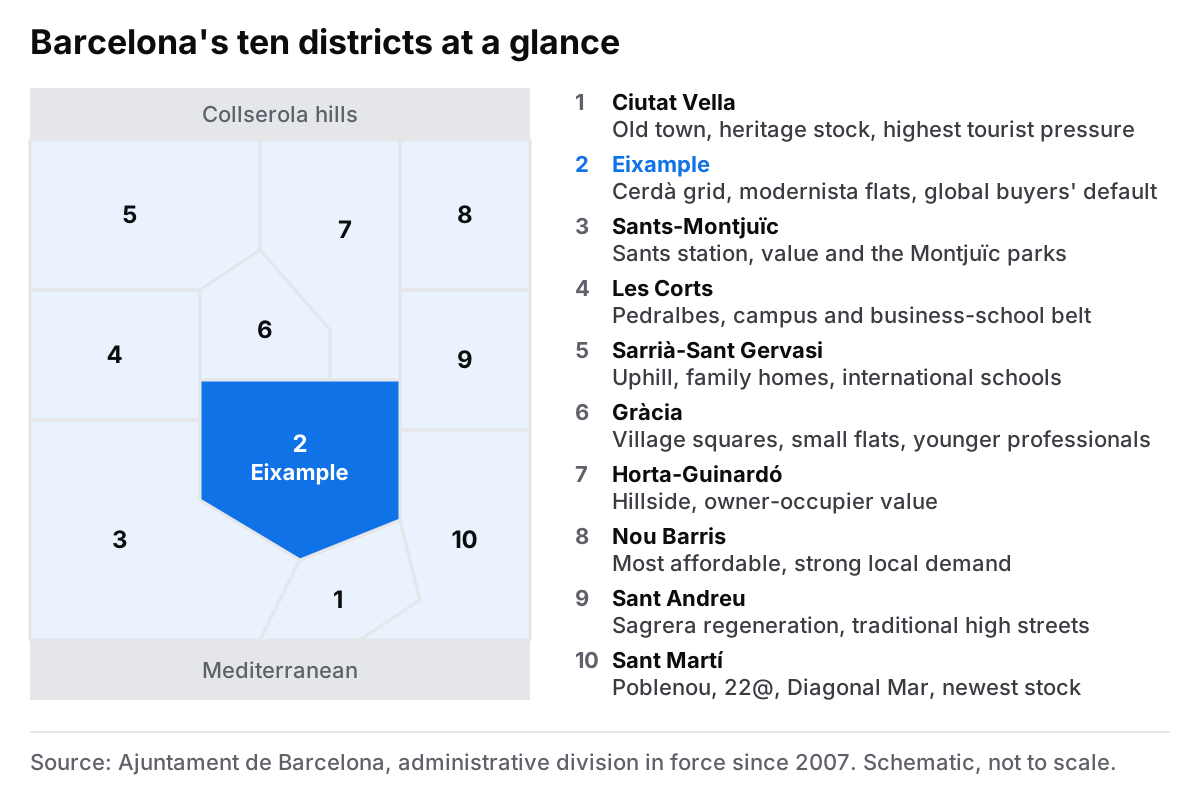
Barcelona covers roughly 100 km² between the Mediterranean Sea (mar) and the Collserola hills (muntanya). Local directions and property orientations rely heavily on this geographic axis. The city is divided into ten administrative districts and 73 neighbourhoods (barris), each serving distinct demographic profiles and investment objectives. Detailed local supply and pricing metrics across every neighbourhood can be tracked using Area Insights for Barcelona’s districts.
- Eixample (Dreta and Esquerra): Designed by Ildefons Cerdà in the late 19th century, Eixample features a iconic grid layout, high ceilings, modernista architecture, and inner courtyard light wells. It remains the default target for international buyers, high-net-worth residents, and commercial-to-residential conversions.
- Sarrià-Sant Gervasi and Les Corts (Pedralbes): Located uphill toward Collserola, these areas form the prime family belt. Pedralbes offers wide avenues, low-density apartment complexes, and detached villas close to top international schools and business hubs.
- Gràcia: Defined by pedestrianised village squares and narrow streetscapes. Its building stock typically consists of smaller, traditional floorplates and walk-up flats without lifts, which maintain constant rental demand among young professionals.
- Ciutat Vella (Gòtic, Born, Raval, Barceloneta): Barcelona’s historic core contains medieval architecture and heavy visitor footfall. As the district most impacted by short-term tourist restrictions, capital values here depend heavily on residential refurbishment quality.
- Sant Martí (Poblenou, 22@, Diagonal Mar, Vila Olímpica): Home to the 22@ technology district and modern beachfront developments. Sant Martí contains the highest concentration of modern residential stock and energy-efficient new builds in the city.
- Horta-Guinardó, Nou Barris, Sant Andreu, and Sants-Montjuic: Predominantly residential districts driven by domestic owner-occupiers. Sant Andreu features ongoing long-term urban regeneration around the La Sagrera high-speed railway hub, offering steady local housing demand.
What does buying a flat in Barcelona cost in tax?
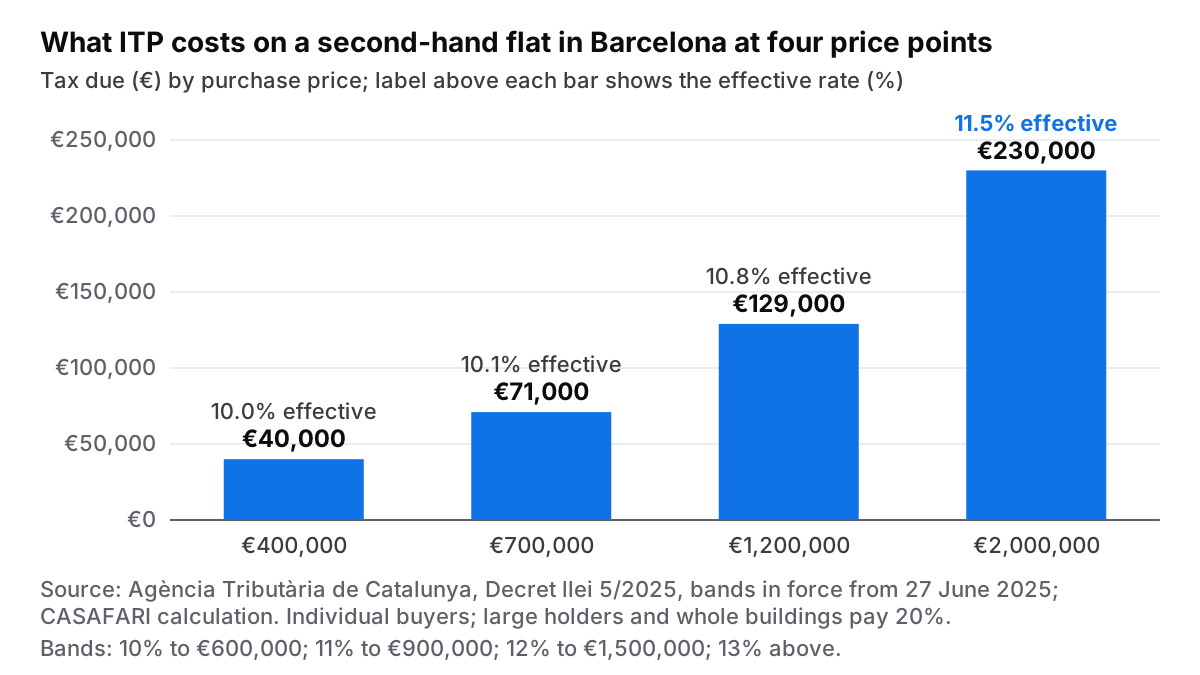
When purchasing a second-hand property in Barcelona as an individual, buyers pay Catalonia’s Property Transfer Tax (Impuesto sobre Transmisiones Patrimoniales or ITP). Under Decret llei 5/2025, enacted by the Agència Tributària de Catalunya on 27 June 2025 following the February 2025 fiscal agreement, ITP is applied on a progressive marginal scale:
- 10% on the purchase price up to €600,000
- 11% on the portion between €600,000 and €900,000
- 12% on the portion between €900,000 and €1,500,000
- 13% on any amount exceeding €1,500,000
Because these rates apply marginally across price bands rather than to the entire sum, effective tax rates vary. A home purchased for €400,000 incurs €40,000 in ITP (an effective rate of 10.0%). A €700,000 acquisition generates €71,000 in tax (10.1%), a €1,200,000 property incurs €129,000 (10.8%), and a €2,000,000 prime acquisition attracts €230,000 in tax (11.5%).
For institutional investors and portfolio buyers, Decret llei 5/2025 introduced a flat 20% ITP rate applying to purchases by large holders (gran tenidor, defined as entities holding more than 10 urban residential properties or over 1,500 m² of residential space) or when buying entire residential buildings.
For new-build developments, buyers pay 10% Value Added Tax (VAT/IVA) plus Stamp Duty (Actos Jurídicos Documentados or AJD) instead of ITP. Ongoing ownership costs include local property tax (Impuesto sobre Bienes Inmuebles or IBI), community charges, and Non-Resident Income Tax (IRNR). On disposal, sellers face capital gains tax and local land value tax (plusvalía municipal). You can review conveyancing stages in the step-by-step guide to buying property in Spain and learn about legal execution in the contract and the escritura explained.
Can you still let a Barcelona flat to tourists?
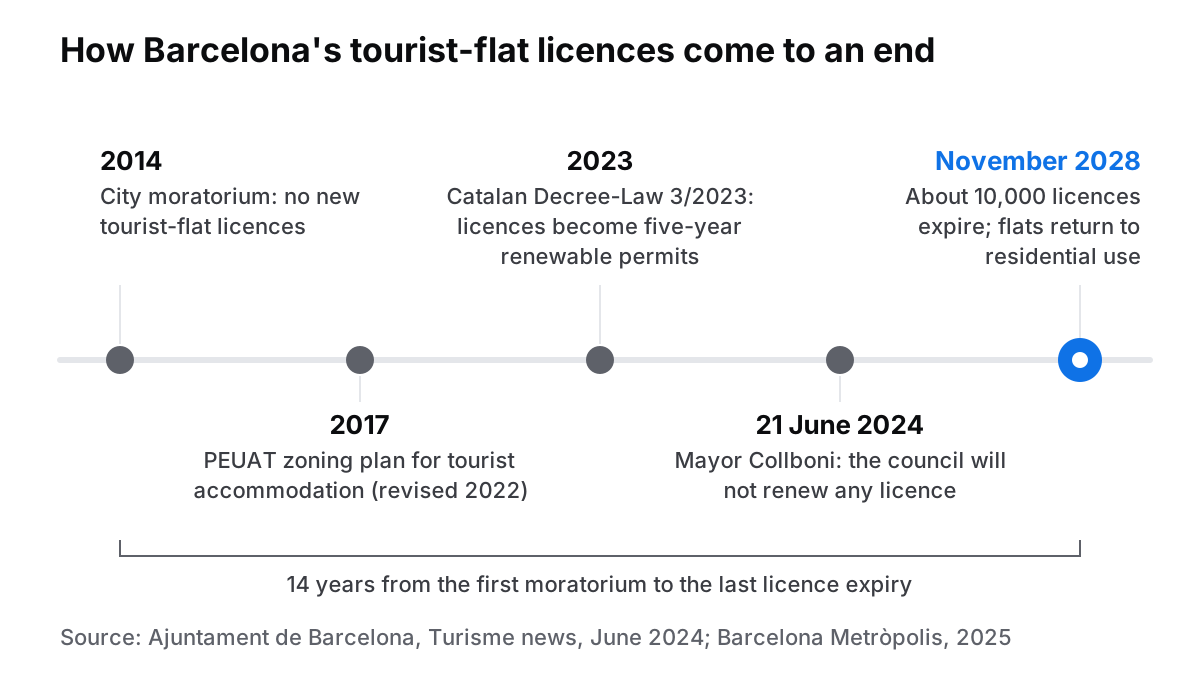
Short-term holiday lets are being phased out in Barcelona. Since the municipal moratorium of 2014 and the implementation of the PEUAT urban plan, no new tourist-use housing licences (HUT) have been granted, as documented by Barcelona Metròpolis. Under the Generalitat de Catalunya’s Decret llei 3/2023, existing tourist licences were converted into five-year renewable municipal permits.
In June 2024, Mayor Jaume Collboni confirmed that Barcelona City Council will exercise its statutory right not to extend any of the city’s roughly 10,000 active tourist licences. Consequently, all licensed tourist apartments are scheduled to lose their commercial status by November 2028 and revert to residential supply.
Investors evaluating flats marketed with active HUT licences must price acquisitions on long-term residential lease mechanics rather than temporary holiday income. Furthermore, seasonal (temporada) and room rentals within Catalonia are governed under strict municipal framework conditions. Underwrite prospective acquisitions by referencing long-term returns through how rental yield is calculated and where to find it.
How does Catalonia’s rent cap work for a Barcelona landlord?
Barcelona operates as a declared stressed residential market zone (zona de mercat residencial tensionat). As reported by Público on the rent cap extension, the Generalitat extended these price controls in July 2026 for an additional 12 months, broadening the measure to 302 Catalan municipalities.
Under Spain’s Housing Act (Ley 12/2023 por el Derecho a la Vivienda), residential lease pricing follows strict statutory rules:
- Standard Landlords: The rent agreed under a new long-term lease cannot exceed the rent of the previous tenancy agreement, adjusted only by the official state inflation index. All public listings must state both the previous rent and the benchmark price index.
- Large Holders (Gran Tenidor) & Unlet Properties: If the landlord owns five or more residential units in a stressed zone, or if the flat has not been leased within the past five years, the rent is strictly capped at the maximum limit calculated by the official reference price index of the Ministry of Housing (Ministerio de Vivienda).
Landlords and investors cannot set contract rents freely based on market competition alone. You can read a complete breakdown of legal compliance in what the 2023 Housing Act changed for landlords. To establish realistic valuation targets, cross-reference street-level data with a valuation and market study for a specific flat.
Transport, schools and daily life: what moves demand street by street
Infrastructure and educational amenities heavily influence micro-location values across Barcelona:
- Transport Links: Urban transit is operated by Transports Metropolitans de Barcelona (TMB metro and bus networks), alongside Rodalies commuter rail and tram routes. Barcelona-Sants station connects to Madrid via high-speed AVE rail services in roughly two and a half hours. Josep Tarradellas Barcelona-El Prat Airport is directly reachable via metro line L9 Sud and the R2 Nord train line.
- Education: International families concentrate around Sarrià-Sant Gervasi, Pedralbes, and adjacent suburban municipalities. Key institutions include the Benjamin Franklin International School, Kensington School, Oak House School, St. Peter’s School, and the American School of Barcelona. State schools deliver primary and secondary tuition primarily in Catalan.
- Higher Education: Continuous tenant demand across Ciutat Vella, Pedralbes, and Poblenou is sustained by university faculties (Universitat de Barcelona, Universitat Politècnica de Catalunya, Universitat Pompeu Fabra) and business institutions, including IESE Business School, ESADE, and EADA.
Residency and ownership rules for non-EU buyers
Foreign individuals, regardless of nationality or EU status, can purchase real estate in Spain without restriction. Foreign buyers must obtain a foreigner tax identification number (Número de Identificación de Extranjero or NIE) and open a Spanish bank account prior to signing the deed of purchase (escritura pública) before a notary.
Property acquisition no longer grants residency rights. Spain’s investor residence permit tied to real estate purchases of €500,000 or more (the ‘Golden Visa’) was formally repealed under Ley Orgánica 1/2025, taking effect on 3 April 2025. Non-EU buyers planning to reside in Barcelona must apply for independent visa categories, such as the Remote Worker (Digital Nomad) Visa under the Startups Act (Ley 28/2022) or the Non-Lucrative Residence Visa. Spanish banking institutions continue to offer mortgage financing to non-resident property buyers subject to standard underwriting conditions.
How CASAFARI reads Barcelona
Navigating a heavily regulated real estate market requires real-time data accuracy across all ten districts. CASAFARI aggregates property market metrics directly from primary listing sources and transaction registries across Spain:
- Area Insights: Tracks total active listings, asking prices, transaction trends, days on market, and rental rate averages at district and neighbourhood level.
- Comparables: Generates precise market valuations by evaluating historical comps, price adjustments, and live inventory for specific residential units.
- Property Sourcing: Helps real estate professionals and investors locate private sales, price reductions, and off-market investment opportunities.
Developers, proptech platforms, and quantitative analysts can integrate this live real estate data directly through our developer tools. Read the Area Insights developer documentation for API specifications, or explore data analytics directly by logging into the CASAFARI platform.
Frequently asked questions
Can foreigners buy property in Barcelona?
Yes, foreign individuals and legal entities can purchase real estate in Barcelona without legal restriction. Buyers must obtain a Spanish tax identification number (NIE) and open a local bank account before completing the purchase before a notary. Owning property no longer confers residence rights following the closure of the investor permit route in April 2025, meaning non-EU buyers must secure residency through alternative routes such as the digital nomad visa. Step-by-step conveyancing details can be found in the step-by-step guide to buying property in Spain.
Can I rent out my Barcelona flat on Airbnb?
You can only let a property on short-term holiday platforms if it already possesses a valid tourist-use licence (HUT). Barcelona City Council has maintained a strict moratorium on new licences since 2014 and confirmed in June 2024 that all existing tourist licences will expire without renewal in November 2028. Unlicensed tourist letting attracts severe administrative fines. Buyers should underwrite property acquisitions on standard residential leases subject to regional rent control.
What taxes do you pay when buying a flat in Barcelona?
When purchasing a resale property in Barcelona, individual buyers pay Catalonia’s Property Transfer Tax (ITP), which runs on a progressive scale of 10% up to €600,000, 11% up to €900,000, 12% up to €1,500,000, and 13% on higher amounts. Large property holders and corporate buyers purchasing entire residential buildings pay a flat 20% ITP rate. New-build homes are subject to 10% VAT (IVA) plus Stamp Duty (AJD) instead of ITP. Buyers should also budget for notary fees, land registry fees, annual municipal property tax (IBI), and non-resident income tax.
Is Barcelona rent-controlled?
Yes, Barcelona is classified as a stressed residential market zone under Spain’s 2023 Housing Act, with the declaration extended by the Generalitat de Catalunya in July 2026. Landlords issuing new tenancy contracts cannot exceed the rent charged under the previous lease contract, adjusted only by official indexation. For properties owned by large holders or flats unlet during the previous five years, maximum rent levels are capped directly by the state’s official reference price index. Landlords can review regulatory compliance in what the 2023 Housing Act changed for landlords.