
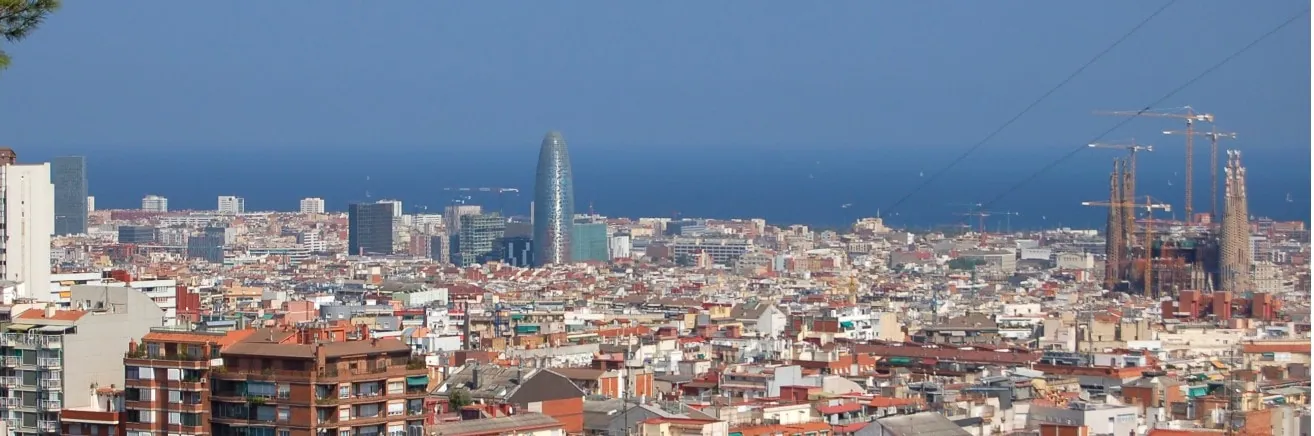
EIXAMPLE ESQUERRA PROPERTY GUIDE
Modern neighborhood famous for its liberality and cut-off corner buildings
Eixample Esquerra, comprising L’Antiga and La Nova Esquerra in central Barcelona, represents one of the city’s most desirable residential and investment districts. In Q3 2026, CASAFARI Area Insights records an average asking price of €6,970/m² (+2.8% year on year) and an average asking rent of €33.4/m²/month in L’Antiga Esquerra de l’Eixample, contrasting with official registered second-hand closing prices averaging €6,413/m².
Where is Eixample Esquerra and how is it divided?
Since 2006, Barcelona officially divides the western half of Ildefons Cerdà’s iconic grid—stretching west from Carrer de Balmes over to Tarragona and Josep Tarradellas—into two distinct neighbourhoods along Carrer del Comte d’Urgell. L’Antiga Esquerra de l’Eixample registered a population of 42,411 residents in January 2026, while La Nova Esquerra de l’Eixample accounted for 58,261 residents, bringing the combined total across Esquerra de l’Eixample to 100,672 inhabitants according to the Ajuntament de Barcelona Padró Municipal d’Habitants.
The district is bordered by Dreta de l’Eixample to the east across Carrer de Balmes, Sant Antoni and El Raval to the south-east, Sants-Montjuïc and Plaça d’Espanya to the south-west, Les Corts to the west, and Sant Gervasi-Galvany and Gràcia across Avinguda Diagonal to the north. Connectivity is exceptional, served by Metro lines L1, L3 and L5 (with key stops at Hospital Clínic, Entença, Rocafort, Tarragona and Universitat), regional FGC trains at Provença, and the Aerobús linking Plaça d’Espanya and Plaça de Catalunya to El Prat Airport in under thirty minutes. Furthermore, the €412 million FGC L8 underground rail extension—with heavy tunneling works active through 2026 and service entry targeted for 2029–2030—will introduce major new interchanges at Hospital Clínic on Carrer del Comte d’Urgell and at Francesc Macià, further elevating transit accessibility across the wider Eixample property market.
What is daily life like in L’Antiga and La Nova Esquerra?
Daily life in the two halves of Eixample Esquerra offers distinct atmospheres. L’Antiga Esquerra centres on the historic 19th-century Universitat de Barcelona campus, the bustling Mercat del Ninot, the tree-lined pedestrian promenade of Carrer d’Enric Granados, the vibrant Gaixample cultural quarter, and the major medical and research cluster anchored by Hospital Clínic. By contrast, La Nova Esquerra features wider street proportions, slightly larger mid-20th-century residential blocks, and expansive green spaces like Parc de l’Espanya Industrial and Parc de Joan Miró, which houses the prominent Biblioteca Joan Miró.
The urban fabric has been profoundly enhanced by the Superilla Barcelona pedestrian green axes (eixos verds), completed in July 2023 and fully integrated by 2026 along Carrer del Consell de Cent, Carrer de Rocafort, Carrer del Comte Borrell (with an extension approved by the City Council in April 2026), and Carrer de Girona. Intersections such as Consell de Cent with Enric Granados and Comte Borrell now function as traffic-calmed civic squares, commanding a notable micro-location premium for surrounding properties. Gastronomic and social offerings range from world-class dining destinations like the Michelin-starred Disfrutar on Carrer de Villarroel to traditional neighbourhood tapas bars and sophisticated cocktail lounges.
Housing stock and buyer profiles: from Modernista fincas regias to family flats
Architectural typology varies significantly across the district. L’Antiga Esquerra is renowned for its late-19th and early-20th-century fincas regias and Modernista buildings featuring chamfered xamfrans, hydraulic mosaic tiles (panot and Nolla), soaring coffered ceilings with Catalan vaulting (volta catalana), and classic interior galleries overlooking quiet Cerdà courtyard gardens (interiors d’illa). Prized assets include principal apartments on the first floor with expansive rear terraces and sobreàtic penthouses.
Moving west of Carrer del Comte d’Urgell into La Nova Esquerra—particularly around Carrer de Rocafort, Carrer de Calàbria and Carrer d’Entença—the architectural profile transitions to 1960s–1980s brick and concrete construction. These buildings typically offer underground parking facilities, ground-level lifts, rational room layouts and efficient bedroom-to-surface ratios. International buyers from the UK, France, Northern Europe and the United States, alongside medical consultants and corporate executives, predominantly target turn-key renovated apartments or unrenovated fincas regias along prime corridors like Enric Granados, Consell de Cent, Muntaner and Rambla de Catalunya. Meanwhile, domestic Catalan families seeking stability within the urban core drive the active €350,000 to €650,000 market in La Nova Esquerra.
Eixample Esquerra property prices and rental market in 2026
When evaluating real estate figures in Eixample Esquerra, market participants must carefully distinguish between portal asking prices and registered closing figures. CASAFARI splits Esquerra de l’Eixample into L’Antiga Esquerra de l’Eixample (location id 10554) and La Nova Esquerra de l’Eixample (location id 10555). According to CASAFARI Area Insights (queried on 25 October 2026), the average asking price for apartments for sale in L’Antiga Esquerra reached €6,970/m² in Q3 2026, representing a 2.8% year-on-year increase compared to €6,780/m² in Q3 2025.
In contrast, official registered closing prices (preu de compravenda registrat) published by the Ajuntament de Barcelona and property registrars reflect actual completed transactions. Over the twelve-month period from July 2025 to June 2026, registered second-hand closing prices averaged €6,413/m² in L’Antiga Esquerra and €5,655/m² in La Nova Esquerra (up from full-year 2025 closing averages of €6,205/m² across 410 sales in L’Antiga Esquerra and €5,373/m² across 373 sales in La Nova Esquerra). Average registered transaction values updated in September 2026 stood at €579,100 in L’Antiga Esquerra versus €348,700 in La Nova Esquerra, illustrating the structural premium commanded by prime historic stock.
The rental market exhibits a similar two-tier dynamic. CASAFARI Area Insights recorded an average asking rent of €33.4/m²/month in L’Antiga Esquerra in Q3 2026, marking a 6.7% decrease year on year from €35.8/m²/month in Q3 2025. This downward adjustment aligns with official registered closing rents from INCASÒL deposit statistics in H1 2026, which averaged €1,319/month (€17.35/m²) in L’Antiga Esquerra and €1,168/month in La Nova Esquerra, demonstrating how active portal listings previously dominated by high-priced temporary lets have moderated following recent legislative reforms.
Taxes, property licences and rental regulations in 2026
Property acquisition and management in Barcelona are governed by an updated regulatory framework. Under Catalonia’s Decree-Law 5/2025 (in force since 27 June 2025), Property Transfer Tax (ITP) on residential resales follows progressive brackets: 10% up to €600,000; 11% from €600,000.01 to €900,000; 12% from €900,000.01 to €1,500,000; and 13% for any amount exceeding €1,500,000. Furthermore, large property holders (grans tenidors—defined as owners of 5 or more residential units in stressed zones like Barcelona, or 10+ across Catalonia) and corporate buyers acquiring entire residential buildings are subject to a flat 20% ITP rate, while tax rebates for property flipping companies have been abolished.
For non-EU buyers, Spain’s Organic Law 1/2025 repealed Articles 63–67 of Law 14/2013 as of 3 April 2025, formally ending the Golden Visa route for property acquisitions of €500,000 or more. Investors now explore alternative pathways such as the Digital Nomad Visa or non-lucrative residency permits. In the short-term rental sector, Barcelona’s PEUAT plan maintains a strict ban on new tourist apartment licences, and under Catalan Decree-Law 3/2023, all ~10,101 existing tourist licences across the city will expire without renewal in November 2028, reverting units to residential use. Additionally, Law 11/2025 (effective 1 January 2026) subjects medium-term seasonal leases and room rentals in stressed zones to the same reference-index rent caps as permanent long-term tenancies.
How real estate professionals analyse Eixample Esquerra with CASAFARI
Street-by-street precision is paramount in Eixample Esquerra, where a fifth-floor apartment overlooking a pedestrian green axis trades in a distinctly different league from an interior unit facing heavy traffic arteries. Acquisitions teams and advisory professionals rely on CASAFARI Property Sourcing to aggregate clean, deduplicated listings across thousands of sources, identifying price adjustments and private vendor opportunities instantly.
To benchmark micro-location values against historical trajectories, professionals utilise our property valuation and market study tool alongside CASAFARI Area Insights, gaining clear visibility into the spread between asking prices and registered closing data. International buyers can also consult our complete guide to buying property in Spain and explore analyses on using transactional data to prove the cost of overpricing. To build automated underwriting workflows via APIs and AI agents, review the Area Insights API documentation or sign in to the CASAFARI platform to begin exploring verified market intelligence.
Frequently asked questions
What is the difference between L’Antiga Esquerra and La Nova Esquerra de l’Eixample?
Carrer del Comte d’Urgell divides Eixample Esquerra into two official neighbourhoods. L’Antiga Esquerra, located to the east towards Balmes, is the historic core built around the Universitat de Barcelona and Hospital Clínic, characterised by classic fincas regias and higher asking prices. La Nova Esquerra, extending west towards Plaça d’Espanya, features a larger population, wider mid-20th-century residential blocks, family amenities like Parc de Joan Miró, and slightly lower registered closing prices.
How much is Property Transfer Tax (ITP) when buying a flat in Eixample Esquerra in 2026?
Under Catalonia’s Decree-Law 5/2025, buyers of resale residential properties pay progressive ITP rates: 10% on the first €600,000, 11% for portions between €600,000.01 and €900,000, 12% between €900,000.01 and €1,500,000, and 13% on amounts exceeding €1,500,000. Large property holders owning five or more residential units in Barcelona and purchasers acquiring entire residential buildings are subject to a flat 20% rate.
Can you buy an apartment in Eixample Esquerra for short-term or seasonal rental?
No new tourist apartment licences are granted in Eixample under Barcelona’s municipal regulations, and all existing tourist licences across the city will expire without renewal in November 2028. Furthermore, under Catalan Law 11/2025, medium-term seasonal rentals and room-by-room lettings in stressed residential zones are bound by the same mandatory reference-index rent caps as standard long-term tenancies.
How will the L8 metro extension and Hospital Clínic redevelopment affect Eixample Esquerra?
The €412 million FGC L8 rail extension—scheduled for completion around 2029–2030—will add major new underground stations at Hospital Clínic and Francesc Macià, improving connectivity. Simultaneously, the relocation of Hospital Clínic to Avinguda Diagonal by 2035 will transform the current Villarroel site into green spaces and local community facilities, enhancing long-term residential appeal.
What kind of properties should a family looking for modern amenities consider in Eixample Esquerra?
Families seeking modern functionality should focus on La Nova Esquerra, where the architectural profile shifts to 1960s–1980s brick and concrete construction. These buildings are well-suited for modern living, typically offering amenities like underground parking, lifts, and rational room layouts with efficient bedroom-to-surface ratios.
Is there a significant price difference between prime historic apartments and 20th-century residential stock?
Yes, there is a clear valuation split between the two neighbourhoods reflecting their distinct architectural assets. Registered transaction values from September 2026 reached €579,100 in L’Antiga Esquerra with its prime fincas regias, compared to €348,700 in La Nova Esquerra, where 20th-century housing stock predominates.