
BAIRRO ALTO PROPERTY GUIDE
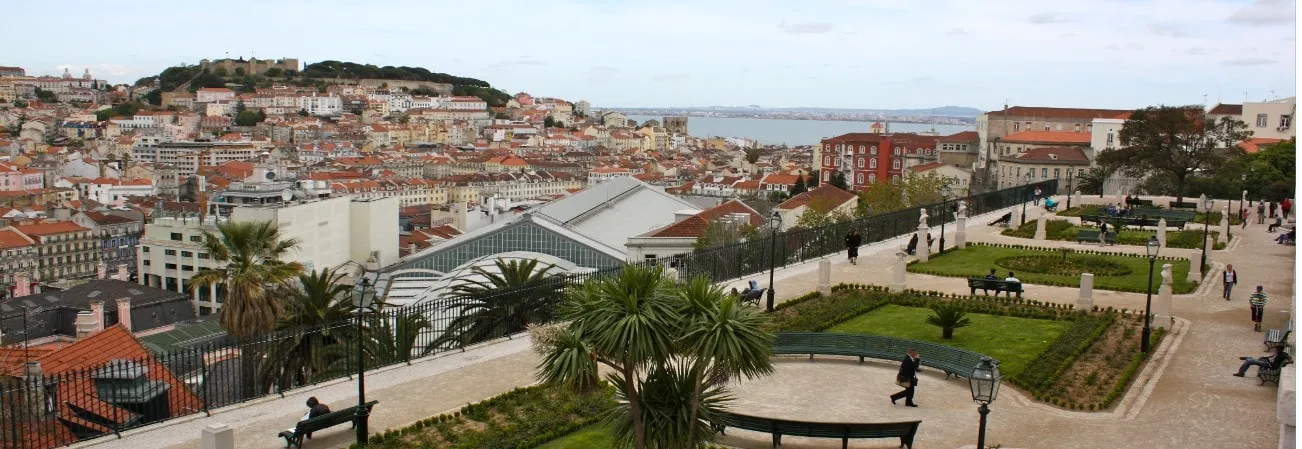
Bohemian and artsy area of pretty cobblestone paths and ancient buildings
On a Saturday morning along Rua da Atalaia, shutters remain down while a renovation team carries timber up a 16th-century staircase. Bairro Alto sits in Lisbon’s Misericórdia parish between Chiado, Príncipe Real, and Bica. Buying property in this historical grid requires balancing character against strict municipal short-let containment rules and the end of the real estate Golden Visa route. Evaluating current supply and transaction dynamics through data ensures informed decision-making.
Where exactly is Bairro Alto, and what is it like to live there?
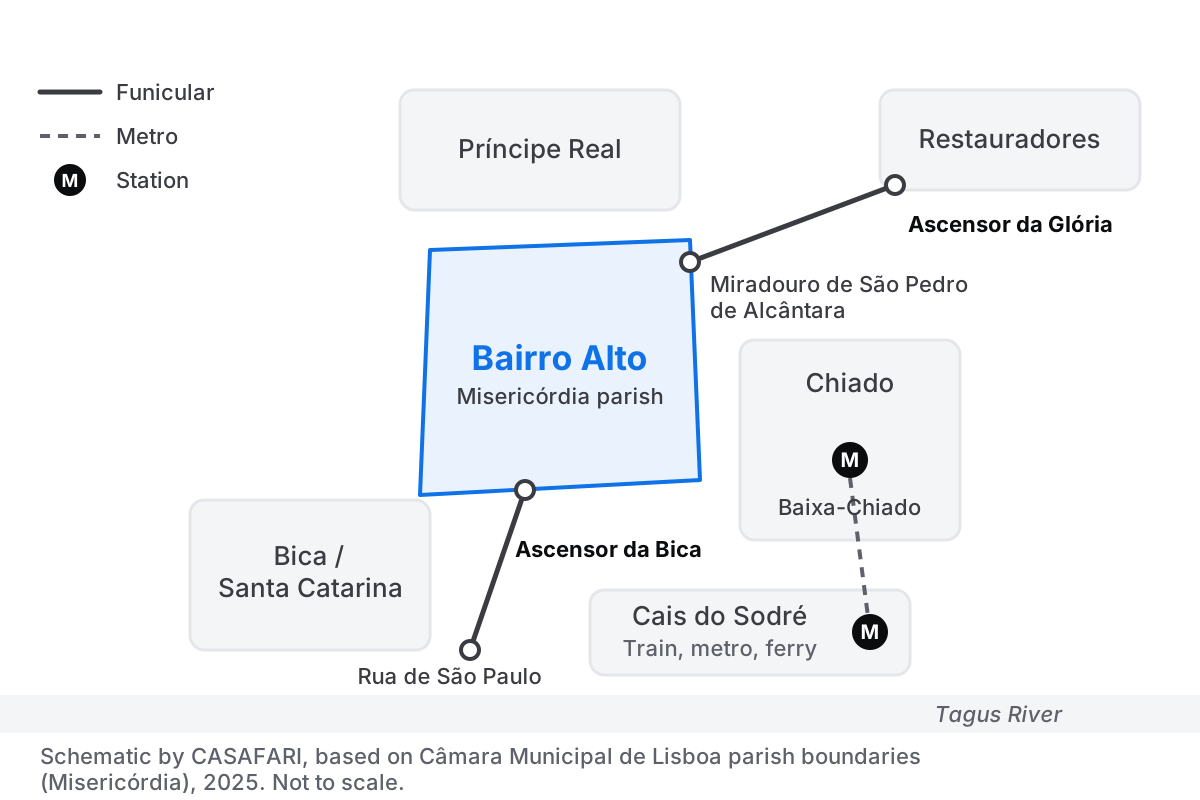
Bairro Alto forms a compact 16th-century grid in central Lisbon. Following the 2012 administrative reorganization under Lei n.º 56/2012, it forms part of Misericórdia parish. The district is bounded by Chiado along Rua da Misericórdia to the east, Príncipe Real to the north, and Bica and Santa Catarina to the south-west, with Cais do Sodré located downhill towards the Tagus river.
Key residential corridors include Rua da Rosa, Rua da Atalaia, Rua do Diário de Notícias, Rua do Norte, and Travessa da Queimada. Built on a formal grid plan in the 1500s, Bairro Alto’s structural fabric withstood the 1755 earthquake with less destruction than the lower-lying districts described in the Baixa guide.
The neighbourhood shifts dramatically throughout the day. Mornings are peaceful, punctuated by local delivery vans and café patrons. In the evening, bars open and nightlife gathers across main thoroughfares. Ground-floor and first-floor apartments on primary bar streets experience substantial night noise at weekends, which impacts both resale pricing and long-term tenant profiles. Residents enjoy proximity to panoramic viewpoints such as Miradouro de São Pedro de Alcântara and Miradouro de Santa Catarina, with Jardim do Príncipe Real just a brief walk north.
What kind of property is for sale in Bairro Alto?
Housing stock consists almost entirely of pre-1950 Pombaline and pre-Pombaline residential buildings standing three to five storeys tall. These structures feature narrow frontages, wooden floor joists, and traditional masonry. Elevator installations and underground parking are rare due to plot dimensions and historic preservation rules.
Many buildings have been fully rehabilitated into multi-unit residential schemes offering studio, one-bedroom, and two-bedroom apartments. Buyer demand originates from international second-home purchasers, investors focusing on long-term lettings, and local professionals seeking proximity to central commercial districts.
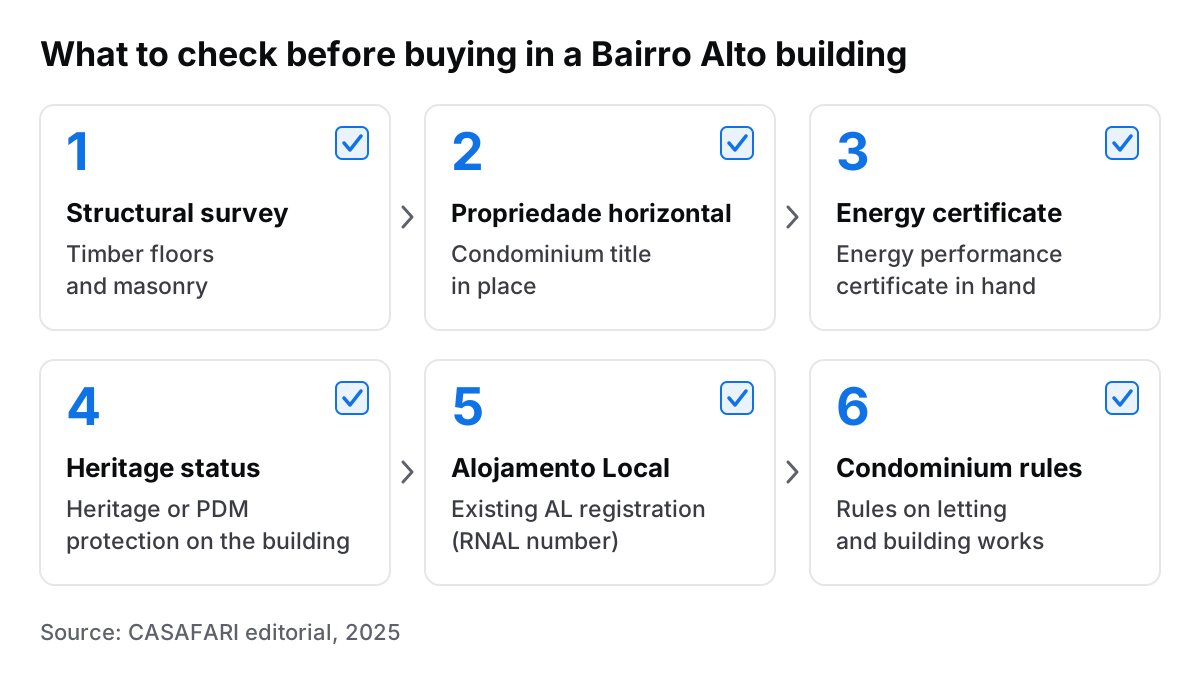
When purchasing an apartment in a historic building, structural and regulatory due diligence is vital:
- Structural survey: Inspect load-bearing timber structures and floor levelness.
- Condominium status: Confirm propriedade horizontal title documents are properly registered.
- Energy performance: Review certification and insulation upgrades, particularly window double-glazing.
- Heritage regulations: Verify municipal protection constraints within Lisbon’s municipal master plan (PDM).
- Existing licensing: Confirm whether any current tourist letting registration is attached to the unit.
Agents sourcing historic units across multiple portals can use Property Sourcing to identify available inventory in Misericórdia.
Can you still let a Bairro Alto flat to tourists?
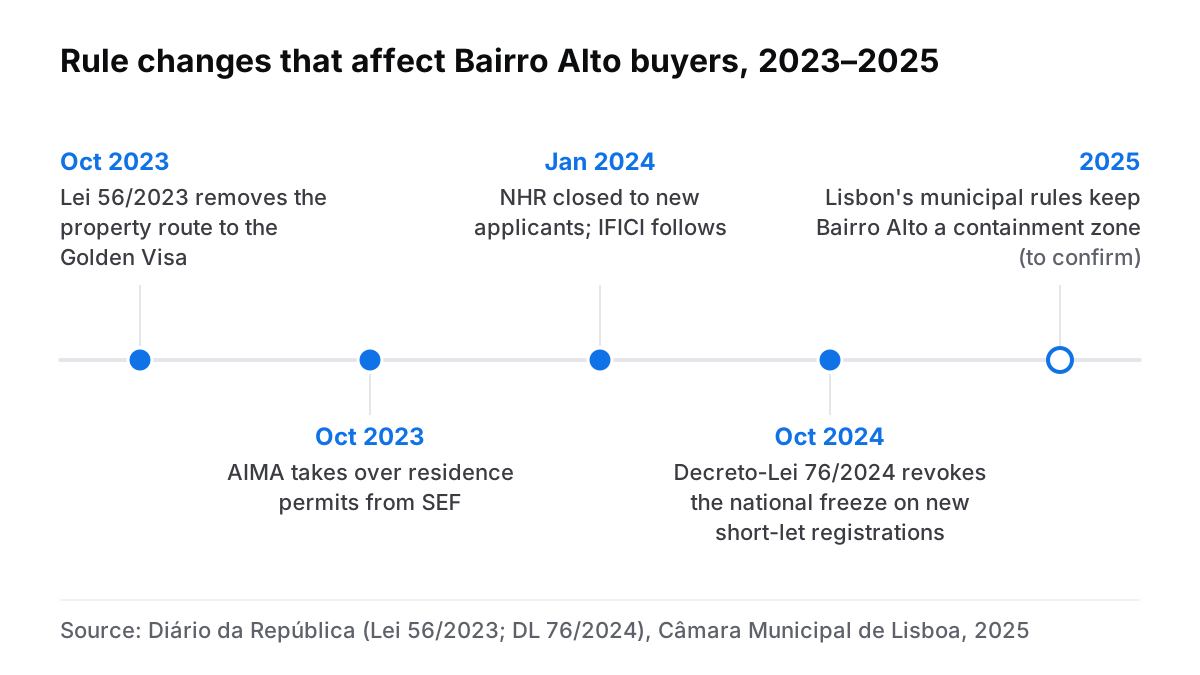
Short-term letting regulations in Portugal underwent major adjustments between 2023 and 2024. In October 2023, national legislation under Lei n.º 56/2023 (Mais Habitação) suspended new Alojamento Local (AL) short-let registrations across coastal areas. Subsequently, Decreto-Lei n.º 76/2024 revoked the national freeze and returned regulatory authority over short-term letting licences to local municipalities.
Under Lisbon City Council’s Alojamento Local rules, central historic districts including Bairro Alto are classified within municipal containment zones (zonas de contenção). Consequently, new short-let registrations are not issued in Bairro Alto. Properties without an active, transferable AL licence must be evaluated as residential units or long-term rental assets.
Prospective buyers should inspect official entries on the national RNAL register (rnt.turismodeportugal.pt), review condominium bylaws regarding short lets, and examine long-term yield potential. To evaluate historical yield trends, consult how Lisbon rents have moved since 2018.
Which residency and tax rules have changed since 2023?
Changes to Portuguese tax laws and immigration pathways affect international real estate transactions:
- Golden Visa (ARI): The real estate investment route was eliminated in October 2023 by Lei n.º 56/2023. Purchasing real estate in Bairro Alto no longer confers eligibility for Portugal’s residency-by-investment scheme.
- Tax Regimes: The Non-Habitual Resident (NHR) regime closed to new applicants in 2024. It was succeeded by the IFICI regime, which targets scientific research, innovation, and specialized professional roles rather than passive real estate investors.
- Residency Visas: Non-EU buyers planning to reside in Lisbon generally utilize D7 passive income visas or digital nomad visas, administered by the Agency for Integration, Migration and Asylum (AIMA).
- Purchase Taxes: Buyers pay Imposto Municipal sobre as Transmissões Onerosas de Imóveis (IMT) on a progressive scale based on property value, alongside 0.8% Imposto do Selo (Stamp Duty), accessible via the official Portal das Finanças. First-time buyers aged 35 or under may qualify for IMT and stamp duty exemptions under specific conditions. For further detail, read our step-by-step guide to buying property in Portugal.
How do you get around from Bairro Alto?
Bairro Alto offers excellent pedestrian access to central Lisbon, though steep gradients present logistical considerations:
- Metro: Baixa-Chiado station, operated by Metropolitano de Lisboa, serves as the primary station, connecting the Blue (Azul) and Green (Verde) lines.
- Rail and Ferry: Cais do Sodré station sits at the foot of the hill, offering train services along the Cascais line and ferry connections across the Tagus river to Cacilhas.
- Airport Access: Lisbon Airport connects to the network via the Red line; passengers change at São Sebastião to reach the Blue line and Baixa-Chiado.
- Funicular Lifts: The historic Ascensor da Glória and Ascensor da Bica funiculars operate under transit authority Carris. Transport operations are subject to routine technical maintenance and safety inspections.
- Vehicular Access: Most inner streets in Bairro Alto are pedestrianized or restricted to resident permit holders managed by EMEL. Private parking spaces are exceptionally rare.
Schools, food and culture around Bairro Alto
While Bairro Alto contains state and local private Portuguese schools within Misericórdia parish, international schools are situated outside the immediate historic core. Families residing in central Lisbon utilize institutions including Lycée Français Charles Lepierre in Campolide, Deutsche Schule Lissabon in Telheiras, St. Julian’s School in Carcavelos, or Carlucci American International School of Sintra.
Culinary options in the immediate area include fine dining destination Belcanto in the Michelin Guide, holding two Michelin stars in nearby Chiado, as well as 100 Maneiras on Rua do Teixeira.
Cultural landmarks within walking distance include the MNAC – Museu Nacional de Arte Contemporânea do Chiado on Rua Serpa Pinto, Teatro Nacional de São Carlos, and the historic Igreja de São Roque.
How to read the Bairro Alto market with CASAFARI data
Navigating real estate values in Misericórdia requires objective market data rather than anecdotal asking prices. CASAFARI aggregates real estate metrics across market sources to provide transparency.
By leveraging Area Insights for Misericórdia and Bairro Alto, buyers and real estate professionals can analyze:
- Average asking prices per square metre across specific micro-neighbourhoods.
- Average time on market (DOM) and inventory distribution by typology.
- Historical asking price adjustments across active property listings.
- Long-term rental supply and asking rate metrics.
To establish realistic acquisition offers, agents and buyers review comparables with real closing prices. For technical integration and real estate intelligence APIs, software developers can reference the Area Insights developer documentation and Comparables and valuation API docs.
To examine live market metrics or manage real estate portfolios in Lisbon, sign in to the CASAFARI platform or explore our Lisbon area guide.
Frequently asked questions
Is Bairro Alto a good place to buy property in Lisbon?
Bairro Alto is one of Lisbon’s most central and characterful quarters, attracting second-home buyers, international investors, and local professionals. However, its historic housing stock usually lacks lifts or dedicated parking, and nightlife streets can be noisy. It is best suited to buyers who prioritize walkability and prime location over modern building conveniences.
Can I rent out a Bairro Alto flat on Airbnb?
New short-let (Alojamento Local) registrations are generally not granted in Bairro Alto because Lisbon City Council designates the area within its historic containment zone. Buyers can only operate a short-let if purchasing a property with an existing, transferable registration. Investors should verify registrations on the national RNAL database and assess rental potential based on long-term residential yields.
Does buying a flat in Bairro Alto still get you a Golden Visa?
No. The real estate investment route for Portugal’s Golden Visa was officially closed in October 2023 under Lei n.º 56/2023. Real estate purchases anywhere in Portugal no longer qualify for residence by investment. Non-EU buyers looking to move to Lisbon typically apply for the D7 passive-income visa or the digital nomad visa through AIMA.
Is Bairro Alto too noisy to live in?
Noise levels vary significantly depending on the exact street and floor level. Key nightlife hubs such as Rua da Atalaia, Rua do Diário de Notícias, Rua do Norte, and Travessa da Queimada experience high footfall and street noise late into the weekend hours. Higher floors on side streets or properties nearer to Príncipe Real offer much quieter living conditions. Visiting the street late on a weekend evening before making an offer is strongly advised.