
BAIXA PROPERTY GUIDE
Neoclassical elegance in the heart of Lisbon
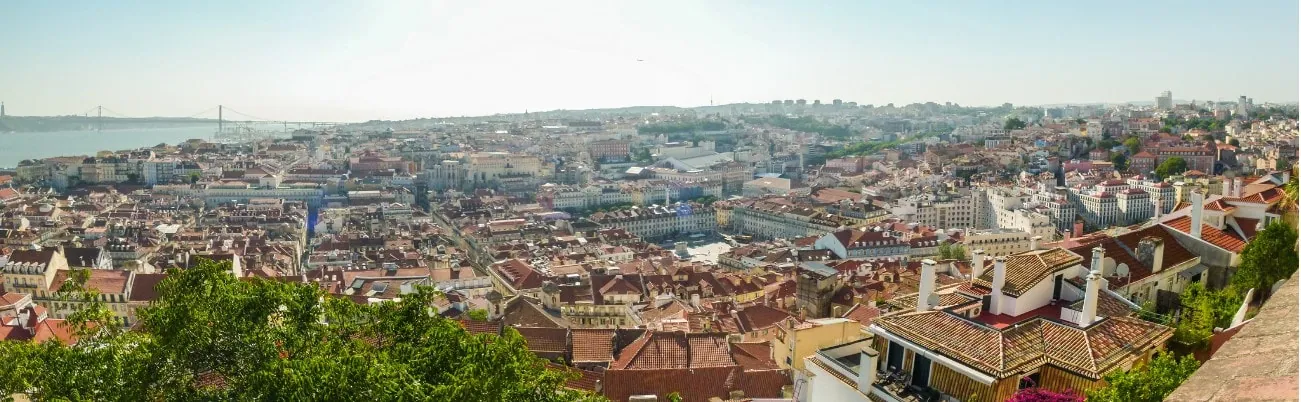
Baixa is the iconic Pombaline grid stretching between Praça do Comércio and Rossio in central Lisbon, situated within the civil parish of Santa Maria Maior. New short-let registrations under Alojamento Local are suspended across the parish by Lisbon City Council. Official data from INE for the 12 months to March 2026 shows Santa Maria Maior’s median sale price slipped 0.5% year on year, while median new-contract rents rose 4.7% to €19.44 per square metre.
Where exactly is Baixa, and what counts as Baixa?
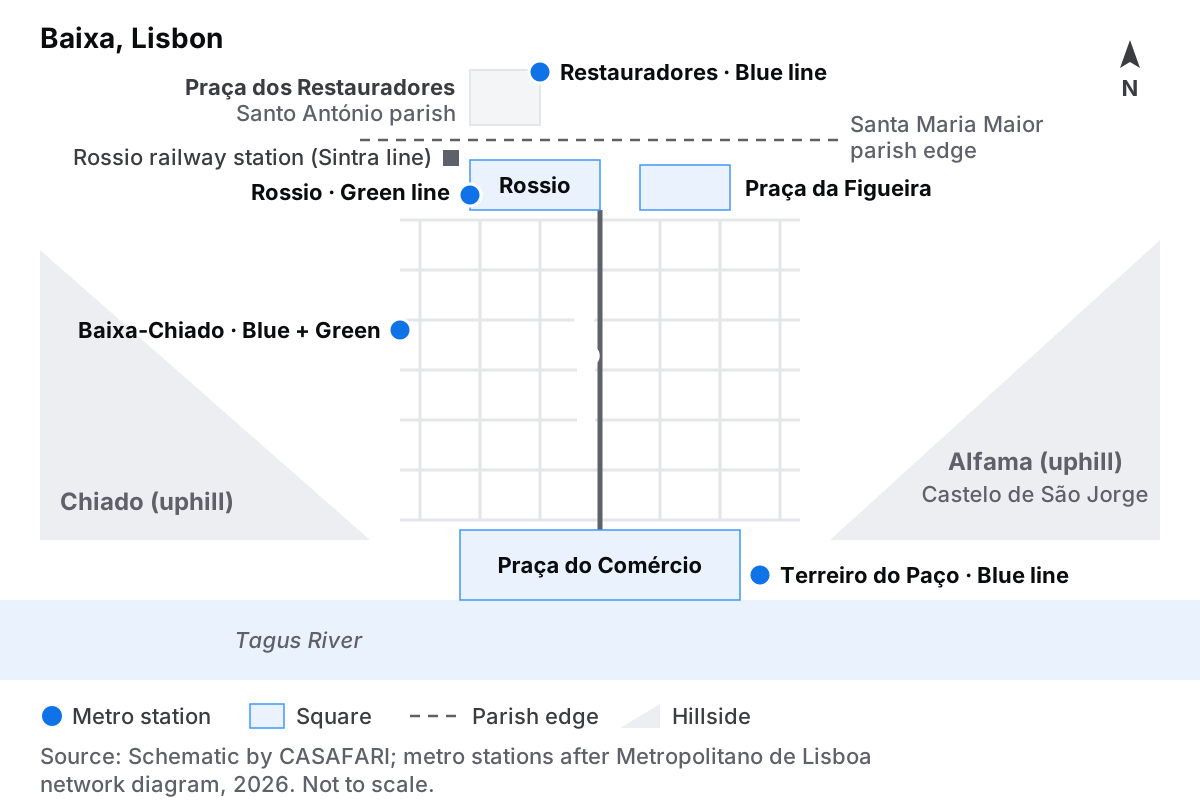
Baixa forms the historical and geographic core of central Lisbon. Bound to the south by the Tagus river at Praça do Comércio and to the north by Rossio (Praça D. Pedro IV) and Praça da Figueira, the central axis is defined by the pedestrianised Rua Augusta. To the west, the topography rises sharply into Chiado and Bairro Alto; to the east, it climbs towards Alfama and the Castle of São Jorge.
From an administrative standpoint, Baixa belongs entirely to the civil parish (freguesia) of Santa Maria Maior, established under the 2012 reorganisation of Lisbon’s administrative boundaries (Lei n.º 56/2012). The parish also covers surrounding historic quarters including Alfama, Mouraria, Castelo, and Sé. Because public statistics, tax records, and municipal regulations operate at parish level, market metrics for Baixa reflect Santa Maria Maior as a whole.
Immediately to the north lies Praça dos Restauradores, which sits in the neighbouring parish of Santo António. While a key landmark for orientation, Restauradores marks the northern boundary beyond the Pombaline grid itself. Characterised by symmetrical street plans, uniform exterior façades, and stone-paved pedestrian avenues, Baixa hosts a lively commercial atmosphere during daytime hours while remaining noticeably calmer at night than nearby nightlife hubs.
Why does Baixa look the way it does? The 1755 earthquake and the Pombaline plan
On the morning of 1 November 1755, a magnitude earthquake, followed by fires and a tsunami, devastated Lisbon’s medieval core. Rather than rebuilding along the previous irregular medieval streets, the reconstruction was directed by Sebastião José de Carvalho e Melo, later Marquês de Pombal. The project introduced a modern, orthogonal grid layout lined with standardised buildings.
The defining structural innovation of the era was the gaiola pombalina (Pombaline cage), a internal timber framework built into the masonry. Designed to flex during seismic activity without collapsing, it stands as one of Europe’s earliest pre-engineered anti-seismic construction systems. Understanding the condition of this timber frame is critical for any structural survey today.
Pombaline street planning designated specific streets for distinct commerce and craftsmanship. This historical layout remains clear in street names across the grid: Rua dos Sapateiros (cobblers), Rua da Prata (silversmiths), Rua dos Douradores (gilders), and Rua dos Fanqueiros (drapers). Architectural guidelines governed window placement, cornice heights, and façade decoration, establishing a cohesive architectural style across the district.
What is daily life like: Rossio, Praça do Comércio, cafés and dining
At the northern head of the grid, Rossio serves as a central meeting point. Anchored by the Teatro Nacional D. Maria II at its northern end, the square is flanked by traditional cafés, including the historic Café Nicola. Nearby, the Church of São Domingos stands as a striking landmark; severely damaged by earthquakes in 1531 and 1755 and gutted by fire in 1959, its interior remains exposed with visible historic stone scars.
Along the riverfront, Praça do Comércio opens directly onto the Tagus estuary through monumental arcades. Historical establishments like Martinho da Arcada, open since 1782, maintain links to Portuguese literary history, including writer Fernando Pessoa. Traditional taverns (tascas) and hotel dining options line the inner grid streets, while fine-dining destinations such as the two-Michelin-starred Alma are situated a short walk uphill in neighbouring Chiado.
For residents, living in Baixa offers direct pedestrian access to services, culture, and riverfront paths. However, urban residential amenities are distinct: the grid contains minimal green space, no dedicated international schools, and restricted private parking. Families looking for proximity to international curricula typically explore Western Lisbon or suburban corridors while using central Lisbon as a professional or cultural hub.
How do you get around from Baixa?
Public transport connectivity in Baixa is among the most comprehensive in Lisbon. The district is served by three primary metro stations inside or directly bordering the grid: Baixa-Chiado (connecting the Azul and Verde lines), Rossio (Verde line), and Terreiro do Paço (Azul line). Restauradores station sits at the northern edge on the Azul line, offering direct routes across the city network.
Rail transport links are anchored by Rossio railway station. Designed by architect José Luís Monteiro with an 19th-century Neo-Manueline façade, the station serves as the urban terminus for CP suburban trains to Sintra. For regional connections northwards, Santa Apolónia station is situated a short distance to the east, while Cais do Sodré station to the west connects to the Cascais suburban line.
Vehicle movement within the grid is heavily restricted. Most thoroughfares are pedestrianised or reserved for public transit and emergency services. Private resident parking is limited, and parking permits are allocated strictly according to parish boundaries by the local municipality, making vehicular access a key consideration during property acquisition.
What do the official numbers say about Baixa property in 2026?
Official transaction statistics from INE show that for the 12 months ending March 2026, the median sale price for family dwellings across Lisbon municipality reached €5,082 per m², marking a 15.2% year-on-year increase. In contrast, Santa Maria Maior was one of only two Lisbon parishes where median transaction prices fell slightly, dropping 0.5% year on year. This price consolidation reflects early market stabilisation in central districts compared to outer municipal zones.
Buyer profiles in Lisbon display notable pricing variance. According to INE data for the 12 months to March 2026, buyers with a foreign tax domicile paid a median price of €6,325 per m² across Lisbon, compared to €5,000 per m² paid by domestic tax residents.
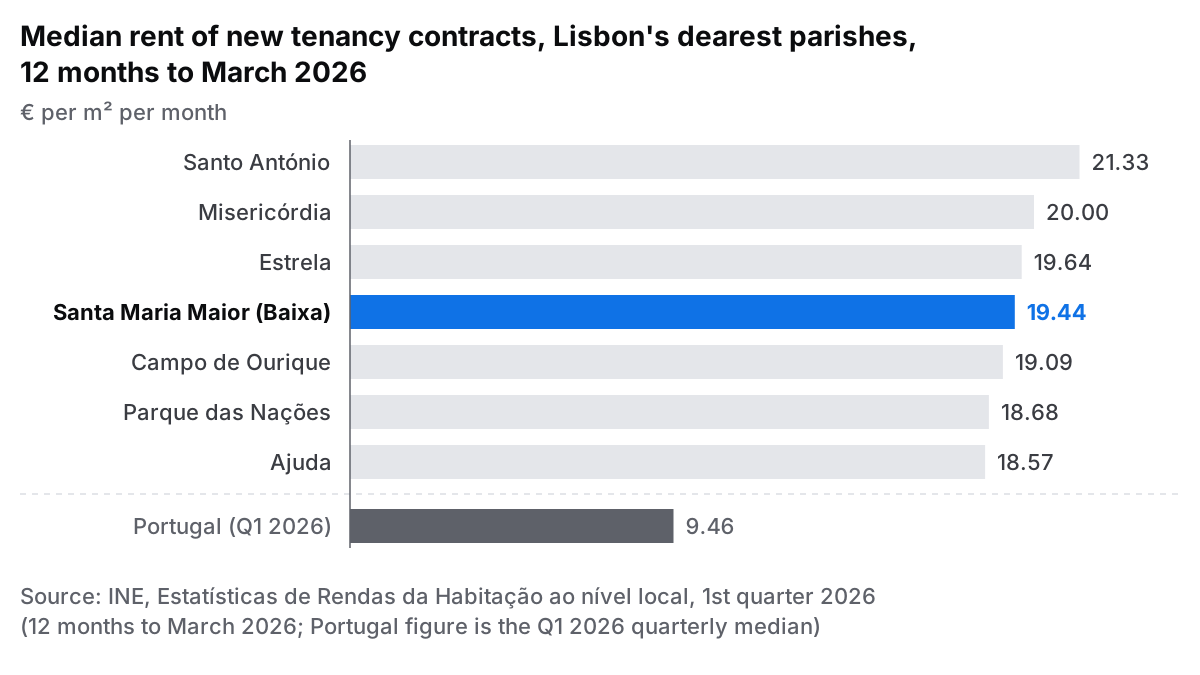
In the rental market, INE figures from the 1st quarter of 2026 report a median rent for new tenancy contracts in Santa Maria Maior of €19.44 per m² per month, up 4.7% year on year. This places Santa Maria Maior fourth among Lisbon’s highest-rent parishes, trailing Santo António (€21.33/m²), Misericórdia (€20.00/m²), and Estrela (€19.64/m²). For comparative perspective, how Lisbon rents moved from 2018 to 2023 provides useful context for long-term trends. Real estate professionals assessing granular street-level pricing can draw on Area Insights for Lisbon’s parishes and streets to complement official public statistics.
Can you still let a Baixa flat short-term? Alojamento Local rules in Santa Maria Maior
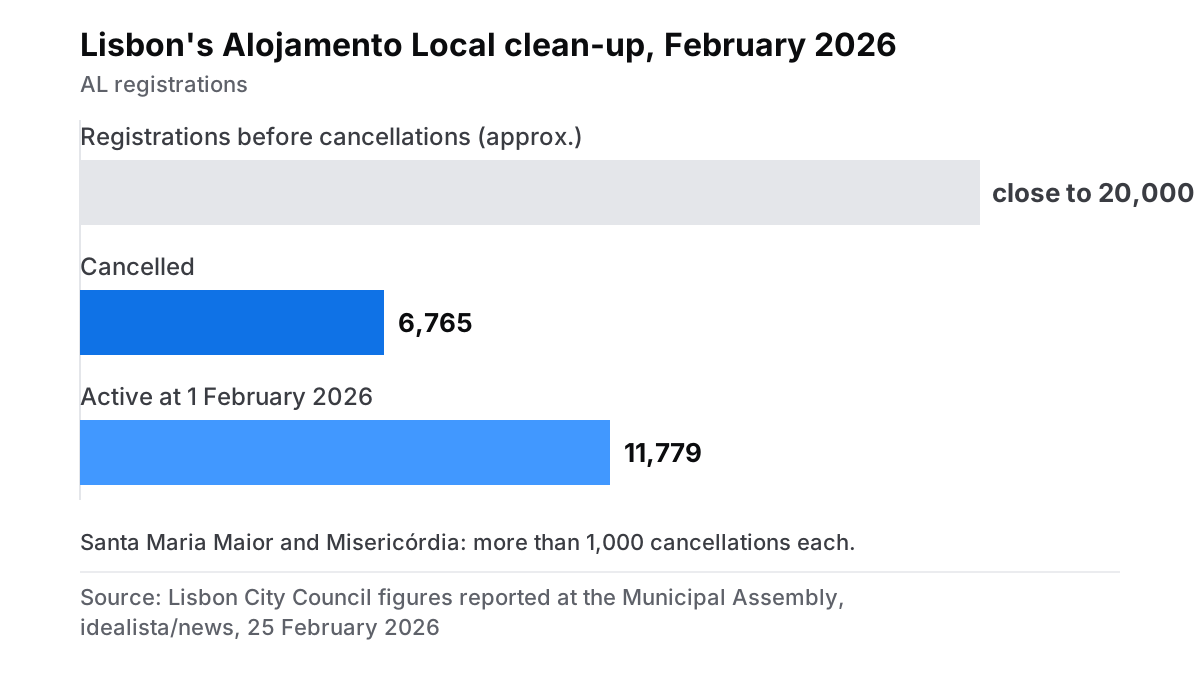
Short-term holiday letting under the Alojamento Local (AL) framework is strictly controlled in central Lisbon. Following municipal reviews reported at the Lisbon Municipal Assembly (idealista/news), Lisbon City Council cancelled 6,765 inactive or non-compliant AL registrations citywide, leaving 11,779 active registrations as of February 2026. Santa Maria Maior experienced over 1,000 individual licence cancellations.
Santa Maria Maior remains designated as a containment zone (zona de contenção). Lisbon City Council confirmed that cancelled registrations do not reopen capacity for new licence applications while a parish remains in containment status. Consequently, new AL registrations are not being granted within Baixa.
For investors, this regulation distinguishes properties holding an existing, legally transferable AL registration from standard residential stock. Long-term residential leasing remains fully permitted under standard tenancy law. Buyers evaluating acquisition strategies should confirm current municipal zoning maps and seek formal legal verification before committing capital.
Taxes, residency and what to check before buying a Pombaline building
Property acquisition in Portugal involves municipal property transfer tax (IMT) applied on a progressive scale based on purchase price and property use, alongside Stamp Duty (Imposto do Selo) fixed at 0.8% of the contractual value. Annual property ownership incurs Municipal Property Tax (IMI). Buyers should consult our guide to buying property in Portugal for detailed tax procedural overviews.
Regarding residency pathways, purchasing real estate no longer qualifies for Portugal’s Golden Visa (ARI) scheme. The real estate investment route was formally eliminated by Lei n.º 56/2023 on 7 October 2023. Similarly, the original Non-Habitual Resident (NHR) tax status closed to new applicants in 2024, replaced by the professional-specific IFICI incentive scheme. Foreign investors require independent legal advice regarding residence and tax positioning.
When conducting due diligence on Pombaline real estate, buyers must evaluate specific building characteristics:
- Structural integrity of the gaiola pombalina timber frame and documentation of past structural modifications.
- Presence, condition, or feasibility of elevator installations in historical stairwells.
- Heritage protection regulations governing interior alterations and façade restoration.
- Condominium administrative history, reserve funds, and shared maintenance agreements.
- Validity of the Usage Licence (licença de utilização) and official Energy Performance Certificate.
To establish accurate market valuations for unique historic stock, agents rely on targeted comparative market studies using CASAFARI’s valuation and market study tools. Real estate professionals can learn how to run a market analysis in CASAFARI within our documentation.
How CASAFARI tracks Baixa and the rest of Lisbon
CASAFARI monitors real estate market activity across Portugal by aggregating listing data from thousands of professional sources and matching duplicate entries into unified property histories. Through detailed tracking of asking prices, supply volumes, and transactional benchmarks, the platform provides clear visibility into neighbourhood dynamics.
Professionals seeking to analyze property data programmatically can access the Area Insights documentation on developers.casafari.com (in English). To explore market analytics directly, users can sign in to the CASAFARI platform.
Frequently asked questions
Is Baixa a good area to live in Lisbon?
Baixa offers an exceptionally central lifestyle with pedestrianised avenues, flat terrain and four metro stations within walking distance. However, as Lisbon’s commercial heart, it has limited green space, scarce residential parking and no international schools within the grid. In February 2026, Lisbon City Council reported over 1,000 cancelled Alojamento Local registrations in the parish of Santa Maria Maior (reported by idealista/news), shifting the neighbourhood balance back towards long-term residents. Official figures from INE show median new-contract rents in the parish reached €19.44 per square metre in the 12 months to March 2026.
Can you still get an Alojamento Local licence in Baixa, Lisbon?
No new short-term rental (Alojamento Local) registrations are being issued in Baixa. The neighbourhood lies within Santa Maria Maior, one of six Lisbon parishes maintained as containment zones where the municipal council confirmed in February 2026 that cancelled licences do not make room for new registrations (idealista/news, 25 February 2026). Existing licences may remain valid and can transfer with property sales under specific legal conditions. Prospective buyers should verify the registration status on the RNAL database and consult legal counsel before proceeding.
Does buying a flat in Baixa qualify for Portugal’s Golden Visa?
No, real estate acquisitions anywhere in Portugal no longer qualify for the Golden Visa residency scheme following the enactment of Lei n.º 56/2023 on 7 October 2023. Alternative Golden Visa pathways remain open through qualified fund investments, job creation or research contributions. Additionally, the Non-Habitual Resident (NHR) tax regime closed to new applicants in 2024, replaced by the targeted IFICI framework. Buyers should consult a qualified tax advisor and lawyer regarding their specific circumstances.
What should I check before buying a Pombaline building in Baixa?
Purchasing in a Pombaline building requires thorough structural due diligence, particularly regarding the integrity of the flexible timber internal frame known as the gaiola pombalina. Buyers must check whether previous renovations compromised structural elements, verify if a lift is installed or feasible, and review municipal heritage restrictions. Essential documentation includes the licence of use (licença de utilização), energy certificate, condominium accounts and any ground-floor commercial lease terms. To evaluate local pricing accurately, agents and buyers rely on transaction-based comparables through CASAFARI’s valuation tools.