
Ras Al Khaimah
The UAE’s Rising Frontier for Ultra-Modern Living and Investment
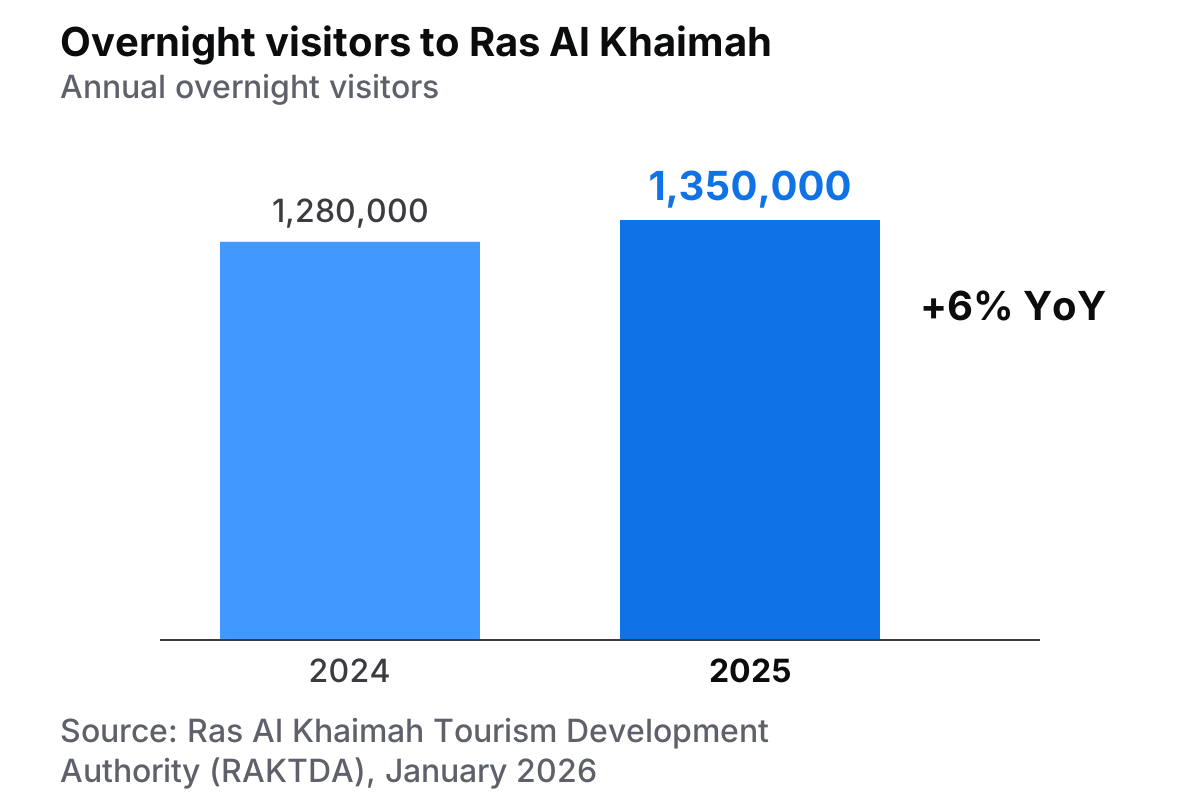
Ras Al Khaimah offers non-UAE nationals 100% foreign freehold ownership in designated waterfront developments, combined with 0% personal income tax on rental returns and capital gains. Home to roughly 400,000 residents, the northernmost emirate welcomed a record 1.35 million overnight visitors in 2025 according to the Ras Al Khaimah Tourism Development Authority (RAKTDA) in January 2026, driven by growing international investor demand ahead of the USD 5.7 billion Wynn Al Marjan Island opening in September 2027.
Why are international buyers and residents moving to Ras Al Khaimah?
Positioned between the Hajar Mountains and the Arabian Gulf, Ras Al Khaimah offers a distinct lifestyle alternative to neighbouring emirates. While Dubai and Abu Dhabi present high-density urban environments, Ras Al Khaimah maintains an outdoor-focused pace, combining terracotta deserts, coastal mangroves, and dramatic peak elevations with modern infrastructure.
For relocating families and professionals, the emirate provides a complete social and educational ecosystem. International schooling is regulated by the RAK Department of Knowledge (RAKDOK), featuring established campuses such as RAK Academy (with sites in Khuzam, Al Hamra, and Al Rams), Sherfield School RAK, GEMS Westminster, and the International School of Choueifat. Healthcare provision includes the JCI-accredited RAK Hospital in Al Qusaidat alongside the specialized Sheikh Khalifa Specialty Hospital.
How is transport evolving across Ras Al Khaimah and the wider UAE?
Road mobility relies primarily on the E311 (Sheikh Mohammed Bin Zayed Road) and E611 (Emirates Road) highway corridors, providing direct driving access across the northern emirates. Local public transport is managed by the Ras Al Khaimah Transport Authority (RAKTA), operating local and intercity buses alongside regulated taxis and ride-hailing services.
Regional connectivity is advancing rapidly through two major infrastructure initiatives:
- eVTOL Air Taxis: Following a tripartite agreement signed in September 2025 between RAKTA, Joby Aviation, and Skyports Infrastructure, testing progressed through 2026 to support a planned 2027 commercial launch connecting key hubs, as outlined by Joby Aviation in June 2026. This electric air taxi network will link Al Marjan Island, Jebel Jais, and Dubai.
- Etihad Rail: The UAE national rail network inaugurated Phase 1 passenger services between Abu Dhabi and Fujairah on 30 June 2026, expanding service to Dubai and Al Dhaid on 30 September 2026. Ras Al Khaimah’s passenger station is integrated into subsequent phases of the national network expansion.
What defines the lifestyle in Ras Al Khaimah from Jebel Jais to the Arabian Gulf?
Ras Al Khaimah’s geographic diversity supports a wide array of recreational and cultural pursuits across four distinct environments:
- Jebel Jais and the Hajar Mountains: Rising to 1,934 metres above sea level, Jebel Jais is the UAE’s highest peak. According to the RAKTDA Jebel Jais Fact Sheet published in August 2025, the mountain hosts the 2,830-metre Jais Flight zipline (reaching speeds between 120 and 160 km/h from a 1,680-metre launch platform), the 1,840-metre Jais Sledder alpine coaster, and marked hiking routes including the Samar and Farfar trails.
- Coastal and Maritime Recreation: Coastal areas feature private beach clubs, mangrove kayaking, non-motorised water sports, and equestrian activities such as swimming with horses at the Al Jazeerah Equestrian Club.
- Heritage and Nature Reserves: Cultural destinations include the Suwaidi Pearl Farm in Al Rams (the UAE’s only operational pearl farm), the preserved 18th-century coral-stone fishing village of Al Jazirah Al Hamra, and the historic Dhayah Fort. Natural sites include the mineral-rich thermal waters at Khatt Springs and the protected Arabian oryx habitat within the Al Wadi Nature Reserve.
- Climate: The emirate enjoys year-round sunshine with mild coastal winters from October to April. Temperatures on the upper slopes of Jebel Jais remain up to 10°C cooler than sea level throughout the summer months.
How does the Ras Al Khaimah property market work for foreign investors?
Real estate expansion in Ras Al Khaimah is supported by large-scale commercial and hospitality projects. As reported by EnterpriseAM UAE in August 2026, the Wynn Al Marjan Island integrated resort represents a USD 5.7 billion investment and is confirmed to open in September 2027. Demand is further reinforced by growing tourist numbers, which rose 6% year-on-year from 1.28 million overnight visitors in 2024 to 1.35 million in 2025.
Legal Framework and Freehold Zones
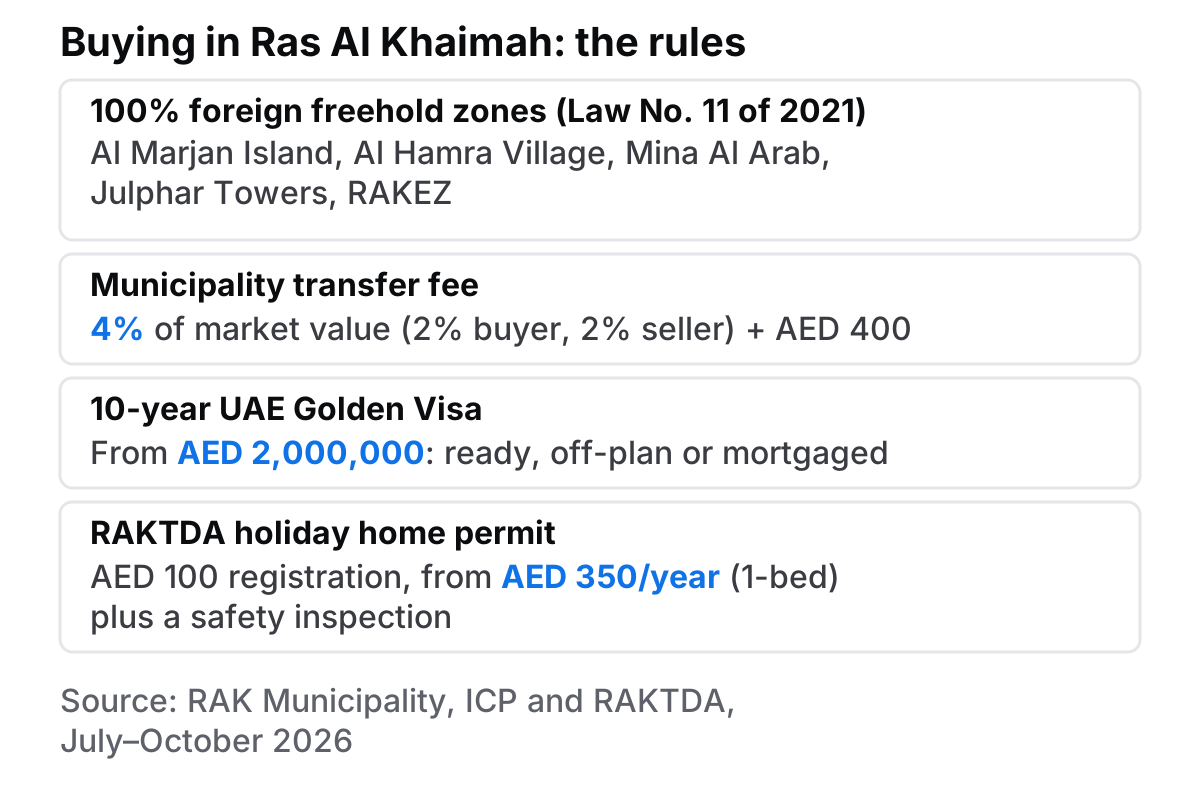
Under RAK Law No. 11 of 2021 and Decree No. 12 of 2023 issued by RERA-RAK, non-GCC nationals can purchase 100% freehold titles in designated investment zones, as detailed by Estates UAE in July 2026. Recognized freehold zones include Al Marjan Island, Al Hamra Village, Mina Al Arab, Julphar Towers, and selected master developments within the Ras Al Khaimah Economic Zone (RAKEZ).
Taxation and Transaction Fees
Individual real estate investors pay 0% personal income tax on employment salary, capital gains, and personal rental income. Under UAE Federal Decree-Law No. 47 of 2022, corporate entities face a 0% tax rate on taxable income up to AED 375,000 and 9% on income exceeding that threshold, while Qualifying Free Zone Persons operating within RAKEZ can access 0% tax on Qualifying Income (RAKEZ, August 2025).
Property acquisition costs are regulated by the municipality framework:
- Property Transfer Fee: Standard 4% transfer fee based on market value, split equally as 2% buyer and 2% seller (Ras Al Khaimah Municipality, October 2026).
- Administrative Fees: AED 200 scheme plan fee plus AED 200 title deed issuance fee.
- Tenancy Registration: Annual residential leases incur a 4% registration fee.
Residency via the UAE Golden Visa
Investors purchasing property with a minimum value of AED 2,000,000 qualify for a 10-year renewable UAE Golden Visa through the Federal Authority for Identity, Citizenship, Customs and Port Security (ICP) (Official Portal of the UAE Government, July 2026). The threshold can be satisfied through a single asset or a combined property portfolio across ready or off-plan developments. Under updated rules, mortgaged properties also qualify once the certified asset value reaches AED 2,000,000, regardless of the remaining mortgage balance.
To analyse local transaction volumes and district growth patterns, institutional investors and agents rely on CASAFARI Area Insights and specialized CASAFARI solutions for property investors. Understanding these micro-market trends highlights why hyper-localised data matters in real estate when selecting between primary residences and holiday rental units.
Which Ras Al Khaimah districts attract residents versus short-term rental investors?
Ras Al Khaimah displays a clear division between inland residential districts and coastal tourism zones:
- Inland Residential Suburbs: Neighbourhoods such as Al Dhait and Khuzam consist primarily of suburban villas and low-rise apartments preferred by long-term local and expatriate families due to proximity to schools and civic services.
- Al Marjan Island: A multi-island reclaimed archipelago dedicated to luxury hospitality, branded residences, and beachfront apartments designed for capital growth and short-term tourist lettings.
- Al Hamra Village & Mina Al Arab: Established waterfront master developments featuring private villas, townhouses, marinas, an 18-hole championship golf course, and protected lagoon wetlands.
Short-Term Rental Licensing Rules
Property owners operating holiday lets must register through the RAKTDA Holiday Homes System (October 2026). Official requirements include an initial AED 100 registration fee and an annual permit fee starting from AED 350 for a one-bedroom apartment, alongside mandatory property safety inspections.
To evaluate active inventory and identify emerging opportunities across these communities, property professionals use Property Sourcing tools to monitor market dynamics.
Where can you go on a day trip from Ras Al Khaimah?
Thanks to its geographical position, Ras Al Khaimah serves as a convenient gateway for regional excursions:
- Musandam Peninsula (Oman): Located directly north across the border, offering coastal dhow cruises through mountain fjords.
- Dubai: Accessible via the E311 highway for commercial hubs, international transport connections, and leisure infrastructure.
- Hatta: Situated in the Hajar Mountains, offering mountain biking, hiking trails, and kayaking at Hatta Dam.
To analyze live market data, evaluate comparative pricing, and track developments across Ras Al Khaimah, sign in to the CASAFARI platform.
Frequently asked questions
Can foreigners buy freehold property in Ras Al Khaimah?
Yes, non-UAE and non-GCC nationals can purchase 100% freehold property in designated investment zones across Ras Al Khaimah. These zones include Al Marjan Island, Al Hamra Village, Mina Al Arab, Julphar Towers, and properties within the Ras Al Khaimah Economic Zone (RAKEZ). Ownership rights and registration are governed by Ras Al Khaimah Law No. 11 of 2021 and regulated under RERA-RAK by Decree No. 12 of 2023.
What are the property transfer fees and taxes in Ras Al Khaimah?
The Ras Al Khaimah Municipality charges a standard 4% property transfer fee on the property’s market value, officially split equally between buyer (2%) and seller (2%), alongside AED 200 for the scheme plan and AED 200 for the title deed. Individual investors pay 0% personal income tax on rental yields and capital gains. Corporate structures pay 0% on profits up to AED 375,000 and 9% above that threshold under UAE Federal Decree-Law No. 47 of 2022.
How do you qualify for a UAE Golden Visa through property in Ras Al Khaimah?
Property buyers qualify for a 10-year renewable UAE Golden Visa by investing at least AED 2,000,000 in Ras Al Khaimah real estate, processed through the Federal Authority for Identity, Citizenship, Customs and Port Security (ICP). You can meet this AED 2 million threshold with a single property or a portfolio of ready or off-plan properties. Mortgaged properties also qualify once the certified property value reaches AED 2 million, regardless of the remaining loan balance.
How do you get a short-term rental permit in Ras Al Khaimah?
To let a property as a holiday home in Ras Al Khaimah, owners or authorised operators must register online through the Ras Al Khaimah Tourism Development Authority (RAKTDA) Holiday Homes portal. Applicants submit their title deed or attested tenancy contract, Emirates ID or passport, a recent utility bill, and a developer No Objection Certificate (NOC). Costs include an AED 100 registration fee and an annual permit starting at AED 350 for a one-bedroom unit, subject to a RAKTDA classification and safety inspection.