
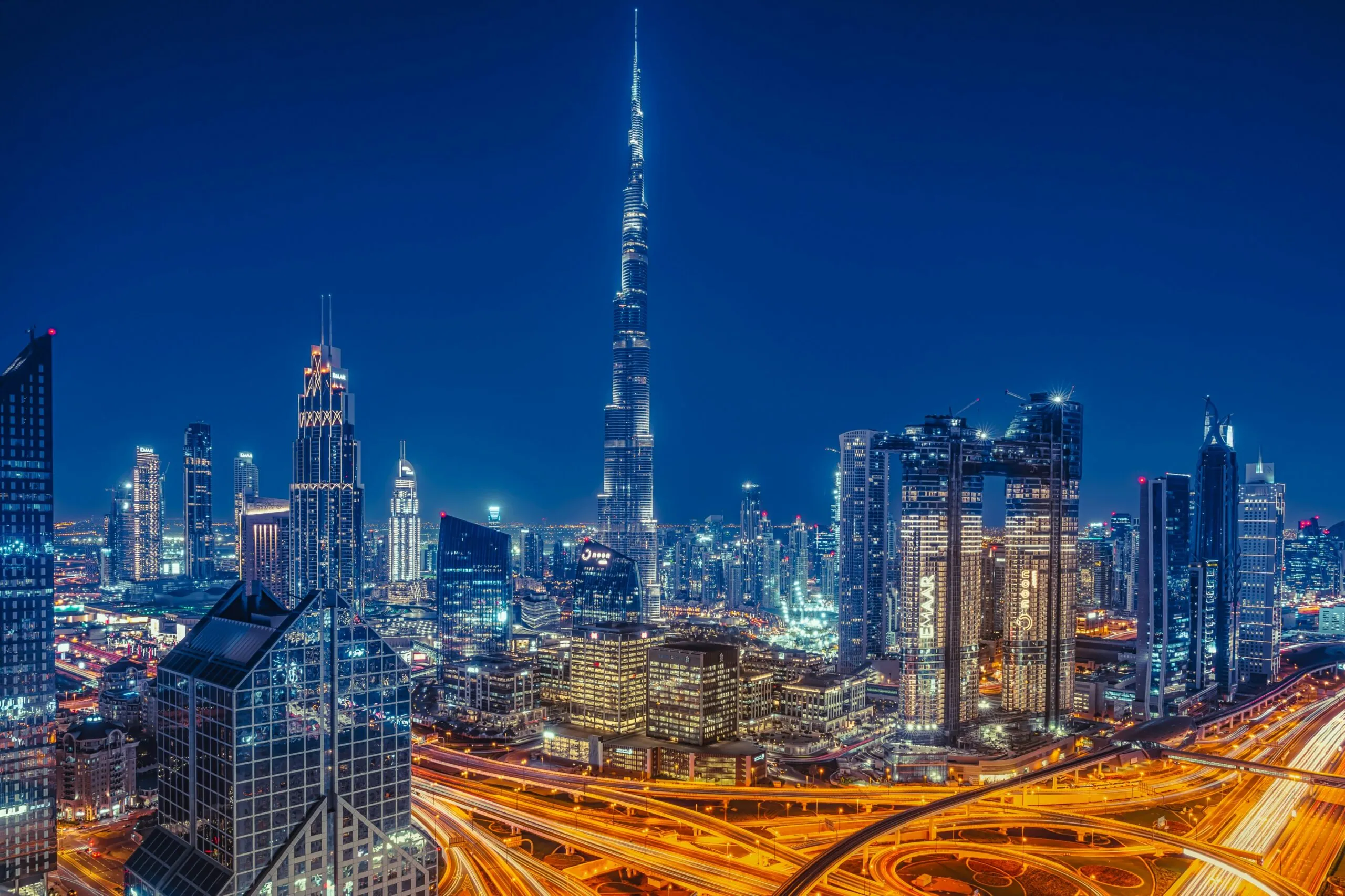
Dubai attracts global investors and residents through a combination of strong demographic growth, high capital liquidity, and competitive rental yields. According to Digital Dubai statistics via WAM, the emirate’s permanent population reached 4.82 million in September 2026. Residential property delivers robust income, with apartments yielding 6.66% to 7.07% on average, as reported by Engel & Völkers Dubai. Furthermore, purchasing property valued at AED 2,000,000 or more grants eligibility for a 10-year UAE Golden Visa under Dubai Land Department (DLD) rules.
How does urban connectivity and daily life work in Dubai’s residential districts?
Mobility and public transport
The driverless Dubai Metro serves as the central transit spine of the emirate, seamlessly connecting Dubai International Airport, the Dubai International Financial Centre (DIFC), Downtown Dubai, and Dubai Marina. To serve expanding urban corridors, construction is progressing on the Dubai Metro Blue Line. As detailed by the Dubai Media Office RTA Metro Blue Line update, the 30-kilometre, 14-station network extension broke ground in June 2025, is on track to achieve 30% completion by the end of 2026, and is scheduled for passenger service on 9 September 2029.
Under the Dubai 2040 Urban Master Plan, which aims to accommodate a target population of 5.8 million permanent residents, city planning focuses on a “20-minute city” model where everyday services are accessible within short travel times. Active mobility infrastructure is expanding rapidly: according to an Emirates News Agency (WAM) report on RTA cycling tracks, dedicated cycling and e-scooter tracks now operate across Mirdif, Muhaisnah 3, Al Barsha South 2, Al Barsha 3, and Al Barsha 2 (where a 10.5-kilometre track was completed in March 2026). Furthermore, the RTA is currently conducting supervised autonomous taxi testing with Cruise in the coastal districts of Jumeirah 1, 2, and 3 ahead of a commercial launch planned for late 2026.
Climate, sport, and community life
Life in Dubai adapts to a distinct seasonal cadence. The hot summer months between June and September shift physical activity to world-class air-conditioned facilities, indoor sports arenas, and climate-controlled retail destinations. From October to May, daily life turns outdoors across landscaped residential communities, beach promenades, and desert parks.
Padel tennis has become a mainstay of social life, with dedicated clubs such as Matcha in Al Quoz and Real Padel drawing active playing communities. Endurance cyclists utilize the 80-kilometre Al Qudra Cycle Track through the Al Marmoom Desert Conservation Reserve. Waterfront leisure centers around beach clubs at Dubai Harbour (such as Be Beach) and Jumeirah Islands, while family weekends feature local artisan gatherings like the Ripe Market in green master-planned developments like Jumeirah Village Circle (JVC) and Meydan.
Why does Dubai attract international property investors and entrepreneurs?
Rental yields, residency, and macroeconomic fundamentals
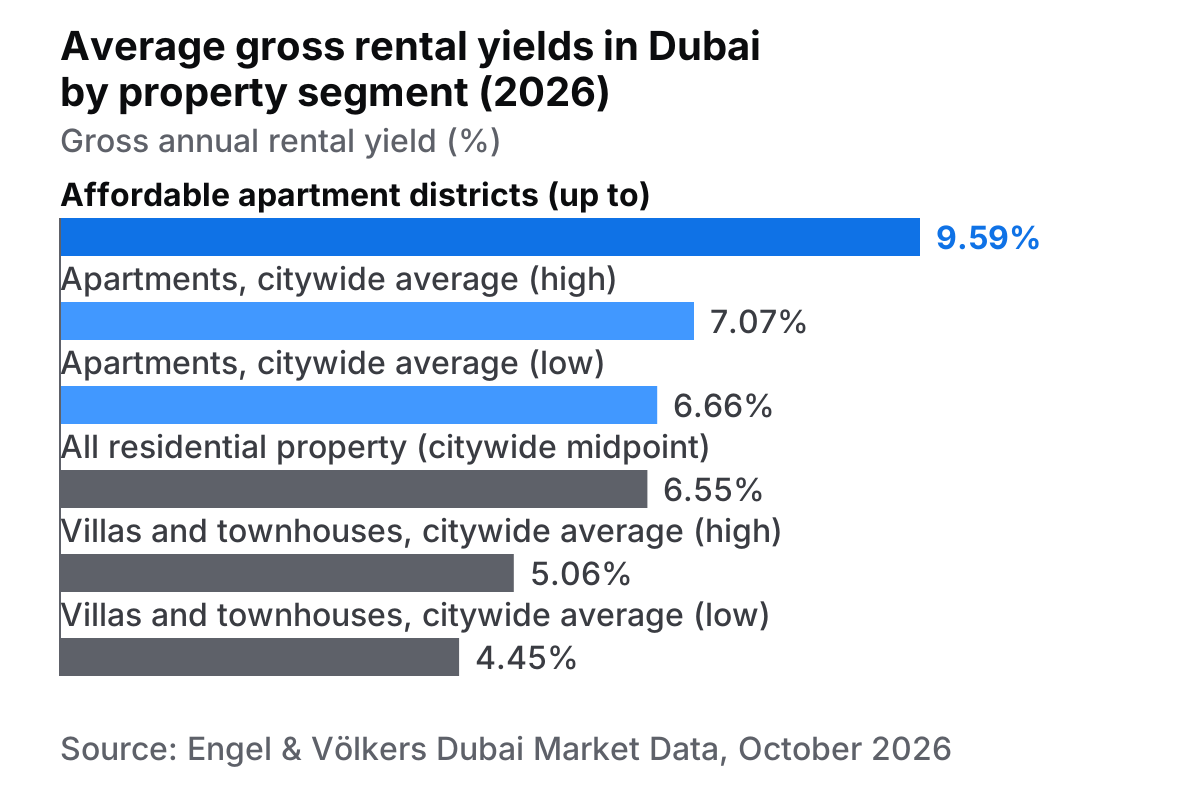
The Dubai residential market has matured from a speculative trading hub into a high-yielding institutional asset class favoured for long-term rental cash flow. Data published in the Engel & Völkers Dubai rental yield report for October 2026 shows citywide gross residential yields averaging 6.34% to 6.76%. Apartments lead performance, generating average gross yields of 6.66% to 7.07% citywide, with higher-density affordable districts such as Dubai Sports City and International City reaching gross yields up to 9.59%. Villas and townhouses deliver gross yields between 4.45% and 5.06%. To understand how these gross figures compare across various asset classes, see how to calculate and compare gross rental yields.
Long-term resident capital is further secured by transparent residency pathways. According to official Dubai Land Department (DLD) Golden Visa investor requirements, real estate investors qualify for a 10-year renewable UAE Golden Visa by holding property worth at least AED 2,000,000 in a single title or combined portfolio. Both mortgaged assets (backed by a No-Objection Certificate from a UAE bank) and off-plan properties (purchased from approved developers and verified through Oqood registration and construction benchmarks) satisfy eligibility criteria.
Macroeconomic stability underpins institutional capital flows. The IMF United Arab Emirates economic outlook (October 2026) highlights that following a strong 6.2% real GDP expansion in 2025, the UAE economy weathered a temporary -3.9% contraction in 2026 amidst regional trade disruptions before being projected to rebound to +7.7% real GDP growth in 2027.
Corporate tax relief and business incentives
Dubai provides a business-friendly environment with 100% foreign corporate ownership across almost all mainland commercial sectors. Under Cabinet Decision No. 215 of 2025 and Ministerial Decision No. 24 of 2026, the UAE Government R&D tax incentives programme introduced a Phase 1 non-refundable tiered tax credit of 15%, 35%, and up to 50% on qualifying R&D expenditure (capped at AED 5,000,000, including a 30% expenditure uplift on qualifying UAE staff salaries).
Additionally, as confirmed by the Federal Tax Authority (FTA) Small Business Relief rules, Ministerial Decision No. 131 of 2026 has extended Corporate Tax Small Business Relief through 31 December 2029. This allows resident taxable entities with gross revenues of AED 3,000,000 or less to elect for a 0% effective corporate tax rate.
High-liquidity prime hubs versus residential sanctuaries
Dubai’s real estate market offers distinct micro-markets depending on investor strategy. Prime urban hubs like Downtown Dubai, Business Bay, and Dubai Marina experience high transaction volumes, high liquidity, and strong demand for short-term holiday lets under local regulation. Conversely, low-density family sanctuaries such as Dubai Hills Estate, Nad Al Sheba, and Meydan appeal to end-users and long-term tenants seeking greenery, international schools, and community privacy. Real estate professionals and portfolio managers rely on CASAFARI Area Insights and property valuation and market study tools to benchmark pricing dynamics and stock availability across these distinct districts, while institutional buyers leverage specialized real estate data solutions for property investors.
Which landmarks and neighbourhoods define the Dubai visitor experience?
Architectural icons and historic souks
Dubai presents a striking contrast between ultra-modern architectural landmarks and preserved historic trade quarters. Modern icons include the 828-metre Burj Khalifa, the futuristic torus-shaped Museum of the Future, and the choreographed fountains at The Dubai Mall. A short journey across Dubai Creek reveals the Al Fahidi Historical Neighbourhood, where restored 19th-century wind-tower houses crafted from coral stone stand alongside the traditional spice and gold souks of Deira.
Key districts for short-term stays
Visitors and short-term tenants predominantly focus on three flagship districts. Downtown Dubai centers around grand boulevard living and immediate access to global retail and cultural venues. Dubai Marina and Jumeirah Beach Residence (JBR) feature continuous pedestrian waterfront promenades and direct beach access. Meanwhile, Palm Jumeirah offers luxury resort living, private beaches, and signature beachfront villas.
Where can residents escape within two hours of Dubai?
When seeking a retreat from the city, residents and investors enjoy accessible weekend destinations within a two-hour drive:
- Hatta: Situated 90 minutes inland in the Hajar Mountains, this mountain enclave offers kayaking across the turquoise waters of Hatta Dam, mountain biking trails, and outdoor activity hubs.
- Abu Dhabi: Located an hour south along the E11 motorway, the UAE capital features world-class cultural landmarks including the Sheikh Zayed Grand Mosque and Louvre Abu Dhabi on Saadiyat Island.
- Al Qudra Lakes: An accessible desert oasis located on the fringe of the Al Marmoom Desert Conservation Reserve, ideal for wildlife watching including Arabian oryx, desert foxes, and seasonal flamingos.
- Jebel Jais: The highest peak in the United Arab Emirates, located in the neighbouring emirate of Ras Al Khaimah, offering cooler mountain temperatures and scenic hiking trails.
To analyse real estate micro-markets, track live listing volumes, or evaluate investment yields across Dubai’s freehold districts, sign in to the CASAFARI platform to access comprehensive real estate intelligence.
Frequently asked questions
Can foreigners buy freehold property anywhere in Dubai?
No, foreign nationals (non-UAE and non-GCC citizens, whether resident or non-resident) cannot purchase property everywhere in the emirate. Under Article 4 of Law No. 7 of 2006 and Regulation No. 3 of 2006, as detailed in the UAE Government guide to expatriates buying property, international buyers may acquire freehold title—or leasehold and usufruct rights for up to 99 years—only within designated freehold zones. Areas such as Downtown Dubai, Dubai Marina, Palm Jumeirah, JVC, and Dubai Hills Estate allow foreign ownership, whereas only UAE and GCC nationals may acquire property outside designated zones.
How do you qualify for the 10-year UAE Golden Visa through property in Dubai?
To qualify for the 10-year UAE Golden Visa through real estate, investors must hold property registered in their name with a total purchase value of at least AED 2,000,000, according to Dubai Land Department (DLD) Golden Visa investor requirements. Both mortgaged assets (financed through an approved UAE bank with a bank No-Objection Certificate) and off-plan properties (purchased from approved local developers and verified via Oqood registration and construction progress) qualify. The investment threshold can be met with a single primary property or a combined real estate portfolio.
What are the property transfer fees and transaction costs in Dubai?
Property acquisitions in Dubai involve standard official fees payable at transfer. The Dubai Land Department (DLD) transfer fee is 4% of the agreed purchase price, plus fixed title deed administration fees of approximately AED 520 to AED 580. Buyers must also pay a Registration Trustee fee of AED 4,000 plus 5% VAT for transactions of AED 500,000 or above (or AED 2,000 plus 5% VAT below AED 500,000), while standard real estate agency commission is typically 2% of the purchase price plus 5% VAT.
What are the rules for short-term holiday lets in Dubai?
Under Decree No. 41 of 2013, every short-term rental unit must obtain an active Holiday Homes permit from the Dubai Department of Economy and Tourism (DET) holiday homes permit portal prior to marketing, with unlicensed operations incurring an AED 5,000 fine. Properties must be leased as a complete unit rather than individual rooms, private individual owners are capped at holding 8 active permits, and standalone villas must sit within a gated compound containing at least four villas. Standard registration fees are waived from 1 May 2026 to 30 April 2027, and guests pay a daily Tourism Dirham charge per bedroom for the first 30 nights.