
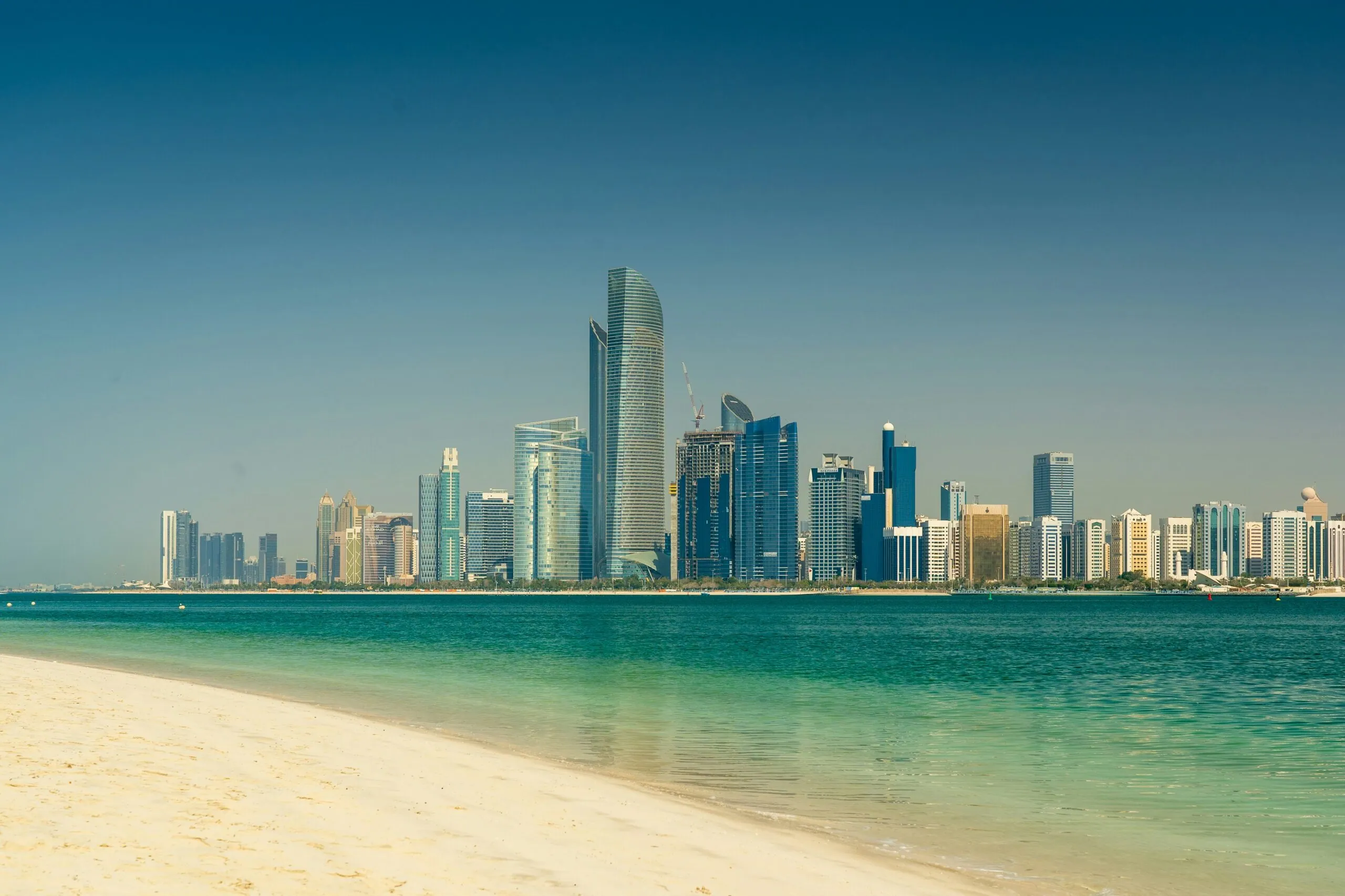
On Mamsha Al Saadiyat, facing the turquoise waters of the Arabian Gulf, international buyers find a calm, master-planned alternative to Dubai. Under Law No. 19 of 2005 as amended in 2019, non-UAE nationals may acquire full freehold ownership in designated investment zones such as Saadiyat Island, Yas Island, Al Reem Island and Al Maryah Island. Purchases incur a 2% registration fee with the Abu Dhabi Real Estate Centre (ADREC), while live property pricing and trends are tracked continuously by the ticker on this page. For district-level market research, professionals use CASAFARI Area Insights.
Why buyers compare Abu Dhabi with Dubai, and why it is a different market
Investors comparing the United Arab Emirates’ two largest real estate markets often notice a contrast in tempo. Dubai is built around fast-paced international connectivity and high-density commercial hubs. Abu Dhabi, the federal capital, offers a quieter, greener environment with expansive public realm planning and a strong foundation of sovereign institutional backing.
Development in Abu Dhabi is guided primarily by government-backed master developers, including Aldar Properties, Modon Properties, Imkan and Bloom Holding. Rather than rapid speculative expansions, property launches are released in managed phases aligned with infrastructure and cultural investment.
Both emirates permit non-nationals to acquire freehold title in designated areas. In Abu Dhabi, foreign freehold status is concentrated in specific investment zones—primarily master-planned waterfront islands and selected mainland hubs—rather than scattered across older urban districts. For international buyers seeking long-term capital stability alongside modern architectural standards, Abu Dhabi presents a structured alternative.
Island living and the mainland: what daily life looks like
Life in Abu Dhabi operates at two distinct speeds. On the waterfront islands surrounding the main island, modern high-rise apartments and luxury beachfront villas cater to international professionals, executive families and retirees. These districts feature pedestrian promenades, private beach clubs and direct access to international schools.
On the mainland, established villa communities offer generous plots, traditional majlis layouts and tree-lined streets suited to long-term residency. Understanding how these environments complement each other helps buyers select the district that aligns best with their lifestyle or investment goals.
Getting around: cars, buses, the airport and Etihad Rail
Abu Dhabi island and its adjacent suburbs are laid out on a clean grid system, making private vehicles and taxis the primary mode of daily transport. Public transit is operated by Abu Dhabi Mobility (the Integrated Transport Centre), which manages an extensive network of air-conditioned buses accessible via the Hafilat smart card. The emirate does not operate an urban metro system.
International transport connections saw major infrastructure upgrades when Terminal A at Zayed International Airport opened on 1 November 2023, followed by the formal renaming of the airport in February 2024. For inter-emirate travel, passenger service on Etihad Rail connecting Abu Dhabi to Dubai is scheduled for 2026, expanding on the national freight network that has operated across the UAE since 2023. In technology hubs like Masdar City, autonomous passenger shuttle trials offer a glimpse into future localized transit.
Climate: when the city lives outdoors
Abu Dhabi experiences an arid desert climate with two primary seasons. From October to April, winter brings mild, sunny weather that encourages outdoor living, coastal sports, and dining along waterfront promenades. During the summer months, temperatures rise significantly, and daily activities transition into climate-controlled indoor spaces, shopping destinations and covered sports facilities.
The waterfront islands: Yas, Saadiyat, Al Reem and Al Maryah
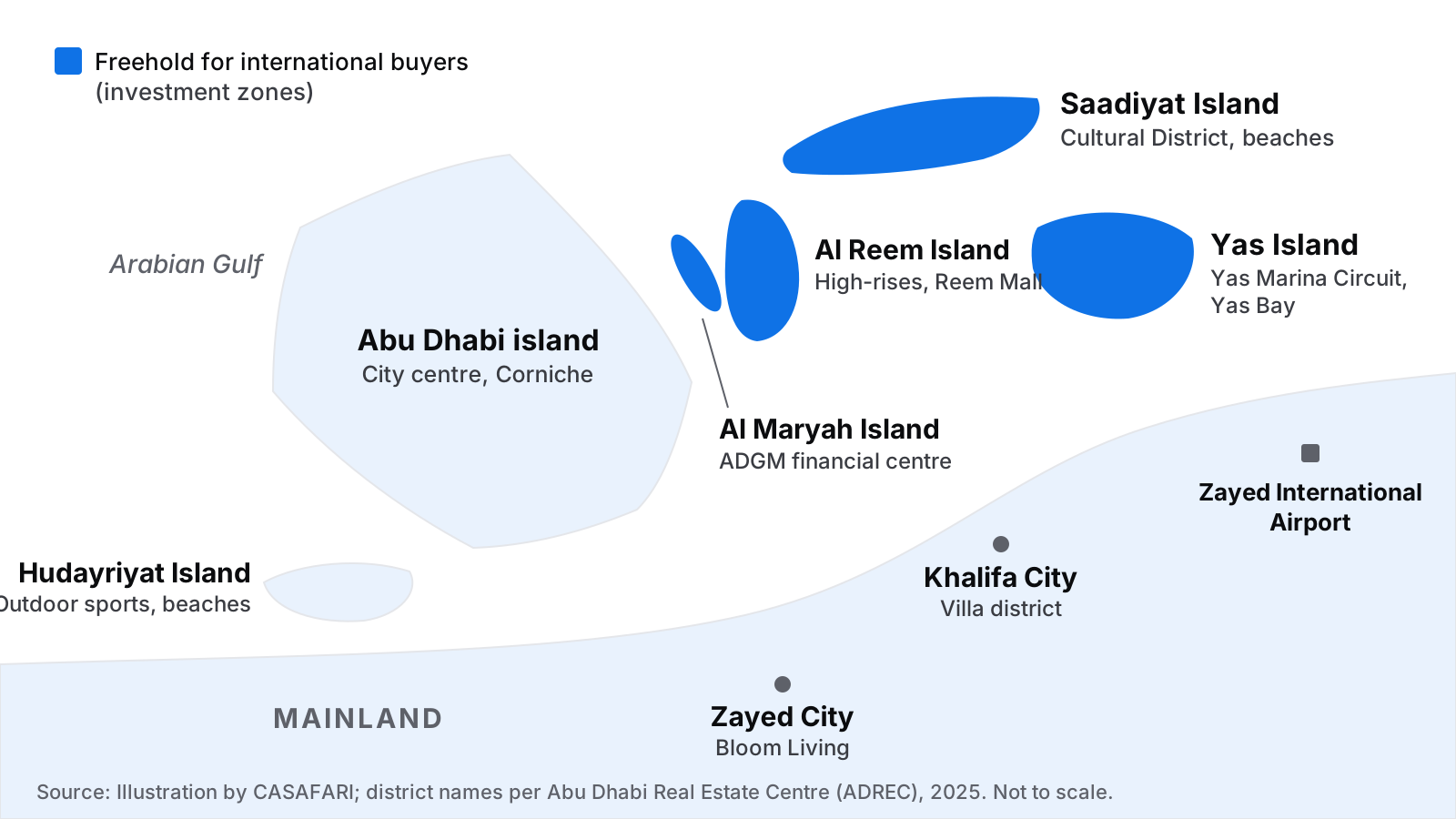
Abu Dhabi’s waterfront investment zones represent the core of international property transactions. Each island carries a distinct character and target demographic.
-
Yas Island: Known globally as an entertainment hub, Yas Island houses landmark attractions including Ferrari World, Warner Bros. World, Yas Marina Circuit and the waterfront dining district at Yas Bay. Indoor entertainment is anchored by the 18,000-capacity Etihad Arena, which opened in January 2021. Residential options on Yas consist of modern apartments and gated villa communities popular with families and short-let investors.
-
Saadiyat Island: Recognized as the emirate’s cultural capital, Saadiyat Island features pristine white sand beaches and the Saadiyat Cultural District. Here, Louvre Abu Dhabi (opened November 2017) and the Abrahamic Family House (opened March 2023) sit alongside top-tier residential developments such as Mamsha Al Saadiyat and Louvre Abu Dhabi Residences by Aldar.
-
Al Reem Island: Located minutes from the central business district, Al Reem Island is dominated by high-rise residential towers and waterfront apartments, offering accessible entry points for buyers. Reem Mall features major indoor leisure venues, including Snow Abu Dhabi. Significantly for business owners, jurisdiction over Al Reem Island was expanded into the Abu Dhabi Global Market (ADGM) financial free zone, aligning its regulatory framework with neighbouring Al Maryah Island.
-
Al Maryah Island: The primary financial centre of Abu Dhabi, home to ADGM headquarters, premium office towers, luxury hotels and upscale retail at The Galleria.
Families moving to the islands have access to leading international schools regulated by the Abu Dhabi Department of Education and Knowledge (ADEK). Notable institutions include Cranleigh Abu Dhabi on Saadiyat Island, Repton School Abu Dhabi on Al Reem Island, and Brighton College Abu Dhabi located nearby on the mainland edge.
The mainland: Khalifa City, Al Mushrif, Zayed City and Hudayriyat
Mainland Abu Dhabi offers established residential neighbourhoods that contrast with island high-rises.
- Khalifa City and Al Mushrif: Traditional villa districts favoured for large family homes, private gardens and proximity to major parks like Umm Al Emarat Park.
- Zayed City: Home to master-planned developments such as Bloom Living by Bloom Holding, designed as a walkable, Mediterranean-inspired community with integrated schools and a central town square.
- Hudayriyat Island: Developed by Modon Properties as a sports and leisure destination west of the main island, featuring public cycling tracks, outdoor obstacle courses and beachfront glamping.
Investor Note: Most traditional mainland villa districts are reserved for UAE and GCC nationals. International buyers must confirm that a mainland project sits within a designated investment zone before proceeding.
Can foreigners buy property in Abu Dhabi, and what does it cost to register?
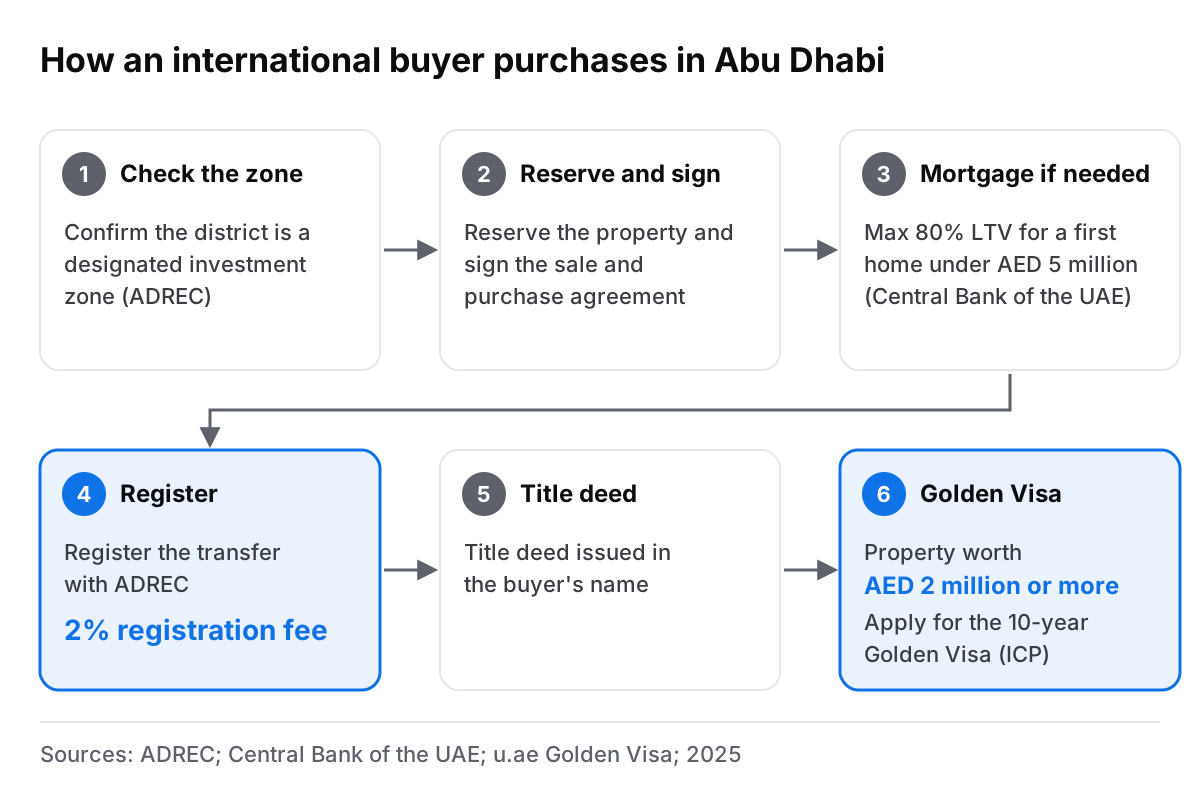
Foreign nationals, non-resident individuals and foreign-owned companies may buy property on a full freehold basis in designated investment zones under Law No. 19 of 2005, following major amendments enacted in 2019. Ownership titles are registered with the Abu Dhabi Real Estate Centre (ADREC).
Transaction costs and tax structures remain straightforward:
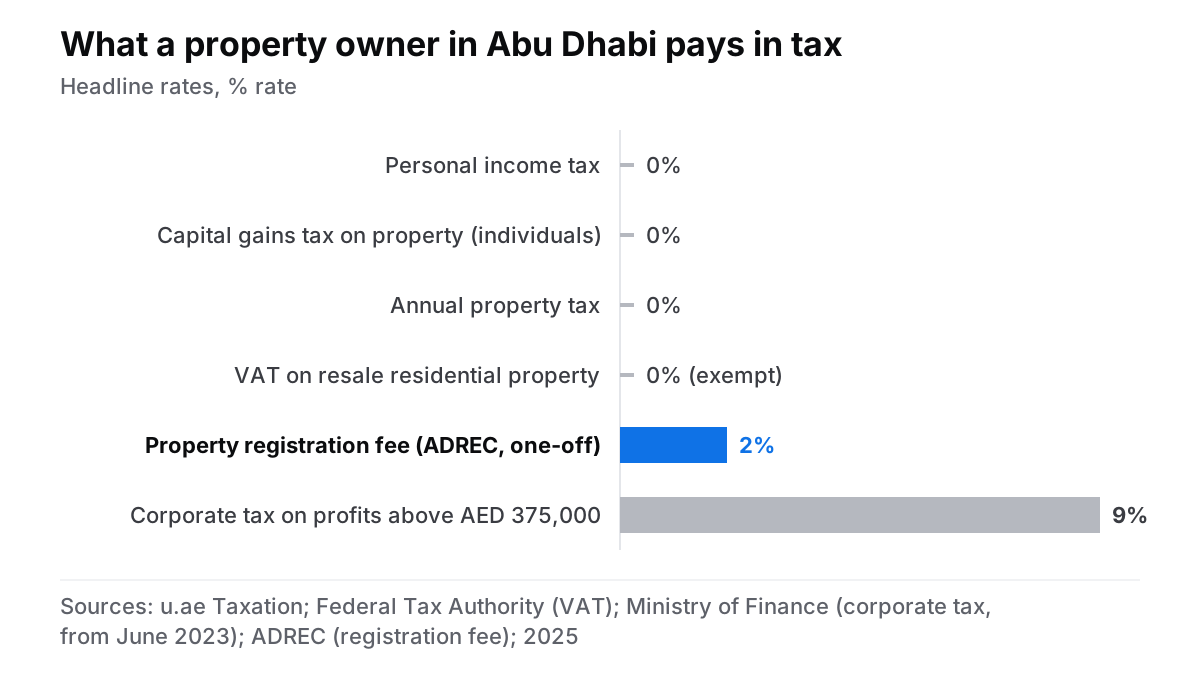
- Registration Fee: A 2% property transfer fee is payable to ADREC upon title transfer (contract terms dictate allocation between buyer and seller).
- Value Added Tax (VAT): According to the Federal Tax Authority, VAT is set at 5%. The first sale of a newly constructed residential property within three years of completion is zero-rated, while subsequent resales and residential rental leases are exempt.
- Personal Taxation: Individual buyers pay 0% personal income tax, 0% capital gains tax on property sales, and zero annual municipal property tax (u.ae Taxation).
- Mortgages: Under Central Bank of the UAE mortgage regulations, non-national buyers can borrow up to an 80% loan-to-value (LTV) ratio for their first home purchase under AED 5 million (75% for properties above AED 5 million), and up to 50% for off-plan purchases.
- Residency: Owners purchasing real estate worth AED 2 million or more qualify to apply for a 10-year renewable UAE Golden Visa via the Federal Authority for Identity, Citizenship, Customs and Port Security (ICP). Mortgaged properties and off-plan units from approved developers qualify under rules active since October 2022. Note that the Blue Residency launched in May 2024 is dedicated to environmental contributors, not real estate investors.
- Holiday Lets: Property owners wishing to run short-term holiday rentals must secure a holiday-home licence from the Department of Culture and Tourism – Abu Dhabi (DCT Abu Dhabi) and adhere to master-community guidelines.
Doing business from Abu Dhabi: ownership, tax and incentives
Abu Dhabi provides a modern legal structure for business owners and corporate investors. Since June 2021, Federal Decree-Law No. 26 of 2020 has allowed 100% foreign ownership of onshore companies across most commercial and industrial sectors without requiring a local Emirati sponsor.
For corporate tax, the UAE Ministry of Finance implemented a 9% federal corporate tax on taxable business profits exceeding AED 375,000, effective for financial years starting on or after 1 June 2023 (profits up to AED 375,000 are taxed at 0%). Business incentives are supported by institutions such as the Abu Dhabi Investment Office (ADIO) and the Khalifa Fund.
Investors analyzing prospective market performance can review how to compare locations before investing and understand how rental yield is calculated and found in CASAFARI.
Landmarks and culture: from the Grand Mosque to the museums of Saadiyat
Abu Dhabi’s cityscape balances historic cultural landmarks like the Sheikh Zayed Grand Mosque and Qasr Al Watan with world-class contemporary developments. When narrowing down districts, foreign buyers typically focus on three primary zones:
- Saadiyat Island: Cultural prestige, low-density villa estates and high-end beachfront apartments.
- Yas Island: Entertainment-led communities, family townhouses and modern resort apartments.
- Al Reem Island: High-density urban living, convenient commute times and accessible apartment pricing.
Day trips from Abu Dhabi: Al Ain, Liwa and Sir Bani Yas
Beyond the capital island, the Emirate of Abu Dhabi extends into historical and ecological landscapes:
- Al Ain: Located about 90 minutes east, Al Ain features the UNESCO World Heritage Cultural Sites of Al Ain (inscribed in 2011), including ancient oases, palm groves and historic forts.
- Liwa Oasis: Situated on the edge of the Rub’ al Khali (Empty Quarter), offering desert dunes and luxury retreats like Qasr Al Sarab.
- Sir Bani Yas Island: Located off the western coast, hosting the Arabian Wildlife Park with free-roaming gazelles, giraffes and protected species.
Who Abu Dhabi suits, and how to research a district before buying
Abu Dhabi is ideally suited to long-term investors, expatriate executives and families seeking standard legal transparency, clean urban planning and premium security. Apartment developments on Al Reem and Yas appeal to yield-focused investors, while beachfront homes on Saadiyat attract capital-preservation buyers seeking Golden Visa residency.
Before making an acquisition, professionals verify district-level historical data and real-time market metrics. You can confirm countries where CASAFARI data is available and explore CASAFARI’s tools for property investors. Technical teams may consult the Area Insights developer documentation in English, or sign in to CASAFARI to explore Abu Dhabi district metrics directly.
Frequently asked questions
Can foreigners buy property in Abu Dhabi?
Non-UAE nationals can purchase property on a freehold basis within designated investment zones, including Saadiyat Island, Yas Island, Al Reem Island, Al Maryah Island, Al Raha Beach and Masdar City. This right was established under Law No. 19 of 2005 and expanded to full freehold title by a 2019 amendment. Property titles are registered with the Abu Dhabi Real Estate Centre (ADREC). Outside designated investment zones, real estate ownership is restricted to UAE and GCC nationals.
Does buying property in Abu Dhabi qualify for a UAE Golden Visa?
Investors purchasing property valued at AED 2 million or more qualify for a 10-year renewable UAE Golden Visa residency. Under regulations in force since October 2022 from the Federal Authority for Identity, Citizenship, Customs and Port Security (ICP), mortgaged properties and off-plan units bought from approved developers are eligible. Applications are processed through Abu Dhabi government channels. The Blue Residency launched in May 2024 is a separate 10-year visa for environmental contributors, not a property investment route.
What fees and taxes do you pay when buying property in Abu Dhabi?
Property purchases in Abu Dhabi incur a 2% transfer registration fee payable to the Abu Dhabi Real Estate Centre (ADREC), with contractual terms deciding the cost split between buyer and seller. Individual buyers pay 0% personal income tax, 0% capital gains tax, and no annual municipal property tax. The Federal Tax Authority applies a 5% VAT rate, though the first sale of a new residential property within three years of completion is zero-rated, and subsequent resales or leases are exempt.
Can I let my Abu Dhabi apartment as a short-term holiday home?
Property owners may let their apartment as a holiday home only after acquiring a licence from the Department of Culture and Tourism – Abu Dhabi (DCT Abu Dhabi). In addition to government licensing, owners must ensure compliance with individual building management and master-community rules regarding short lets. Unlicensed short-term letting can result in administrative fines. Many investors partner with licensed property management companies to operate holiday homes on Yas and Saadiyat islands.