
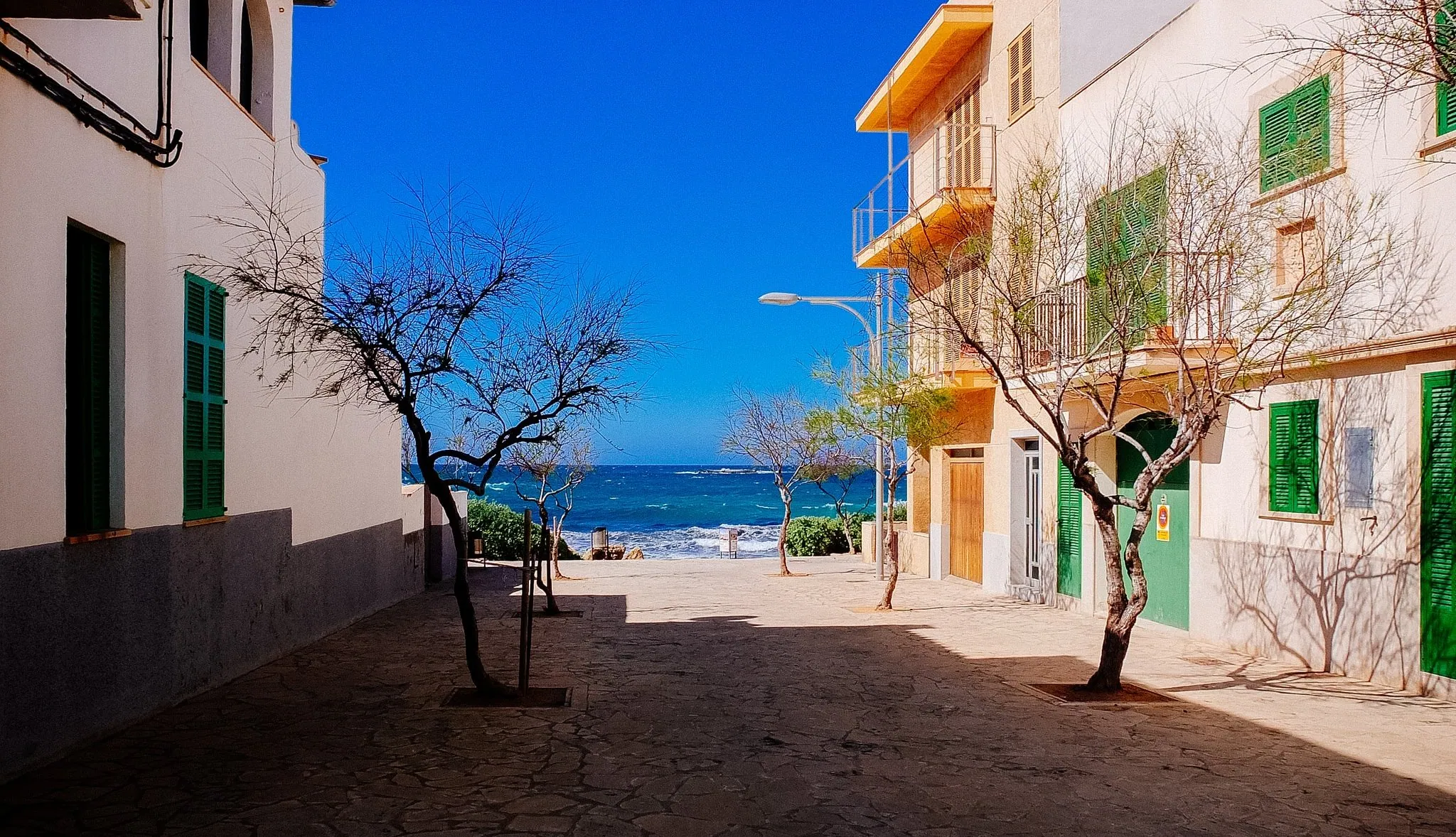
COLONIA SAN JORDI PROPERTY GUIDE
Unspoilt and easy-going area with fantastic beaches all around
Colònia de Sant Jordi is a serene coastal town of 2,971 residents within the south-eastern municipality of Ses Salines (INE, January 2025). Renowned for its proximity to the 3-kilometre white-sand dunes of Es Trenc and Cabrera National Park, it sits 47.5 kilometres (35 to 45 minutes) from Palma Airport. Property acquisitions are subject to progressive Balearic transfer tax from 8% to 13% and strict tourist licensing rules.
Why Buy Property in Colònia de Sant Jordi and Ses Salines?
Situated on a headland in south-eastern Mallorca, Colònia de Sant Jordi strikes a balance between coastal tranquil life and authentic Mediterranean heritage. It serves as the primary coastal centre of the municipality of Ses Salines, housing 2,971 of the municipality’s 5,248 residents (Instituto Nacional de Estadística, January 2025), with 2,230 living in the inland village of Ses Salines itself. Unlike purpose-built holiday resorts, it retains a year-round lived-in feel, supported by local commerce, traditional dining, and permanent residents.
The history of the area is tied to its natural salt flats, the Sa Vall salt pans. Exploited since the 4th century BC by Punic, Roman and Arab traders, these are among the oldest working salt pans in the world and remain commemorated on the official coat of arms of Ses Salines. Established in 1879 as an agricultural and fishing colony by the Marqués del Palmer, the settlement expanded steadily before Ses Salines gained administrative independence from neighboring Santanyí in 1925.
Residential property here ranges from coastal apartments along the port and front-line promenade to low-rise townhouses and modern detached villas. Moving inland towards Ses Salines town and Campos, the landscape transitions to rustic plots and traditional Mallorcan stone fincas. To analyze hyper-local stock, pricing shifts, and listing density across south-east Mallorca, real estate professionals turn to CASAFARI Area Insights and our targeted Property Sourcing across the entire Mallorca market.
Protected Beaches, Cabrera National Park and Outdoor Life
Colònia de Sant Jordi is surrounded by some of the Balearic Islands’ most prized natural landscapes. The coastline forms part of the Es Trenc-Salobrar de Campos Maritime-Terrestrial Natural Park (Govern de les Illes Balears, December 2025). Directly west of the harbour lie the coastal wetlands of Ets Estanys and the 3-kilometre undeveloped beach of Es Trenc, famous for its fine white sand and shallow turquoise waters.
Within the town itself, families gather at Sa Platja des Port, adjacent to the marina. Heading south-east along the coastal walking trail reveals unspoilt pine-backed coves such as Es Dolç and Es Carbó, which remain accessible only on foot or by boat.
For nautical enthusiasts, the harbour is the primary gateway to the Cabrera Archipelago Maritime-Terrestrial National Park. Located roughly 10 kilometres (6 nautical miles) offshore, it represents the shortest boat crossing from Mallorca. Daily excursions run throughout the season, taking 25 to 45 minutes by speedboat or up to one hour by conventional vessel (October 2026).
Outdoor activities are a major draw year-round. The calm, clear waters attract open-water swimmers and divers, while the flat topography of the southern plains makes the region a favoured base for road cyclists. Golfers are within easy driving reach of two major courses: Vall d’Or Golf near Portocolom (25 km, 30–40 minutes) and Golf Son Antem near Llucmajor (35.5 km, 30–40 minutes, May 2026).
Day-to-Day Living, Markets and Transport Connections
Life in Colònia de Sant Jordi revolves around the harbour promenade along Carrer Gabriel Roca, lined with seafood restaurants, bakeries, and casual cafes. While the town offers a laid-back dining scene, livelier marina nightlife can be found further east in neighbouring hubs like Cala d’Or.
Local markets bring regular activity to the area (March 2026). Colònia de Sant Jordi hosts a seasonal afternoon market along Avinguda Primavera from May to October (roughly 16:00 to 21:00), which takes place on Tuesdays (having shifted from its original Wednesday slot launched in 2021). For comprehensive grocery shopping, local produce, and traditional craftsmanship, the administrative centre of Campos holds major morning markets every Thursday and Saturday (08:00 to 13:30).
Cultural events punctuate the annual calendar. On 23 April, the town celebrates its patron saint day of Sant Jordi, featuring a traditional boat blessing at the harbour. The summer festivities (Festes d’Estiu) span late July to mid-August, reaching their climax on the first weekend of August with beachside concerts and fireworks at Cala Galiota (August 2026).
Transport links across the island are fast and direct (May 2026):
- Campos: 10–14 km (15 minutes by car via Ma-6014 / Ma-19) for large supermarkets, medical clinics, and legal services.
- Palma de Mallorca Airport (PMI): 47.5 km (35 to 45 minutes via the Ma-19 motorway).
- Central Palma: 52–55 km (45 minutes by car).
Taxes, Tourist Licences (ETV) and Buying Rules in Mallorca in 2026
Navigating real estate transactions in the Balearic Islands requires an understanding of current legal frameworks, tax obligations, and residency regulations.
Balearic Property Purchase Taxes (ITP & IVA)
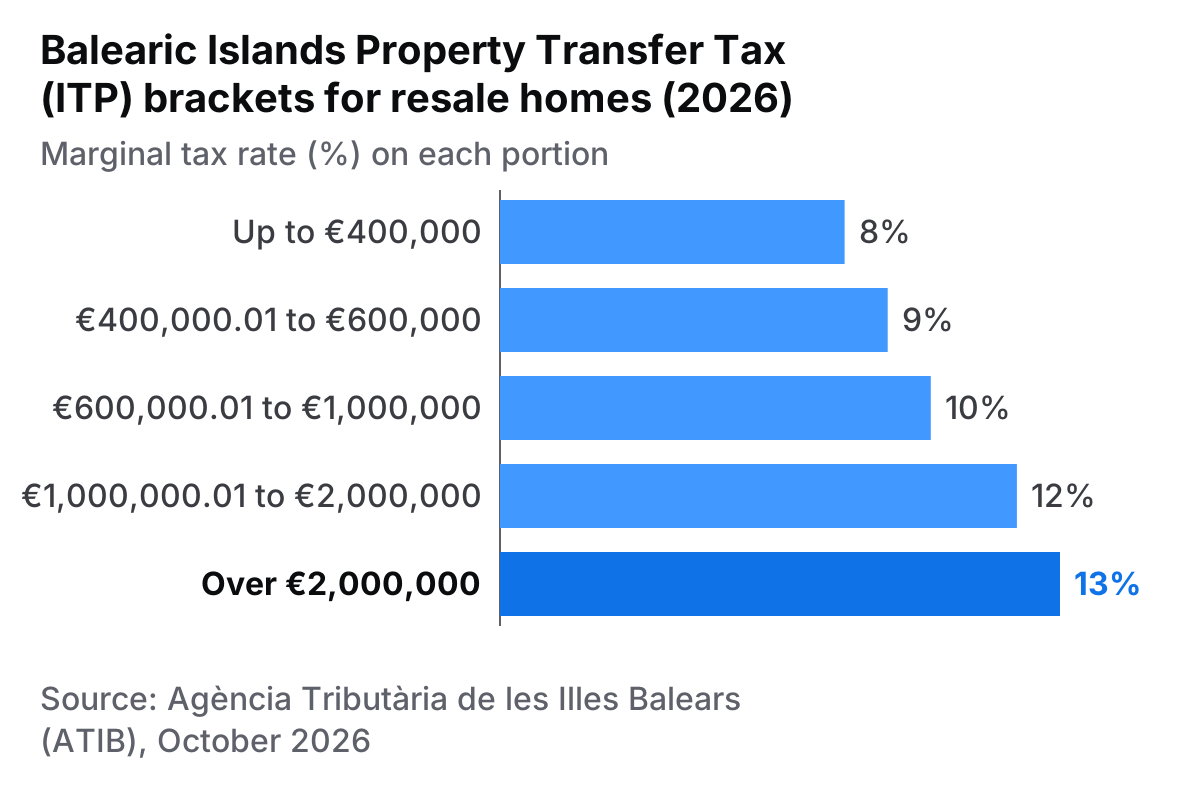
When buying a resale property in Colònia de Sant Jordi, purchasers pay the progressive Balearic Property Transfer Tax (Impuesto sobre Transmisiones Patrimoniales or ITP), calculated on marginal brackets (Agència Tributària de les Illes Balears, October 2026):
- Up to €400,000: 8%
- €400,000.01 to €600,000: 9%
- €600,000.01 to €1,000,000: 10%
- €1,000,000.01 to €2,000,000: 12%
- Portion above €2,000,000: 13%
For new-build properties purchased directly from a developer, buyers pay 10% VAT (IVA) plus 1.5% Stamp Duty (AJD), which increases to 2% AJD for property values exceeding €1,000,000.
Tourist Licence Restrictions (ETV Rules)
Under Decree-Law 4/2025 and the ongoing tourist bed moratorium, acquiring short-term holiday rental licences (ETV) in Mallorca remains tightly regulated (Consell de Mallorca, October 2026):
- Apartments: New ETV licences for apartments in multi-family residential buildings are strictly prohibited.
- Detached and Terraced Homes: New licences can only be acquired if places are available in the Consell de Mallorca’s 1:1 deregistration pool. Costs stand at €3,500 per place for detached villas, €875 per place for semi-detached/terraced homes, and €291.67 per place for primary residences let up to 60 days per year (ETV60).
- Existing Licences: Properties sold with a valid, active ETV licence retain their operational status, making verified existing licences a key consideration for investment buyers. For further context on yield strategies, read our guide to owning a rental property in Mallorca and Ibiza.
Non-EU Residency and Legal Process
Following the enactment of Organic Law 1/2025 on 2 January, Spain permanently ended its real estate Golden Visa program on 3 April 2025 (Boletín Oficial del Estado). Non-EU citizens (including British, American, and Swiss buyers) can no longer claim Spanish residency through a €500,000 real estate purchase. Non-EU buyers intending to spend more than 90 days per 180-day period in Spain must now apply for standard visas, such as the Non-Lucrative Visa or Digital Nomad Visa. For step-by-step guidance, refer to our complete guide to buying property in Spain.
To price assets, examine comparative market data, and track historical pricing across Ses Salines, real estate professionals rely on CASAFARI’s property valuation and market study tools. Developers and institutional analysts can review our Area Insights API documentation or sign in to the CASAFARI platform to access live market data.
Frequently asked questions
Can I get a tourist rental licence (ETV) for a property in Colònia de Sant Jordi?
Under Balearic Decree-Law 4/2025 (April 2025), new tourist rental licences (ETV) are strictly prohibited for apartments in multi-family buildings across Mallorca. As of 2026, the Consell de Mallorca only reallocates deregistered tourist places on a 1:1 basis for detached houses (€3,500 per place), semi-detached or terraced houses (€875 per place), and primary residences let for up to 60 days a year (€291.67 per place).
What are the property purchase taxes in Colònia de Sant Jordi and the Balearic Islands?
According to the Agència Tributària de les Illes Balears (ATIB, October 2026), resale properties are subject to a progressive Property Transfer Tax (ITP) across marginal brackets: 8% on the first €400,000, 9% between €400,000.01 and €600,000, 10% between €600,000.01 and €1,000,000, 12% between €1,000,000.01 and €2,000,000, and 13% on any amount above €2,000,000. New-build homes are taxed at 10% VAT (IVA) plus 1.5% Stamp Duty (AJD), rising to 2% AJD when the property value exceeds €1,000,000.
Can non-EU buyers still obtain a Spanish Golden Visa by purchasing property in Mallorca?
No. Under Spain’s Organic Law 1/2025, the Golden Visa route granting residency for a €500,000 real estate investment was permanently abolished on 3 April 2025. Non-EU citizens—including British buyers—who wish to spend more than 90 days in any 180-day period in Mallorca now apply for alternative permits such as the Non-Lucrative Visa or the Digital Nomad Visa.
How far is Colònia de Sant Jordi from Palma de Mallorca Airport and Es Trenc beach?
Colònia de Sant Jordi lies 47.5 kilometres south-east of Palma de Mallorca Airport (PMI), which takes 35 to 45 minutes by car via the Ma-19 motorway (May 2026), while central Palma is roughly 45 minutes away (52 to 55 km). The eastern end of the protected Es Trenc-Salobrar de Campos Natural Park—including Ets Estanys and the 3-kilometre white-sand stretch of Es Trenc—begins directly on the western edge of the town.