SES SALINES PROPERTY GUIDE
Hidden gem with some of the best beaches on the island and a rich history
Ses Salines is a 39.12 km² municipality in Mallorca’s south-eastern Migjorn region, with 5,248 inhabitants recorded in 2025 by the Instituto Nacional de Estadística (INE). Split between the traditional inland village of Ses Salines and the coastal resort of Colònia de Sant Jordi, the area attracts buyers seeking authentic country fincas on rural plots of at least 14,000 m² and coastal residences near protected beaches bordering Es Trenc Natural Park.
Why buyers and investors look to Ses Salines in south-eastern Mallorca
Situated on a low-lying coastal plain with an average altitude of 53 metres, the municipality of Ses Salines combines countryside living with a coastline featuring ten distinct beaches. These include the 900-metre Es Dolç beach, the secluded cove of Es Carbó, and the pristine eastern dunes of the Es Trenc Natural Park, as noted in municipal geographic data published in October 2026. The area’s historical salt pans, worked since antiquity, give the municipality its name and give the surrounding landscape its open character.
For real estate professionals, investors, and private buyers evaluating opportunities across south-eastern Mallorca, live market pricing figures and historical price-per-square-metre comparisons are available directly on this page via the embedded CASAFARI ticker. For broader district comparison and historical inventory tracking, real estate teams rely on CASAFARI Area Insights to evaluate local supply trends.
Towns and villages of the Ses Salines municipality: inland heritage versus coastal living
The municipality is divided into two primary residential hubs, each catering to distinct lifestyle and investment preferences:
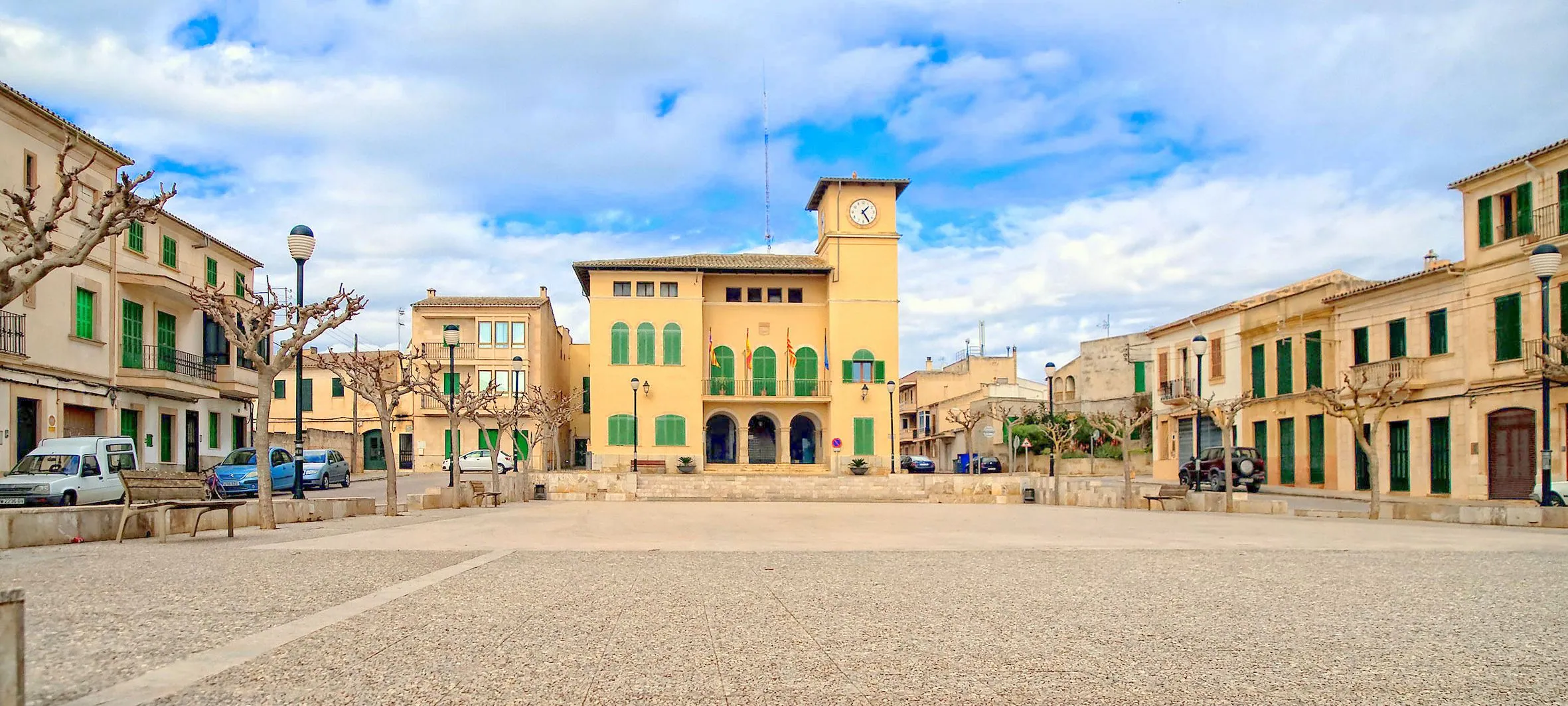
- Ses Salines Town: Located inland, Ses Salines village registered 2,230 residents in 2025 according to the INE Padrón Municipal. Characterised by traditional golden marès sandstone townhouses, narrow stone streets, local coffee shops, and weekly fruit and artisan markets, the town serves as the administrative center. The surrounding rural countryside (suelo rústico) is peppered with historic agricultural estates (fincas).
- Colònia de Sant Jordi: Situated directly on the Mediterranean, Colònia de Sant Jordi expanded from a modest fishing and salt-shipping village into a coastal enclave of 2,971 residents in 2025 (up from 2,860 in 2024, according to the INE). Known for its seaside promenade, seafood dining, and sports tourism, it serves as the gateway to the maritime nature reserve of Cabrera.
Nautical enthusiasts and boat owners in Colònia de Sant Jordi benefit from a local harbour managed directly by Ports de les Illes Balears (PortsIB). As of October 2026, the port offers 315 moorings, including 37 dedicated transit berths capable of accommodating vessels up to 12 metres in overall length (LOA) and 4.00 metres in beam, with a 2-metre draught in the inner basin and up to 3 metres along the outer quay.
Transport, infrastructure and international schools near Ses Salines
Despite its tranquil rural character, Ses Salines maintains reliable public transit connections. According to Transport de les Illes Balears (TIB) regional transit data from October 2026, TIB interurban bus line 517 connects Santanyí, Es Llombards, Ses Salines town, Colònia de Sant Jordi, and the inland commercial center of Campos.
At the central Campos transit stops (La Verge 1 and 2), passengers can make direct timed transfers onto express line A51 directly to Palma de Mallorca Airport (PMI), line 501 into central Palma, or line 518 towards Sa Ràpita. Driving time from Ses Salines town to Palma Airport is approximately 35 to 40 minutes along the upgraded Ma-19 highway.
Families relocating to the south-east should note that there are no private international schools operating directly within Ses Salines, Santanyí, or Campos. For the 2026–2027 academic year, the closest English-medium option is the Rafa Nadal International School in Manacor, located approximately 31 km away. The school provides an Anglo-American curriculum taught in English from British Early Years and Primary through to Grade 12 High School Diploma with Spanish homologation. Additional international schools are located around Palma, Marratxí, and Calvià, between 40 and 70 km away.
Rural building rules (suelo rústico) and holiday rental licences (ETV) in 2026
Acquiring land to build or extend a rural estate (finca) in Ses Salines requires strict adherence to the Balearic Urbanism Law (LUIB), the Mallorca Island Territorial Plan (PTIM), and consolidating Decree-Laws 9/2020 and 3/2024.
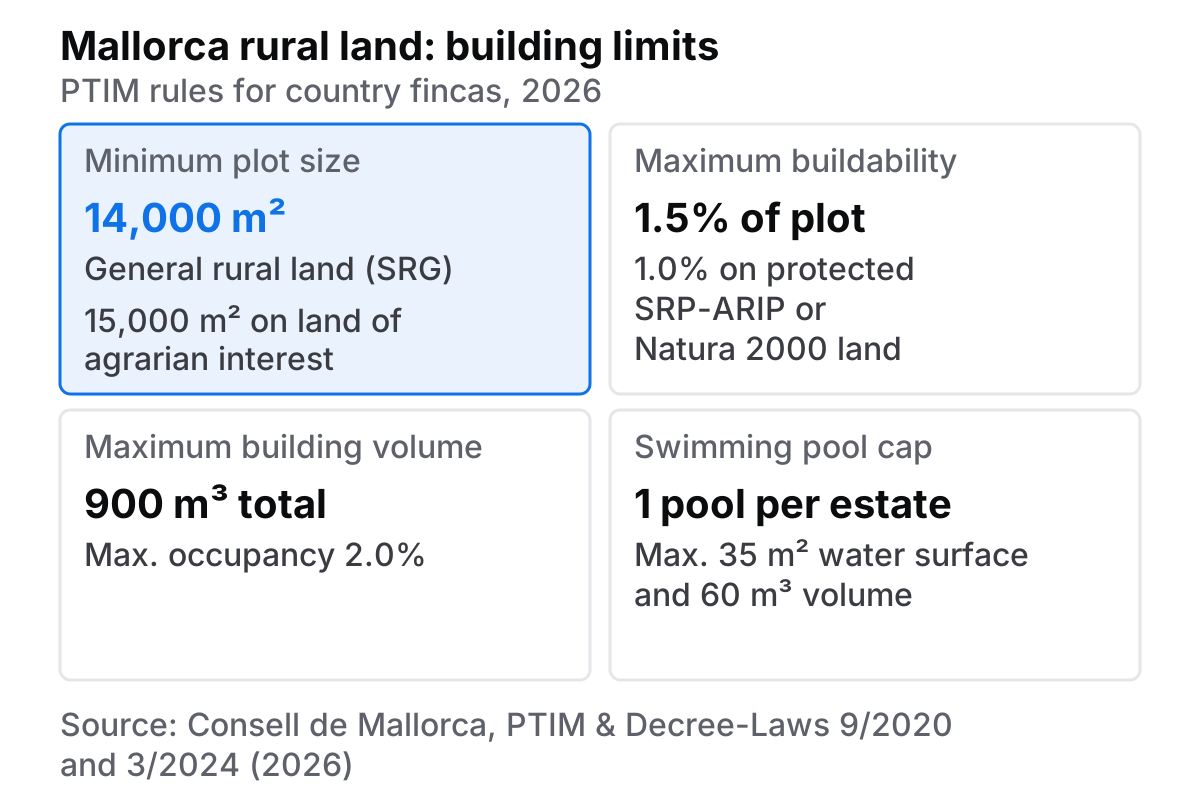
Under current planning regulations, strict caps apply to all general rural land (suelo rústico general):
- Minimum Plot Size: A minimum continuous land area of 14,000 m² is mandatory to construct a single-family detached dwelling on general rural land, increasing to 15,000 m² in designated areas of agrarian interest.
- Maximum Buildability: Total constructed floor space cannot exceed 1.5% of the total plot size (reduced to 1.0% on protected SRP-ARIP land or Natura 2000 protected areas).
- Maximum Footprint & Volume: Building occupancy is capped at 2.0% of the plot area (1.5% in protected zones), and the absolute maximum built volume across all structures on the plot is strictly capped at 900 m³.
- Swimming Pool Restrictions: Only one swimming pool is permitted per rural property, with a maximum water surface area of 35 m² and a total volume capped at 60 m³.
For investors eyeing holiday rental income, strict rules apply under Balearic Decree-Law 4/2025. New holiday rental licences (Estancias Turísticas en Viviendas or ETV) are permanently prohibited for apartments in multi-family residential buildings across Mallorca, including Colònia de Sant Jordi.
To manage overall tourist capacity, the island operates a zero-growth (1:1) exchange pool administered by the Consorci Borsa d’Allotjaments Turístics (CBAT). Under this scheme, new ETV tourist places are re-issued only when existing licences are de-registered. For example, in June 2026, CBAT allocated 1,069 de-registered places via a public lottery scheme exclusively for detached single-family houses (€3,500 per place), semi-detached properties (€875 per place), and primary residence ETV60 licences (€291.67 per place). Investors considering rental assets can read more on the broader strategy of owning a rental property in Mallorca and Ibiza.
Property taxes, wealth tax and residency rules for international buyers
When purchasing residential property in the Balearic Islands, transaction taxes depend on whether the property is a resale or a new-build dwelling.
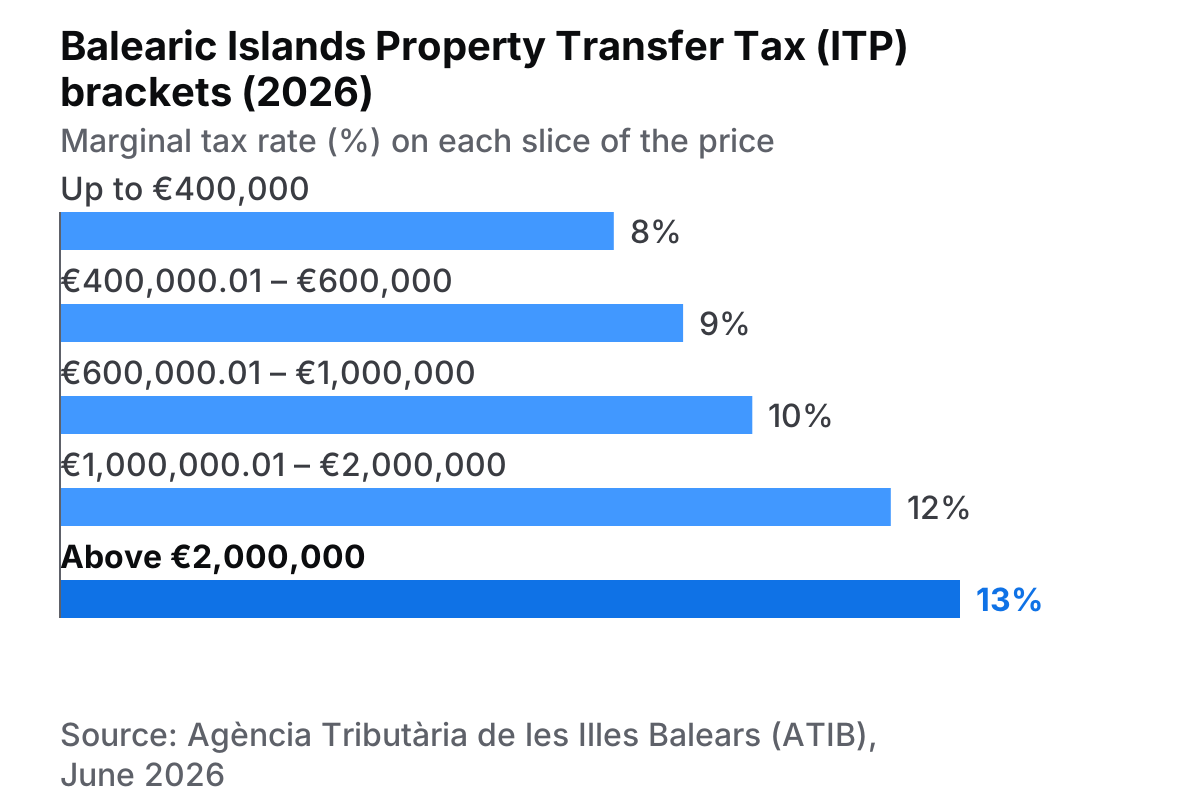
According to official guidelines from the Agència Tributària de les Illes Balears (ATIB) updated for 2026, resale properties are subject to progressive Property Transfer Tax (Impuesto sobre Transmisiones Patrimoniales - ITP):
- Up to €400,000: 8%
- €400,000.01 to €600,000: 9%
- €600,000.01 to €1,000,000: 10%
- €1,000,000.01 to €2,000,000: 12%
- Portion above €2,000,000: 13%
Reduced ITP rates apply to residents purchasing a primary home (4% standard reduced rate, 2% for buyers under 36 or large families, and 100% relief for first-time buyers under 30 on primary homes valued up to €331,859.70 in Mallorca). New-build properties purchased directly from a developer are subject to 10% VAT (IVA) plus 1.5% Stamp Duty (Actos Jurídicos Documentados - AJD). Detailed information on legal structures and conveyancing paperwork can be found in our guide to the Spanish property purchase contract and escritura.
Regarding annual wealth holdings, the Balearic Autonomous Region established an individual tax-free threshold of €3,000,000 for Wealth Tax (Impuesto sobre el Patrimonio) under Regional Law 12/2023 (in force from 2024 through 2026). Balearic tax residents receive an additional €300,000 exemption for their primary residence. Non-resident international buyers whose primary Spanish property assets are situated in Mallorca can also benefit from this regional €3,000,000 allowance.
Non-EU international buyers should note a major immigration rule change: Spain permanently abolished its real estate Golden Visa scheme under Organic Law 1/2025 in the Boletín Oficial del Estado, effective 3 April 2025. Purchasing property valued at €500,000 or more no longer provides a path to Spanish residency. Non-EU nationals planning extended stays in Ses Salines must now apply for conventional residency permissions, such as the Non-Lucrative Visa (NLV) or Digital Nomad Visa.
Whether you are sourcing authentic rural estates in inland Ses Salines or coastal homes in Colònia de Sant Jordi, real estate professionals and private investors use CASAFARI Property Sourcing to search cross-portal listings and access accurate market valuations. To benchmark current asking prices and analyze real-time market data across south-eastern Mallorca, conduct an accurate property valuation and market study or sign in to the CASAFARI platform to explore full regional coverage.
Frequently asked questions
Can you get a holiday rental licence (ETV) in Ses Salines?
Under Decree-Law 4/2025, new ETV holiday rental licences are permanently banned for apartments in multi-family buildings across Mallorca, including Colònia de Sant Jordi. For detached or semi-detached single-family houses, a strict zero-growth (1:1) system applies through the Consorci Borsa d’Allotjaments Turístics (CBAT). Buyers must either acquire a house that already possesses an active ETV licence or apply when de-registered places are released via public allocation draws, such as the June 2026 lottery offering 1,069 places (€3,500 per place for detached houses and €875 for semi-detached homes).
What is the minimum plot size to build a finca in Ses Salines?
Under the Mallorca Island Territorial Plan (PTIM) and Decree-Laws 9/2020 and 3/2024, building a new detached house on general rural land (suelo rústico general) requires a minimum continuous plot size of 14,000 m², which increases to 15,000 m² in areas designated for agrarian interest. Maximum buildability is capped at 1.5% of the plot area (1% in protected SRP-ARIP or Natura 2000 areas), overall built volume cannot exceed 900 m³, and only one swimming pool with a maximum water surface of 35 m² is permitted.
How much is property transfer tax (ITP) and wealth tax in Mallorca?
Property Transfer Tax (ITP) on resale homes in Mallorca is charged on a progressive scale: 8% up to €400,000; 9% between €400,000.01 and €600,000; 10% up to €1,000,000; 12% up to €2,000,000; and 13% on any portion above €2,000,000 (new builds carry 10% VAT plus 1.5% AJD stamp duty). For regional Wealth Tax (Impuesto sobre el Patrimonio), Law 12/2023 sets a tax-free allowance of €3,000,000 per individual, applicable to both tax residents and qualifying non-resident property owners.
Can non-EU buyers still get a Golden Visa by buying property in Mallorca?
No, Spain permanently abolished the real estate Golden Visa on 3 April 2025 through Organic Law 1/2025 (BOE-A-2025-76), which repealed Articles 63 to 67 of Law 14/2013. Purchasing property worth €500,000 or more no longer confers residency rights. Non-EU buyers, including British citizens, looking to spend more than 90 days out of 180 days in Mallorca must instead apply for standard immigration visas, such as the Non-Lucrative Visa or Digital Nomad Visa.