
POLLENSA TOWN PROPERTY
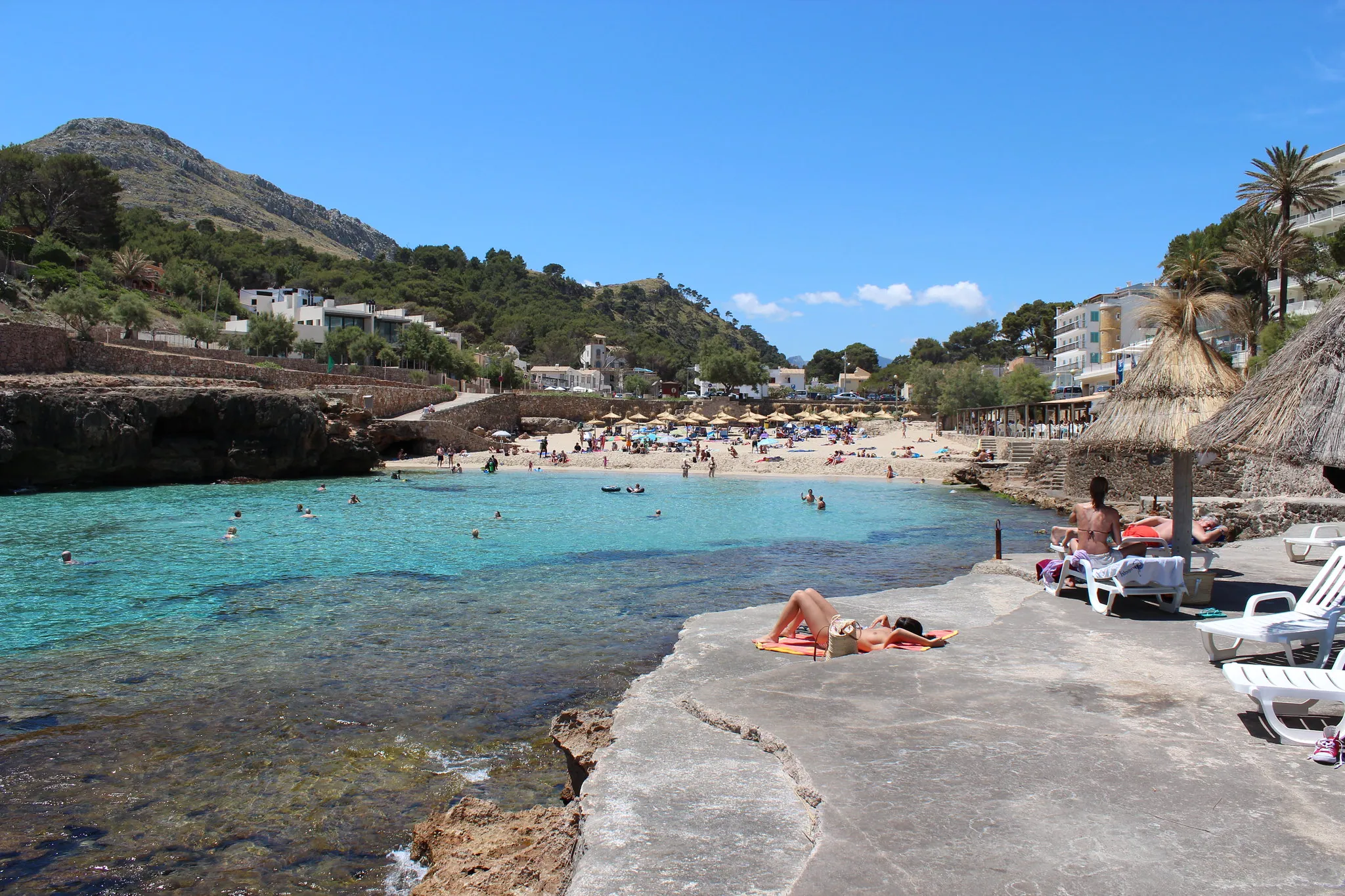
Traditional cobbled town, surrounded by fertile valleys and an idyllic atmosphere. A beauty of its own.
Pollença Town (Pollensa) in northern Mallorca is a historic municipality of 17,807 inhabitants (Instituto Nacional de Estadística, January 2025) situated 60 to 65 km from Palma Airport via the Ma-13 motorway. Prime real estate ranges from restored golden-stone townhouses in the old town to elevated hillside villas in La Font and El Vilà, alongside country fincas across protected valleys.
Where is Pollença Town and how well connected is it?
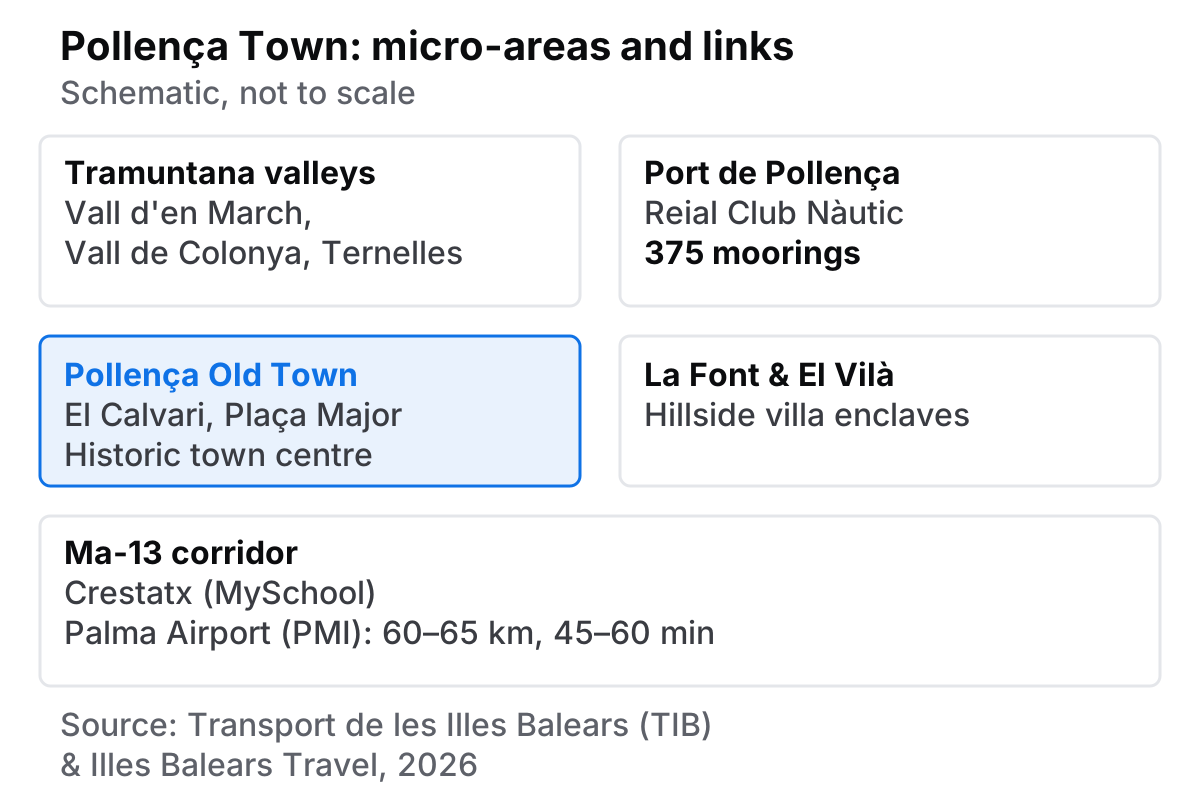
Nestled at the northern foot of the UNESCO-listed Serra de Tramuntana mountains, Pollença Town offers an authentic inland Mallorcan lifestyle while keeping the coast within effortless reach. The coastal resort of Port de Pollença lies just a short drive east, harbouring the Reial Club Nàutic Port de Pollença, which offers 375 moorings for vessels up to 25 metres in length and a draught of 2.70 to 2.80 metres (Illes Balears Travel, 2026).
Driving to Pollença Town from Palma de Mallorca Airport (PMI) takes between 45 and 60 minutes along the Ma-13 motorway. For public transport users, the interurban TIB Line 301 connects Pollença directly with Palma’s Estació Intermodal, while connecting at Alcúdia Ronda Nord with the A32 airport express service (TIB, August 2026).
For international families considering permanent residence, educational infrastructure is nearby. MySchool (Mallorca International School), located in Crestatx (Sa Pobla) just minutes down the Ma-13, provides co-educational instruction following the British National Curriculum from EYFS to Year 11 / IGCSE for ages 3 to 16, delivered 80% in English and 20% in Spanish and Catalan (The Good Schools Guide, September 2026).
Which neighbourhoods and property types define the Pollença market?
Buyers and estate agents navigate three distinct micro-markets within Pollença Town and its surrounding countryside:
- Casco Antiguo (Historic Town Centre): Characterised by narrow cobbled lanes surrounding Plaça Major, the famous 365 cypress-lined steps of El Calvari, the Convent of Sant Domènec (housing the Municipal Museum), and the church of Monti-sion. Property seekers look here for historic casas de pueblo (townhouses) featuring stone facades, exposed beams, and private interior courtyards.
- Hillside Enclaves (La Font & El Vilà): Positioned on the elevated slopes north and east of the town, La Font and El Vilà feature modern detached villas and traditional residences set on terraced plots. These properties offer panoramic views over the valleys towards the Bay of Pollença.
- Surrounding Valleys (Vall d’en March, Vall de Colonya & Ternelles): These fertile valleys are home to Mallorcan country estates (fincas) set amidst olive and almond groves. Strict rustic land protections preserve the architectural heritage and natural scale of these valley properties.
Real estate professionals, buyers and institutional investors track stock availability, benchmark valuations and analyse pricing trends across these micro-locations using CASAFARI Area Insights alongside the property valuation and market study tool.
Why do international buyers choose Pollença Town year-round?
Pollença’s cultural heritage stretches back centuries. Following King Jaume I’s conquest of Mallorca in 1229, northern lands were granted to the Knights Templar. The parish church of Nostra Senyora dels Àngels (Mare de Déu dels Àngels) was established in 1236, handed to the Templars in 1240, and rebuilt in its current Baroque style between 1714 and 1790 (Maiorica Sacra).
Local traditions remain central to community life. The Sunday morning market on Plaça Major, the annual autumn Fira artisan fair, and the iconic La Patrona festival on 2 August reflect this local spirit. The festival culminates in the Moros i Cristians battle re-enactment, commemorating the night of 30–31 May 1550 when townspeople led by Joan Mas successfully repelled 1,500 Ottoman corsairs commanded by Dragut (RTVE, August 2022).
Outdoor living options include hiking up to the 14th-century Santuari del Puig de Maria for views over the bays of Pollença and Alcúdia, playing 9 holes at Golf Pollença or 18 holes at Golf Alcanada, and sailing along the Formentor peninsula. Investors researching broader regional dynamics can explore our guide on owning a rental property in Mallorca and Ibiza.
What taxes, planning rules and tourist licence laws apply in 2026?
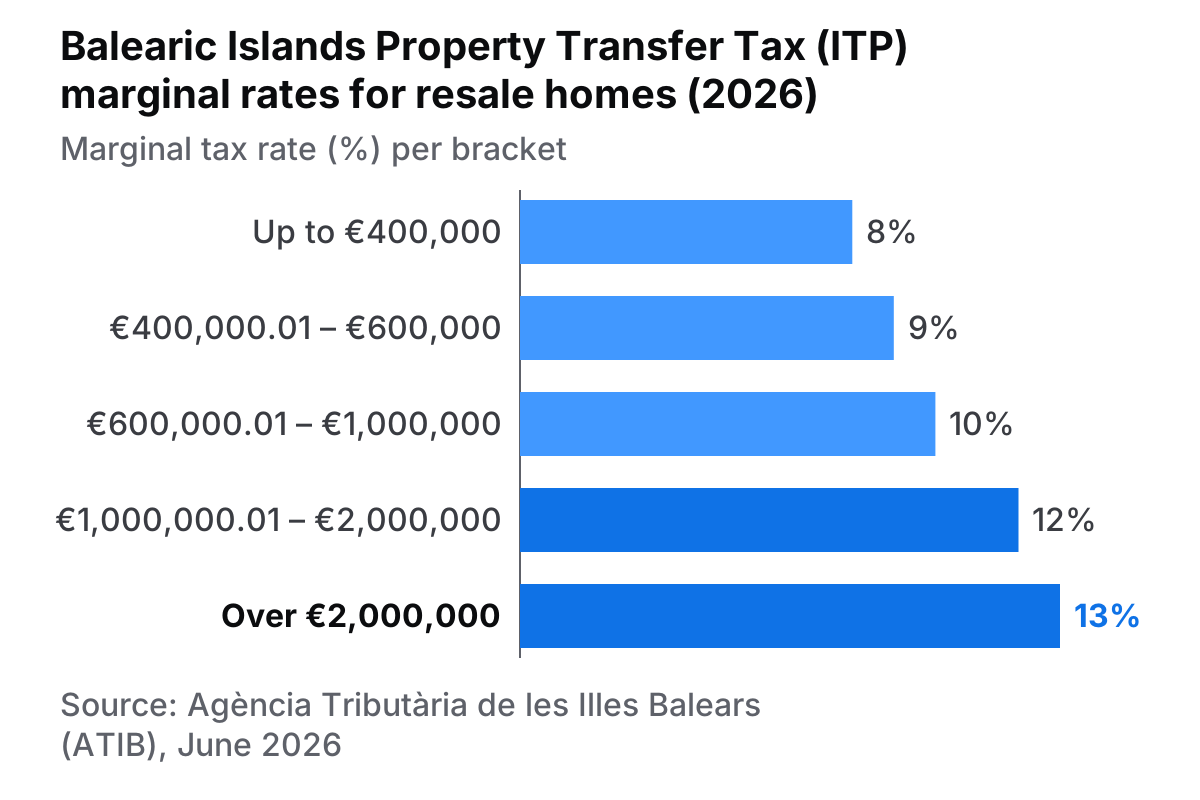
Purchasing resale residential property in Pollença involves progressive Property Transfer Tax (ITP) rates regulated by the Agència Tributària de les Illes Balears (ATIB) as of June 2026:
- Up to €400,000: 8%
- €400,000.01 to €600,000: 9%
- €600,000.01 to €1,000,000: 10%
- €1,000,000.01 to €2,000,000: 12%
- Over €2,000,000: 13%
Reduced rates (2%–4%) and exemptions up to 100% apply exclusively to primary residence buyers under 30 or 36 purchasing homes valued up to €331,859.70 under Law 4/2026.
Planning regulations on rustic land are strictly controlled under Mallorca’s Island Territorial Plan (PTIM), Law 6/1997, and Decree-Law 9/2020 (BOE, in force 2026):
- Minimum Plot Size: 14,000 m² on General Rustic Land (SRG), Agrarian Interest (AIA), and Harmonisation Transition (AT-H) zones. On Forest Rustic Land (SRG-F) and Areas of Landscape Interest (ARIP), the minimum plot size is 50,000 m².
- Building Caps: Construction is restricted to one single-family dwelling per plot, with a maximum building volume of 900 m³ and a maximum swimming pool surface area of 35 m².
For short-term holiday rentals, Decree-Law 4/2025 prohibits new ETV (Estada Turística en Habitatges) licences in multi-family apartment buildings. New licences for single-family detached, semi-detached, or terraced houses can only be secured on a 1:1 replacement (zero-net-growth) basis through allocation draws managed by the Consorci Borsa d’Allotjaments Turístics (CBAT). Consequently, properties with existing, valid ETV licences command a premium.
Non-EU buyers should note that Spain’s real estate Golden Visa scheme (€500,000 threshold) was repealed by Organic Law 1/2025 in the Boletín Oficial del Estado (BOE), effective 3 April 2025. Buyers seeking residency now use alternatives such as the Non-Lucrative Visa or Digital Nomad Visa.
To navigate legal requirements and inspect full portal inventory, read our complete guide to buying property in Spain and use CASAFARI Property Sourcing to aggregate clean, un-duplicated market listings. When you are ready to evaluate live market trends and benchmark valuations in Pollença, sign in to CASAFARI to explore hyper-local market data.
Frequently asked questions
What are the property transfer taxes (ITP) when buying a resale home in Pollença?
Resale residential purchases in Pollença are subject to the Balearic progressive Property Transfer Tax (ITP), managed by the Agència Tributària de les Illes Balears (ATIB, as of June 2026). The general rates start at 8% for the portion up to €400,000, rising to 9% between €400,000.01 and €600,000, 10% between €600,000.01 and €1,000,000, 12% between €1,000,000.01 and €2,000,000, and 13% on any portion exceeding €2,000,000. Reduced rates between 2% and 4% (or 100% relief) apply only to qualifying primary residence buyers under 30 or 36 purchasing properties valued up to €331,859.70 under Law 4/2026.
Can you get a tourist rental licence (ETV) for a property in Pollença Town?
New tourist rental licences (Estada Turística en Habitatges or ETV) in Mallorca are strictly regulated under Balearic Decree-Law 4/2025 (as of October 2026). New licences are completely prohibited for apartments in multi-family residential buildings. For single-family homes, including detached villas and terraced townhouses, new licences can only be acquired on a zero-net-growth (1:1 replacement) basis via periodic allocation draws managed by the Consorci Borsa d’Allotjaments Turístics (CBAT). Consequently, buyers seeking holiday rental income normally look for properties sold with an existing, active ETV licence.
What is the minimum plot size to build a country house on rustic land in Pollença?
Under Mallorca’s Island Territorial Plan (PTIM), Law 6/1997 and Decree-Law 9/2020 (BOE, in force 2026), constructing a single-family home on General Rustic Land (SRG, AIA, or AT-H) requires a minimum plot size of 14,000 m². In protected zones such as Forest Rustic Land (SRG-F) and Areas of Landscape Interest (ARIP), which cover much of Pollença’s countryside, the minimum plot size rises to 50,000 m². Development is restricted to one single-family dwelling per plot, with a maximum building volume of 900 m³ and a swimming pool water surface area capped at 35 m².
Can non-EU buyers still obtain a Spanish Golden Visa by purchasing property in Mallorca?
No, Spain officially abolished the real estate Golden Visa pathway for non-EU investors. Organic Law 1/2025 of 2 January (BOE) repealed Articles 63 to 67 of Law 14/2013, and no new applications have been accepted since 3 April 2025. Existing permit holders retain renewal rights under transitional provisions, but new non-EU buyers seeking residence in Mallorca must apply through alternative visa routes, such as the Non-Lucrative Visa or Digital Nomad Visa.