
FORMENTOR PROPERTY GUIDE
Prime second home location on the exclusive Formentor peninsula
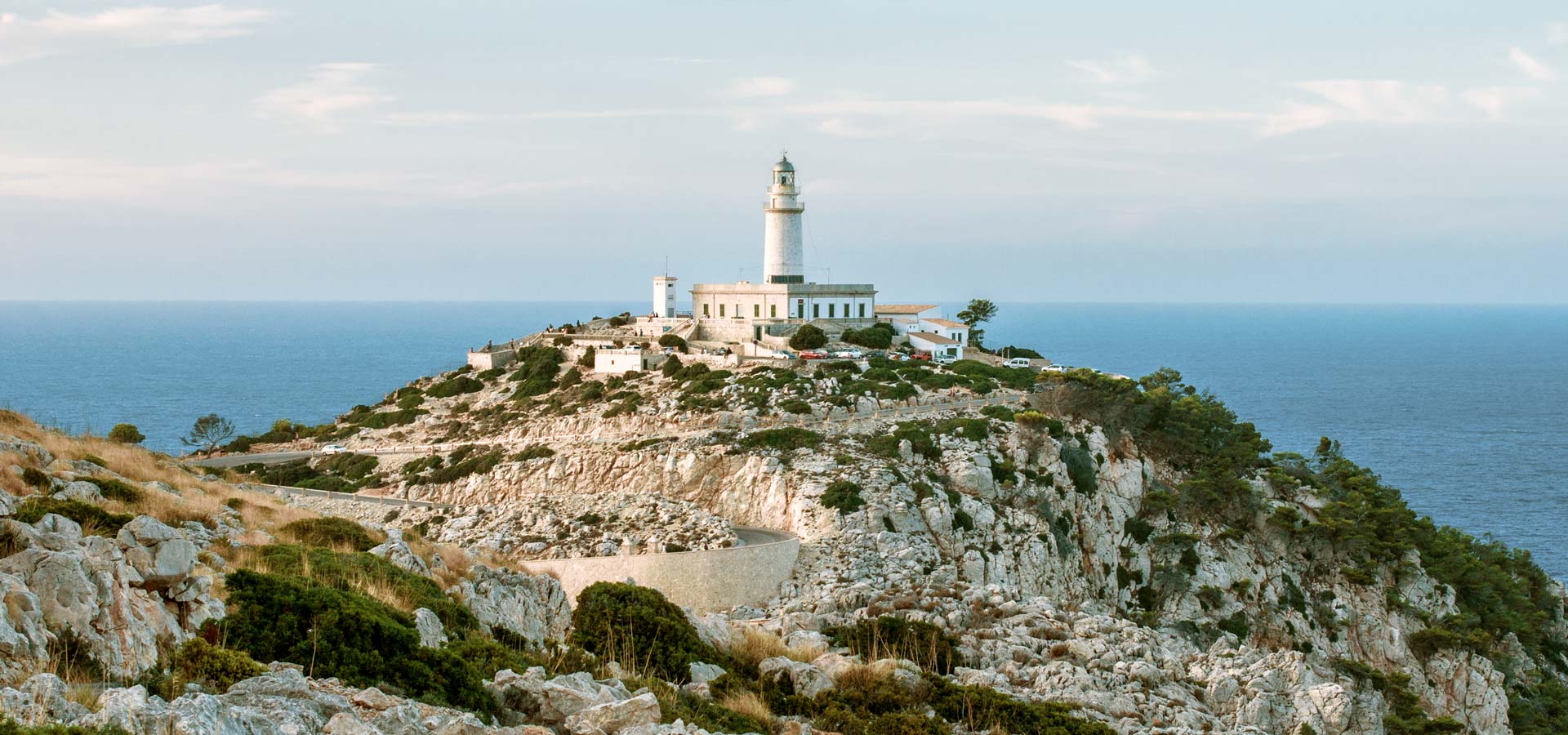
Formentor is northern Mallorca’s most exclusive residential peninsula, situated in the municipality of Pollença along a dramatic 12-kilometre limestone cape. Known for its 840-metre Blue Flag beach (ADEAC 2026) and secluded stone villas, the enclave’s global prestige is anchored by the August 2024 reopening of the historic 1929 hotel as the Four Seasons Resort Mallorca at Formentor, set within a private 40-hectare estate.
Why is Formentor the most coveted peninsula in northern Mallorca?
Forming the northernmost extremity of Mallorca within the municipality of Pollença, the Formentor peninsula extends across a 12-kilometre spine of pine-clad limestone. Measuring approximately 3 kilometres in width, its geography is defined by towering vertical cliffs that exceed 200 metres at the lighthouse and reach a sheer 300-metre drop into the Mediterranean near Puig Fumat, which rises to 335 metres above sea level (with the peninsula’s summit reaching 384 metres).
The residential landscape of Formentor is exceptionally scarce. Housing stock consists primarily of grand, traditional Mallorcan stone villas positioned on expansive wooded plots facing the Bay of Pollença, complemented by a limited selection of low-density townhouses framed by mature landscaped gardens. Protected by stringent environmental rules that prohibit urban expansion, the enclave offers rare privacy for international buyers considering owning a second home in Mallorca and Ibiza.
The coast is punctuated by natural landmarks, including the Mirador des Colomer lookout and the 196-metre Fumat tunnel carved through the mountain along the Ma-2210 road. At the heart of the peninsula lies Platja de Formentor (also known as Cala Pi de la Posada), measuring 840 metres in length and an average of 8 metres in width, which holds ADEAC Blue Flag status for 2025 and 2026–2027. Nearby secluded coves such as Cala Boquer, Cala Castell, and Cala Sant Vicenç provide additional private coastal anchorages.
How has the Four Seasons Resort Mallorca at Formentor reshaped the enclave?
The hospitality identity of the peninsula began on 24 August 1929, when the original Hotel Formentor was founded by the Argentine poet and arts patron Adán Diehl as Mallorca’s first luxury retreat outside Palma. For nearly a century, the hotel served as an international refuge for literary and political figures.
In August 2024, the estate reopened as the Four Seasons Resort Mallorca at Formentor following a comprehensive restoration. Occupying a 40-hectare beachfront plot, the resort features 110 rooms and suites, a private vineyard, a private jetty, a hydrotherapy spa, a tennis court, and multiple culinary concepts, including Mel, Shima (Nikkei cuisine), Cercle, Quiosc, Llum i Sal, and Crocant.
For neighbouring property owners, the arrival of Four Seasons brings refined amenities, direct yacht tender access, and enhanced international visibility, consolidating Formentor’s status among Europe’s top-tier Mediterranean enclaves.
How do connectivity and summer road restrictions work for Formentor residents?
While Formentor feels strikingly remote, key amenities remain easily accessible by car along the Ma-2210 road:
- Platja de Formentor & Hotel Zone: 9 to 10 km (approximately 15 minutes’ drive) from the marina and dining of Port de Pollença.
- Pollença Old Town: Approximately 20 minutes’ drive inland.
- Golf Pollença: 20 to 30 km away (25 to 35 minutes’ drive), located just beyond Port de Pollença.
- Palma de Mallorca Airport (PMI): 75 km from the beach and hotel zone (70 to 75 minutes by car), and up to 95 km from the Formentor Lighthouse.
To preserve the natural environment and prevent traffic congestion during peak season, the Dirección General de Tráfico (DGT Resolution of 14 January 2026) enforces seasonal road restrictions between 15 May and 18 October 2026, from 10:00 to 22:00 daily along the Ma-2210 (PK 2.0 to PK 19.6). Segment 1 (PK 2.0 to PK 8.0, accessing the beach) remains open to general traffic until parking capacity is reached, while Segment 2 (PK 8.7 to PK 19.6, leading to the lighthouse) is closed to private tourist vehicles.
Crucially, property owners and local residents are fully exempt from these restrictions. Owners can register their vehicles with the DGT (formentor@dgt.es) at least three working days in advance to secure automatic number-plate recognition (ANPR) authorization or barrier QR codes. Buying agents searching for available villas across northern Mallorca frequently rely on tools like CASAFARI Property Sourcing to monitor off-market and active opportunities in restricted zones.
What taxes, holiday-let rules, and residency laws apply when buying in Formentor?
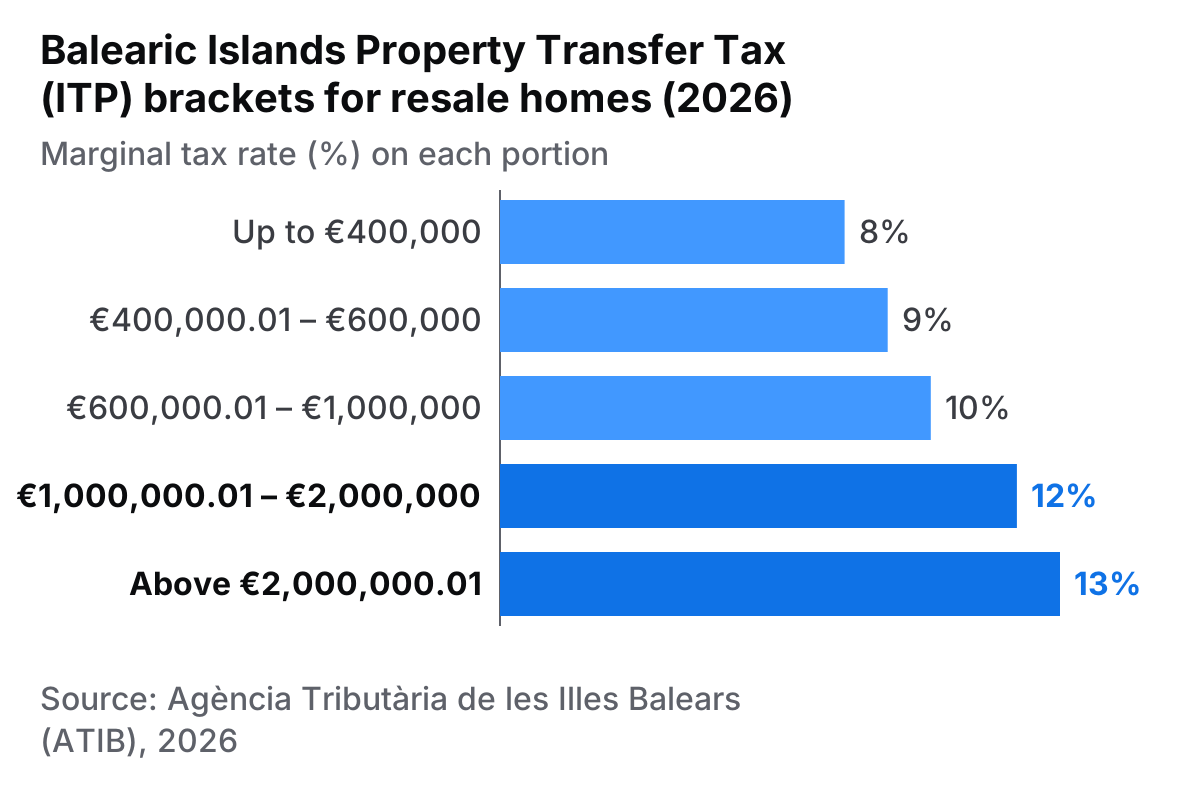
Acquiring ultra-prime real estate in the Balearic Islands requires a clear understanding of regional taxation and legal frameworks. When purchasing a resale villa, buyers pay progressive Property Transfer Tax (Impuesto sobre Transmisiones Patrimoniales or ITP) managed by the Agència Tributària de les Illes Balears (ATIB):
For new-build luxury properties exceeding €1,000,000 subject to VAT, a Stamp Duty (AJD) rate of 2% applies.
Under Balearic Law 12/2023, property owners are subject to Wealth Tax (Impuesto sobre el Patrimonio) with a tax-free individual threshold of €3,000,000. Non-resident owners whose Spanish assets are concentrated in the Balearics may elect to apply this regional €3,000,000 tax-free allowance under Additional Provision Four of Law 19/1991.
Short-term holiday rentals are strictly regulated under Law 8/2012 and Decree-Law 4/2025 (enacted 11 April 2025). New tourist rental licences (ETV) are permanently prohibited in multi-family residential buildings, and the island operates under a zero-net-growth cap on tourist beds. Consequently, existing detached villas in Formentor holding historical, valid ETV licences command a distinct premium.
Regarding residency, Spain’s real estate Golden Visa was officially repealed on 3 April 2025 following the enactment of Organic Law 1/2025 of 2 January 2025. Non-EU buyers purchasing luxury property must now utilise standard non-lucrative or digital nomad visa frameworks if spending more than 90 days per 180-day period in the Schengen zone. Before committing to a transaction, buyers should review our detailed guide to the Spanish property purchase contract and escritura.
To evaluate property valuations and historical trends across Pollença, family offices and real estate advisors use CASAFARI Area Insights and our property valuation and market study tool. Developers and analysts can also review the Area Insights API documentation in English, or sign in to CASAFARI Platform to analyse live market data.
Frequently asked questions
Can property owners drive to Formentor during the summer road restrictions?
Yes. While the DGT restricts general traffic on the Ma-2210 road between 15 May and 18 October 2026 from 10:00 to 22:00 (per the DGT Resolution of 14 January 2026), Formentor residents and property owners are exempt. Owners simply submit their vehicle details to the DGT (formentor@dgt.es) at least three working days in advance to receive automatic number-plate recognition or a QR code for the barriers.
What are the property purchase taxes for luxury villas in Mallorca?
In the Balearic Islands (2026), resale properties are subject to progressive Property Transfer Tax (ITP): 8% on the first €400,000, 9% between €400,000.01 and €600,000, 10% between €600,000.01 and €1,000,000, 12% between €1,000,000.01 and €2,000,000, and 13% on any amount above €2,000,000.01. For rare new-build luxury homes over €1,000,000 subject to VAT, Stamp Duty (AJD) is charged at 2%.
Can you get a holiday rental licence (ETV) for a property in Formentor?
Acquiring a new holiday rental licence (ETV) is heavily restricted under Balearic Law 8/2012 and Decree-Law 4/2025 of 11 April 2025. New licences are permanently banned for apartments and multi-family buildings, and detached villas are subject to an island-wide cap with zero net growth, meaning buyers seeking rental yield normally look for a villa that already holds an active, transferable ETV licence.
Does buying a property in Formentor qualify for a Spanish Golden Visa?
No. Spain abolished its real estate Golden Visa programme on 3 April 2025 following the enactment of Organic Law 1/2025 of 2 January 2025, which repealed Articles 63 to 67 of Law 14/2013. Non-EU buyers purchasing in Formentor now use standard visa routes such as the non-lucrative residence visa or the digital nomad visa when spending more than 90 days per 180-day period in the Schengen area.