

SON ESPANYOL PROPERTY GUIDE
Attractive peaceful area combining rustic neighborhood of unique villas and technology & academic centre
Son Espanyol is a quiet, semi-rural district in northern Palma de Mallorca with 711 registered inhabitants in its core village (INE, January 2024) and roughly 780 across the wider barriada. Located just 10 kilometres from central Palma, the neighbourhood offers historic Mallorcan fincas and spacious Mediterranean villas set on expansive plots, directly bordering the University of the Balearic Islands campus and the ParcBit technology park.
Why do buyers choose Son Espanyol for rural living near Palma?
Bordered by the traditional residential enclaves of Establiments, Son Sardina, and Secar de la Real, Son Espanyol sits framed by the gentle foothills of the Serra de Tramuntana. Country lanes wind past almond and carob groves, delivering genuine countryside privacy without sacrificing proximity to urban conveniences.
The district attracts a distinct mix of buyers: international families seeking space near top-tier international schools, academic leaders and tech executives attached to the nearby university and innovation park, and second-home investors desiring rural seclusion. Driving into Palma Old Town takes 10 to 15 minutes, while the Ma-20 ring road provides rapid 12-to-15-minute connections to the Paseo Marítimo, Marina Port de Mallorca, and the beaches of Cala Major. Professionals analyzing local housing stock often rely on CASAFARI Area Insights to evaluate real-time supply and demand across northern Palma.
What types of homes and rustic plots define the Son Espanyol property market?
The residential landscape in Son Espanyol is characterized by grand historic possessió estates, restored traditional stone fincas, and detached Mediterranean villas featuring private swimming pools, fruit orchards, and panoramic mountain views.
While a small historic village core consists of traditional urban housing, the overwhelming majority of homes and land in Son Espanyol lie on rustic land (suelo rústico) governed by Palma’s General Urban Plan (PGOU) and the Mallorca Territorial Plan (PTI). Under Balearic planning regulations updated in August 2025 (BOE Ley 4/2025), constructing a single-family dwelling on General Rustic Land (SRG) or Agrarian Interest Areas (AIA) requires a minimum plot size of 14,000 m² (two Mallorcan cuarteradas) with a maximum buildability footprint of 3%. In designated Landscape or Forestry Interest Areas (ARIP / SRG-F), the minimum plot requirement rises to 50,000 m² with a 2% buildability cap. Furthermore, total single-family home volume across all rustic categories is strictly limited to 1,500 m³.
Agents and private investors navigating these complex zoning requirements use our property valuation and market study tool to cross-reference legal plot parameters and historic transaction values across rural Palma.
How do ParcBit, the University of the Balearic Islands, and local schools shape demand?
Son Espanyol benefits from an unusual combination of tranquil countryside and cutting-edge educational and economic infrastructure. Immediately adjacent sits the primary campus of the University of the Balearic Islands (UIB). According to U-Ranking performance data for the University of the Balearic Islands (UIB), the institution educates 14,176 students in official degree programmes alongside 2,165 postgraduate students, placing in Group 10 nationally with a 61% graduate employment rate.
Directly neighbouring UIB is the ParcBit science and technology park, home to 115 resident companies and research institutions employing approximately 2,750 workers. In a major infrastructure development, a Fundació Bit announcement on ParcBit housing and innovation community confirmed that the Balearic Government and IBAVI agreed in June 2026 to construct 120 temporary rental units on-site for visiting researchers, university faculty, and technology specialists.
Educational amenities for relocating international families are exceptional. Escola Global International School at ParcBit offers a complete British curriculum for pupils aged 2 to 18 right on the doorstep of Son Espanyol. A short drive away in Son Puig, near Son Vida, Green Valley International School provides both the British curriculum and International Baccalaureate programmes for ages 1 to 18. Golf enthusiasts also enjoy access to Arabella Golf’s premium courses at Son Vida and Son Quint, just a 10-minute drive away.
Public transport links are equally robust. Municipal EMT bus line 9 directly links Son Espanyol to central Palma’s Plaça d’Espanya every 60 minutes. In addition, EMT line 19 serves UIB and ParcBit every 20 minutes during term time, while the extended Palma Metro line M1 offers fast connections every 20 minutes during peak hours.
What are the 2026 tax, holiday rental, and residency rules for buyers in Son Espanyol?
Acquiring real estate in Son Espanyol requires careful attention to Balearic regulatory updates governing short-term lets, property taxes, and residency.
Regarding holiday rental licences (ETV), Palma City Council banned tourist rentals in multi-family residential buildings in 2018. On 3 February 2026, Palma’s Urban Planning Commission extended this restriction by declaring all urban land in the municipality unsuitable for new tourist rental licences, prohibiting new holiday lets even in single-family detached houses. On rustic land, new ETV licences are prohibited on protected terrain and remain suspended under the Consell de Mallorca’s moratorium on common rustic land. Consequently, buyers wishing to operate a holiday let must purchase a property that already holds a valid, active, and transferable ETV licence.
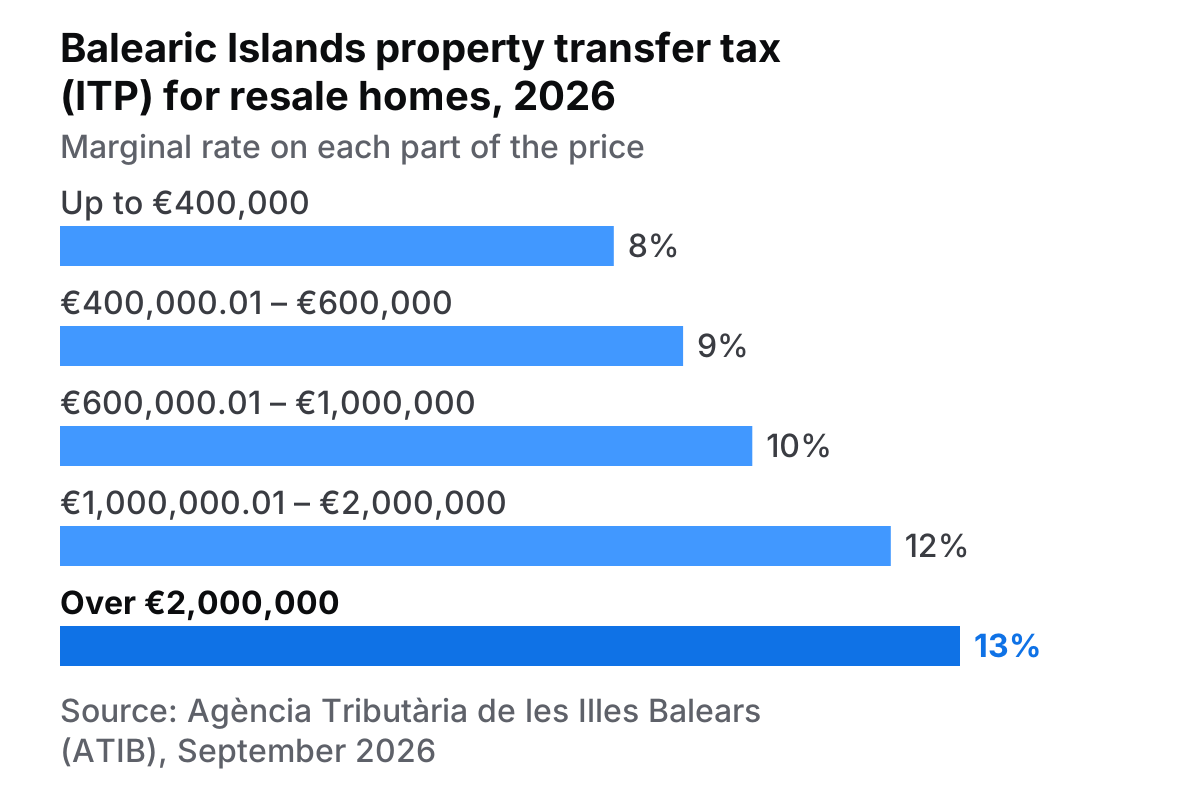
When purchasing resale property in Mallorca, buyers pay Property Transfer Tax (Impuesto sobre Transmisiones Patrimoniales or ITP). The Agència Tributària de les Illes Balears (ATIB) ITP tax brackets apply a progressive scale based on the purchase price:
- Up to €400,000: 8%
- €400,000.01 to €600,000: 9%
- €600,000.01 to €1,000,000: 10%
- €1,000,000.01 to €2,000,000: 12%
- Over €2,000,000: 13%
As of June 2026, buyers under 30 purchasing a primary residence valued at up to €331,859.70 benefit from a 100% tax exemption. For a comprehensive overview of legal procedures when finalizing a purchase, review our guide to the Spanish property contract and escritura deed.
For non-EU buyers, including UK citizens post-Brexit, Spain officially abolished the real estate Golden Visa on 3 April 2025 following the publication of Organic Law 1/2025 in the Boletín Oficial del Estado (BOE). Non-EU buyers relocating to Mallorca now utilize alternative residency pathways, such as the Non-Lucrative Visa or Digital Nomad Visa, while existing Golden Visa holders retain their renewal rights.
Whether evaluating country fincas or advisory opportunities for clients selling a property in Mallorca, real estate professionals rely on Property Sourcing to locate off-market opportunities and track real-time listings across Palma. To analyze live market data and explore comprehensive property analytics, sign in to the CASAFARI platform.
Frequently asked questions
Can you get a tourist rental licence (ETV) for a house or finca in Son Espanyol?
Obtaining a new tourist rental licence (ETV) in Son Espanyol is no longer possible for new applicants. On 3 February 2026, Palma City Council prohibited new tourist rental places across all urban land, including detached single-family houses. Furthermore, rustic land remains subject to the Consell de Mallorca moratorium and strict territorial planning restrictions. As a result, only properties sold with a pre-existing, active, and legally transferable ETV licence can operate as holiday rentals.
What is the minimum plot size to build a house on rustic land in Son Espanyol?
Under Palma’s General Urban Plan (PGOU) and the Mallorca Territorial Plan (PTI), building a new home on General Rustic Land (SRG) or Agrarian Interest Areas (AIA) requires a minimum plot size of 14,000 m² with a 3% maximum buildability footprint. In protected Landscape or Forestry Interest Areas (ARIP / SRG-F), the minimum plot requirement increases to 50,000 m² with a 2% buildability cap. Additionally, the maximum overall single-family building volume across all rustic land is capped at 1,500 m³.
How much is Property Transfer Tax (ITP) when buying a home in Mallorca in 2026?
Resale purchases in Mallorca are subject to progressive Property Transfer Tax (ITP) rates administered by the Agència Tributària de les Illes Balears (ATIB). The marginal rates for 2026 are 8% on the first €400,000, 9% between €400,000.01 and €600,000, 10% between €600,000.01 and €1,000,000, 12% between €1,000,000.01 and €2,000,000, and 13% on any amount exceeding €2,000,000. Young buyers under 30 purchasing a primary residence valued up to €331,859.70 receive a 100% tax exemption.
Can UK and non-EU buyers still get a Spanish Golden Visa by buying property in Mallorca?
No, UK and other non-EU buyers can no longer obtain a Spanish Golden Visa through real estate investment, as the programme was officially repealed on 3 April 2025 under Organic Law 1/2025. Non-EU property owners may stay in Mallorca for up to 90 days within any 180-day period without a visa. Those intending to reside in Mallorca year-round must apply for alternative residency options, such as the Non-Lucrative Visa or the Digital Nomad Visa.