
SANTA CATALINA PROPERTY GUIDE
Bohemian and tranquil hideaway in the heart of the city
Santa Catalina is a prime residential district in Palma de Mallorca’s Districte de Ponent, famed for its low-rise historic architecture, vibrant 1920 municipal market, and immediate proximity to the Old Town and harbour. Bound by strict ground-plus-two (PB+2) height limits that preserve its character and cap housing supply, asking prices averaged over €6,000/m² according to a 2025 Palma property market report by Vivara.
Why do international buyers target Santa Catalina in Palma de Mallorca?
Situated immediately west of the city centre, Santa Catalina forms part of Palma’s Districte de Ponent (Western District). As detailed in a community monograph published on ResearchGate in February 2016, the neighbourhood borders the seaside quarter of Es Jonquet to the south, Son Espanyolet and Son Dameto to the north, Es Camp d’en Serralta to the north-east, and the historic centre (Distrito Centro) to the east across Passeig Mallorca. Its position offers easy foot access to the harbour, the Paseo Marítimo, and the diplomatic residential area of Son Armadams.
Once an extramural working-class quarter populated by fishermen, mariners, ropemakers, and flour millers, Santa Catalina owes its spatial charm to its humble origins. Grounded in the historical account of the history of Santa Catalina and its 1920 municipal market by Mallorca Rutes (October 2026), 18th-century flour windmills still stand watch over the crest leading toward Es Jonquet. Today, these historic roots underpin Palma’s most sought-after residential micro-market, combining maritime heritage with a cosmopolitan village lifestyle that draws professionals and international investors looking into investing in Mallorca’s property market.
What types of property and heritage rules shape Santa Catalina’s streets?
The neighbourhood’s built environment is defined by low-rise traditional townhouses (casas de pescadores), pastel-painted plaster façades, wrought-iron balconies, and distinctive wooden louvred shutters (persianas mallorquinas). Ground-floor residences often conceal secluded internal patios or private gardens, while upper floors feature bright apartments and renovated top-floor penthouses.
Strict urban planning restrictions safeguard this urban fabric. Under Palma’s Special Protection Plan for Santa Catalina, approved by Palma City Council in October 2021 and reported by Última Hora, building heights on interior residential streets are capped at ground floor plus two storeys (PB+2). Ground plus three storeys (PB+3) is permitted only along major perimeter thoroughfares, such as Plaza del Progreso and Calle Caro. The planning code also mandates the restoration of traditional plaster textures and preserves rounded street corners (chaflanes).
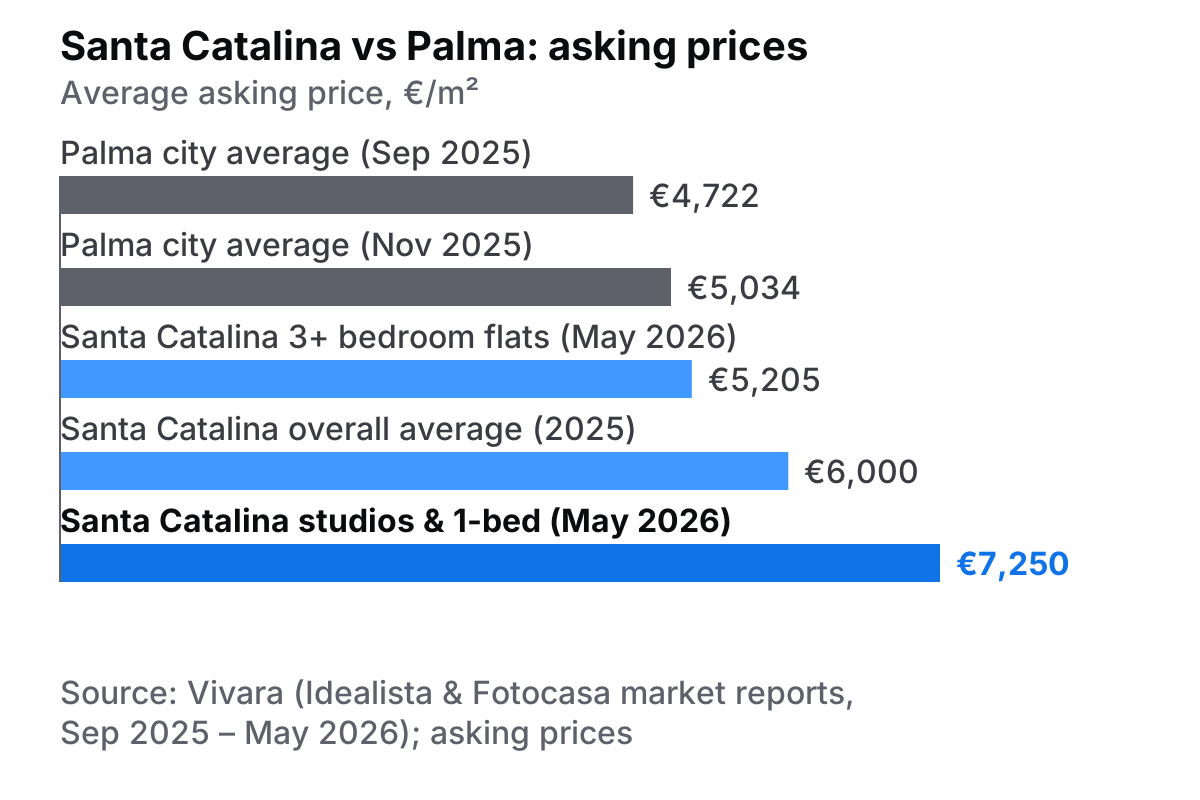
Because new construction cannot exceed these strict vertical contours, residential inventory remains perpetually scarce. Data from Vivara’s market analysis (December 2025) shows that while three-bedroom family apartments averaged €5,205/m² in May 2026, compact studios and one-bedroom units reached €7,250/m² due to intense competition for entry-level pied-à-terre units. Overall asking prices across Santa Catalina exceeded €6,000/m² in 2025, commanding a significant premium over Palma’s city-wide average of €5,034/m² recorded in November 2025. Valuation specialists and estate agents use a property valuation and market study tool to benchmark these hyper-local variations accurately.
Life around the Mercat de Santa Catalina and Carrer de la Fàbrica
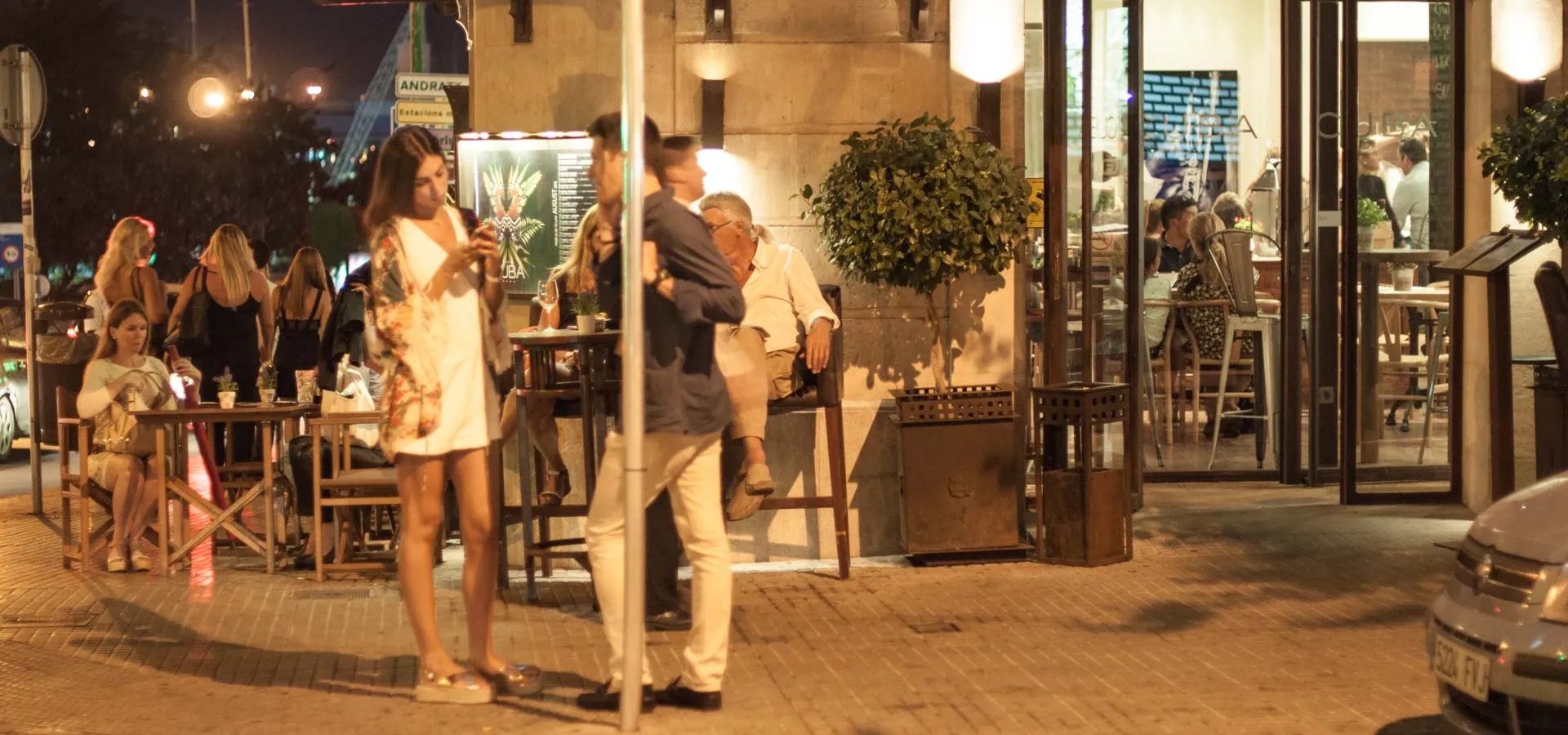
Daily life in the quarter revolves around the Mercat de Santa Catalina. Opened in 1920, it stands as Palma’s oldest municipal food market (Mallorca Rutes, October 2026). Inside, traditional fishmongers, butchers, and local produce stalls operate alongside tapas counters and sushi bars, serving as both a daily market and a central gathering spot for residents.
Extending from the market area is Carrer de la Fàbrica (Calle de la Fábrica in Spanish), a pedestrianised artery recognized by Tasting Palma in July 2026 for its concentration of international restaurants, cafes, and bakeries. To preserve residential quality of life, the October 2021 Special Protection Plan regulates commercial activity by capping restaurant density at a maximum of three hospitality establishments within any 50-metre radius or 100 linear metres of street front (Última Hora, October 2021).
For families and frequent travellers, logistics are straightforward. Palma de Mallorca Airport (PMI) is located approximately 10.8 km to the east—a 10-to-15-minute drive via the Ma-19 motorway, or a direct ride on the EMT A1 airport express bus, which stops on Passeig Mallorca right by the Puerta de Santa Catalina (Binter Canarias, December 2025). International schooling options nearby include Svenska Skolan Mallorca (~2 km away in Son Espanyolet) and the Collège Lycée Français de Palma (~2–3 km away), while Bellver International College and Queen’s College sit 3 to 5 km south-west in Marivent and Bonanova (Kyero, 2026).
What are the tax, tourist-let and residency rules for buying in Santa Catalina in 2026?
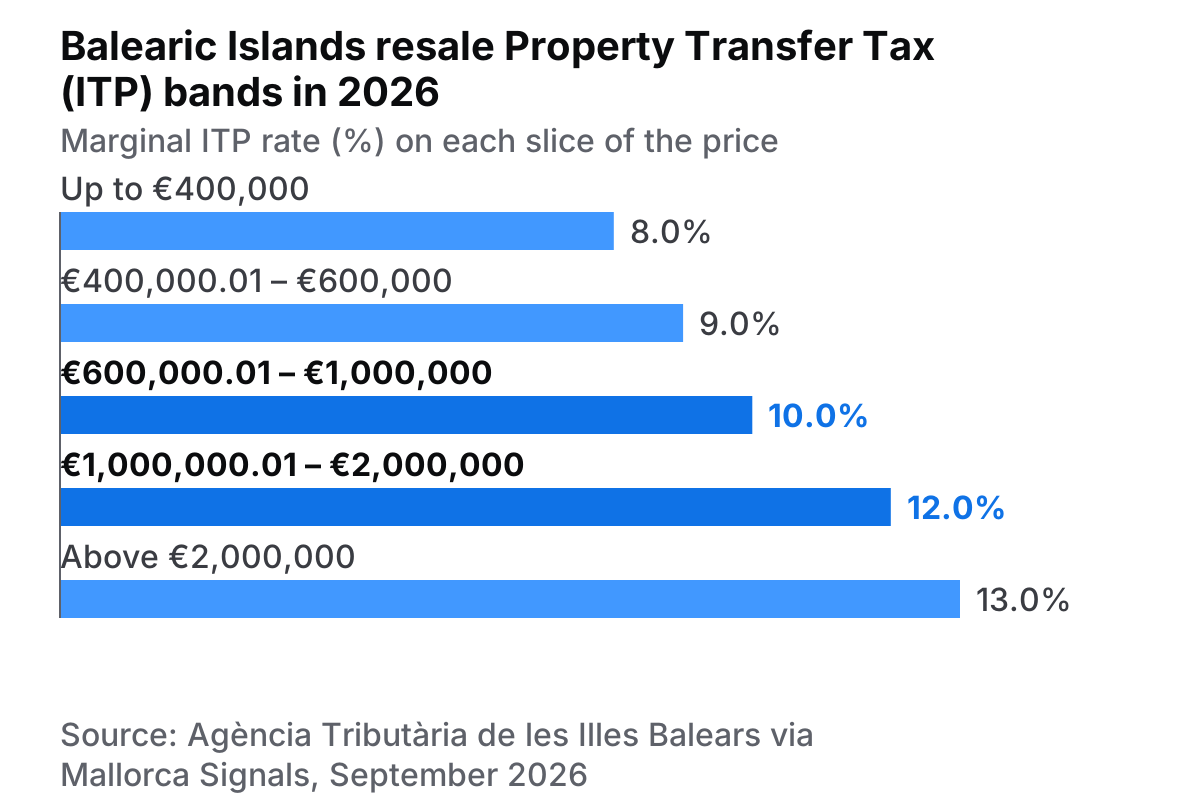
Acquiring real estate in Santa Catalina requires navigation of Balearic regional taxes and local municipal planning frameworks in 2026. Buyers purchasing resale homes pay the progressive Balearic Transfer Tax (ITP), as detailed in the summary of 2026 Balearic Islands property purchase tax bands published by Mallorca Signals in September 2026:
- Up to €400,000: 8.0%
- €400,000.01 to €600,000: 9.0%
- €600,000.01 to €1,000,000: 10.0%
- €1,000,000.01 to €2,000,000: 12.0%
- Portion above €2,000,000: 13.0%
For newly constructed properties purchased directly from a developer, buyers pay 10% VAT (IVA) plus 1.5% Stamp Duty (AJD), which increases to 2.0% AJD for property values reaching or exceeding €1,000,000.
Investors evaluating short-term rental strategies must account for municipal regulatory restrictions. Multi-family apartment holiday lets have been prohibited across Palma since 2018. Following Balearic Decree-Law 4/2025 in April 2025, Palma’s Urban Planning department modified the city’s master plan (PGOU) in February 2026 to declare the entire municipality a single zone closed to new tourist rental licences (ETV), as confirmed in analysis on Palma’s municipal ban on tourist rental licences by Chekin in April 2026. Only properties with pre-existing, legally registered licences retain short-let status. Consequently, buy-to-let investment in Santa Catalina focuses primarily on long-term or formal seasonal residential contracts, where average rents reached €19.6/m² per month in 2025 (Vivara, December 2025).
From a residency perspective, Spain’s real estate Golden Visa programme was officially repealed on 3 April 2025 under Organic Law 1/2025 of 2 January, as confirmed by the Ministry of Housing announcement ending the Golden Visa in April 2025. Non-EU buyers purchasing home equity in Mallorca now utilize standard residence visas, such as the Non-Lucrative Visa or Digital Nomad Visa.
When conducting due diligence on property transactions, buyers and legal advisers should carefully review Spanish property contracts and the escritura. Real estate professionals seeking comprehensive market analytics and neighbourhood-level data can utilize CASAFARI Area Insights or consult the Area Insights API documentation.
To review verified market listings, historical comparables, and regional price metrics for Santa Catalina, sign in to the CASAFARI platform.
Frequently asked questions
Can you get a holiday rental licence (ETV) for an apartment in Santa Catalina?
No. Palma de Mallorca banned tourist rental licences (ETV) in multi-family apartment buildings in 2018, and in February 2026 the city’s Urban Planning department modified the PGOU to declare the entire municipality off-limits for new tourist licences of any kind (following Balearic Decree-Law 4/2025, Chekin, April 2026). Only properties with a valid, pre-existing licence may legally operate as short-term holiday lets.
What are the property purchase taxes in Mallorca in 2026?
For resale properties in the Balearic Islands in 2026, buyers pay a progressive Transfer Tax (ITP) across five bands: 8% on the first €400,000, 9% between €400,000.01 and €600,000, 10% between €600,000.01 and €1,000,000, 12% between €1,000,000.01 and €2,000,000, and 13% on any amount above €2,000,000 (Mallorca Signals, September 2026). New-build purchases from a developer attract 10% VAT (IVA) plus 1.5% Stamp Duty (AJD), which rises to 2% AJD when the property value reaches or exceeds €1,000,000.
Is Spain’s Golden Visa still available when buying property in Santa Catalina?
No. Spain officially abolished the Golden Visa for real estate investment on 3 April 2025, when Organic Law 1/2025 of 2 January took effect and repealed articles 63 to 67 of Law 14/2013 (Ministerio de Vivienda y Agenda Urbana, April 2025). Non-EU citizens purchasing property in Mallorca now rely on standard non-lucrative, digital nomad, or work visas rather than property-linked residency.
Which international schools and airport links serve Santa Catalina?
Santa Catalina lies 10.8 km from Palma de Mallorca Airport (PMI)—around 10 to 15 minutes by car along the Ma-19 motorway, or a direct ride on the EMT A1 airport bus from Passeig Mallorca by the Puerta de Santa Catalina (Binter Canarias, December 2025). Families have quick access to Svenska Skolan Mallorca (about 2 km away) and the Collège Lycée Français de Palma (2 to 3 km away in the Son Espanyolet and El Terreno area), with Bellver International College and Queen’s College 3 to 5 km to the south-west (Kyero, 2026).