
PORTIXOL PROPERTY GUIDE
Charming and friendly harbour in a privileged area
Portixol (Es Portitxol) and neighbouring El Molinar represent one of Palma de Mallorca’s most exclusive coastal enclaves. In September 2026, average residential asking prices reached 7,769 €/m² after an all-time peak of 8,567 €/m² in June 2026, while average long-term rents stood at 21.9 €/m²/month. Strict municipal height limits preserve its traditional low-rise charm, creating a high-demand, low-supply prime micro-market.
Why is Portixol one of Palma de Mallorca’s most sought-after coastal neighbourhoods?
The name Es Portitxol carries deep historical roots along the Bay of Palma. Contrary to a popular myth among real estate listings suggesting it translates to “port and sun”, the Diccionari de l’Enciclopèdia Catalana confirms that Es Portitxol is a Mozarabic and Catalan diminutive of “port”, meaning “little harbour” or small sheltered cove for boats.
Once a modest working-class quarter of fishermen and mariners alongside El Molinar, the area underwent a thoughtful urban restoration starting in the late 1990s. Today, it stands as one of the Balearic Islands’ most desirable residential districts, combining village tranquility with immediate proximity to central Palma.
Connectivity is a primary draw for international buyers and relocating families. Portixol lies roughly a 10-to-15-minute drive from both Palma’s historic centre and Palma de Mallorca Airport. According to EMT Palma, public transport is anchored by bus Line 35, stopping directly at Es Portitxol (stop 462) and Es Molinar (stops 463 and 446) on its route between the Aquarium and Plaça de la Reina. Additional service from lines 18, 27, and 28 provides seamless transit across the capital, with easy interchange to the Airport Line A1 at Porta des Camp or Alexandre Rosselló.
What is the lifestyle like along the Portixol harbour, beaches and promenade?
Life in Portixol revolves around its picturesque harbour and pedestrianised seafront. At the heart of the district sits the historic Club Nàutic Portitxol, founded in 1928 by local residents and fishermen. The club manages 263 moorings for vessels up to 8 metres in length and a 2.5-metre draught, hosting sailing, canoeing, and fishing academies that keep nautical traditions active year-round.
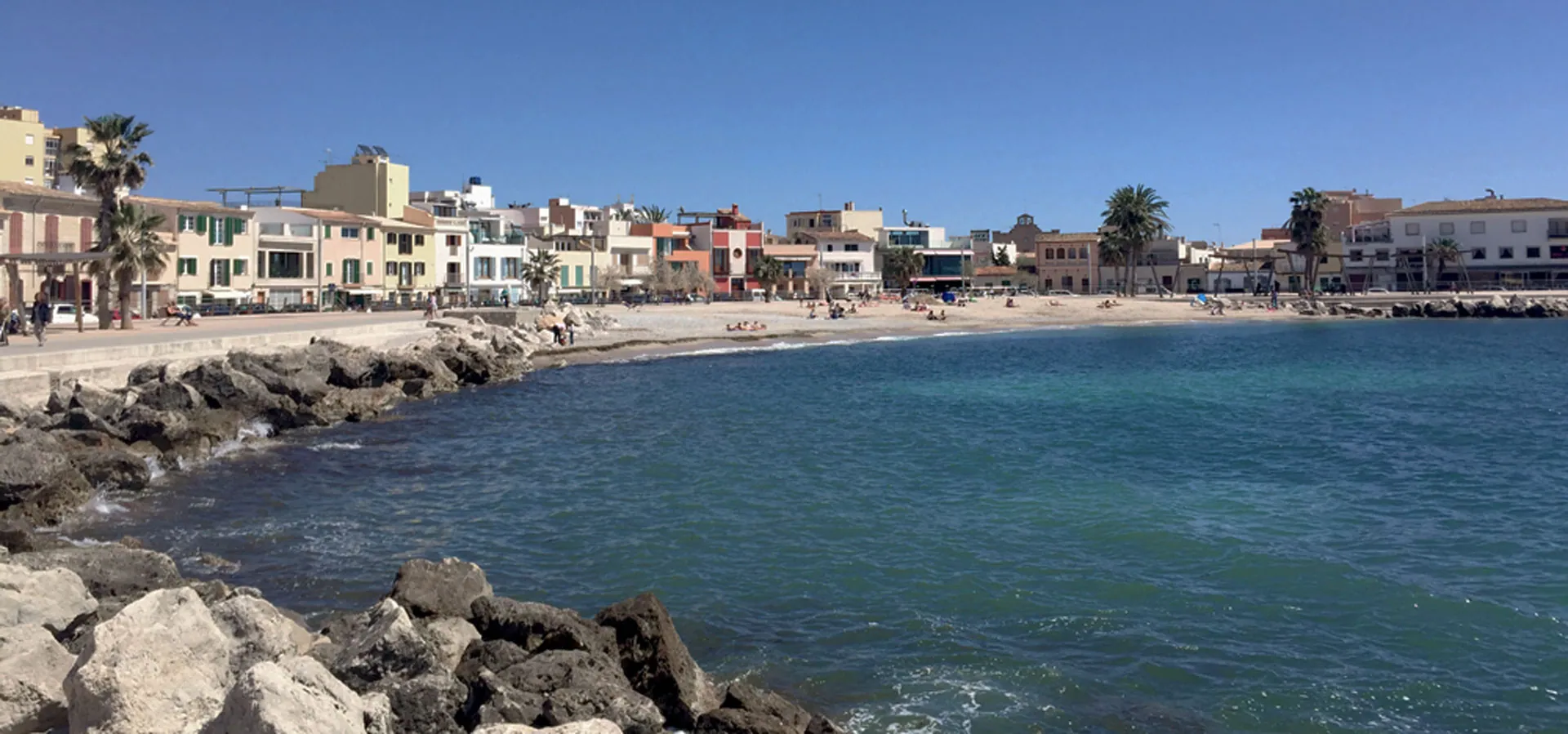
Beyond the harbour basin, the coastline opens into a series of distinct beaches and coves. To the west towards the cathedral lies the wide sandy stretch of Can Pere Antoni, home to high-end beach clubs like Nassau Beach Club. Moving east past Es Portitxol’s pebble inlet, the coast extends through El Molinar towards Cala Gamba, Ciudad Jardín, and Playa de Palma.
A dedicated car-free promenade stretches continuously along the bay. Uninterrupted by road traffic, it attracts cyclists, runners, and strolls between seaside cafés and seafood restaurants. This open-air lifestyle creates a vibrant, health-conscious community atmosphere unique within Palma.
What types of property and price levels define the Portixol-Molinar market?
The Portixol-Molinar real estate sector is defined by high capital value and strict structural constraints. Market data from Idealista price report for Portixol-Molinar (September 2026) shows average residential asking valuations at 7,769 €/m², following an all-time peak of 8,567 €/m² set in June 2026. On the rental side, the Idealista Balearic rental report (September 2026) recorded average asking rents of 21.9 €/m²/month, closely tracking the record high of 22.2 €/m²/month achieved in July 2026.
Urban planning rules play a key role in maintaining property values. As highlighted by Crónica Balear, Palma’s General Urban Plan (PGOU) and Detailed Planning Scheme (POD) designate El Molinar as a protected traditional core. The seafront enforces a general height limit of ground floor plus one storey (PB+1) and is explicitly excluded from upward building extensions allowed elsewhere in Palma.
This low-rise mandate shapes the district’s housing options:
- Traditional casitas: Fully renovated two-storey former fishermen’s homes on the front line, featuring private courtyards and roof terraces.
- Low-rise apartments: Modern two- to three-storey residential developments located one or two blocks back from the water, offering open-plan layouts and underground parking.
- Luxury penthouses: Top-floor units with panoramic views across the Bay of Palma and private rooftop solariums.
How do tourist rental rules, purchase taxes and market data shape a purchase in Portixol?
For property investors and second-home buyers, navigating local regulations is essential. Palma banned short-term tourist lets in multi-family apartment buildings in 2018. As reported by Infobae España, Palma City Council amended the municipal urban plan (PGOU) in February and May 2026 to declare the entire municipality an unsuitable zone for tourist accommodation in residential dwellings (ETV/ETH). This measure completely prohibits new tourist rental licences across all residential properties—including single-family houses—and prevents the renewal of non-permanent licences.
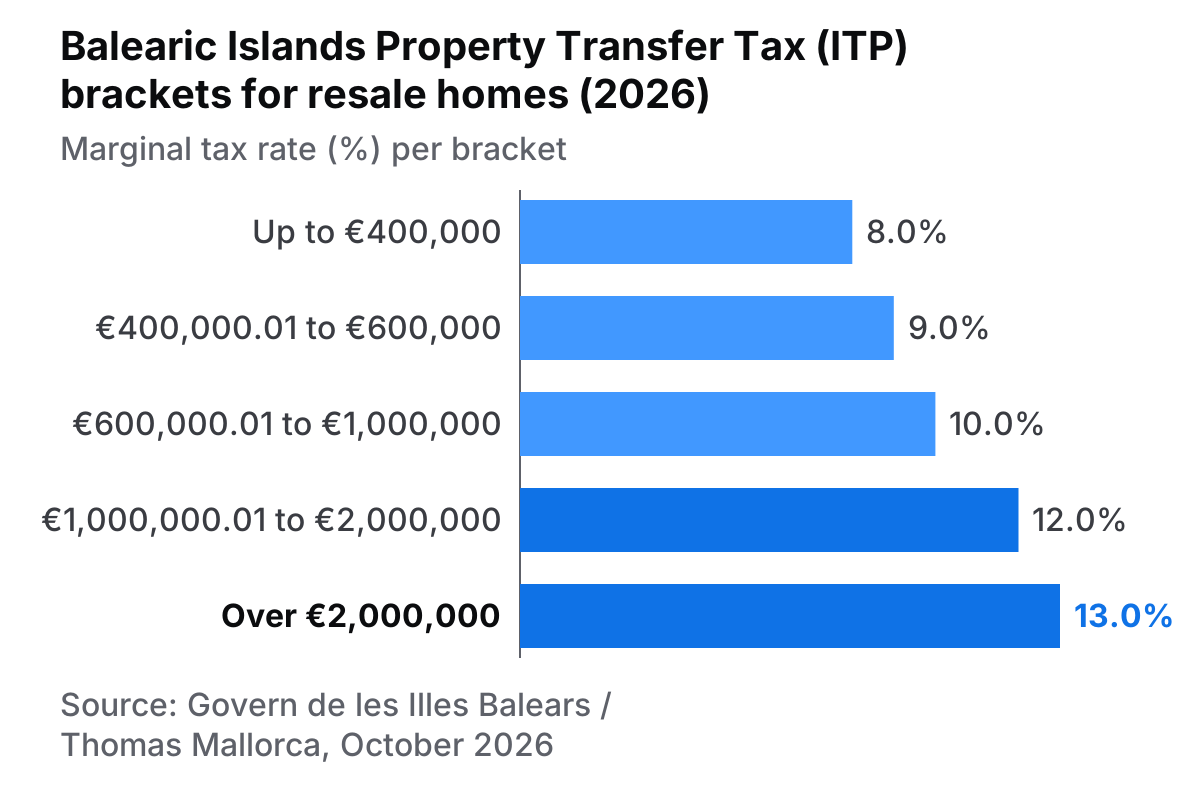
Taxation must also be factored into purchase budgets. According to Thomas Mallorca, buyers purchasing resale homes in the Balearic Islands pay progressive Property Transfer Tax (ITP):
- Up to €400,000: 8.0%
- €400,000.01 to €600,000: 9.0%
- €600,000.01 to €1,000,000: 10.0%
- €1,000,000.01 to €2,000,000: 12.0%
- Over €2,000,000: 13.0%
For new-build properties, buyers pay 10% VAT (IVA) plus Stamp Duty (AJD) at 1.5%, which increases to 2.0% for properties valued at €1,000,000 or more. For comprehensive legal step-by-step guidance, review our guide to buying property in Spain and our analysis on owning a rental property in Mallorca and Ibiza.
Given the tight supply and premium pricing in Portixol, estate agents and professional investors rely on granular market intelligence. Using CASAFARI Area Insights, property valuation and market study tools, and off-market Property Sourcing, professionals track historic valuation trends, sales speeds, and true transaction comps across Palma.
Whether evaluating a seafront casita or an investment apartment along the bay, accessing real-time market data ensures informed decision-making. You can sign in to the CASAFARI platform to explore verified sales comps, street-level price analytics, and live property sourcing across Mallorca.
Frequently asked questions
Can you get a tourist rental licence for a property in Portixol?
No. Tourist rentals in multi-family apartment buildings have been prohibited in Palma since 2018, and in February and May 2026 Palma City Council amended the municipal urban plan (PGOU) to declare all of Palma an unsuitable zone for tourist stays in residential properties (ETV/ETH). This prohibits new short-term rental licences across all property types, including single-family fishermen’s houses, and bars the renewal of non-permanent licences (Infobae España, February 2026).
What are the property purchase taxes (ITP and AJD) when buying in Portixol, Mallorca?
As of October 2026, resale properties in the Balearic Islands are subject to progressive Property Transfer Tax (ITP): 8% on the tranche up to €400,000, 9% from €400,000.01 to €600,000, 10% from €600,000.01 to €1,000,000, 12% from €1,000,000.01 to €2,000,000, and 13% on any amount above €2,000,000. New-build properties attract 10% VAT (IVA) plus Stamp Duty (AJD) at 1.5%, which increases to 2% when the property value is €1,000,000 or higher (Thomas Mallorca, October 2026).
Why are buildings in Portixol and El Molinar mostly low-rise?
Under Palma’s General Urban Plan (PGOU) and Detailed Planning Scheme (POD), El Molinar is classified as a traditional historic core and is excluded from the vertical building extensions permitted elsewhere in the city. New construction and redevelopments along the seafront must respect a maximum height of ground floor plus one storey (PB+1), preserving the scale of the original fishermen’s cottages (Crónica Balear, March 2025).
How well connected is Portixol to central Palma and Mallorca Airport?
Portixol lies roughly 10 to 15 minutes by car from both Palma’s historic centre and Palma de Mallorca Airport, and is connected to both by the seafront cycle path and public buses. EMT Palma Line 35 links stops 462 (Es Portitxol) and 463/446 (Es Molinar) directly to Plaça de la Reina and the Cathedral, while passengers can transfer to the A1 Airport bus at Porta des Camp or Alexandre Rosselló (EMT Palma, 2026).