
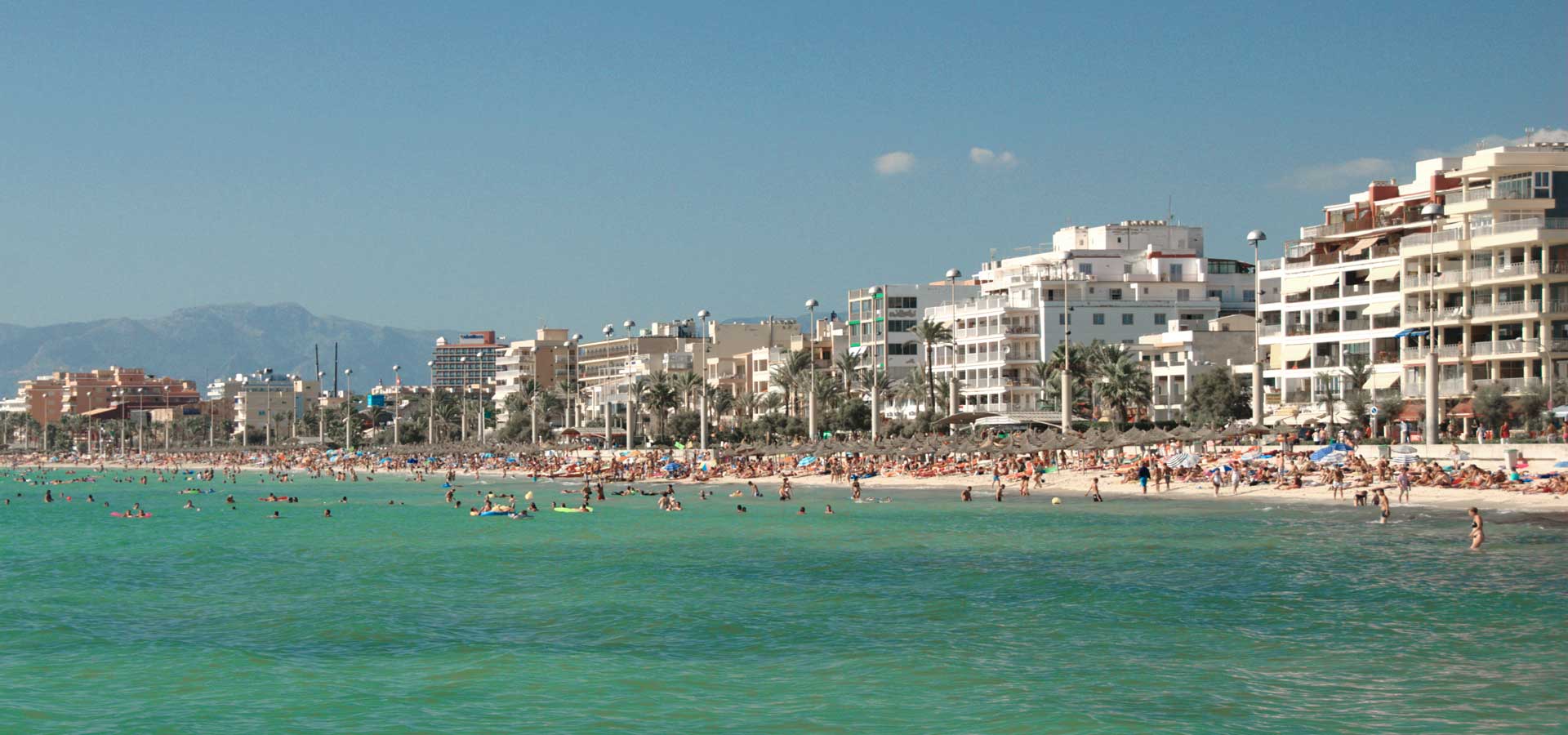
Playa de Palma stretches across a 4.6-kilometre sandy bay east of Palma from Can Pastilla to S’Arenal, home to 13,031 residents in Platja de Palma proper and over 40,215 across the wider statistical district (INE Padrón, 2025). According to the Idealista Balearic Islands price report (September–October 2026), asking prices averaged €4,710/m². Located just 5 to 12 kilometres from Palma de Mallorca Airport (a 10 to 20-minute drive), the area combines immediate airport access with year-round coastal living.
Where is Playa de Palma and how is the coastline structured?
Positioned along the south coast of Mallorca, Playa de Palma encompasses a 4,600-metre catalogued beach with an average width of 50 metres. A continuous coastal promenade of roughly 6 kilometres runs from west to east, connecting distinct residential neighbourhoods: Can Pastilla at the western tip, Les Meravelles and Sometimes in the central section, and S’Arenal at the eastern end.
The beach promenade is historically divided into 15 numbered beach stations known as Balnearios. Balneario 15 anchors the western waterfront in Can Pastilla, while Balneario 1 sits at the eastern end in S’Arenal.
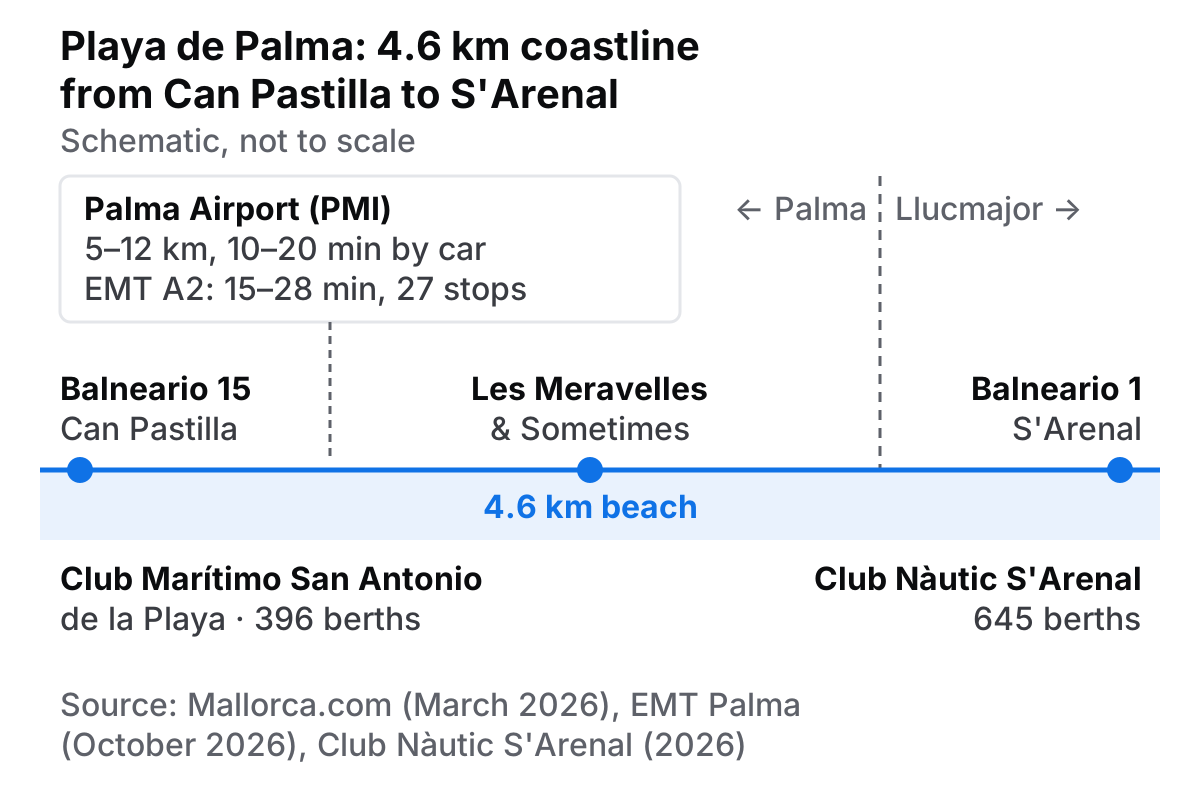
Administrative governance across this coastline is split. While Can Pastilla, Les Meravelles, Sometimes and western S’Arenal belong to the municipality of Palma, eastern S’Arenal crosses into the municipality of Llucmajor. This municipal divide dictates local tax administrative bodies, urban planning regulations and school catchment boundaries. Inland, the district connects to the rural villages of Es Pil·larí, Sant Jordi and Sa Casa Blanca, forming the broader Platja de Palma i Pla de Sant Jordi district.
Transport connectivity remains one of Playa de Palma’s main operational advantages. Palma de Mallorca Airport (PMI) lies between 5 and 12 kilometres from the resort strip depending on the section, taking between 10 and 20 minutes by car. Public transit is provided by the EMT Palma Line A2 airport route, which serves 27 designated stops along the coastal boulevard with a transit time of 15 to 28 minutes.
What drives demand for Playa de Palma property among international buyers?
Once regarded primarily as a seasonal holiday destination, Playa de Palma has transitioned into a sought-after coastal suburb for international second-home owners, commuting professionals and relocators. According to the Idealista price report (September–October 2026), average asking prices for residential property stand at €4,710/m², having reached a peak of €4,806/m² in January 2026. Active seller listings reflect an average asking figure of €5,106/m² across houses and flats.
The long-term rental market demonstrates stable underlying demand from airport personnel and local professionals. Asking rents averaged €21.62/m²/month for apartments and €23.38/m²/month across all property types in September–October 2026. According to official municipal population records published by the INE (Padrón Municipal, January 2025 data), the district supports a permanent resident population of over 40,215 people, including 13,031 in Platja de Palma, 5,679 in Can Pastilla, and 11,166 in adjacent Es Coll d’en Rabassa.
Real estate professionals and private investors evaluating individual micro-markets rely on CASAFARI Area Insights to analyze price distributions across beachfront apartment complexes compared to quiet residential streets in Sometimes or detached chalets in Les Meravelles. When benchmarking valuation parameters or preparing acquisition offers, agents utilise our automated property valuation and market study tool to track historic asking dynamics against surrounding Palma districts. For broader context on regional fundamentals, read our insight on investing in Mallorca’s property market.
Which marinas, golf courses and schools serve Playa de Palma?
Nautical facilities frame both ends of the bay. At the western boundary in Can Pastilla, Club Marítimo San Antonio de la Playa (CMSAP) offers 396 berths, an active sailing school and a full-service boatyard. At the eastern end in S’Arenal, Club Nàutic S’Arenal (CNA) provides 645 berths accommodating vessels between 6 and 20 metres, equipped with a 20 to 70-tonne travelift and hosting international regattas such as the Trofeo Princesa Sofía. Detailed harbour services and berth specifications can be reviewed directly on the Club Nàutic S’Arenal marina facilities portal.
A dedicated coastal cycle path runs alongside the promenade, linking Playa de Palma westward through Can Pastilla and Portixol to Palma’s Paseo Marítimo, enabling car-free commuting into the city centre.
For golfers, the nearby municipality of Llucmajor hosts Golf Son Antem. Designed by Francisco López-Segalés on a former Mallorcan estate, the complex features two 18-hole championship courses: Son Antem East (opened in 1994) and Son Antem West (opened in 2001). Course features and bookings can be explored via the Golf Son Antem East and West courses website.
Families residing year-round in the area fall under Palma School Zone D (Conselleria d’Educació, 2025–2026 school year). Educational establishments across the coastal strip include:
- State primary schools: CEIP Can Pastilla (Can Pastilla) and CEIP Els Tamarells (S’Arenal).
- State-subsidised (concertado) schools: CC La Porciúncula (Les Meravelles) and CCEI Sant Francesc d’Assís (S’Arenal).
- Nearby district primary schools: CEIP Es Pil·larí and CEIP Sa Casa Blanca.
Specific zoning rules and administrative school boundaries are outlined in the Conselleria d’Educació official school catchment zones.
What are the property taxes and holiday rental rules in Playa de Palma in 2026?
Navigating regulatory rules and taxation is vital when acquiring residential real estate in Palma.
Regarding short-term holiday rentals, tourist lets in multi-family apartment buildings have been prohibited across the entire municipality of Palma since July 2018. In February 2026, Palma City Council updated its general urban plan (PGOU), declaring the municipality fully saturated and eliminating all remaining options for new Estancias Turísticas en Viviendas (ETV) licences, including for single-family detached homes. Details on the municipal decision are reported in coverage of Palma’s February 2026 ban on new tourist rental licences.
As a result, only 76 residential properties in Playa de Palma and Can Pastilla possess pre-existing, grandfathered ETV licences (out of 632 licensed residential properties across Palma). New acquisitions cannot obtain fresh tourist rental permits.
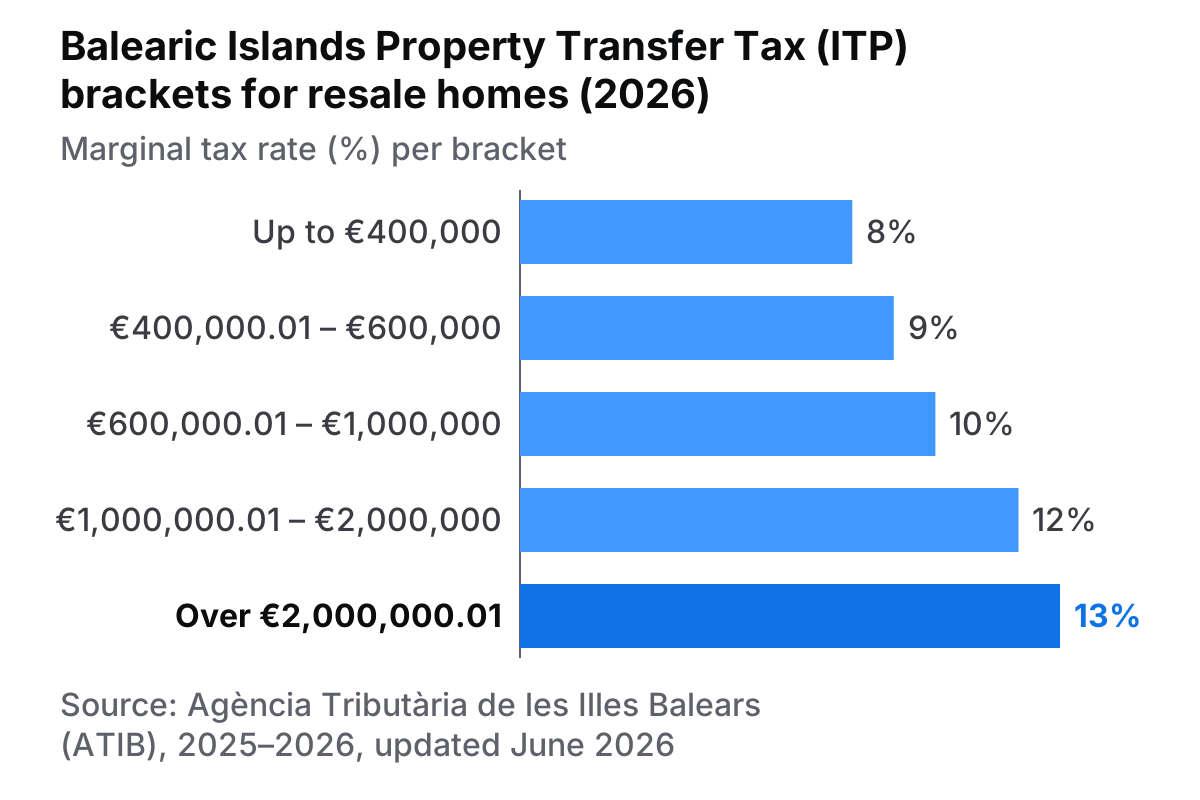
When purchasing resale property in Mallorca, buyers pay the Balearic Property Transfer Tax (Impuesto sobre Transmisiones Patrimoniales - ITP). Tax rates follow a progressive scale based on the purchase price, administered by the Agència Tributària de les Illes Balears (ATIB) ITP rates:
- Up to €400,000: 8%
- €400,000.01 to €600,000: 9%
- €600,000.01 to €1,000,000: 10%
- €1,000,000.01 to €2,000,000: 12%
- Over €2,000,000.01: 13%
Eligible first-time buyers under 30 purchasing a primary residence valued up to €331,859.70 (as updated in June 2026) can access a 100% tax exemption, alongside reduced rates (2%–4%) for specific family and disability categories. Buyers seeking full legal and tax details on acquiring Balearic real estate can consult our complete guide to buying property in Spain.
To identify compliant residential properties, evaluate long-term rental performance or verify existing regulatory parameters, real estate professionals and institutional buyers use CASAFARI Property Sourcing to search clean, deduplicated listings. Explore comprehensive real estate market data by choosing to sign in to CASAFARI.
Frequently asked questions
Can I get a holiday rental licence (ETV) for a property in Playa de Palma?
No new tourist rental licences can be obtained in the Palma municipality section of Playa de Palma. Palma banned holiday lets in apartment buildings in July 2018, and in February 2026 the City Council modified the PGOU to ban new Estancias Turísticas en Viviendas (ETV) across all property types, including detached houses. Only the 76 properties in Playa de Palma and Can Pastilla that already held a valid ETV licence before the February 2026 freeze may legally let to tourists.
How long does it take to get from Playa de Palma to Palma de Mallorca Airport?
Playa de Palma sits 5 to 12 kilometres from Palma de Mallorca Airport (PMI), depending on whether you travel from Can Pastilla in the west or S’Arenal in the east. By car, the journey takes between 10 and 20 minutes. By public transport, the EMT urban bus line A2 (Aeroport–S’Arenal) stops 27 times along the Playa de Palma corridor and takes 15 to 28 minutes.
What is the Property Transfer Tax (ITP) when buying a resale home in Playa de Palma?
According to the Agència Tributària de les Illes Balears (ATIB) for 2025–2026, resale residential purchases are taxed on a progressive scale: 8% on the first €400,000; 9% between €400,000.01 and €600,000; 10% between €600,000.01 and €1,000,000; 12% between €1,000,000.01 and €2,000,000; and 13% on any amount above €2,000,000.01. Reduced rates of 2% to 4% and a 100% exemption apply for eligible primary-residence buyers under 30 on homes valued up to €331,859.70 (threshold updated in June 2026).
Which marinas and schools are located in Playa de Palma?
The bay is served by two marinas: Club Marítimo San Antonio de la Playa in Can Pastilla (396 berths) at the western end, and Club Nàutic S’Arenal (645 berths for boats of 6 to 20 metres) at the eastern end. For families, Palma’s School Zone D includes state primary schools CEIP Can Pastilla and CEIP Els Tamarells, as well as state-subsidised schools CC La Porciúncula in Les Meravelles and CCEI Sant Francesc d’Assís in S’Arenal.