
PALMA OLD TOWN PROPERTY GUIDE
Charming historical heart of Palma
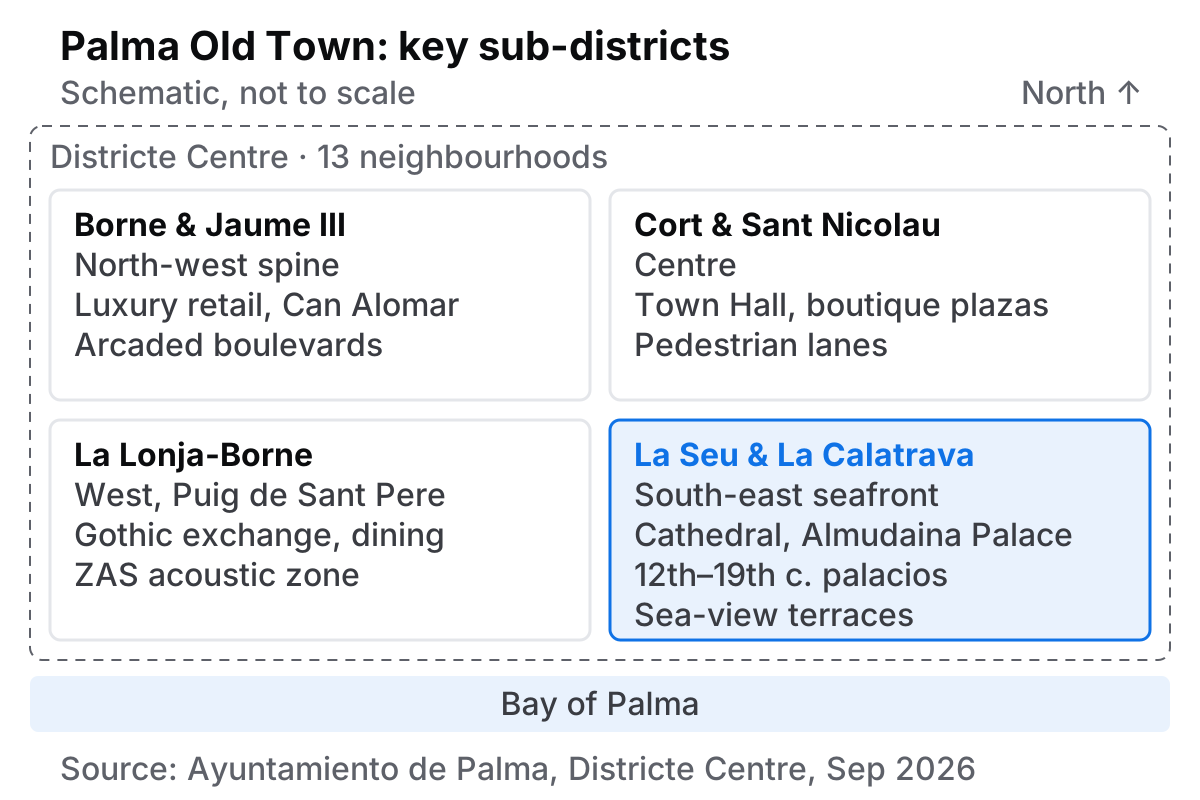
Palma Old Town (Casco Antiguo, officially the Districte Centre encompassing 13 historic neighbourhoods including La Calatrava, Cort, La Lonja-Borne and Sant Nicolau) is Mallorca’s premier urban residential market, prized for gothic courtyards, roof terraces overlooking La Seu, and high walkability. Buyers in 2026 must factor in Balearic ITP transfer tax rates reaching 13% above €2,000,000 and Palma City Council’s February 2026 municipal ban on all new tourist rental licences.
Why Buy Property in Palma’s Casco Antiguo?
Palma’s central district comprises 13 distinct administrative neighbourhoods (barrios), ranging from the quiet residential lanes of Monti-sion and Puig de Sant Pere to the bustling commercial avenues of El Mercat and Sant Nicolau. What unites these micro-districts is a architectural heritage spanning Roman, Moorish, Gothic, and Modernist eras. Residential properties range from medieval townhouses and grand bourgeois palacios featuring stone-arched interior courtyards (patios mallorquines) to sympathetic conversions offering penthouses with private roof terraces.
For international buyers and investors, navigating the micro-markets of the Old Town requires clear visibility over listing inventory and historic pricing trends. Because properties in neighbouring streets can command vastly different valuations based on lift access, interior courtyard rights, and cathedral or sea views, professionals rely on CASAFARI Area Insights and the property valuation and market study tool to benchmark listing data across all 13 neighbourhoods. Buying agents searching for unlisted or multi-agency restoration opportunities across the centre also use CASAFARI Property Sourcing to trace property histories across portals.
La Seu and La Calatrava: Historic Palaces and Sea Views
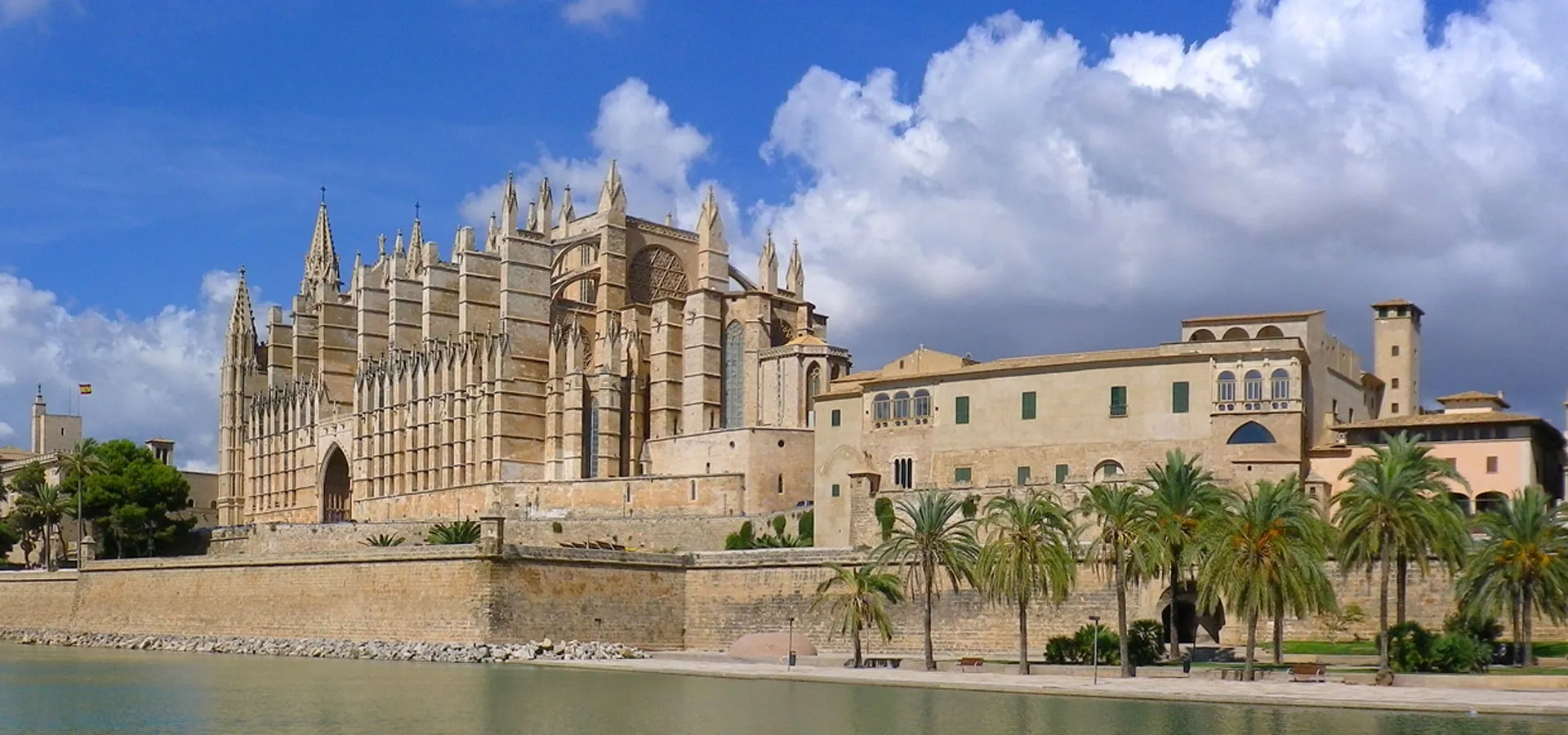
Framing the southern seafront wall of the Old Town are the historic quarters of La Seu and La Calatrava. Dominating the skyline is Palma Cathedral (La Seu), commissioned by King James I (Jaume I). Its central nave stands between 43.3 and 44 metres high, making it the second tallest Gothic cathedral nave in Europe after Beauvais Cathedral in France. Adjacent to the cathedral stands the Royal Palace of La Almudaina, which was rebuilt between 1305 and 1314 by order of King James II (Jaume II) over the former Muslim alcázar. Managed today by Patrimonio Nacional, it serves as an official ceremonial residence for the Spanish Royal Family.
The winding residential streets surrounding the Bishop’s Garden (Jardí del Bisbe) and the 10th-century Arab Baths (Banys Àrabs) contain some of Palma’s finest noble residences. Restored palacios in La Calatrava often preserve original stone arcades, timber-beamed ceilings, and private garages, while top-floor apartments offer panoramic views over the cathedral’s flying buttresses and the Bay of Palma.
La Lonja, Paseo del Borne and Avinguda Jaume III: Dining and Luxury Retail
To the west of the cathedral lies the vibrant quarter of La Lonja (La Llotja-Born), centered on the 15th-century Mediterranean-Gothic former merchants’ exchange (Sa Llotja). The neighbourhood is famous for its pedestrianised alleyways and dining options, including the iconic 16th-century courtyard venue Bar Ábaco, which renewed its 20-year lease in late 2019 and continues to operate from spring to late autumn.
La Lonja has undergone significant urban refinement in recent years. Famed nightlife venues of the past have given way to upscale residential and hospitality uses; for example, the historic Jazz Voyeur Club at Calle Apuntadors 5 permanently closed in November 2019 when the building was converted into a boutique hotel. To preserve residential quality of life, the municipality has designated La Lonja-Born an Acoustic Saturation Zone (ZAS), placing strict limits on restaurant terrace hours and outdoor sound levels.
Running north from the seafront, Paseo del Borne acts as Palma’s luxury retail spine. Flagship stores include Louis Vuitton in the historic Can Alomar building at No. 19, Relojería Alemana’s Rolex boutique at No. 19 alongside its second store at No. 6, and Carolina Herrera. This tree-lined boulevard connects directly to the arcaded shopping corridor of Avinguda Jaume III, forming the prime retail core of the Old Town.
Taxes, Tourist Let Rules and Practicalities for Buyers in 2026
Acquiring a residence in Palma Old Town requires careful navigation of the Balearic tax framework and local municipal land-use laws. Anyone planning a purchase should consult a guide to the Spanish property purchase contract and escritura and review the regional tax brackets.
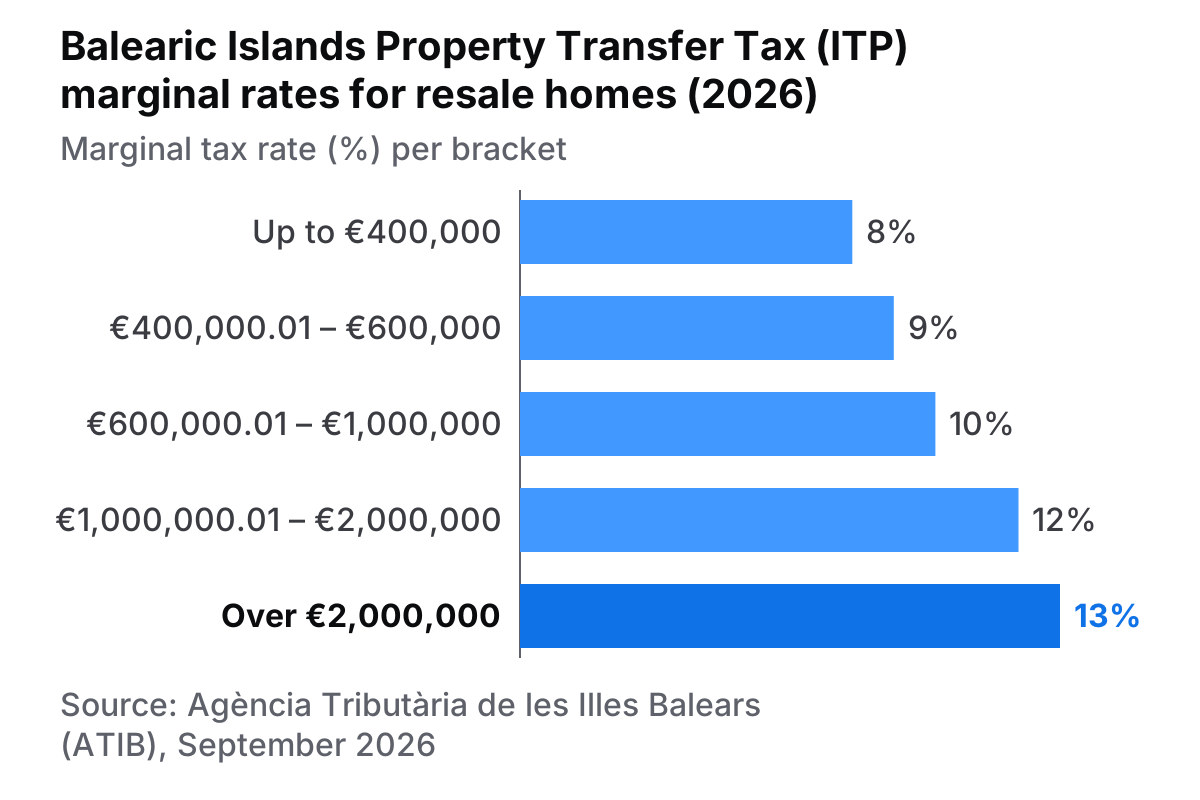
For resale properties, the Property Transfer Tax (Impuesto sobre Transmisiones Patrimoniales or ITP) managed by the Agència Tributària de les Illes Balears (ATIB) is calculated on a progressive scale based on the property value:
| Property Purchase Price Bracket | Balearic ITP Marginal Rate |
|---|---|
| Up to €400,000 | 8% |
| €400,000.01 to €600,000 | 9% |
| €600,000.01 to €1,000,000 | 10% |
| €1,000,000.01 to €2,000,000 | 12% |
| Over €2,000,000 | 13% |
Investors looking for short-term holiday rental returns must take note of local regulations. Palma City Council banned short-term tourist lets in multi-family apartment buildings in 2018. Following a Balearic-wide moratorium in April 2025, Palma modified its General Urban Plan (PGOU) in February 2026, declaring the entire municipality closed to new tourist rental licences of any modality. Investors generating rental income in the Casco Antiguo must focus on long-term primary residential leases (arrendamiento de vivienda) or non-tourist seasonal contracts under Spain’s Urban Leases Act (LAU).
Regarding residency options, Spain abolished its Golden Visa program (residency via €500,000+ real estate purchase) on 3 April 2025 under Organic Law 1/2025, published in the Boletín Oficial del Estado (BOE). Non-EU buyers now utilise standard Schengen rules, non-lucrative residency, or digital nomad visas.
Finally, inner-city vehicle access is tightly managed. Palma’s Low Emission Zone (ZBE) has been enforced since January 2025, with €200 fines levied since July 2025 on unbadged vehicles entering the central ring road; details are available via MobiPalma. Property owners inside the Old Town must obtain resident ACIRE permits to drive and park within restricted residential streets.
Whether you are acquiring a historic penthouse or advising clients on selling a property in Mallorca, real-time market data is essential. You can sign in to CASAFARI to analyze comparable sales, active listings, and neighborhood price trends across Palma de Mallorca.
Frequently asked questions
Can you get a tourist rental licence for an apartment in Palma Old Town?
No, short-term tourist rentals in multi-family apartment buildings have been prohibited in Palma since 2018. In February 2026, Palma City Council modified its General Urban Plan (PGOU) to declare the entire municipality closed to any new tourist rental licences of any modality. Property owners in the Old Town seeking rental yields must use long-term residential contracts or qualifying seasonal leases under Spain’s Urban Leases Act (LAU).
What is the property transfer tax (ITP) in Mallorca for resale homes?
Property Transfer Tax (ITP) in the Balearic Islands is levied on a progressive marginal scale managed by the ATIB. Resale purchases are taxed at 8% on the first €400,000; 9% between €400,000.01 and €600,000; 10% between €600,000.01 and €1,000,000; 12% between €1,000,000.01 and €2,000,000; and 13% on any portion exceeding €2,000,000. Reduced rates apply only to qualifying primary residences for young buyers and protected groups.
Is the Spanish Golden Visa still available for Palma property buyers?
No, Spain officially eliminated the investor residency visa program on 3 April 2025 under Organic Law 1/2025 of 2 January. Non-EU nationals purchasing property in Palma can no longer claim residency by investing €500,000 or more in real estate. Buyers from non-EU countries now rely on non-lucrative residency visas, digital nomad visas, or standard Schengen 90/180-day allowances.
Can residents drive and park inside Palma’s Casco Antiguo?
Yes, but vehicle movement inside the Old Town is governed by resident-only ACIRE zones and Palma’s Low Emission Zone (ZBE). Registered residents and property owners must apply for an ACIRE access card to drive into their designated neighbourhood streets. Additionally, all non-exempt motor vehicles entering the ZBE perimeter must display a valid DGT environmental badge to avoid €200 fines.