
EL TERRENO PROPERTY GUIDE
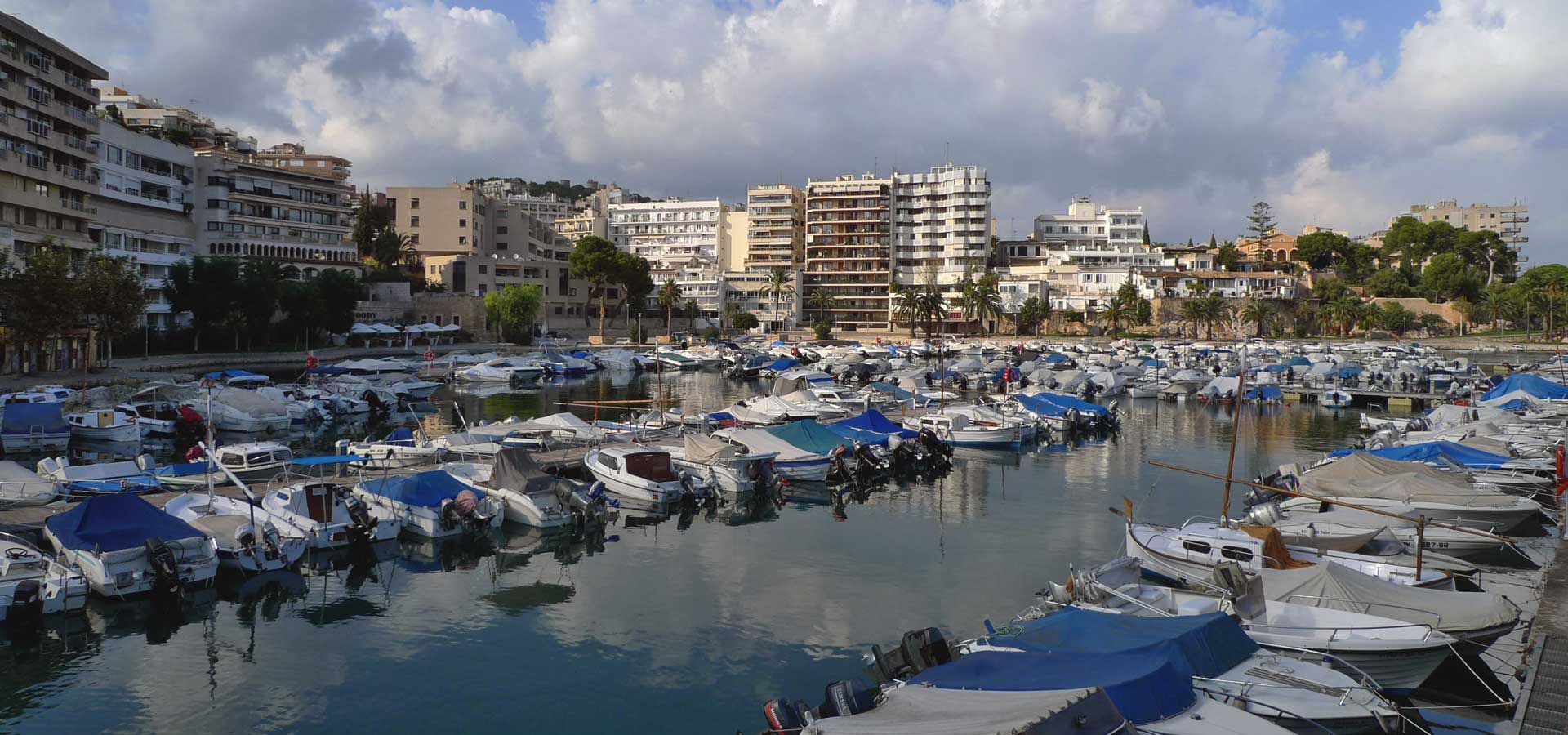
Surrounded by nature and sea views over the bay of Palma
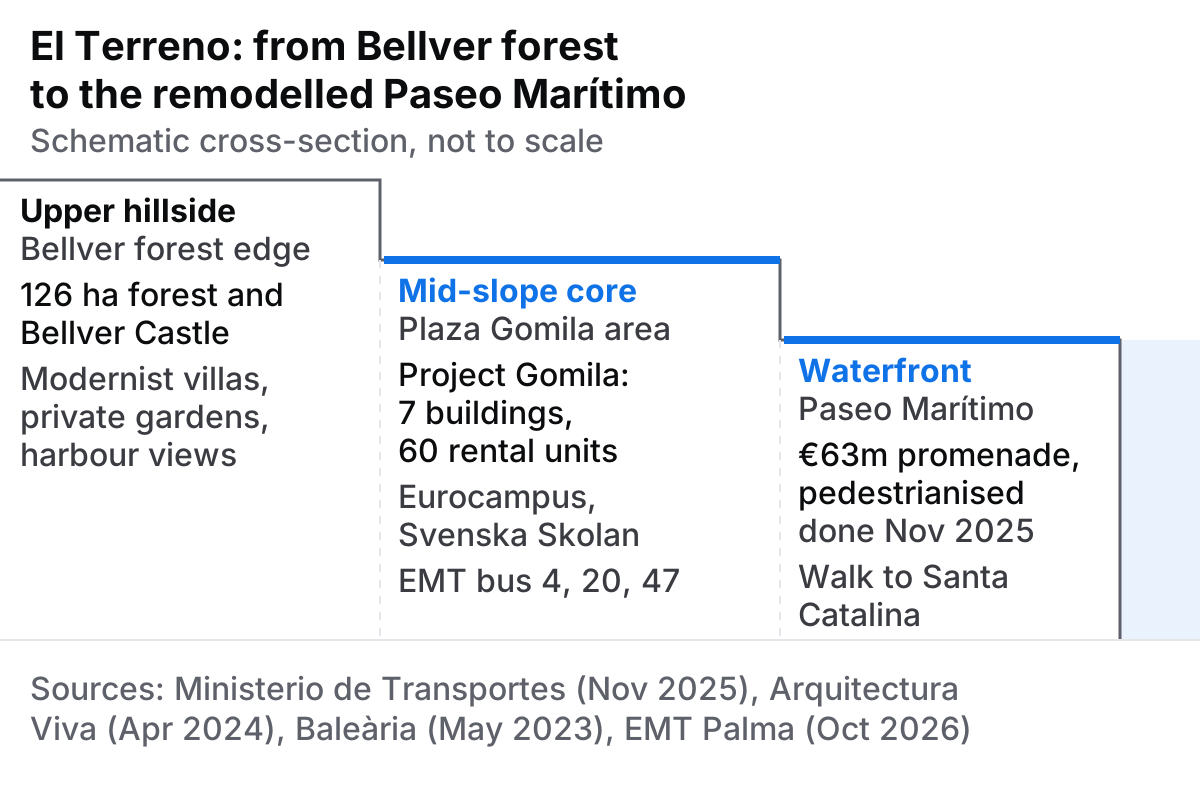
El Terreno is Palma de Mallorca’s historic hillside district, set between the 126-hectare Bellver Castle forest and the bay of Palma. Buying property here offers a blend of architectural heritage and urban renewal, anchored by the seven-building Project Gomila redevelopment completed in April 2024 and the €63 million pedestrian transformation of the Paseo Marítimo finished in November 2025.
Why are buyers and investors returning to El Terreno?
El Terreno occupies a distinctive geographic position on Palma’s western amphitheatre, sloping from the municipal woodland down to the Mediterranean harbour. Once the bohemian haunt of writers and artists in the mid-20th century, the neighbourhood is undergoing a significant revival driven by major public and private infrastructure investments.
Two primary architectural projects have reshaped the district’s economic landscape. At the heart of the neighbourhood, Project Gomila—promoted by the Fluxà family and designed by MVRDV alongside GRAS Reynés Arquitectos—rehabilitated four historic buildings and constructed three contemporary structures around Plaza Gomila. Completed in April 2024, as documented by Arquitectura Viva, the development delivered 60 rental residences and revived street-level commercial spaces.
At the neighbourhood’s lower boundary, the Ministry of Transport, Mobility and Urban Agenda finalized a comprehensive €63 million remodelling of Palma’s Paseo Marítimo in November 2025. The project expanded pedestrian promenades, planted hundreds of trees, and reconnected El Terreno directly to the marina waterfront.
What types of property can you find on the El Terreno hillside?
The topography of El Terreno creates distinct micro-markets that vary considerably by elevation, street layout, and building typology. Understanding these architectural zones is essential for evaluating property values and rental potential.
On the upper slopes, bordering the 126-hectare Bellver Castle forest, the housing stock consists predominantly of early-20th-century modernist villas, traditional Balearic summer mansions, and detached homes with private gardens and elevated views across the Bay of Palma. Further down toward Avinguda de Joan Miró and Plaza Gomila, the streetscape transitions to refurbished low-rise apartment blocks, townhouse conversions, and modern residential infill.
Navigating El Terreno requires close attention to micro-location factors. Upper-slope streets feature steep gradients, narrow lanes, and limited off-street parking. Plot orientation, structural access, and sea-view corridors create sharp pricing distinctions between adjacent streets.
Professional buyer’s agents and institutional investors use CASAFARI Area Insights to evaluate hyper-local price variations and historical listing trends across specific streets. When valuing complex hillside properties or detached villas, real estate professionals rely on an accurate property valuation and market study to benchmark comparable sales data, while agents sourcing off-market or multi-agency listings streamline acquisition using CASAFARI Property Sourcing.
How do schools, transport and daily life work in El Terreno?
El Terreno is one of Palma’s most established residential hubs for international families, largely due to its concentration of multilingual educational institutions within walking distance.
According to abcMallorca, the district hosts the Eurocampus—which houses both the Deutsche Schule (German School) and the Lycée Français (French School)—as well as the Svenska Skolan (Swedish School). Immediately adjacent in neighbouring Cala Major, Bellver International College offers a British curriculum, making the hillside particularly convenient for relocating global professionals.
Daily life in El Terreno combines outdoor recreation with urban connectivity. Residents have direct pedestrian access to trail networks throughout Bellver Castle park, while the upgraded harbour promenade provides a scenic walk into the dining and cultural district of Santa Catalina. Golf enthusiasts can reach the Son Vida, Son Muntaner, and Son Quint courses inland within a short drive.
Public transportation connects El Terreno smoothly to central Palma and the airport. Per schedules from EMT Palma, bus routes 4, 20, and 47 run frequently along Avinguda de Joan Miró and Plaza Gomila, offering rapid transfers to the A1 airport express line at Passeig Mallorca and Plaça d’Espanya.
What taxes, rental rules and residency laws apply when buying in El Terreno?
Acquiring real estate in Mallorca requires navigating specific Balearic tax rates, tourist licensing restrictions, and national immigration rules. Buyers should structure acquisitions with a clear understanding of regional regulations.
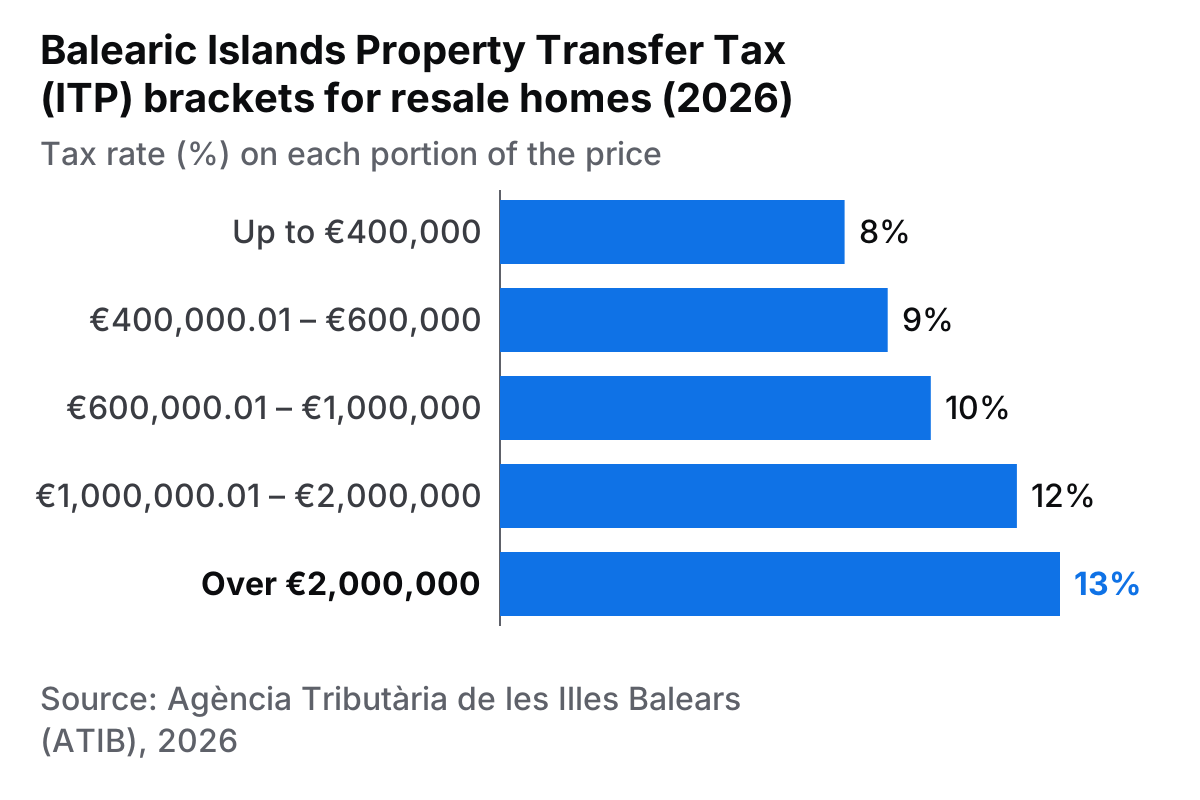
When purchasing a resale residential property in the Balearic Islands, buyers pay Property Transfer Tax (Impuesto sobre Transmisiones Patrimoniales - ITP) calculated on a progressive scale managed by the Agència Tributària de les Illes Balears (ATIB). Rates begin at 8% for the first €400,000 of property value and rise incrementally to 13% for the portion exceeding €2,000,000. Understanding legal documentation from private contracts to public deeds is detailed in our guide to the Spanish property purchase contract and escritura.
For high-net-worth investors, wealth tax considerations are equally relevant. Under Law 12/2023, the Balearic Islands set the tax-free individual threshold for Wealth Tax (Impuesto sobre el Patrimonio) at €3,000,000 per taxpayer, as confirmed by ATIB guidelines.
Investors evaluating short-term holiday rental yields must account for strict Balearic legislation. Under Law 8/2012 and Decree-Law 4/2025, detailed on Mallorca.es, new tourist rental licences (ETV) are strictly prohibited in multi-family apartment buildings across the island. New ETV licences for single-family detached houses depend on the Consell de Mallorca’s 1:1 temporary allocation pool. Consequently, apartment buyers in El Terreno focus on long-term residential or seasonal tenancies; prospective landlords can review strategic considerations in our guide to owning a rental property in Mallorca and Ibiza.
Finally, non-EU buyers should note that Spain officially abolished its real estate investor visa (the Golden Visa) on 3 April 2025 under Organic Law 1/2025, announced by La Moncloa. Non-EU citizens purchasing property in Palma must now utilize alternative residency frameworks, such as the Non-Lucrative Visa or the International Telework (Digital Nomad) Visa.
Whether analyzing market trends or sourcing acquisition targets across Palma de Mallorca, property professionals can sign in to the CASAFARI platform or explore technical integrations via the Area Insights API documentation (in English).
Frequently asked questions
Can you get a holiday rental licence (ETV) for an apartment in El Terreno?
No. Under Balearic Law 8/2012 and Decree-Law 4/2025, new tourist rental licences (ETV) are strictly prohibited in multi-family apartment buildings throughout Mallorca. Only single-family detached houses or primary residences operating under specific temporary rules are eligible through the Consell de Mallorca’s replacement pool. Consequently, apartment investors in El Terreno focus exclusively on long-term or seasonal residential leases.
What are the property purchase taxes in Mallorca in 2026?
When purchasing resale property in Mallorca, buyers pay progressive Property Transfer Tax (ITP) administered by the ATIB. The rate starts at 8% on values up to €400,000, rising to 9% up to €600,000, 10% up to €1,000,000, 12% up to €2,000,000, and 13% on any portion above €2,000,000. In addition, the Balearic Wealth Tax exemption threshold stands at €3,000,000 per individual taxpayer.
Is the Spanish Golden Visa still available for non-EU property buyers in Palma?
No. The Spanish government permanently ended the investor residency visa (Golden Visa) for property investments under Organic Law 1/2025, which came into effect on 3 April 2025. Non-EU buyers purchasing a home in Palma who plan to reside in Spain for more than 90 days per 180-day period must apply through alternative pathways, such as the Non-Lucrative Residency Visa or the Digital Nomad Visa.
Which international schools are in or near El Terreno?
El Terreno is a central hub for international education in Palma. The neighbourhood accommodates the Eurocampus (comprising the German School and French School) and the Svenska Skolan (Swedish School). In addition, Bellver International College is situated immediately adjacent to the neighbourhood in Cala Major.