
CIUDAD JARDIN PROPERTY GUIDE
Quiet and charming beach neighbourhood close to Palma
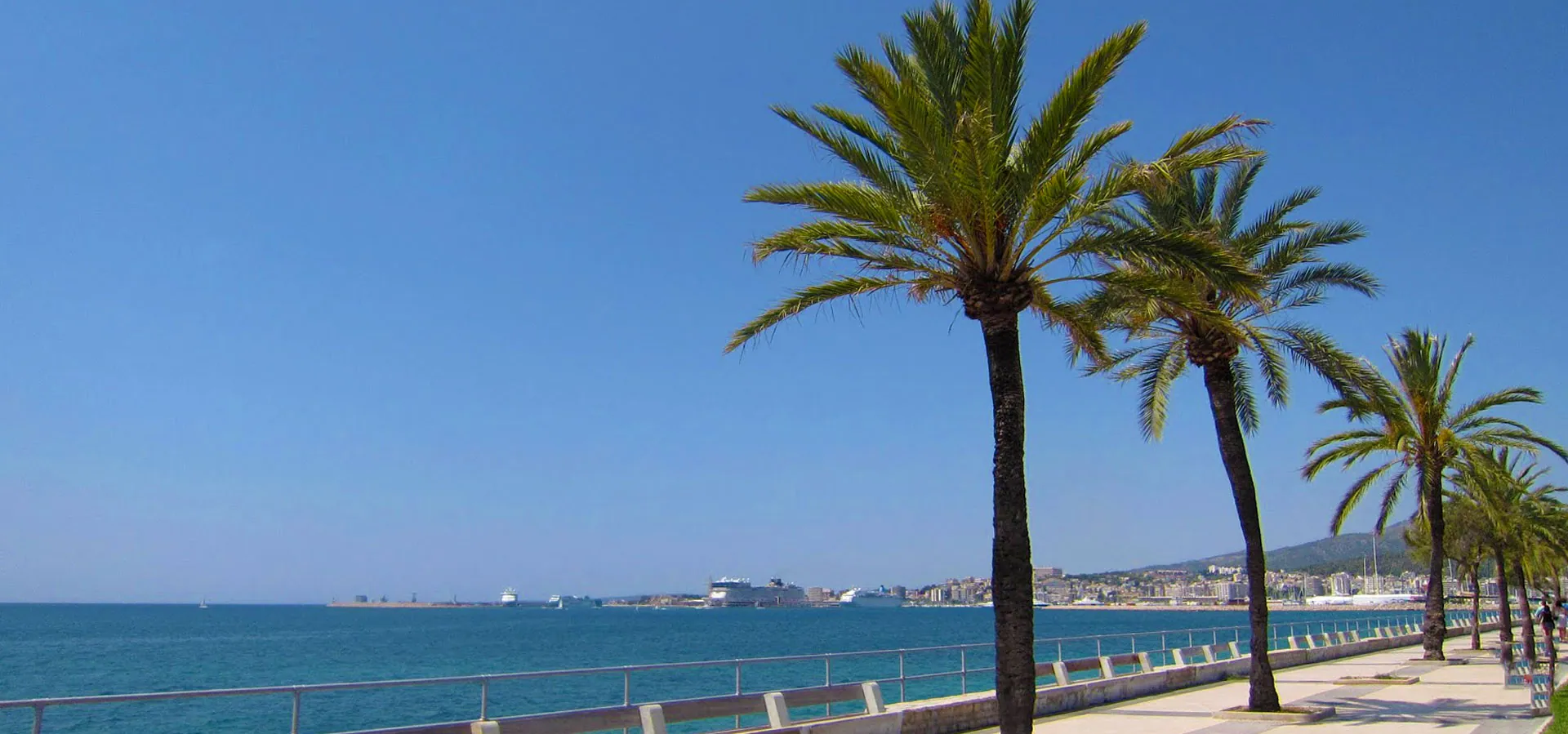
Ciudad Jardín (Catalan: Ciutat Jardí) is a low-rise coastal residential enclave in the Es Coll d’en Rabassa ward of Palma de Mallorca (11,166 residents, INE 2025), situated four to six kilometres east of the historic city centre and five minutes from Palma Airport. Renowned for its Blue Flag sandy beach, seafront promenade, and 1920s garden-city origins, it offers beachfront apartments and detached homes alongside year-round local amenities.
Why buy property in Ciudad Jardín, Palma de Mallorca?
Unlike historic urban centres or holiday resorts shaped purely by mid-century tourism, Ciudad Jardín developed as an intentional garden-city suburb. The neighbourhood was anchored by the modernist Hotel Ciutat Jardí, inaugurated in August 1921 by the development firm Progreso Urbano and declared a National Tourist Interest Monument in 1986. Today, this heritage translates into a distinct architectural layout characterised by low-rise residential blocks, art-deco details, and detached single-family villas set back from quiet streets.
Administratively part of the Es Coll d’en Rabassa ward within Palma’s Platja de Palma district (13,031 residents, INE 2025), Ciudad Jardín provides a tranquil coastal alternative to central Palma and busier resort hubs. The neighbourhood maintains a permanent, year-round population rather than fluctuating seasonally.
For estate agents, valuation specialists, and investors evaluating coastal inventory, market transparency across hyper-local enclaves is essential. Using CASAFARI Property Sourcing, property professionals can track available listings across fragmented portals, while CASAFARI Area Insights offers real-time analytical data on market trends and listing activity across Palma’s eastern coastline.
What is the lifestyle like along the Ciudad Jardín promenade, parks and marinas?
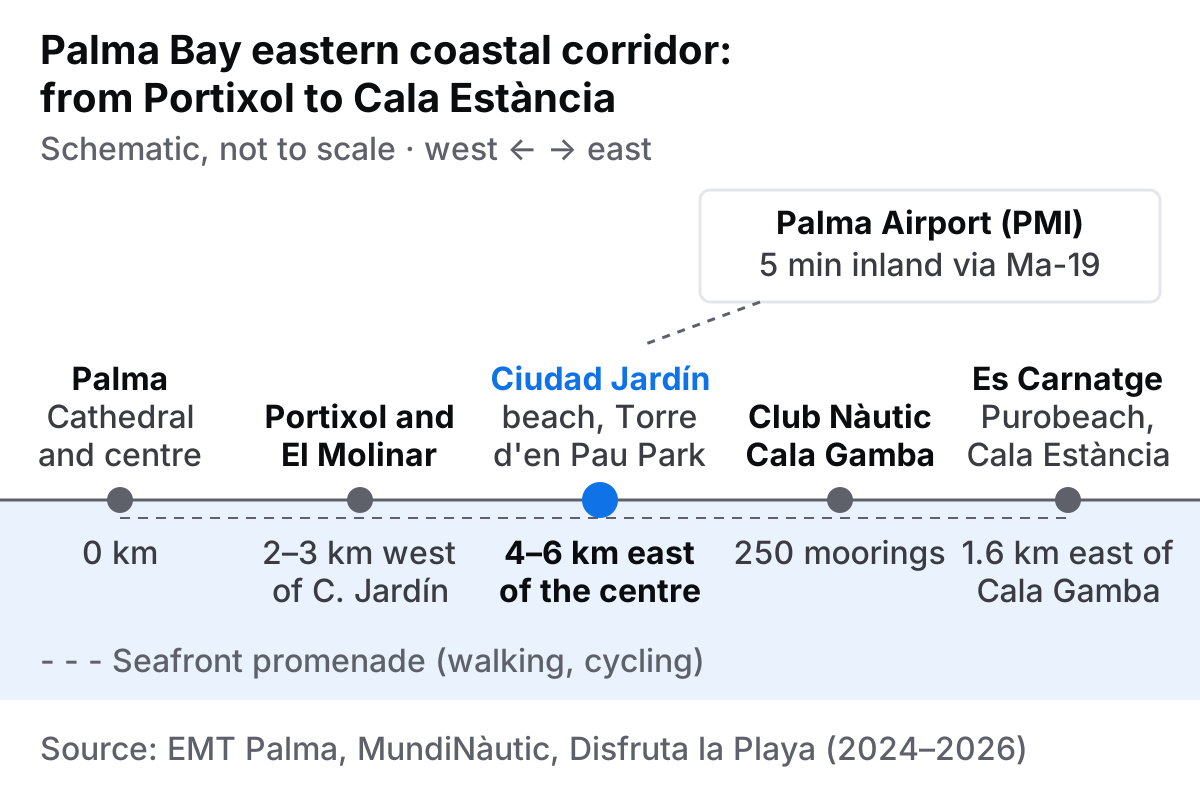
Life in Ciudad Jardín revolves around its broad, sheltered sandy beach, which was awarded the Blue Flag for environmental quality by ADEAC for 2025 and the 2026–2027 period (as documented in the ADEAC 2026 Blue Flag beaches report). A wide, traffic-free seafront promenade runs directly alongside the shoreline, featuring dedicated pedestrian and cycling routes. To the west, the promenade connects seamlessly through El Molinar and Portixol toward Palma Cathedral; to the east, it leads through the Es Carnatge coastal nature reserve toward Can Pastilla.
Directly behind the beach lies the Parque de la Torre d’en Pau, a municipal park providing mature trees and green space. The park surrounds the historical fort of Torre d’en Pau, constructed in 1666 as a coastal defence tower and later converted into a 19th-century military battery, now preserved under a Bien de Interés Cultural declaration for Torre d’en Pau in the BOE.
Maritime enthusiasts benefit from immediate access to Club Nàutic Cala Gamba, situated on the eastern shoreline of the neighbourhood and providing approximately 250 moorings. Further along the coastline lie Club Marítim Molinar de Llevant (2 km west) and Club Nàutic Portitxol (3 km west). Shoreline dining in Ciudad Jardín focuses on long-standing seafood restaurants along the promenade, while lifestyle beach venues such as Purobeach Palma operate nearby on the rocky promontory of Caló de Son Caios, approximately 1.6 km east of Cala Gamba.
How well connected is Ciudad Jardín to Palma centre and the airport?
Situated between 4 and 6 kilometres east of Palma’s historic old town, Ciudad Jardín offers exceptional convenience for commuters and frequent international travellers. Palma de Mallorca Airport (PMI) is located approximately five minutes away by car via the Ma-19 motorway, making the area popular for second-home owners seeking lock-up-and-leave properties.
Public transit links managed by the EMT Palma public transport network are robust and frequent. Urban bus Line 35 connects the beachfront directly to central landmarks including Plaça de la Reina and Palma Cathedral. Supplemental routes include Line 18 (Son Riera to Sindicat) and Line 28 (Circular Son Llàtzer, providing direct transit to the regional hospital and FAN Mallorca shopping complex), alongside express airport services A1, A2, and 34.
What taxes, residency rules and rental regulations apply in Ciudad Jardín?
Investors evaluating property in Ciudad Jardín must navigate strict Balearic regulatory frameworks. Regarding short-term holiday lettings, Palma prohibited holiday rentals in multi-family apartment buildings in 2018. According to Palma ETV holiday rental regulations, the city’s urban planning commission declared all urban land unsuitable for new holiday rental licences (ETV) in February 2026. Unlicensed tourist letting incurs severe penalties, with fines reaching up to €500,000 under Balearic Decree-Law 4/2025. Consequently, investors focus on long-term residential leasing or capital growth; prospective landlords can review our analysis on owning a rental property in Mallorca.
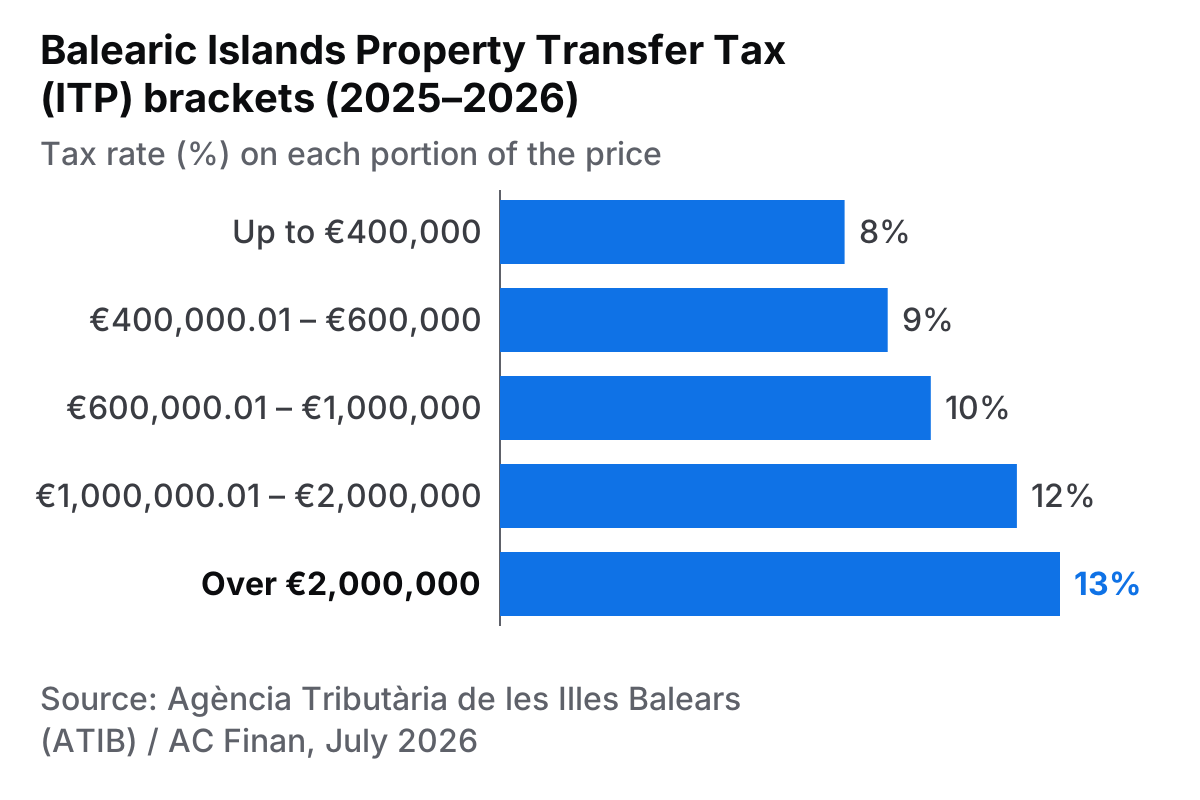
When purchasing resale residential property, buyers pay the progressive Transfer Tax (Impuesto sobre Transmisiones Patrimoniales or ITP) collected by the Agència Tributària de les Illes Balears (ATIB). As outlined in details on Balearic Islands progressive ITP tax brackets, the scale applies as follows:
- Up to €400,000: 8%
- €400,000.01 to €600,000: 9%
- €600,000.01 to €1,000,000: 10%
- €1,000,000.01 to €2,000,000: 12%
- Over €2,000,000: 13%
For non-EU purchasers, residency requirements changed substantially in 2025. As published in Organic Law 1/2025 in the Official State Gazette (BOE), Spain repealed articles 63 to 67 of Law 14/2013, effectively abolishing the real estate Golden Visa as of 3 April 2025. Non-EU nationals intending to stay beyond 90 days must apply through standard non-lucrative or digital nomad visa pathways, as detailed in our broader guide to buying property in Spain.
To accurately benchmark local prices and accurately value acquisitions against historic sales data, real estate professionals and buyers can use our property valuation and market study tools. To explore granular real estate analytics, you can sign in to the CASAFARI platform.
Frequently asked questions
Where is Ciudad Jardín located in Palma de Mallorca and how do you get there?
Ciudad Jardín (Ciutat Jardí) is a coastal neighbourhood in the Es Coll d’en Rabassa ward of eastern Palma, located 4 to 6 kilometres from the city centre and five minutes from Palma Airport. It is linked to central Palma at Plaça de la Reina and the Cathedral by EMT Palma bus line 35, supported by lines 18 and 28. A continuous seafront promenade and cycle path also connect the neighbourhood westwards through Portixol directly into the city centre.
Can you get a holiday rental licence (ETV) for a property in Ciudad Jardín?
No new tourist rental licences (ETV) are issued for properties in Ciudad Jardín. Palma has prohibited holiday rentals in multi-family apartment buildings since 2018, and the city’s urban planning commission declared all urban land unsuitable for new ETV licences in February 2026. Unlicensed short-term letting faces substantial regulatory fines reaching up to €500,000 under Balearic Decree-Law 4/2025.
What is the property transfer tax (ITP) when buying a home in Mallorca in 2026?
Resale residential purchases in the Balearic Islands attract progressive Property Transfer Tax (ITP) rates managed by the ATIB. Buyers pay 8% on the first €400,000, 9% on values between €400,000.01 and €600,000, 10% up to €1,000,000, 12% up to €2,000,000, and 13% on any portion exceeding €2,000,000.
Can non-EU buyers still obtain a Spanish Golden Visa by purchasing property in Mallorca?
No, Spain permanently ended its real estate Golden Visa scheme on 3 April 2025 under Organic Law 1/2025. Non-EU nationals purchasing property in Mallorca who wish to reside in Spain for longer than 90 days in a 180-day window must utilize alternative immigration pathways, such as the non-lucrative visa or the digital nomad visa.