
BONANOVA PROPERTY GUIDE
Exclusive hilly neighbourhood bounded by the greenery of Bellver castle
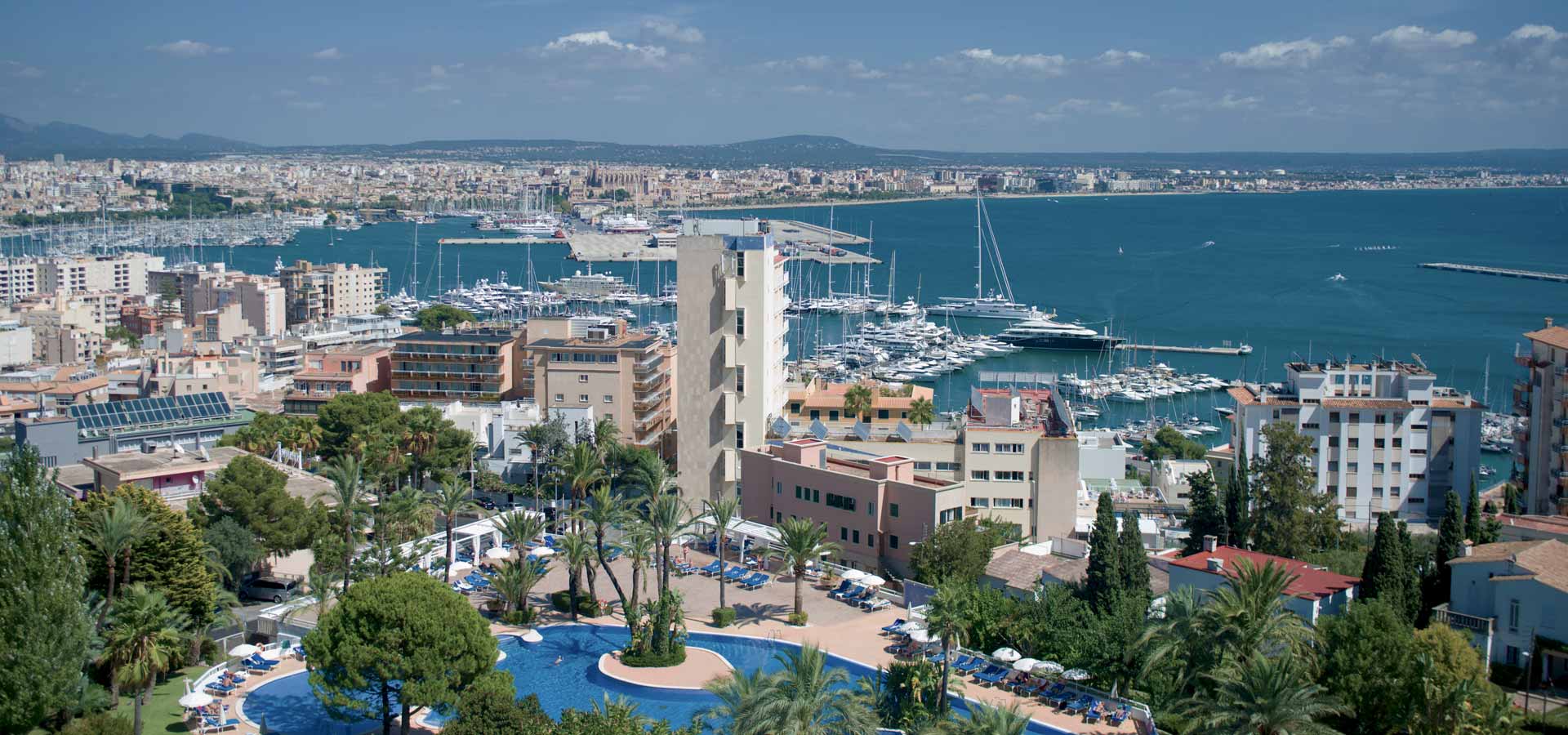
Bonanova is a residential neighbourhood (barri) in Palma de Mallorca’s Districte de Ponent, set on the wooded slopes between the Bosc de Bellver forest and the Bay of Palma. Known for quiet streets, coastal views, and detached villas alongside mid-rise apartment buildings, it offers rapid access to central Palma, the port, and two British-curriculum international schools.
Where is Bonanova, and why is it Palma’s quietest hillside?
Situated on the south-western slopes of the Bellver hill, Bonanova occupies an elevated vantage point above the capital. According to the Ajuntament de Palma, the district forms part of the city’s Districte de Ponent alongside neighbouring Gènova to the west, Cala Major and Sant Agustí along the shoreline, and Portopí, El Terreno, and Son Armadams towards the harbour.
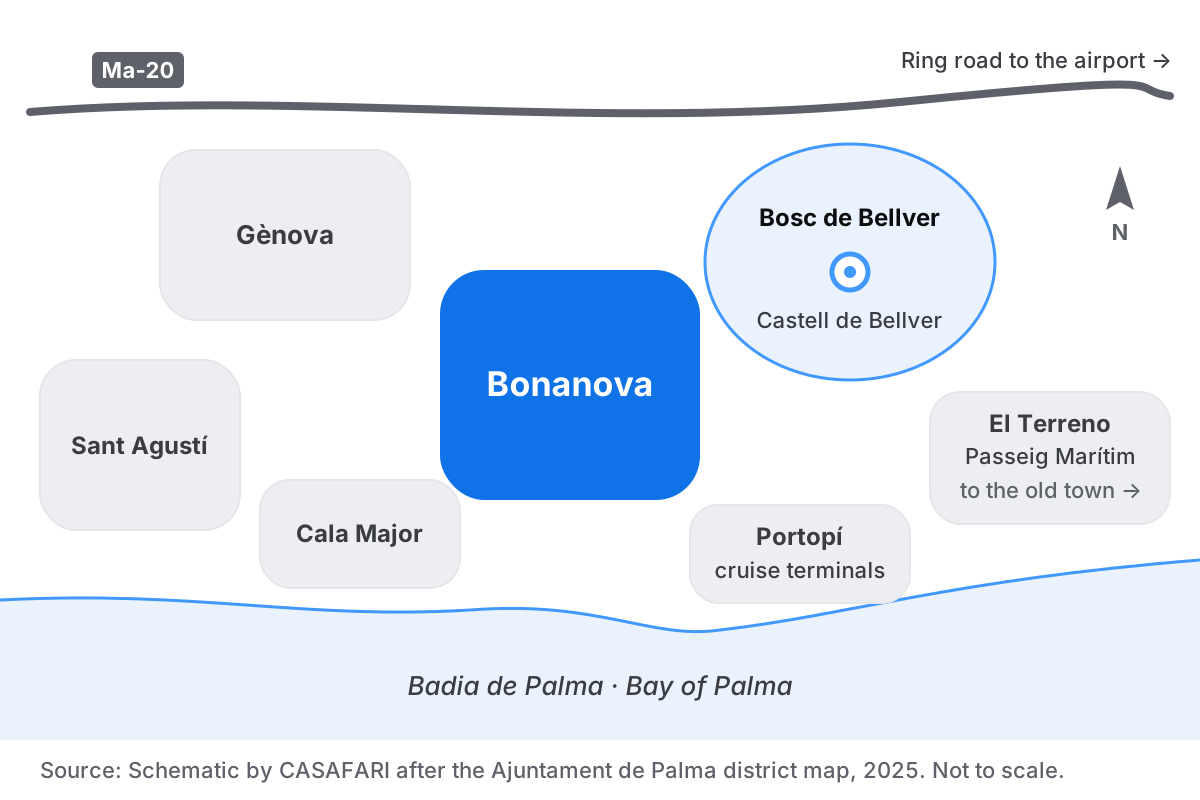
What sets Bonanova apart from lower-lying coastal districts is its immediate proximity to the Bosc de Bellver, the extensive pine forest surrounding the 14th-century circular fortress. Built between 1300 and 1311 for King Jaume II of Mallorca, the Castell de Bellver crowns the crest of the hill and houses Palma’s municipal history museum. For residents on the upper residential avenues, the forest acts as an urban green belt, offering direct walking access into quiet woodland paths just steps from home.
What is Bonanova property like?
Property in Bonanova ranges from mid-20th-century family villas built on terraced parcels to modern apartment complexes and penthouses overlooking the harbour. Because the terrain rises steeply from the waterfront, orientation and elevation strongly influence light and panoramic views across the Bay of Palma.
Lower sections of Bonanova feature apartment buildings constructed between the 1960s and 1980s, often set in landscaped grounds with shared swimming pools. On higher roads, standalone detached houses and multi-level modern villas dominate. Navigating these incline-heavy streets makes dedicated parking spaces or underground garages essential features for permanent residence.
This topography attracts second-home buyers seeking relative quiet near the city centre, families relocating for local education, and international buyers wanting a manageable lock-up-and-leave residence. Buyers interested in valuation dynamics across individual streets can review a valuation and market study for a Bonanova villa before placing an offer.
How far is Bonanova from the centre, the port and the airport?
Bonanova’s location provides convenient road links to Palma’s primary infrastructure:
- Old town and harbour: The city centre and the harbourfront boulevard (Passeig Marítim) lie directly down the hill. At the foot of the slope sit Palma’s main cruise ship facilities (Estació Marítima) at the Dics de l’Oest, administered by the Autoritat Portuària de Balears.
- Airport access: According to Aena, Palma de Mallorca Airport (Son Sant Joan, PMI) sits roughly 8 kilometres east of the city centre. Drivers from Bonanova reach the terminal via the Ma-20 ring road (Via de Cintura), bypassing downtown traffic.
- Coastline: The sandy bay of Cala Major lies directly below the district’s south-western border, offering quick access to the water for morning swims.
Schools, shopping and everyday life on Palma’s west side
Everyday conveniences for Bonanova residents are concentrated at the base of the hill and in neighbouring districts. On the seafront road, the Porto Pi Centro Comercial provides a supermarket, retail stores, and services for daily needs.
Cultural landmarks are similarly close. The Fundació Miró Mallorca, located in Cala Major on Carrer de Saridakis, preserves Joan Miró’s historic studio space and art collection. Nearby, the gardens of Marivent Palace—the official summer venue of the Spanish royal family—are open to the public during scheduled periods of the year.
For families with school-age children, two long-established British-curriculum schools operate in the immediate vicinity: Queen’s College in Gènova and Bellver International College in Cala Major.
Buying in Bonanova: taxes, residency and the rules on holiday lets
When acquiring real estate in the Balearic Islands, buyers must account for regional transaction taxes, immigration guidelines, and local municipal zoning laws. To review the general legal procedures involved in completing a Spanish transaction, consult the step-by-step guide to buying property in Spain.
Balearic property transaction taxes
Property acquisitions in Mallorca incur specific regional transfer taxes depending on whether the asset is a resale or a new build. According to the Agència Tributària de les Illes Balears (ATIB), resale properties attract a progressive Property Transfer Tax (ITP) scaled across price bands:
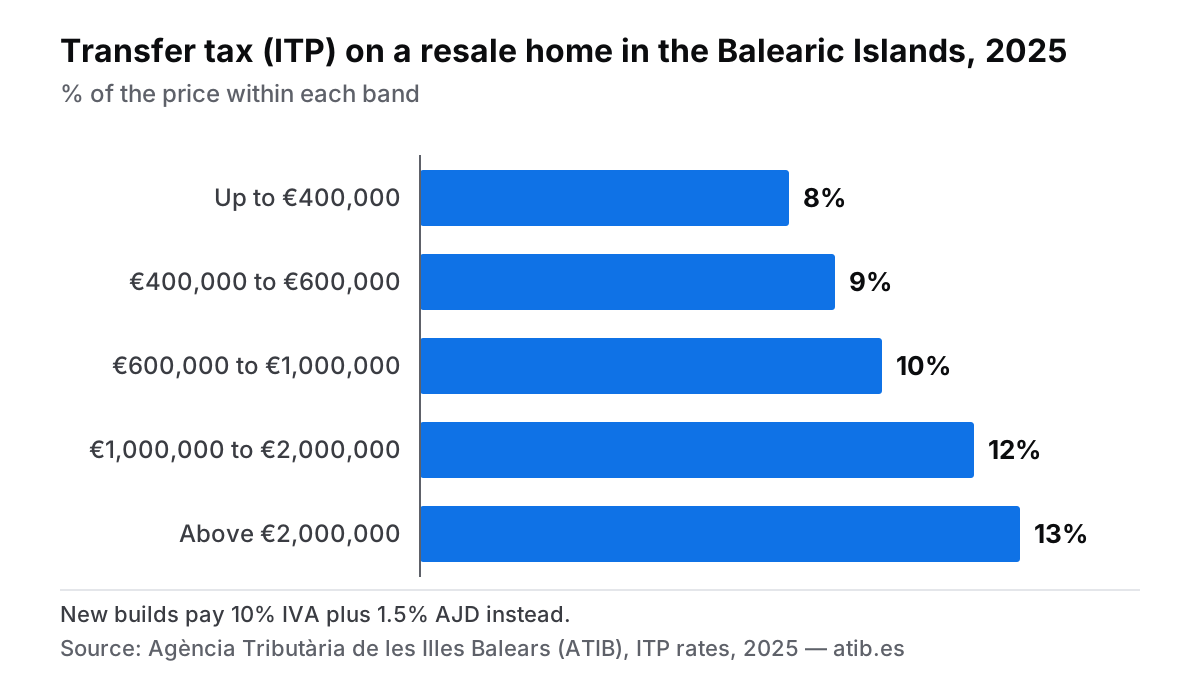
For new-build developments purchased directly from a developer, buyers pay 10% Value Added Tax (IVA) plus 1.5% Stamp Duty (AJD).
Residency considerations
Following the enactment of Ley Orgánica 1/2025, Spain’s residence visa for property investors (commonly termed the ‘Golden Visa’) was formally repealed on 3 April 2025. Non-EU citizens, including UK residents, are subject to standard Schengen Area rules allowing visa-free stays of up to 90 days within any 180-day period unless they secure an alternative non-lucrative or professional visa.
Short-term holiday letting restrictions
Investors evaluating potential rental yields should note strict municipal limits on short-term holiday lets (estades turístiques). Since 2018, the Ajuntament de Palma has prohibited holiday lets in apartment units located within multi-family residential buildings across the entire municipality. Only detached single-family dwellings situated in specifically zoned sectors are eligible to apply for an ETV tourist licence.
Furthermore, under Real Decreto 1312/2024, all short-term rental properties advertised on online platforms across Spain must display a verified registration code from the Registro Único de Arrendamientos. Owners considering long-term residential leases instead can read about the 2023 Housing Act and what it changed for landlords or review broader island context on what owning a rental property in Mallorca involves.
Who buys in Bonanova, and why they stay
Bonanova’s buyer profile consists primarily of international residents from the UK, Germany, Scandinavia, and Switzerland, alongside local professionals moving out of Palma’s core in search of gardens and outdoor space. Its international heritage is well-documented: New Zealand record-breaking aviator Jean Batten spent her final weeks in Palma before passing away on 22 November 1982, as recorded by NZ History.
What continues to draw buyers to Bonanova is its unique combination of elevated quiet, direct proximity to Bellver forest, and convenient access to the shoreline and old town.
How CASAFARI tracks the Bonanova market
CASAFARI aggregates real estate listings from multiple portals and agencies across Spain, deduplicating property records to provide accurate market supply metrics. Estate agents, valuation professionals, and investors use Area Insights for Bonanova and the rest of Palma to analyze live supply levels, median asking prices, and average days on market within specific district boundaries. Real estate professionals planning to list an asset in the district can also review our guide on how to sell a property in Mallorca.
Developers seeking to integrate market datasets into custom software applications can review the Area Insights documentation on developers.casafari.com for technical API details. To explore live property market data across Mallorca, sign in to the CASAFARI platform.
Frequently asked questions
Is Bonanova a good area of Palma to live in?
Yes, Bonanova is highly regarded for its quiet, residential character and elevated views over the Bay of Palma. Situated in the Districte de Ponent beside the Bosc de Bellver forest, it offers a peaceful alternative to the city centre while remaining a short drive from the harbour and surrounding districts like Gènova and Cala Major. Because the neighbourhood is built on steep terrain, having a private vehicle is generally recommended for daily errands.
Can I let a flat in Bonanova to holidaymakers?
No, holiday letting in apartment buildings is not permitted. Since 2018, the Ajuntament de Palma has banned tourist rentals in multi-family residential flats across the entire municipality. Only detached single-family houses located in specific permitted zones can apply for an ETV licence. Furthermore, under Real Decreto 1312/2024, any legal short-term rental advertised online must carry a valid registration number from the national registry.
What taxes do I pay when buying a home in Bonanova?
When purchasing a resale property in Bonanova, buyers pay the Balearic Property Transfer Tax (ITP), which follows a progressive rate structure from 8% up to 13% for amounts exceeding €2,000,000. New-build properties are subject to 10% IVA (VAT) plus 1.5% Stamp Duty (AJD). Additional costs include notary, property registry, and legal fees. Note that Spain’s property-based investor visa ended on 3 April 2025 under Ley Orgánica 1/2025.
Which international schools are near Bonanova?
Two established British-curriculum schools are located in the immediate neighbouring districts. Queen’s College sits on Carrer Joan de Saridakis in Gènova, just west of Bonanova, while Bellver International College is situated on Carrer Josep Costa i Ferrer in adjacent Cala Major. Both schools are within a few minutes’ drive of Bonanova residences.