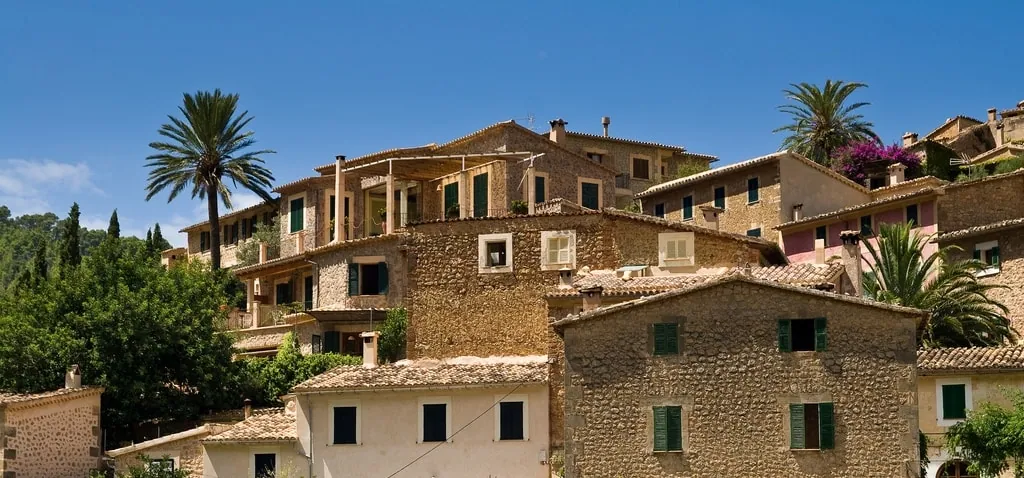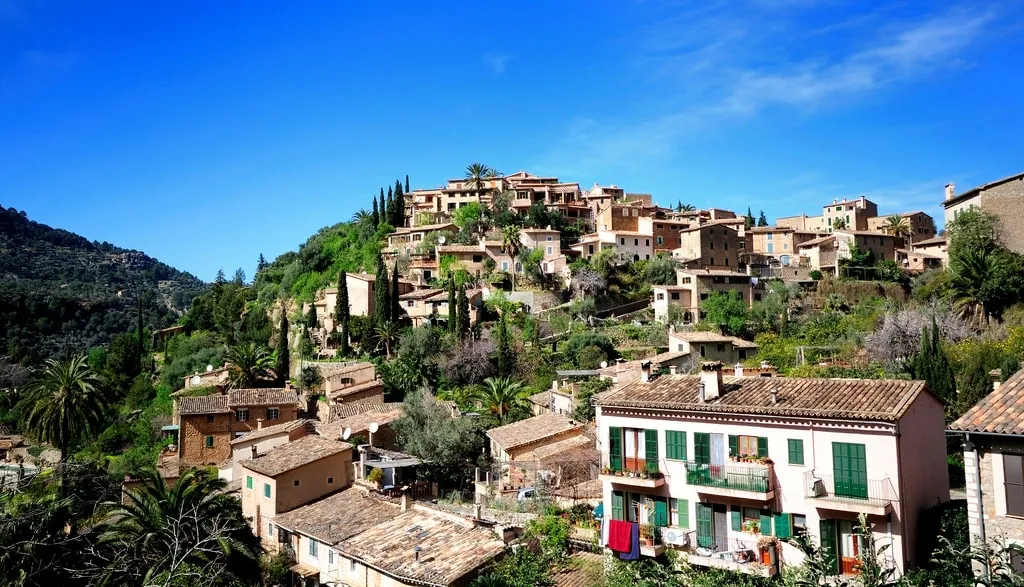
DEIA REAL ESTATE GUIDE
Bohemian gem of the island hidden in the magnificent Tramuntana mountains
Deià is one of the Mediterranean’s most supply-constrained luxury real estate markets. Nestled in Mallorca’s UNESCO-protected Serra de Tramuntana, this municipality had just 741 registered residents as of January 2025 according to the Instituto Nacional de Estadística (INE) municipal register. Strict environmental zoning, tight pool construction caps, and Balearic property transfer tax (ITP) rates reaching 13% make local property valuation uniquely dependent on micro-location and legal compliance.
How is the Deià municipality structured for property buyers?
Deià represents an ultra-prime enclave where historic architectural heritage meets extreme topographical limits. With a registered population of 741 inhabitants in January 2025—up 3.3% from 717 in 2024 according to the Instituto Nacional de Estadística (INE) municipal register—the municipality enforces rigid preservation standards that prevent mass residential development.
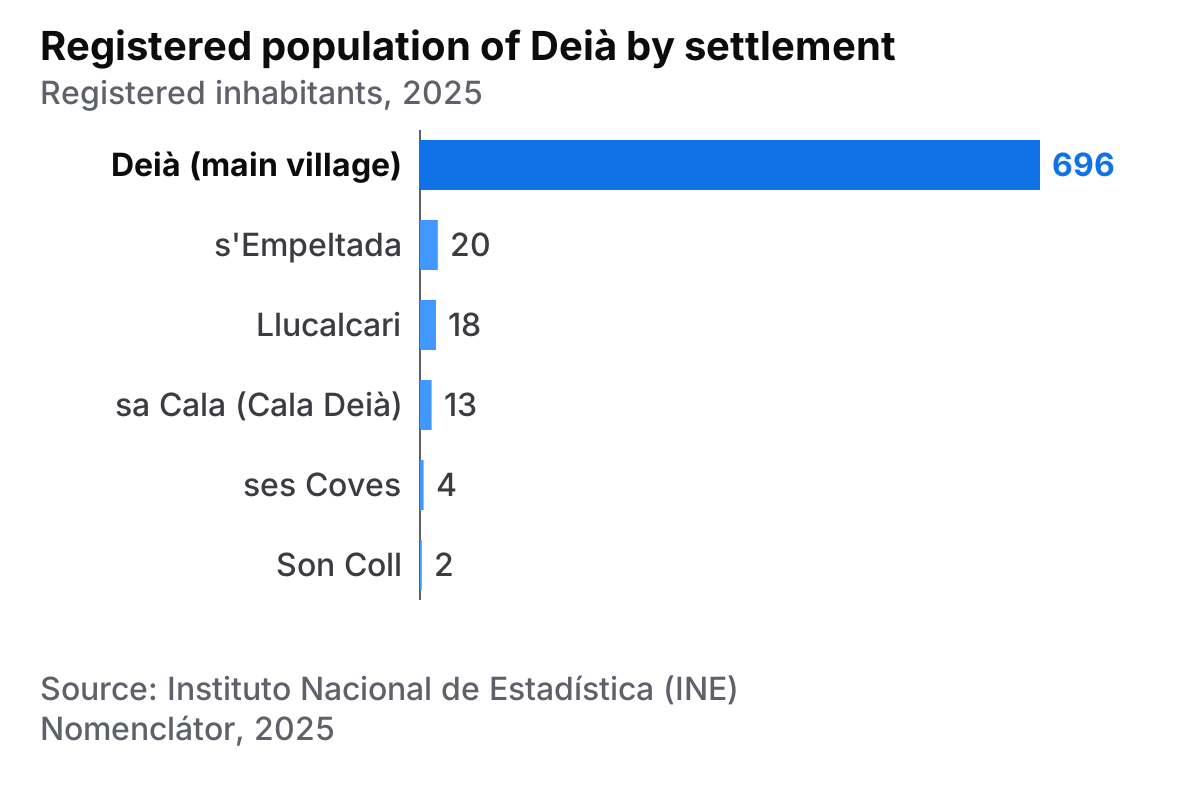
Data from the INE Nomenclátor breaks down the municipal population across six official settlements:
- Deià main village: 696 residents
- s’Empeltada: 20 residents
- Llucalcari: 18 residents
- sa Cala / Cala Deià: 13 residents
- ses Coves: 4 residents
- Son Coll: 2 residents
Within the main village itself, five historical quarters display distinct micro-market characteristics: Es Puig, Es Clot, Es Racó, Sa Vinya Vella, and Baix des Penyal. Position along the steep terrain dramatically impacts winter sunlight hours, vehicular access, private parking, and uninhibited Mediterranean views. Consequently, neighbouring stone village houses can command substantially different market valuations based on elevation and orientation.
While the live ticker at the top of this page displays current average asking prices per square metre and district trends across Deià, evaluating individual historic fincas and townhouses requires refined comparative analysis. Estate agents and institutional investors rely on CASAFARI Area Insights to analyze hyperlocal historical transactions and track long-term price evolution across these distinct hamlets.
What planning, pool and tourist-let rules apply in the Serra de Tramuntana?
Purchasing property in Deià requires rigorous due diligence regarding land classification and planning restrictions governed by the Plan Territorial Insular de Mallorca (PTIM) and the Balearic Urban Planning Law (LUIB).
Under Article 68 bis of the Balearic Urban Planning Law (LUIB), strict limits govern swimming pool construction on rustic land (suelo rústico). Where a single-family dwelling is legally permitted on general rustic land, only one pool per estate is allowed, capped at a maximum water surface area of 35 m² and a total volume of 60 m³. Crucially, on protected Serra de Tramuntana land categories—such as ANEI (Área Natural de Especial Interés) or ARIP (Área Rural de Interés Paisajístico) plots under 50,000 m²—new swimming pool construction is strictly prohibited.
Similarly, holiday-letting capacity is tightly controlled under the Balearic holiday rental regime (ETV). The regional moratorium on new tourist beds, reinforced by Decree-Law 4/2025, prohibits the issuance of new ETV licences for apartments and multi-family residential units. Single-family detached dwellings can only apply for a licence if temporary places become available through the Consell de Mallorca tourist licence pool (CBAT), subject to strict municipality-level zoning. Existing, fully valid ETV licences therefore represent a major capital premium in the Deià market.
Before executing a purchase contract, buyers should review our guide to the Spanish purchase contract and escritura and utilize CASAFARI Property Sourcing to trace historical property listings, planning approvals, and cadastral references.
Which taxes and residency rules affect international buyers in Deià?
Acquiring real estate in Deià incurs Balearic regional transaction taxes and ongoing asset taxes administered by the Agència Tributària de les Illes Balears (ATIB).
Resale purchases are subject to the progressive Property Transfer Tax (Impuesto sobre Transmisiones Patrimoniales, ITP). According to the Agència Tributària de les Illes Balears (ATIB) ITP tax brackets, the rates for 2025–2026 are structured as follows:
- Up to €400,000: 8%
- €400,000.01 to €600,000: 9%
- €600,000.01 to €1,000,000: 10%
- €1,000,000.01 to €2,000,000: 12%
- Above €2,000,000: 13%
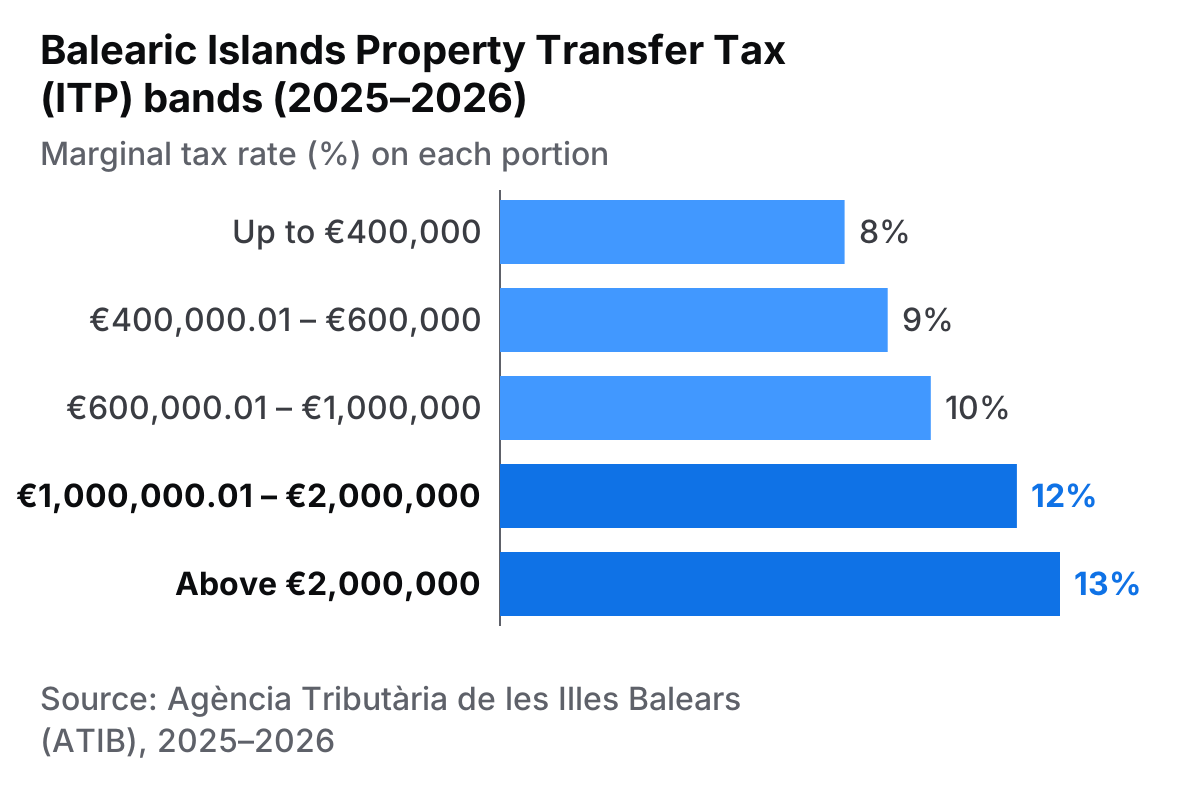
Because prime residential properties in Deià regularly exceed €2,000,000, the marginal tax rate of 13% applies to the portion above this threshold.
Regarding annual wealth tax (Impuesto sobre el Patrimonio), Balearic Law 12/2023 established a tax-free exempt threshold of €3,000,000 per individual taxpayer, detailed in the ATIB Balearic Wealth Tax regulations. This threshold applies to both resident tax-payers and non-residents choosing Balearic autonomous tax rules. Net wealth exceeding €3,000,000 is taxed at progressive regional rates ranging from 0.28% to 3.45%.
For non-EU buyers (including UK and US citizens), residency paths changed significantly when Spain officially abolished the Golden Visa for real estate purchases under Organic Law 1/2025, published in the Boletín Oficial del Estado (BOE) repeal of the investor visa. Since 3 April 2025, purchasing property worth €500,000 or more no longer confers residency rights. Non-EU buyers planning to reside in Spain must instead apply for alternative visas, such as the Non-Lucrative Visa or Digital Nomad Visa.
How well connected is Deià for year-round living, transport and schooling?
Despite its secluded location on Mallorca’s west coast, Deià maintains practical transport connections along the Ma-10 scenic mountain route. Public transit is served by the TIB line 203 timetable, which connects Port de Sóller, Sóller (20–25 minutes from Deià), Deià village (with stops at Llucalcari, s’Empeltada, Deià, and Es Clot), Valldemossa (15–20 minutes), and Palma’s Estació Intermodal in 45–55 minutes.
Families living in the municipality have access to local primary education facilities listed in the Ajuntament de Deià municipal education directory. Located on Carrer Es Verger s/n, these include Escoleta Municipal Es Verger for early childhood (ages 0–3) and CEIP Robert Graves for primary education (ages 3–12). For secondary and international schooling, families commute towards Palma, where institutions such as Bellver International College, Baleares International College, Queens College, Lycée Français, Eurocampus, and The Academy are situated.
Whether you are advising clients on selling a property in Mallorca or sourcing unlisted acquisitions, accurate data remains vital. Property advisors and investment professionals leverage a property valuation and comparative market study to benchmark pricing and evaluate asset liquidity across the Serra de Tramuntana.
To explore market data, manage valuations, and track property inventory across Mallorca, sign in to the CASAFARI platform.
Frequently asked questions
What are the property transfer taxes (ITP) when buying a home in Deià?
Resale property acquisitions in Deià are subject to Balearic Property Transfer Tax (ITP) administered by the ATIB. The progressive rates for 2025–2026 are 8% up to €400,000, 9% between €400,000.01 and €600,000, 10% between €600,000.01 and €1,000,000, 12% between €1,000,000.01 and €2,000,000, and 13% on any portion exceeding €2,000,000. Additionally, under Law 12/2023, the Balearic wealth tax exemption threshold is set at €3,000,000 per taxpayer.
Can you obtain a tourist rental licence (ETV) for a property in Deià?
Under the Balearic moratorium introduced in February 2022 and reinforced by Decree-Law 4/2025, new tourist rental licences (ETV) are banned for apartments and multi-family residential buildings. Single-family detached houses can only acquire a licence if de-registered places are reallocated through the Consell de Mallorca temporary pool (CBAT) and the property satisfies strict Serra de Tramuntana zoning criteria. As a result, properties with pre-existing, active ETV licences command a strong valuation premium.
Is it legal to build a swimming pool on rustic land in Deià?
Building a new swimming pool is strictly prohibited on protected Serra de Tramuntana land categories, such as ANEI or ARIP plots under 50,000 m², under Article 68 bis of the Balearic Urban Planning Law (LUIB). Where a single-family home is permitted on general rustic land, only one pool per estate is allowed. That pool is subject to strict maximum dimensional caps of 35 m² of water surface area and 60 m³ of volume.
Can non-EU buyers still get a Spanish Golden Visa by buying property in Mallorca?
No, Spain officially abolished the Golden Visa residency-by-investment scheme for real estate purchases on 3 April 2025 under Organic Law 1/2025 (BOE). Non-EU buyers, including UK and US nationals, retain full rights to purchase real estate in Deià without restrictions. However, those wishing to spend more than 90 days per 180-day period in Spain must now apply for alternative immigration routes, such as the Non-Lucrative Visa or Digital Nomad Visa.