
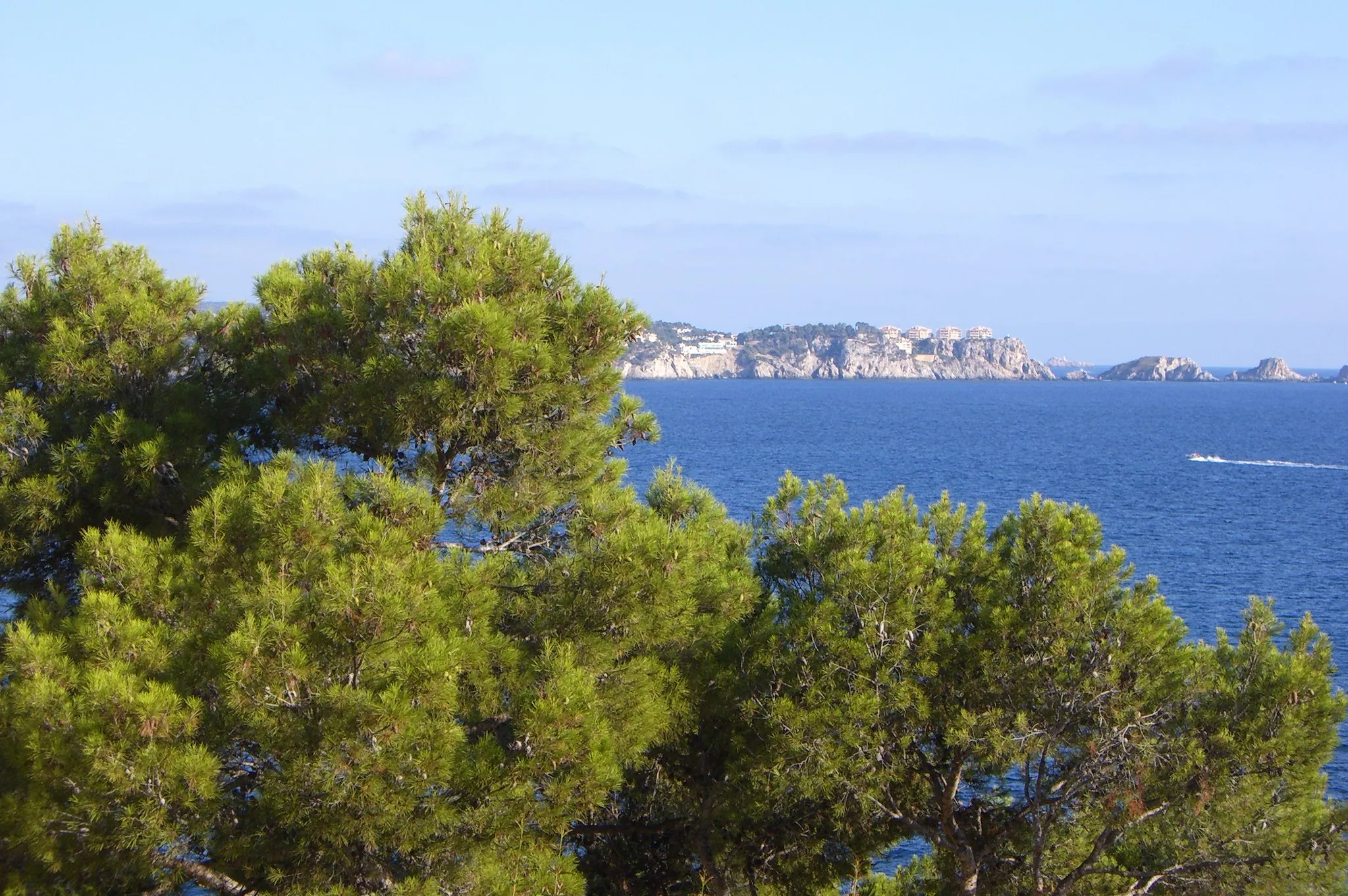
PEGUERA & CALA FORNELLS PROPERTY GUIDE
Middle-class tourists & competitive athletes
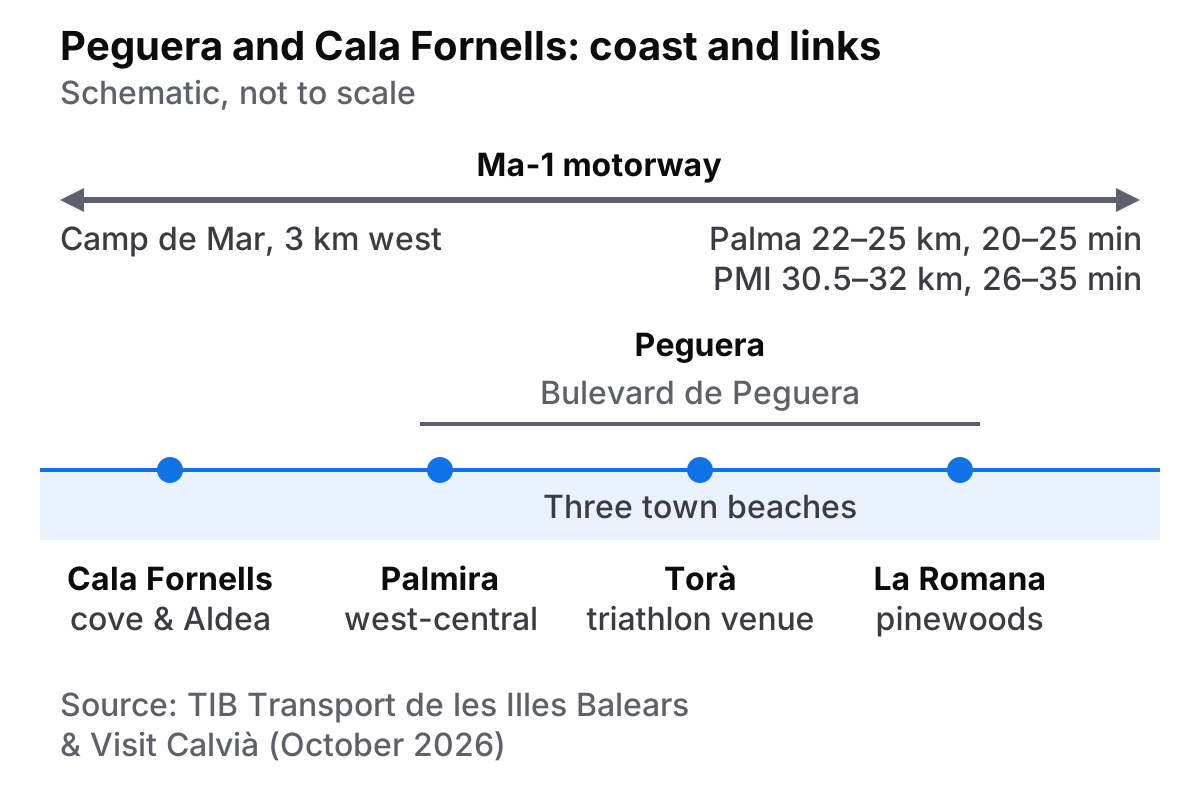
Peguera and its cliffside neighbour Cala Fornells sit on the south-west coast of Mallorca in the municipality of Calvià, 22 to 25 km (20–25 minutes via the Ma-1 motorway) from Palma and 30.5 to 32 km from Palma de Mallorca Airport (PMI). Home to 4,095 registered residents according to the INE (2025) and averaging 5,111 €/m² (Fotocasa, October 2026), the area pairs three fine-sand beaches with iconic terracotta hillside residences.
Why do international buyers choose Peguera and Cala Fornells in Calvià?
Nestled between the golf and beach enclave of Camp de Mar in Andratx to the west and the pine-covered hills of the Serra de Tramuntana to the north, Peguera and Cala Fornells offer one of south-west Mallorca’s most sheltered microclimates. Connectivity is straightforward for commuters and holidaymakers alike. Driver access to central Palma takes between 20 and 25 minutes along the Ma-1 motorway, while public transport is managed by the intercity TIB network. According to the TIB intercity bus line 102 timetable (October 2026), frequent buses connect Peguera directly with Palma Intermodal Station via routes 102 and 101. Airport transfers are equally efficient: the direct Aerotib A11 bus service links Peguera and neighbouring resorts to Palma de Mallorca Airport (PMI) in 60 to 75 minutes, or roughly 26 to 35 minutes by car.
Peguera’s history as a resort town began in 1928 with the opening of the Hotel Platges de Peguera, followed by a formal tourist urbanisation plan in 1958 spearheaded by Francisca Roca Warring. Contrary to local urban legends, Peguera does not feature a cathedral; its central place of worship is the mid-20th-century Parròquia del Sant Crist de Peguera. The historical tie between Calvià and ecclesiastical authorities dates back to the 1229 conquest of Mallorca, when King James I allocated lands such as Son Vic Vell near Peguera to Berenguer de Palou, Bishop of Barcelona, establishing a seasonal retreat that top prelates preserved into the mid-1900s.
Today, the area boasts a deeply established German-speaking community alongside British and Scandinavian residents, creating a stable, year-round economy. Outdoor enthusiasts benefit from direct hiking and mountain biking trails leading into the rural village of Es Capdellà, while endurance sports lovers gather each autumn for the Challenge Peguera Mallorca international triathlon.
Peguera vs Cala Fornells: how do the beaches, architecture and property types compare?
Peguera’s coastal front is structured around three main urban sandy beaches: Platja Palmira, Platja de Torà, and Platja de la Romana. As outlined in the Visit Calvià guide to Peguera’s beaches (June 2026), these sheltered bays are joined by a continuous seafront promenade and the pedestrianised Bulevard de Peguera, where open-air cafés, medical clinics, pharmacies, and restaurants operate through all four seasons.
In contrast, Cala Fornells occupies a tranquil, pine-draped headland immediately west of Peguera. The district is celebrated internationally for its unique organic architecture, designed between 1973 and 1976 by Russian-born architect Pedro Otzoup. His residential complexes—Aldea Cala Fornells I, II, and III—feature terracotta-toned Mediterranean facades, uneven rooflines, ceramic tiles, and intricate archways inspired by traditional Mexican villages, ensuring no two apartments are identical. High-end hospitality supports the area’s prestige, anchored by the five-star Hotel Petit Cala Fornells on Carretera de Cala Fornells, 78, known for its sea-view terraces and pristine cove access.
Property values reflect these distinct micro-locations within Calvià, which leads Spain’s INE Urban Indicators (2026) as the country’s highest-priced municipality with an overall average transaction price of €981,485. While general residential listings in Peguera average 5,111 €/m² (+7.3% year-on-year; Fotocasa, October 2026), prime supply tells a different story. Prime detached villas and renovated frontline flats in Cala Fornells and upper Peguera average 7,090 €/m² for houses and 7,340 €/m² for apartments.
What taxes, holiday rental rules and visa laws apply when buying in Peguera in 2026?
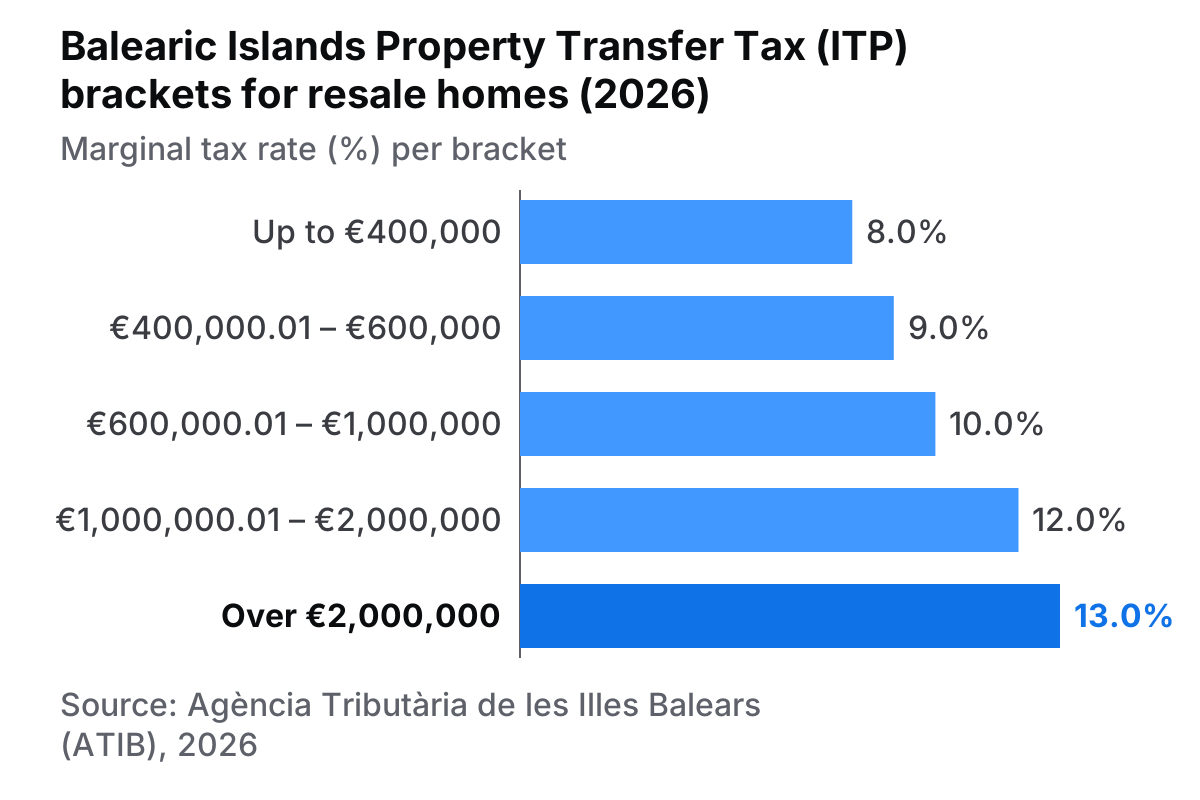
Acquiring real estate in Mallorca requires a clear understanding of regional tax brackets, local zoning decrees, and residency requirements. For resale properties, buyers pay the Balearic Islands Property Transfer Tax (Impuesto sobre Transmisiones Patrimoniales, ITP). According to the official Agència Tributària de les Illes Balears (ATIB) ITP tax brackets (2026), ITP is calculated on a progressive scale:
- 8% on the property value up to €400,000
- 9% for the portion between €400,000.01 and €600,000
- 10% for the portion between €600,000.01 and €1,000,000
- 12% for the portion between €1,000,000.01 and €2,000,000
- 13% on any amount exceeding €2,000,000
When purchasing a new-build property directly from a developer, buyers pay 10% VAT (IVA) plus Stamp Duty (AJD) charged at 1.5%, which increases to 2% for properties valued at €1,000,000 or above.
Investors considering short-term holiday letting must navigate strict regional restrictions. Under Balearic Decree-Law 4/2025 on tourist rental containment (in force since 16 April 2025 and throughout 2026), new tourist rental licences (ETV) are strictly prohibited for apartments in multi-family buildings across Mallorca. Detached or semi-detached single-family homes can only purchase rental places if slot capacity is available within the Consell de Mallorca’s (CBAT) zero-growth 1-for-1 exchange pool. To review broader considerations regarding holiday lets, see our article on owning a rental property in Mallorca and Ibiza.
Non-EU buyers should also note significant changes to Spanish immigration law. Under Organic Law 1/2025 ending the Spanish Golden Visa, the fast-track residency scheme for real estate investments of €500,000 or more was officially abolished on 3 April 2025. Non-EU buyers planning to spend more than 90 days per 180-day period in Spain now typically utilize the Non-Lucrative Visa or the Digital Nomad Visa. For step-by-step guidance on legal procedures, review our guide to Spanish property contracts and the public deed (escritura).
How to analyse hyper-local supply and valuations in Peguera and Cala Fornells with CASAFARI
Micro-locations within south-west Mallorca command vastly different valuation premiums. A mid-tier flat near the pedestrianised Bulevard de Peguera requires a completely different pricing strategy compared to an architectural Pedro Otzoup residence in Aldea Cala Fornells or a cliffside villa overlooking Platja de la Romana. Evaluating these price dynamics demands real-time, deduplicated market data.
Real estate professionals, private investors, and buyers use CASAFARI Area Insights and our specialized property valuation and market study tool to track real-time asking prices, stock distribution, and average time on market across Calvià. Furthermore, real estate agents sourcing off-market or active properties rely on CASAFARI Property Sourcing to monitor historical price movements across multiple portals.
To start analysing hyper-local data across Mallorca, sign in to the CASAFARI platform. Software engineering teams can explore our English-language Area Insights API documentation to integrate market analytics directly into proprietary software.
Frequently asked questions
What are the property purchase taxes in Peguera and Cala Fornells?
Resale properties in Peguera and Cala Fornells are subject to the Balearic Islands Property Transfer Tax (ITP), calculated on a progressive scale ranging from 8% on the first €400,000 up to 13% for amounts over €2,000,000. For new-build properties purchased from a developer, buyers pay 10% VAT (IVA) plus Stamp Duty (AJD) at 1.5%, which rises to 2% for homes priced at €1,000,000 or above.
Can you get a holiday rental licence (ETV) for an apartment in Peguera or Cala Fornells?
No, new tourist rental licences (ETV) are strictly prohibited for apartments in multi-family buildings across all of Mallorca under Balearic Decree-Law 4/2025. Investors seeking short-term holiday rental income must either purchase a property with an existing valid licence or acquire a detached single-family house through the Consell de Mallorca’s 1-for-1 exchange pool.
How far are Peguera and Cala Fornells from Palma and Mallorca Airport?
Peguera and Cala Fornells are located 22 to 25 km west of Palma de Mallorca via the Ma-1 motorway, taking 20 to 25 minutes by car. Palma de Mallorca Airport (PMI) is 30.5 to 32 km away, or a 26 to 35-minute drive. Direct public transport includes TIB bus lines 102 and 101 to Palma Intermodal Station, as well as the Aerotib line A11 connecting directly to the airport in 60 to 75 minutes.
Does buying a property in Mallorca still qualify for a Spanish Golden Visa?
No, Spain officially abolished the Golden Visa route for real estate investments of €500,000 or more under Organic Law 1/2025, effective 3 April 2025. In 2026, non-EU buyers can no longer obtain residency through property acquisition alone, though existing holders can renew their permits and new buyers can apply for non-lucrative or digital nomad visas.