
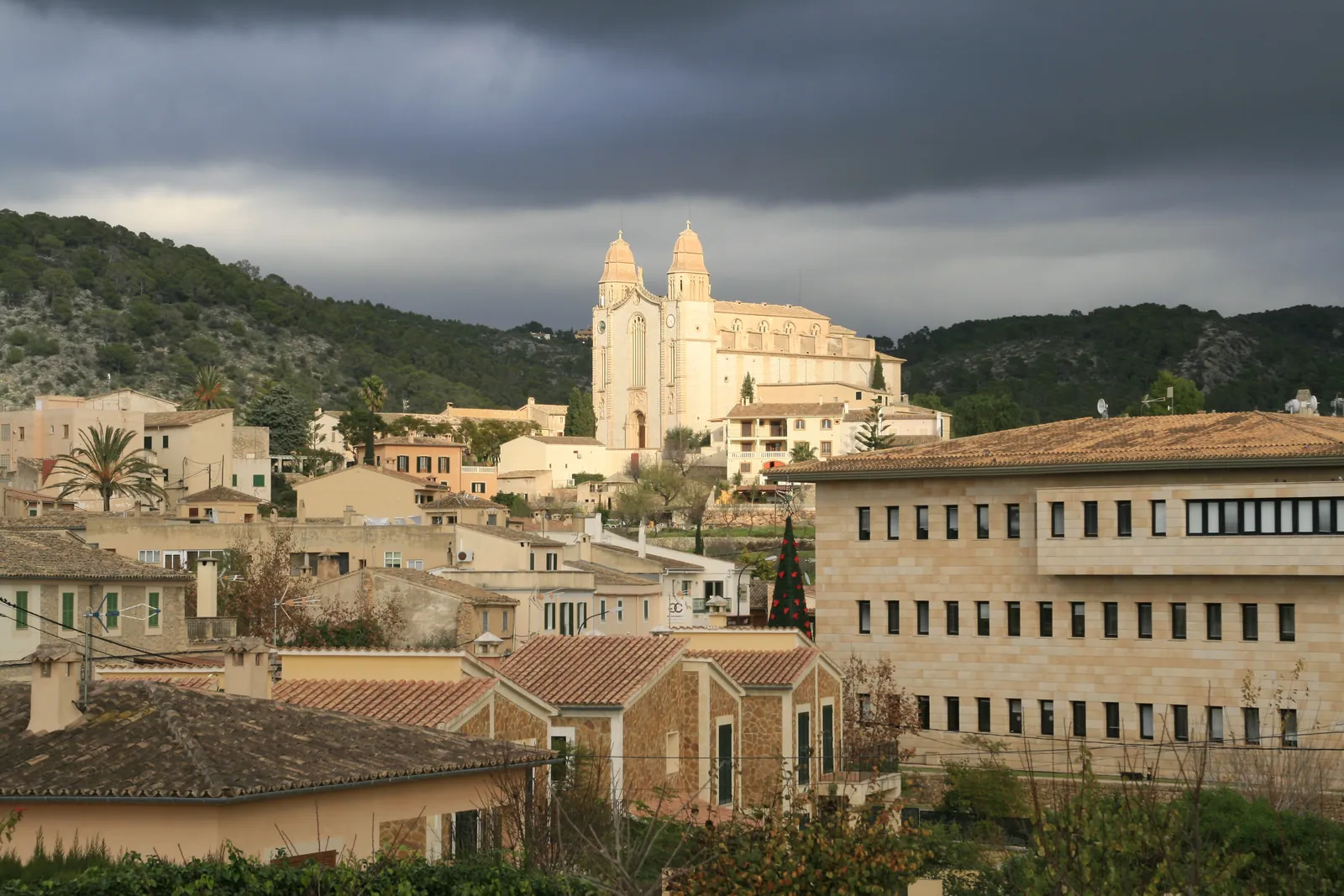
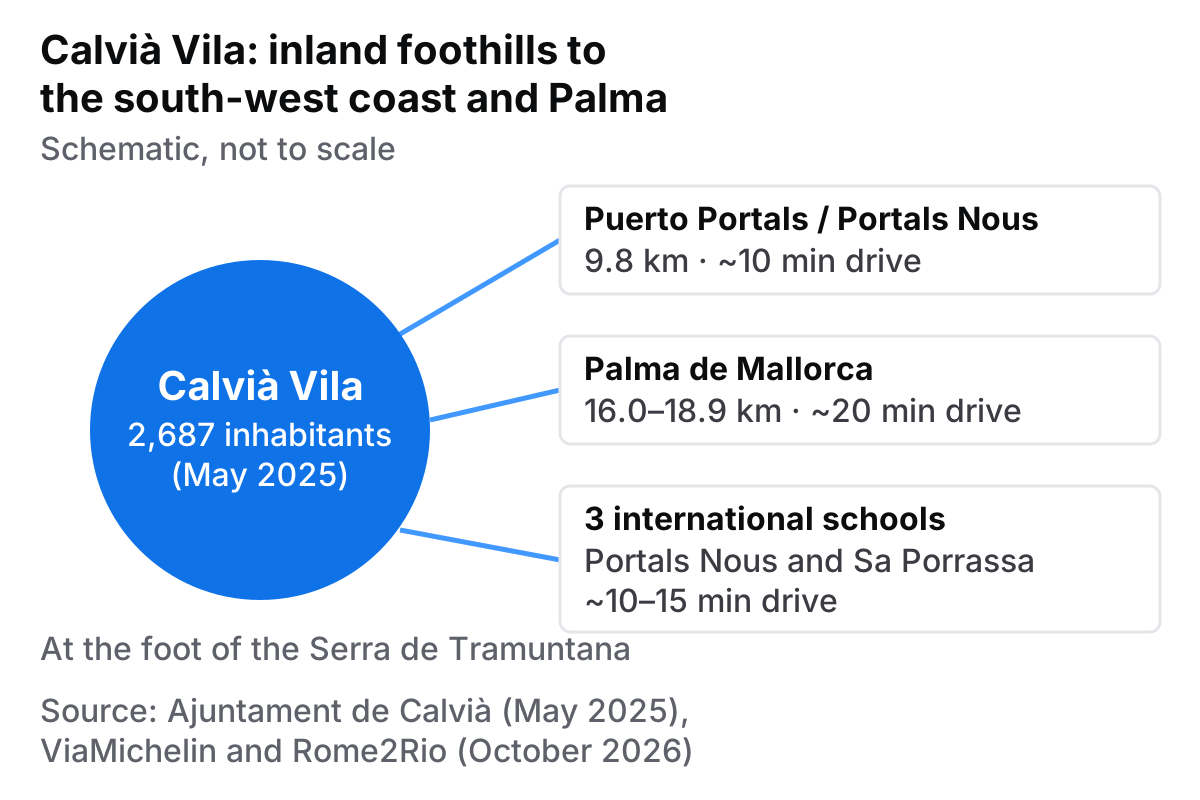
Calvià Vila (often written Calvia Villa) is the historic administrative capital of south-west Mallorca’s wealthiest municipality. Located at the foot of the Serra de Tramuntana, the village core houses 2,687 registered residents, combining quiet stone townhouses and countryside estates just 9.8 km (10 minutes) from Puerto Portals and 16 km (20 minutes) from central Palma de Mallorca.
Where is Calvia Villa in Mallorca and why do buyers look inland?
Nestled in a wide, sheltered valley at the southern foot of the Serra de Tramuntana mountain range, Calvià Vila serves as the historic and civic centre of the broader Calvià municipality. While the municipality as a whole counts 53,793 residents, as recorded by the Instituto Nacional de Estadística (INE) in January 2025, the peaceful village core (núcleo) maintains an intimate population of just 2,687 inhabitants, according to municipal register figures from the Ajuntament de Calvià in May 2025.
This modest scale gives Calvià Vila a tranquil, year-round residential feel that contrasts with the bustling coastal resorts nearby. Location data logged in October 2026 shows that drivers reach the superyacht harbour of Puerto Portals and Portals Nous in approximately 10 minutes (9.8 km), while the capital city of Palma de Mallorca lies between 16 and 18.9 km away, a smooth 20-minute drive via the Ma-1014 and Ma-1 motorway.
Protection from northern winds provided by the Tramuntana peaks creates a mild microclimate across the valley. Almond, carob, and citrus groves surround the village, attracting international buyers seeking authentic Balearic village life within effortless reach of international schools, marinas, and urban amenities.
What types of property and architecture define Calvia Villa?
The architectural identity of Calvià Vila is grounded in traditional Mallorcan craftsmanship. Within the historic village streets, prospective buyers discover traditional village houses (cases de poble) characterized by ochre-toned stone façades, deep-set window embrasures, traditional green timber shutters, inner stone arches, and private rear courtyards or citrus gardens. Unlike coastal developments, the village core has remained free of high-rise apartment structures.
Moving outward from the village centre toward Es Capdellà, the landscape opens into expansive country plots. Here, the local market features historic rural estates (possessions) and contemporary country villas (fincas rústiques). These properties often sit on generous acreage, offering mature olive trees, swimming pools, and sweeping views of the mountain peaks.
At the heart of the village stands the parish church of Sant Joan Baptista. Tracing its roots back to an early 1248 structure, the current historicist edifice—featuring prominent twin façade towers and a blend of neo-Gothic, neoclassical, and neo-Romanesque elements—was designed by architect Bartolomé Ferrá y Perelló and constructed between 1867 and 1896. Real estate advisors and private investors examining local real estate dynamics routinely rely on tools like CASAFARI Area Insights alongside professional property valuation and market study resources to evaluate individual plot configurations, historic features, and pricing accuracy across the municipal boundaries.
What is everyday life like in Calvia Villa: markets, schools, sports, and marinas?
Life in Calvià Vila moves to a comfortable, authentic rhythm throughout the four seasons. Every Monday morning from 08:30 to 13:30, the main street (Carrer Major) near the church hosts the traditional weekly market. According to the Ajuntament de Calvià Monday market schedule, over 60 market stalls line the road, selling island-grown fruits, cured cheeses, olive oils, leather goods, and local handicrafts.
Community culture flourishes during annual local celebrations. The Festes de Sant Joan Baptista around 24 June feature traditional mass, folk dancing, and a long-standing tradition dating from the 1950s where senior village residents aged 75 and above are served almond ice cream with ensaïmada. In July, the ten-day Festes de Sant Jaume (16 to 25 July) bring open-air concerts, the traditional Nit de Foc fire run (correfoc), playful Olimpiadas Payesas games, and communal street dinners.
Active residents benefit from extensive local civic facilities. The municipal Palau d’Esports Melani Costa, located at Avinguda des Capdellà 55, features a 6-lane heated indoor swimming pool, a teaching pool, a fully equipped fitness centre, an indoor sports hall, a climbing wall, and the adjacent Es Mofarés football pitch. For outdoor recreation, world-class golf courses including Real Golf de Bendinat, Golf de Poniente, and the championship courses of Santa Ponsa sit within a 10-to-15-minute radius. Boating enthusiasts enjoy quick access to nearby coastal hubs such as Puerto Portals, Philippe Starck-designed Port Adriano, and Port d’Andratx.
For relocating families participating in the second-home market in Mallorca and Ibiza, educational proximity is a primary advantage. Three major international institutions operate within a 10-to-15-minute drive:
- Agora Portals International School (Portals Nous): Offering the Spanish curriculum and International Baccalaureate (IB) for ages 1 to 18.
- King Richard III College (Portals Nous): Delivering the British National Curriculum from nursery through to A-Levels (ages 2 to 18).
- Baleares International College - BIC (Sa Porrassa): Following the British National Curriculum for students aged 3 to 18.
What taxes, residency rules, and tourist licence laws apply to buyers in Calvià?
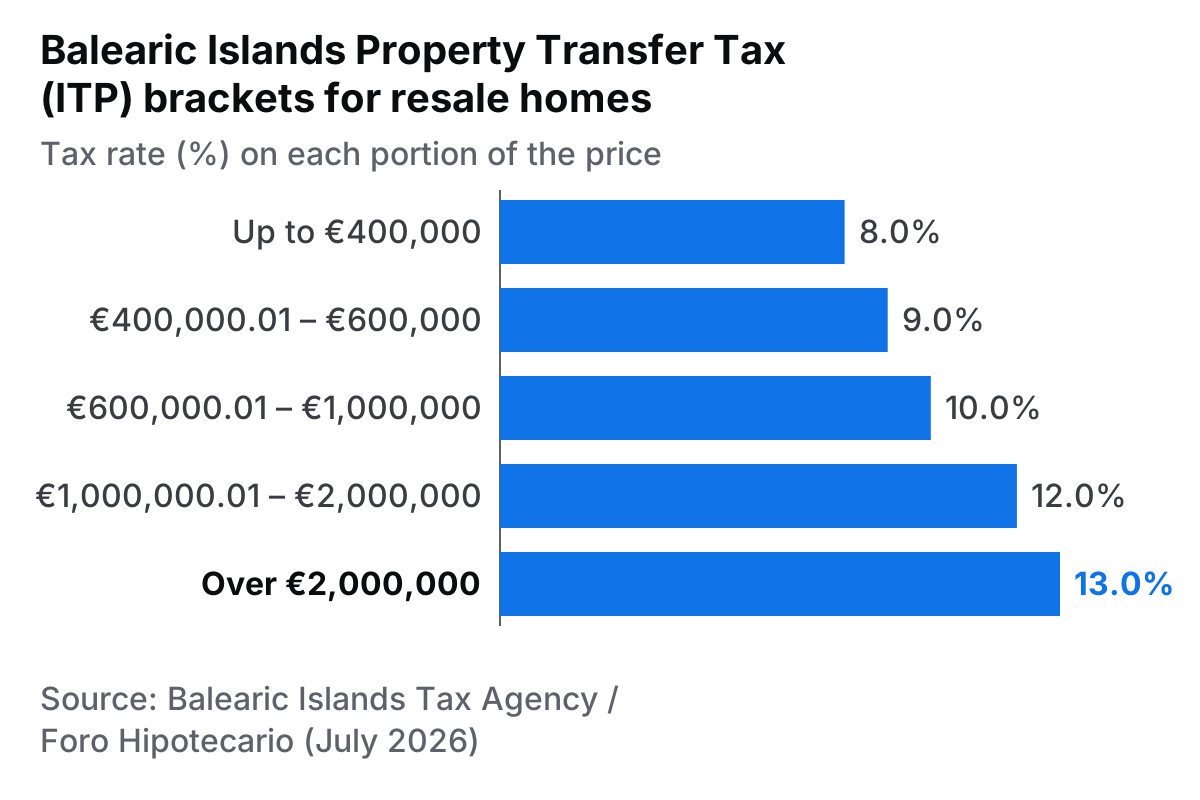
Navigating a property transaction in Mallorca requires an up-to-date understanding of Balearic tax structures and regional planning legislation. Resale residential purchases in Calvià are subject to the Balearic Islands Property Transfer Tax (Impuesto sobre Transmisiones Patrimoniales - ITP). As verified by the Balearic Islands ITP progressive tax brackets, the tax is calculated on a progressive scale based on the property’s purchase price:
| Purchase Price Tier | Progressive ITP Rate |
|---|---|
| Up to €400,000 | 8.0% |
| €400,000.01 to €600,000 | 9.0% |
| €600,000.01 to €1,000,000 | 10.0% |
| €1,000,000.01 to €2,000,000 | 12.0% |
| Portion over €2,000,000 | 13.0% |
Note: Reduced tax rates (down to 4%, 2%, or 0%) apply strictly to qualifying primary residences for younger buyers or specific family categories under statutory price caps.
Investors considering short-term holiday letting must comply with strict regional restrictions. As detailed in the Mallorca ETV holiday rental licence regulations following Balearic Decree-Law 4/2025 enacted in April 2025, new holiday rental licences (ETV) are permanently prohibited for apartments in multi-family residential buildings across the archipelago. For single-family properties—such as detached fincas or village townhouses—new places can only be requested from the Consell de Mallorca’s temporary pool when existing licences are cancelled under a strict 1:1 replacement mechanism.
Regarding residency options, non-EU buyers should note that Spain officially repealed its real estate Investor Visa program. As published in the Spanish Government announcement ending the Golden Visa, Law 14/2013 real estate residency provisions were suppressed effective 3 April 2025 following Organic Law 1/2025. Non-EU nationals relocating to Mallorca now typically apply for Non-Lucrative Visas or Digital Nomad Visas.
To review complete market data, cross-reference historical transaction trends, and analyze real estate inventory across the Balearic Islands, real estate professionals and private investors are invited to sign in to the CASAFARI platform.
Frequently asked questions
What are the property transfer tax (ITP) rates when buying a resale home in Calvià?
Resale home purchases in Calvià are taxed according to the Balearic Islands’ progressive Property Transfer Tax (ITP) scale. As of 2026, the rates are 8% on the first €400,000, 9% between €400,000.01 and €600,000, 10% between €600,000.01 and €1,000,000, 12% between €1,000,000.01 and €2,000,000, and 13% on any amount exceeding €2,000,000. Reduced rates down to 0% are reserved exclusively for qualifying primary residences under strict age and income conditions.
Can you get a tourist rental licence (ETV) for a property in Calvia Villa?
Under Balearic Decree-Law 4/2025, new ETV tourist rental licences are permanently banned for apartments in multi-family buildings. For detached, semi-detached, or terraced single-family homes in Calvià Vila, new tourist places can only be obtained from the Consell de Mallorca temporary pool under a strict 1:1 replacement process when existing licences are cancelled.
Which international schools are closest to Calvia Villa?
Three premier international schools operate within a 10-to-15-minute drive of Calvià Vila inside the municipality. These include Agora Portals International School in Portals Nous (IB and Spanish curriculum, ages 1–18), King Richard III College in Portals Nous (British National Curriculum, ages 2–18), and Baleares International College in Sa Porrassa (British National Curriculum, ages 3–18).
Can non-EU buyers still get a Spanish Golden Visa by purchasing property in Mallorca?
No, non-EU buyers can no longer obtain a Spanish Golden Visa through real estate investment. Spain officially abolished the real estate residency route on 3 April 2025 following the enactment of Organic Law 1/2025. Non-EU buyers planning to reside in Calvià currently utilize alternative residency pathways such as the Non-Lucrative Visa or the Digital Nomad Visa.