
ARTA PROPERTY GUIDE
The centre of Arta municipality, cultural and natural treasure in the north east of Mallorca
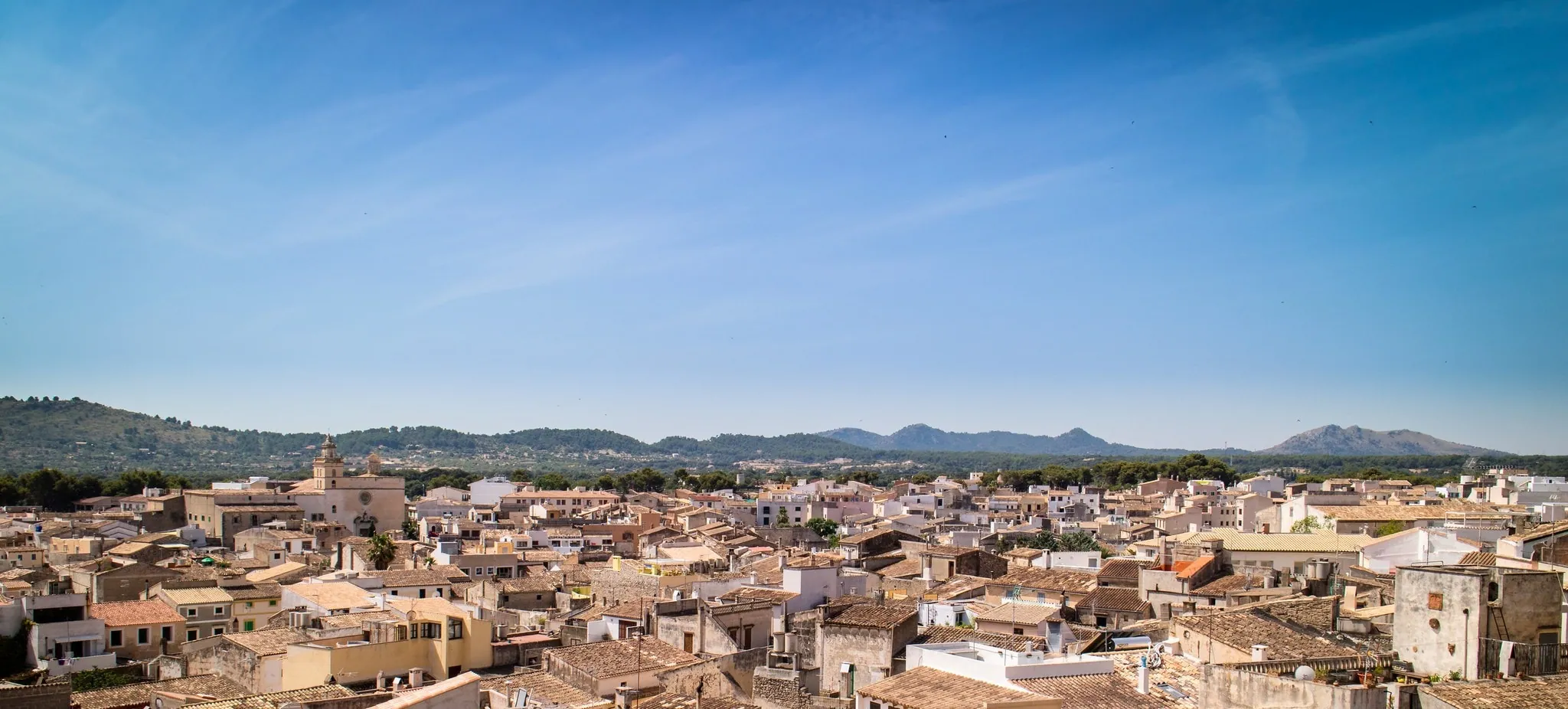
A Tuesday morning on Plaça del Conqueridor in Artà opens to yellow sandstone facades, shade trees, and local market stalls. Artà is a historic hilltop municipality in Mallorca’s north-east, nestled in the Serra de Llevant, offering restored townhouses in the historic core, country fincas in the surrounding valley, and coastal properties at Colònia de Sant Pere. Free from high-rise resort development, Artà borders the protected Parc Natural de la Península de Llevant.
What kind of property is on the market in Artà?
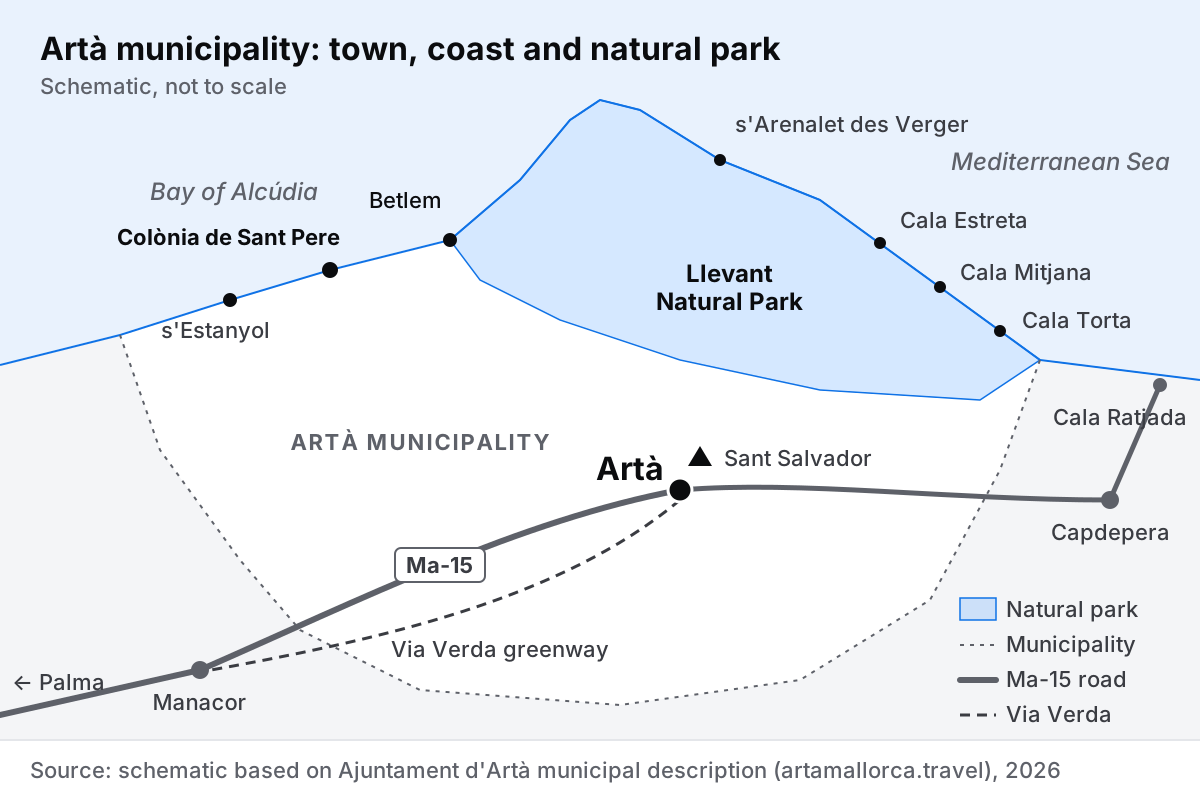
The municipal market splits into three distinct environments: the historic town centre, the surrounding agricultural valley, and the coastal settlements on the Bay of Alcúdia.
In the centre of Artà, property searchers find traditional stone townhouses (casas de pueblo) with green wooden shutters. Many feature inner courtyards (patios), original stone arches, and roof terraces overlooking the town rooftops. Larger grand townhouses (casals) line the primary thoroughfares, often requiring sympathetic restoration to update mechanical systems while preserving historic architectural features.
Moving into the surrounding countryside, the landscape transitions to rustic land (suelo rústico) dotted with agricultural fincas set among almond, olive, and carob groves. Planning regulations on rustic land strictly limit building footprints, swimming pool dimensions, and extensions. When evaluating country properties, buyers must verify the property’s legal planning status, confirm the existence of a valid occupancy certificate (cédula de habitabilidad), and review the history of any past building works.
Along the coast, the seaside village of Colònia de Sant Pere and the adjacent residential areas of Betlem and s’Estanyol offer detached villas and low-rise apartment complexes. These locations provide direct sea views and waterfront living that are not available within the elevated inland town centre. Using Area Insights for Artà allows prospective buyers to monitor available housing stock, listing durations, and market distribution across these distinct sub-markets.
Heritage that holds its value: Sant Salvador, Ses Païsses and the old town
Artà’s architectural character is anchored by the Sanctuary of Sant Salvador, a walled complex perched on a hill above the town. Reached by a monumental stone staircase lined with cypress trees, the site offers panorama views extending across the valley to the north-east coastline.
On the edge of the town lies the prehistoric Talaiotic settlement of Ses Païsses, an ancient stone-walled compound that highlights the area’s deep historical roots. The historic center features narrow, winding lanes flanked by traditional stone structures. Properties within the historic quarter are subject to municipal heritage conservation guidelines established by the local administration. When planning renovations, buyers should consult the Ajuntament d’Artà’s own guide to the municipality and check municipal planning records to understand protected façade rules and permitted structural modifications.
Coast, countryside and the Llevant Natural Park
Artà contains extensive protected natural spaces, dominated by the Parc Natural de la Península de Llevant. The park features wilderness hiking trails, coastal habitats, and strict environmental protections that restrict commercial development across the peninsula.
Unlike urbanized resort areas, Artà’s 25-kilometre coastline remains largely undeveloped. The municipality’s coast encompasses wild beaches such as Cala Torta, Cala Mitjana, Cala Estreta, s’Arenalet des Verger, Sa Canova, and Es Caló, alongside the beach at Colònia de Sant Pere. Nearby attractions are sometimes misplaced in popular travel literature: the well-known Coves d’Artà are actually situated at Canyamel in the neighbouring municipality of Capdepera, which is also home to the coastal town of Cala Ratjada.
Maritime leisure centers on the Club Nàutic Colònia de Sant Pere, which provides marina berths and sailing access to the Bay of Alcúdia. The area suits buyers interested in quiet outdoor pursuits and second homes in Mallorca and Ibiza.
Getting to Artà and getting around without a train
Artà lacks a functioning passenger rail line. The historical railway link between Manacor and Artà was decommissioned and converted into the Via Verda, a dedicated greenway for cycling and walking.
Road transport provides the main connection across the island. The Ma-15 highway connects Artà directly to Palma de Mallorca Airport, located a little over an hour away by car. Manacor, situated approximately 20 kilometres to the south-west, serves as the primary regional urban center, providing hospital facilities, large supermarkets, and the terminal station for direct train services to Palma.
Public transport operates via the regional TIB bus network, connecting Artà to Manacor, Palma, and adjacent coastal villages. Daily life in town revolves around local shops, traditional craft workshops specializing in palm-leaf weaving (llata), and the weekly Tuesday market held at Plaça del Conqueridor.
Schools, healthcare and living in Artà all year
Artà functions as a year-round community with established public services. Educational facilities in the municipality include state primary schools such as CEIP Na Caragol in town and CEIP Rosa dels Vents in Colònia de Sant Pere, the state secondary school IES Llorenç Garcías i Font, and semi-private (concertat) schools Sant Salvador and Sant Bonaventura. State instruction is delivered in Catalan and Castilian Spanish. International schools serving the island are predominantly located in and around the Palma metropolitan area, over an hour’s drive away.
Primary healthcare is provided locally at the municipal health center (centre de salut), with complex medical care handled at the Hospital de Manacor.
The resident population consists of local Mallorcan families alongside a long-standing community of international residents, predominantly from German-speaking nations and the United Kingdom. Life slows down noticeably during the winter months, offering a peaceful residential atmosphere.
Residency, taxes and holiday-let rules every buyer should check first
Prospective buyers must navigate several legal and administrative requirements before acquiring real estate in Mallorca.
Non-EU citizens, including British passport holders following Brexit, can purchase property without legal restrictions. However, real estate ownership does not grant immigration rights. Foreign buyers without EU residency must observe Schengen limits allowing maximum stays of 90 days within any 180-day period, as detailed in the UK Government entry rules for Spain. Long-term residency requires a formal visa, such as a non-lucrative or digital nomad visa, as Spain’s investor residence permit (golden visa) was abolished on 3 April 2025 under Ley Orgánica 1/2025.
Regional governance has maintained an open stance toward international buyers; in April 2025, regional authorities formally confirmed they would not impose restrictions on foreign buyers, following decisions reported on the Balearic Government’s April 2025 position on foreign buyers and the rejected initiative to limit foreign purchases in the Balearics and Canaries.
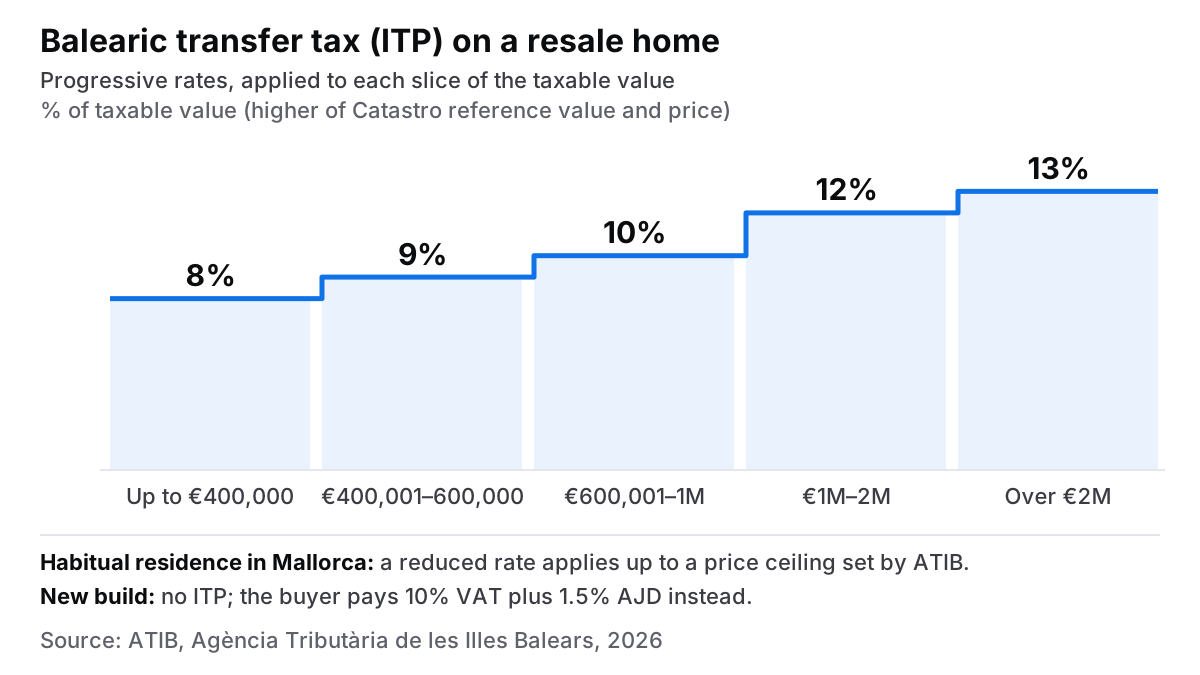
When buying a resale property, buyers pay the Balearic transfer tax (Impuesto sobre Transmisiones Patrimoniales or ITP), calculated on a progressive scale between 8% and 13% based on the property value threshold. New-build homes attract 10% VAT (IVA) plus 1.5% stamp duty (AJD). Reduced ITP rates exist for primary residences. A complete overview of purchase procedures is available in the step-by-step guide to buying property in Spain.
Holiday letting is subject to stringent regulation. Under Balearic tourism law, renting a residential property to short-term tourists requires an official ETV licence issued by the Consell de Mallorca. The island administration has maintained a moratorium on issuing new tourist rental licences, and territorial zoning rules (PIAT) limit where short-term letting is allowed. Buyers seeking rental income should evaluate existing licences prior to making an offer, as explored in our guide on owning a rental property in Mallorca. Long-term residential leases are regulated under Spain’s Housing Act 2023 and what it changed for landlords.
Essential legal due diligence should verify:
- The land registry extract (nota simple) for registered ownership and encumbrances.
- The legal certificate of occupancy (cédula de habitabilidad).
- Energy performance certification (CEE).
- Planning compliance for rustic land structures.
Fiestas and the calendar that shapes the market
Artà’s calendar features deeply rooted traditional celebrations. The feast of Sant Antoni on 16 and 17 January fills the streets with bonfires, traditional verse singing (glosses), and masked figure parades (dimonis). On 13 June, the feast of Sant Antoni de Pàdua features the traditional Cavallets dance, while an annual agricultural and craft fair takes place in September.
Visiting Artà in the winter offers buyers a clear view of local life when seasonal tourism subsides, whereas summer visits demonstrate the peak activity in coastal locations like Colònia de Sant Pere.
How CASAFARI helps you read the Artà market
CASAFARI provides real estate professionals, investors, and buyers with market intelligence across the Balearic Islands. The platform aggregates listing data to deliver clear insights into available inventory, price trends, and distribution by property type.
To conduct precise valuation analysis on individual townhouses or country estates, request a valuation of a specific townhouse or finca with Comparables. Developers and technical teams can consult the Area Insights documentation on developers.casafari.com in English, or real estate professionals can open the Artà data on the CASAFARI platform.
Frequently asked questions
Can British citizens buy property in Artà after Brexit?
Yes, British citizens can freely buy property in Artà and across Mallorca, as Spanish law does not restrict real estate ownership by non-EU nationals. However, property ownership does not confer residency rights, and UK citizens are subject to Schengen rules allowing stays of up to 90 days in any 180-day period without a visa. Longer stays require a suitable Spanish visa, such as the non-lucrative or digital nomad visa, following the abolition of the golden visa under Ley Orgánica 1/2025 in April 2025.
Can I rent out a house in Artà to holidaymakers?
Short-term holiday rentals in Artà require an official ETV tourist licence issued by the Consell de Mallorca, subject to territorial zoning under the PIAT plan. Because the Consell de Mallorca has maintained a moratorium on issuing new tourist places, buyers must purchase a property that already holds a valid, transferrable licence. Unlicensed short-term letting carries substantial administrative fines, while long-term rentals are governed by Spain’s national housing regulations.
How do you get to Artà from Palma airport?
Artà is reached from Palma de Mallorca Airport primarily by car via the Ma-15 highway through Manacor, taking a little over an hour. The municipality has no operational passenger railway, as the former rail route between Manacor and Artà has been transformed into the Via Verda greenway for cycling and walking. Public transport options include regional TIB bus lines connecting Artà to Manacor and Palma.
What taxes do you pay when buying a house in Artà, Mallorca?
When purchasing a resale property in Artà, buyers pay the Balearic transfer tax (ITP), which ranges progressively from 8% to 13% based on purchase price brackets and property value. For brand-new properties, buyers pay 10% VAT (IVA) plus 1.5% stamp duty (AJD). Reduced ITP rates exist for buyers acquiring a primary home, while ongoing costs include annual municipal property tax (IBI) and non-resident income taxes.