

ALCANADA PROPERTY GUIDE
Peaceful area on the doorstep of one of the most beautiful golf courses in Mallorca
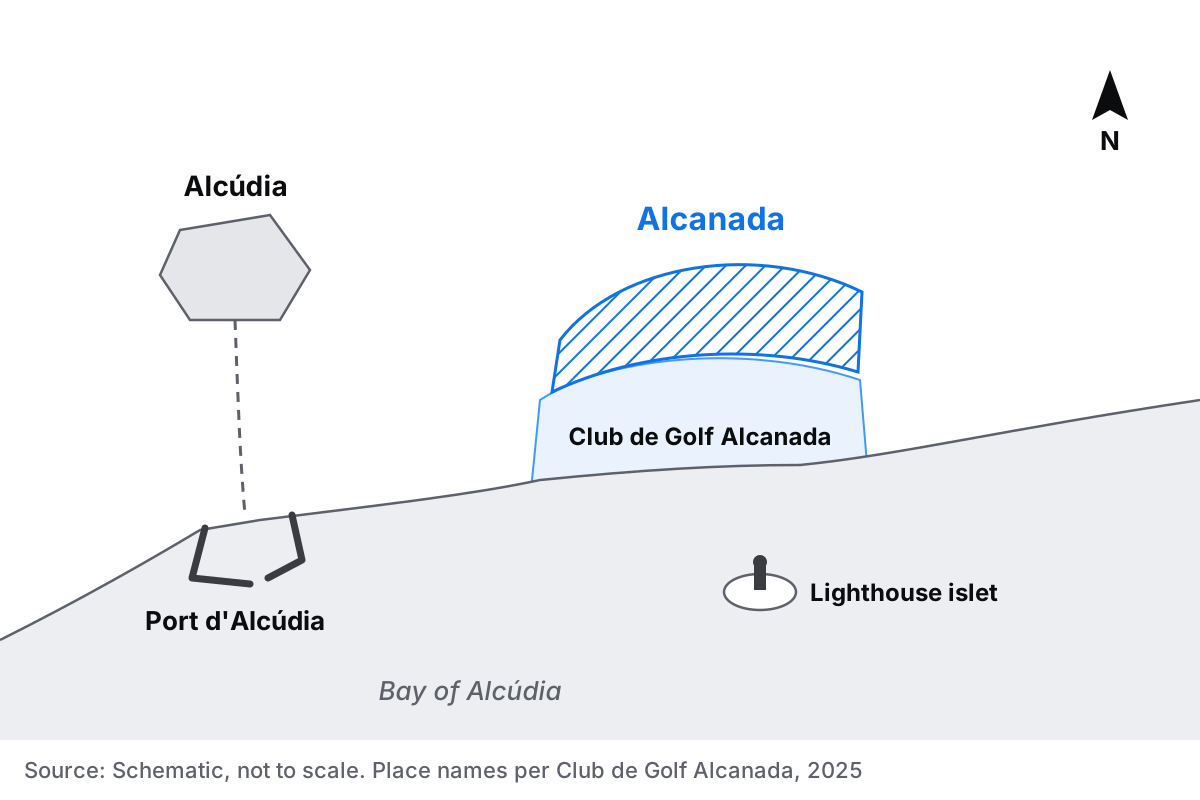
Alcanada is an elevated residential enclave on the north-east shore of the Bay of Alcúdia in Mallorca, framed by hillside pine woods and looking directly over the fairway of Club de Golf Alcanada to the lighthouse islet offshore. Most properties here are substantial detached villas set on sloping south-facing plots, highly prized for privacy and open sea views.
Where is Alcanada and what kind of place is it?
Alcanada (sometimes written as Aucanada) occupies a quiet, green promontory tucked between the historic town of Alcúdia and the bay’s sweep. Unlike the busy waterfront resort of Port d’Alcúdia, this hillside enclave consists almost entirely of low-density, detached homes. There are no high-rise hotels, commercial main streets, or late-night entertainment venues inside Alcanada itself; everyday services, fine dining, and yachting amenities are positioned down along the coast.
The geography dictates the architecture: villas are built into the slope to maximize south-facing views across the Bay of Alcúdia toward the small islet and its 19th-century lighthouse. For buyers seeking quiet residential surroundings within reach of northern Mallorca’s coast, it remains one of the island’s most distinctive settings.
Why do second-home buyers choose Alcanada?
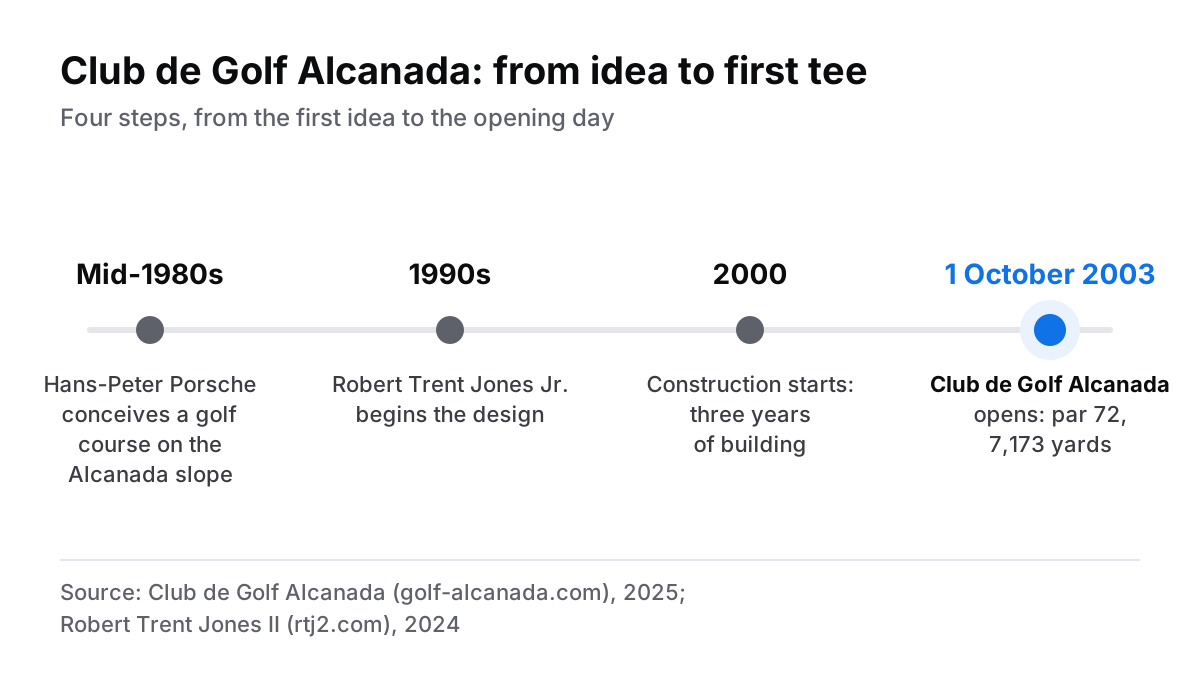
The main attraction of Alcanada is the seamless combination of a peaceful hillside environment and immediate access to a world-class golf course. The origins of the course date back to the mid-1980s, when Hans-Peter Porsche of the Porsche family envisioned a seaside course on the terrain. After thirteen years of licensing procedures and three years of construction, Club de Golf Alcanada officially opened on 1 October 2003.
Designed by Robert Trent Jones Jr. (of Robert Trent Jones II Golf Course Architects), the 18-hole, par-72 course stretches 7,173 yards from the back tees. It winds down toward the sea, offering lighthouse views from almost every hole.
Beyond golf, high-end purchasers seeking second homes in Mallorca and Ibiza choose Alcanada for its privacy and coastal outlook. The nearby marina at Port d’Alcúdia and the walled medieval quarter of Alcúdia old town offer cultural events, restaurants, and boat berths within a brief drive.
What taxes and costs apply when buying a villa in Alcanada?
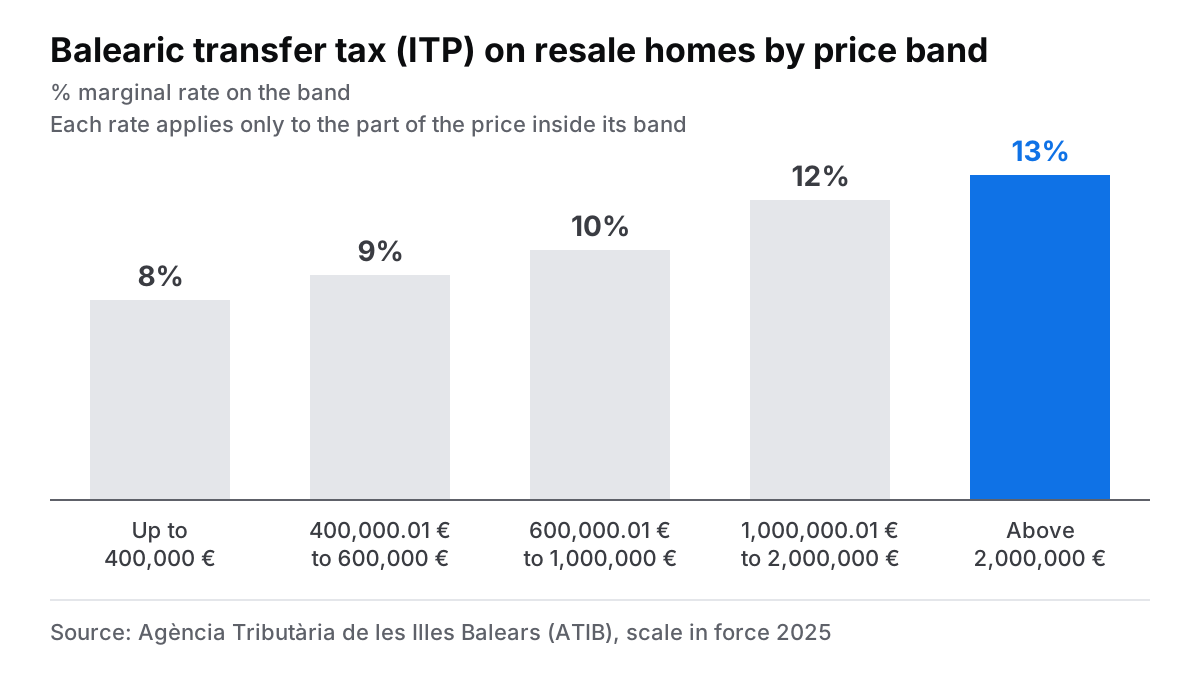
When purchasing a resale property in the Balearic Islands, buyers pay the regional Transfer Tax (Impuesto sobre Transmisiones Patrimoniales or ITP). According to the Agència Tributària de les Illes Balears (ATIB), ITP is calculated on a progressive scale based on the property price:
- 8% on the portion up to 400,000 €
- 9% on the portion between 400,000.01 € and 600,000 €
- 10% on the portion between 600,000.01 € and 1,000,000 €
- 12% on the portion between 1,000,000.01 € and 2,000,000 €
- 13% on the portion exceeding 2,000,000 €
Because the scale is progressive, a villa priced at 1.5 million € is not taxed at a flat 12% rate on the entire sum. Instead, each bracket is taxed at its corresponding percentage. Additional transaction expenses include notary fees, land registry registration fees, and independent legal advice. For a complete overview of the process, review our guide on how buying property in Spain works, step by step. New-build properties are subject to VAT (IVA) and stamp duty (AJD) rather than ITP.
Can you let a property in Alcanada to holidaymakers?
Short-term tourist rentals in Mallorca are strictly regulated under Balearic regional laws. Under a moratorium in place since 11 February 2022, no new tourist-rental places (plazas) are being issued. Furthermore, as reported by Hosteltur regarding the April 2025 tourism-containment decree, new holiday-rental places in multi-family residential buildings remain completely restricted across the archipelago.
If you intend to generate short-term rental income, you must purchase a detached villa that already holds a valid, registered ETV (Estancia Turística en Vivienda) licence. These existing licences can legally transfer to a new owner during the property sale, provided the registration remains in good standing. Buyers should always verify the licence status in the official register before signing any contract. Long-term residential letting operates under different national leasing rules; discover more about owning a rental property in Mallorca and Ibiza.
Does buying in Alcanada still bring residency rights?
Non-EU citizens looking at real estate in Mallorca should note recent statutory changes to Spanish immigration policy. Spain’s investor residence permit—commonly known as the golden visa—was officially closed to new applicants purchasing property on 3 April 2025 under Ley Orgánica 1/2025. Existing permit holders retain their status and renewal rights under transitional provisions, as detailed in this summary on what the end of the golden visa means for buyers.
International buyers from non-EU countries can still freely acquire residential real estate in Mallorca without restrictions. However, those wishing to establish legal residence in Spain must apply through alternative immigration pathways, such as the non-lucrative residence visa or the digital nomad visa. We recommend consulting a qualified Spanish immigration lawyer prior to making investment decisions.
How CASAFARI tracks the Alcanada market
Understanding supply, pricing trends, and valuation data in hyper-local markets like Alcanada requires clear, aggregated market data. CASAFARI’s tools monitor real estate listings across the Balearic Islands, providing real-time transparency for buyers, sellers, and property professionals.
Through Area Insights for any Mallorca neighbourhood, agents and investors can analyze local supply levels, stock turnover, and average price per square metre. For specific individual properties, professionals can generate a valuation and market study for a specific villa. To explore live market analytics or start analyzing properties today, open the CASAFARI platform.
Conclusion
Alcanada remains one of Mallorca’s most exclusive coastal addresses, offering quiet residential living, panoramic bay views, and a world-renowned golf course at its doorstep. Whether evaluating a secondary residence or reviewing local portfolio opportunities, understanding regional tax structures and planning rules ensures a smooth acquisition process.
Frequently asked questions
Can I rent out a villa in Alcanada to holidaymakers?
Only if the villa already holds a valid ETV (Estancia Turística en Vivienda) licence. The Balearic government suspended the issuance of new holiday-rental places on 11 February 2022, and the April 2025 tourism-containment decree further banned new tourist-let places in multi-family buildings. Existing ETV licences can transfer to a buyer upon sale if fully registered, so verifying licence status during due diligence is essential.
What tax do I pay when buying a resale property in Alcanada?
Resale purchases in Mallorca incur the Balearic Transfer Tax (ITP), which follows a progressive scale. Rates start at 8% on the first 400,000 €, rising to 9% up to 600,000 €, 10% up to 1,000,000 €, 12% up to 2,000,000 €, and 13% on any amount above 2,000,000 €. Notary, registry, and legal fees are payable separately.
Does buying a property in Mallorca still give me a golden visa?
No. Spain’s investor residence permit by real estate purchase was closed to new applicants on 3 April 2025 under Ley Orgánica 1/2025. Existing golden visa holders maintain their rights under transitional rules, but new non-EU buyers seeking residence must apply through alternative visa routes such as the non-lucrative visa.
Who designed the Alcanada golf course and when did it open?
Club de Golf Alcanada was designed by Robert Trent Jones Jr. and opened on 1 October 2003, following three years of construction and thirteen years of permit applications. The project was originally conceived in the mid-1980s by Hans-Peter Porsche of the Porsche family. The 18-hole, par-72 course measures 7,173 yards from the back tees.